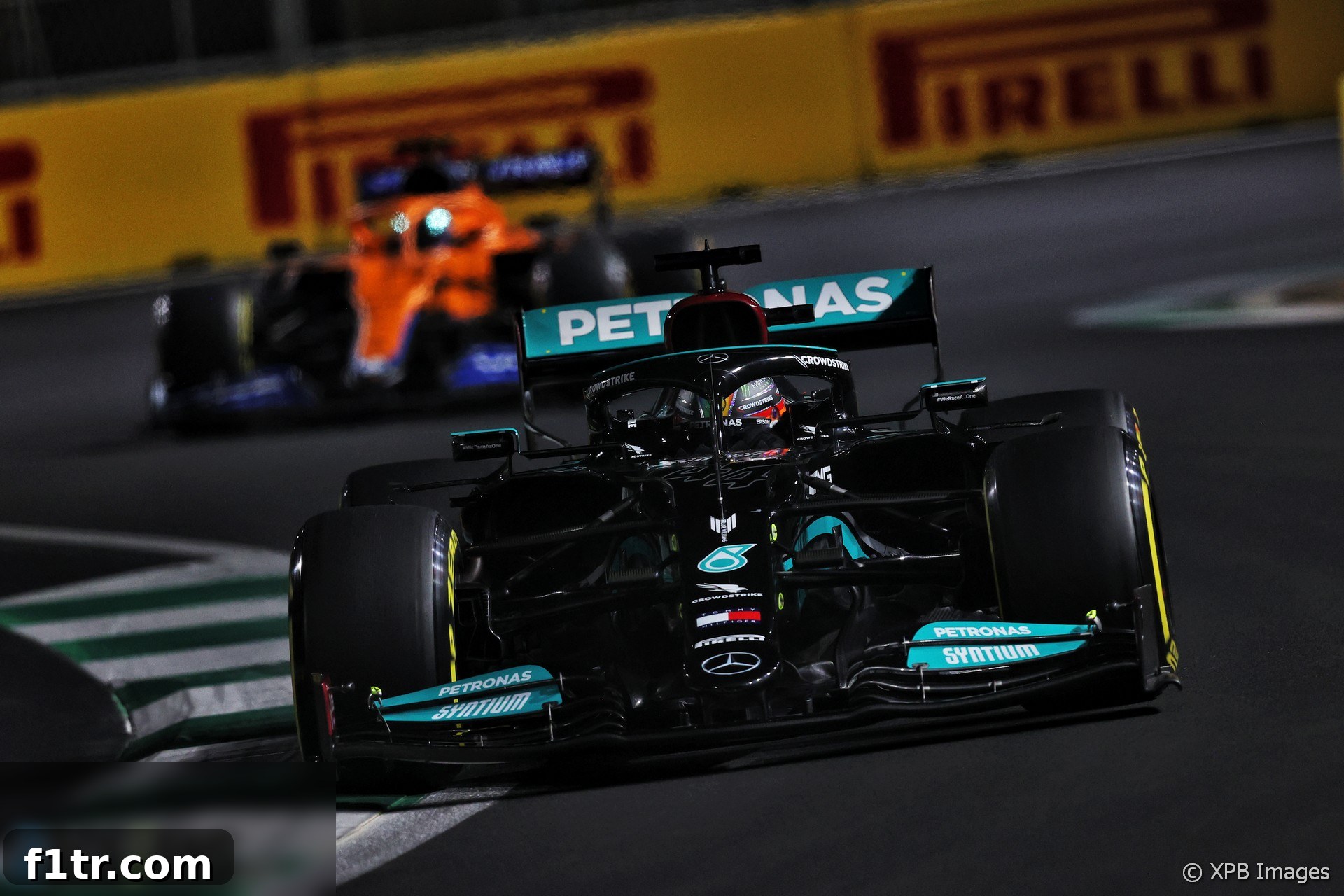
Lewis Hamilton seized a sensational pole position for the inaugural Saudi Arabian Grand Prix, a dramatic session culminating in championship rival Max Verstappen crashing out on the very last corner of his final flying lap. The incident underscored the razor-thin margins and immense pressure inherent in a high-stakes title fight, especially on the ultra-fast and unforgiving Jeddah Corniche Circuit.
Verstappen, who had been setting a blistering pace, was two-tenths of a second quicker than Hamilton through the second sector, poised to claim pole. However, a critical misjudgment at the challenging Turn 27 saw his Red Bull clip the wall, forcing him to come to an immediate halt on the circuit. This unexpected turn of events handed Hamilton a crucial advantage for Sunday’s race.
Hamilton will start from the prime position on the grid, joined by his Mercedes-AMG Petronas F1 Team teammate Valtteri Bottas, securing an all-Mercedes front row. Despite his dramatic exit, Verstappen provisionally occupies third place on the grid. However, a significant cloud hangs over his starting position as his team will need to assess potential damage, particularly to the gearbox. A required replacement gearbox would incur a significant grid penalty, further complicating his championship aspirations.
The Jeddah Corniche Circuit, making its debut on the Formula 1 calendar, proved to be an exceptionally demanding track for qualifying, blending incredibly high speeds with unforgiving proximity to the walls. Its 27 corners, many of which are high-speed, created a unique challenge, especially concerning traffic management during the qualifying sessions.
Q1: Navigating the Chaos and Early Shocks
The first qualifying session commenced under the brilliant artificial lights of Jeddah, and immediate concerns over traffic dominated discussions among all ten teams. With drivers often slowing down to create crucial gaps for flying laps, the tight, flowing nature of the circuit amplified the risk of impeding competitors. Race director Michael Masi had previously issued a directive, instructing drivers that they could only slow down after Turn 25 in the final sector to manage their spacing. Despite this, traffic remained a perennial challenge throughout Q1, setting the stage for some dramatic moments.
George Russell, adept at navigating tricky situations, became one of the first drivers to decisively blast past a queue of slower cars on the approach to the final corner, showcasing the fine line between caution and aggression on this new circuit. Early in the session, Red Bull Racing appeared to set the benchmark, with Max Verstappen and Sergio Perez topping the timesheets. Their initial dominance, however, was quickly challenged by Mercedes, as Lewis Hamilton then superseded his teammate Valtteri Bottas to briefly go fastest, demonstrating the fierce inter-team battle already underway.
As the session progressed, heavy track evolution became a significant factor. With each passing lap, the track rubbered in, offering more grip, and lap times tumbled rapidly. Teams and drivers gained increasing confidence in pushing their soft compound tires to the limit. Carlos Sainz Jnr briefly put his Ferrari at the top before Sergio Perez once again demonstrated Red Bull’s raw pace, setting the overall quickest time of the session.
In the final, tense moments of Q1, Max Verstappen’s critical flying lap was regrettably compromised. The Dutch driver encountered a chaotic melee of slow-moving cars around the final corner, forcing him to abandon his attempt. “Max, there’s too many cars, just back out, there’s too much risk,” came the urgent warning from his race engineer, Gianpiero Lambiase. A frustrated Verstappen’s immediate and expletive-laden reply, “Fucking hell. Can I box? Holy shit,” perfectly encapsulated the high-pressure environment and the costly nature of traffic.
Further drama unfolded for Valtteri Bottas, who had already undergone a late engine change in his Mercedes due to a fuel leak prior to qualifying. During his final run, Bottas reported a “misfire” in his power unit. While attempting to return to the pits, his car came to a halt right at the pit lane entry, necessitating a swift intervention from his Mercedes mechanics who had to push his car clear, adding to the tension within the team.
Despite the persistent concerns over traffic and the various incidents, Q1 remarkably concluded without any red flag interventions or even sustained yellow flags. When the checkered flag flew, the two Haas drivers, Nikita Mazepin and Mick Schumacher, were the first to be eliminated. They were joined by the two Aston Martins, with Lance Stroll and Sebastian Vettel knocked out in 18th and 17th positions, respectively. Nicholas Latifi, in his Williams, was the final driver to miss the cut, finishing 16th. An incident involving Pierre Gasly and Carlos Sainz Jnr, where the AlphaTauri appeared to impede the Ferrari through Turn 3, was noted and placed under investigation by the stewards, highlighting the tight racing conditions.
Drivers eliminated in Q1
| 16 | Nicholas Latifi | Williams-Mercedes | 1’29.177 |
| 17 | Sebastian Vettel | Aston Martin-Mercedes | 1’29.198 |
| 18 | Lance Stroll | Aston Martin-Mercedes | 1’29.368 |
| 19 | Mick Schumacher | Haas-Ferrari | 1’29.464 |
| 20 | Nikita Mazepin | Haas-Ferrari | 1’30.473 |
Q2: Strategic Battles and Unexpected Exits
As the second qualifying session commenced, tyre strategy became paramount. With the harder compound tyres (mediums) widely anticipated to offer a better race pace and durability compared to the softer tyres, securing passage to Q3 on the medium compound was a critical objective for all the front-running teams. This strategic gamble aimed to give drivers a significant advantage at the race start.
Max Verstappen wasted no time in demonstrating his formidable pace on the medium tyres. His first effort was not only impressive but also the first lap of the entire weekend to break the 1’28 barrier, signaling his intent. Lewis Hamilton, in contrast, initially found himself seven-tenths of a second slower than his championship rival, underscoring the challenge ahead for Mercedes.
Sergio Perez then moved into second with a commendable 1’28.175. However, Hamilton quickly responded on his second attempt with the medium tyres, reclaiming the second position and closing the gap to just over a tenth of Verstappen’s time. Perez, not to be outdone, further improved on his subsequent run, snatching the overall fastest time by a mere seven-thousandths of a second ahead of his teammate, showcasing Red Bull’s formidable performance.
The session took a dramatic turn when Carlos Sainz Jnr experienced a high-speed spin through the treacherous Turn 9-10-11 complex. Miraculously, the Ferrari driver managed to keep his car from making contact with the unforgiving barriers, a testament to his car control. However, the incident necessitated a pit stop for new tyres and minor repairs, leaving him with only one precious lap to secure a safe passage to Q3. Unfortunately for Sainz, a subsequent mistake at the very same challenging corner dashed any remaining hopes of further progression, leaving him eliminated.
In a testament to his driving skill and the Mercedes car’s consistent performance, Hamilton managed to improve his time on his well-used, eight-lap old medium tyres, ultimately going fastest. Conversely, Verstappen opted not to set a lap on new soft tyres in the final minutes, confident in his medium tyre performance and likely saving his softs for potential race strategy or a Q3 assault. With Sainz unable to set a representative time, an unexpected opportunity opened up for a driver to snatch a coveted spot in Q3. That chance was emphatically seized by Antonio Giovinazzi, who, despite clipping a wall himself, secured a surprising tenth place at the checkered flag, much to the delight of the Alfa Romeo team.
The second session saw Daniel Ricciardo as the first driver eliminated, narrowly missing out on Q3. Kimi Raikkonen, in the second Alfa Romeo, also missed the cut, finishing 12th. Fernando Alonso was knocked out in 13th, ahead of George Russell in the Williams, who would line up 14th on the grid. Incidents continued to punctuate the session, with Bottas and Raikkonen having a minor collision upon exiting the long Turn 13 corner, where the Mercedes’ right-front tyre clipped the left-rear of the Alfa Romeo. Lando Norris also voiced complaints that Perez had impeded him in the final corner during one of his early runs, highlighting the ongoing traffic challenges.
Drivers eliminated in Q2
| 11 | Daniel Ricciardo | McLaren-Mercedes | 1’28.668 |
| 12 | Kimi Raikkonen | Alfa Romeo-Ferrari | 1’28.885 |
| 13 | Fernando Alonso | Alpine-Renault | 1’28.920 |
| 14 | George Russell | Williams-Mercedes | 1’29.054 |
| 15 | Carlos Sainz Jnr | Ferrari | 1’53.652 |
Q3: The Ultimate Showdown and Verstappen’s Heartbreak
The final qualifying session, Q3, once again distilled the championship narrative into a direct, high-stakes shootout between the two protagonists, Lewis Hamilton and Max Verstappen. The tension was palpable as the battle for pole position for the inaugural Saudi Arabian Grand Prix reached its crescendo.
Mercedes were the first to venture out onto the track, aiming to capitalize on a clear circuit and put in an early banker lap. However, Lewis Hamilton’s first attempt was compromised when he lost control of his car sweeping through Turn 9, a high-speed left-hander, forcing him to abandon the lap and reset his focus for a second run, a rare mistake under pressure.
Undeterred, Hamilton regrouped and delivered a strong second lap, provisionally going fastest with a 1’28.035, just over a tenth quicker than his teammate Valtteri Bottas. But his lead was short-lived. Max Verstappen, demonstrating incredible precision and raw speed, immediately eclipsed Hamilton’s time with a stunningly clean and composed effort, posting a 1’27.653 to snatch the top spot, showcasing Red Bull’s ultimate pace on this challenging circuit. Bottas’s second attempt of the session saw him improve further, moving ahead of his teammate into second place, solidifying Mercedes’ strong performance. Sergio Perez initially sat in fourth place but was soon demoted by an impressive lap from Pierre Gasly’s AlphaTauri.
With time ticking away, Hamilton opted for an early final run. Despite having to expertly scythe his way past a couple of slower cars on his out-lap, he managed to string together an exceptional lap, reclaiming provisional pole by a tenth of a second over Verstappen, raising the stakes even higher for the Dutchman’s final effort.
The stage was set for Verstappen’s response. He embarked on what promised to be one of the most dramatic laps of the season. Displaying breathtaking pace, he went over two-tenths quicker than anyone else through the first two sectors, seemingly destined for pole position. The crowd held its breath as he approached the final, critical corners. However, entering the notorious Turn 27, the very last corner of the lap, disaster struck. Verstappen locked up his left-front wheel, ran wide, and clipped the barrier on the exit with his right-rear tyre, sending his Red Bull car pitching violently back into the wall. The impact was significant, leaving his car stranded at the exit of the corner.
As Verstappen’s stricken Red Bull lay on the track, immediate yellow flags were deployed, preventing any other drivers from improving their times. This sudden and dramatic turn of events solidified Lewis Hamilton’s pole position, making it a well-deserved yet bittersweet outcome given the nature of Verstappen’s crash. Valtteri Bottas, having put in a solid performance, secured the second spot, completing an all-Mercedes front row, a significant advantage for the start of the race.
Max Verstappen, despite the crash, provisionally qualified third on the grid. However, the true impact of the incident will only become clear after Red Bull’s assessment of his car. The ominous threat of a grid penalty for a required replacement gearbox loomed large, a potentially severe blow to his championship campaign. Charles Leclerc continued Ferrari’s strong showing, securing fourth on the grid, ahead of Sergio Perez in fifth and an excellent performance from Pierre Gasly in sixth. Lando Norris secured a solid seventh for McLaren, with Yuki Tsunoda, Esteban Ocon, and Antonio Giovinazzi impressively rounding out the top ten, showcasing the competitive depth of the field.
Top ten in Q3
| 1 | Lewis Hamilton | Mercedes | 1’27.511 |
| 2 | Valtteri Bottas | Mercedes | 1’27.622 |
| 3 | Max Verstappen | Red Bull-Honda | 1’27.653 |
| 4 | Charles Leclerc | Ferrari | 1’28.054 |
| 5 | Sergio Perez | Red Bull-Honda | 1’28.123 |
| 6 | Pierre Gasly | AlphaTauri-Honda | 1’28.125 |
| 7 | Lando Norris | McLaren-Mercedes | 1’28.180 |
| 8 | Yuki Tsunoda | AlphaTauri-Honda | 1’28.442 |
| 9 | Esteban Ocon | Alpine-Renault | 1’28.647 |
| 10 | Antonio Giovinazzi | Alfa Romeo-Ferrari | 1’28.754 |
Go ad-free for just £1 per month>> Find out more and sign up
2021 Saudi Arabian Grand Prix
- Mercedes seal record eighth consecutive constructors title as Hamilton misses driver’s crown
- Analysis: Is Jeddah circuit’s layout fit for F1 or a “recipe for disaster”?
- Hamilton closes on another Schumacher record with first ‘hat-trick’ of 2021
- How Hamilton and Verstappen’s roughest scrap yet played out on the radio
- Brawn defends Masi following criticism of Saudi Arabian GP decisions
Browse all 2021 Saudi Arabian Grand Prix articles