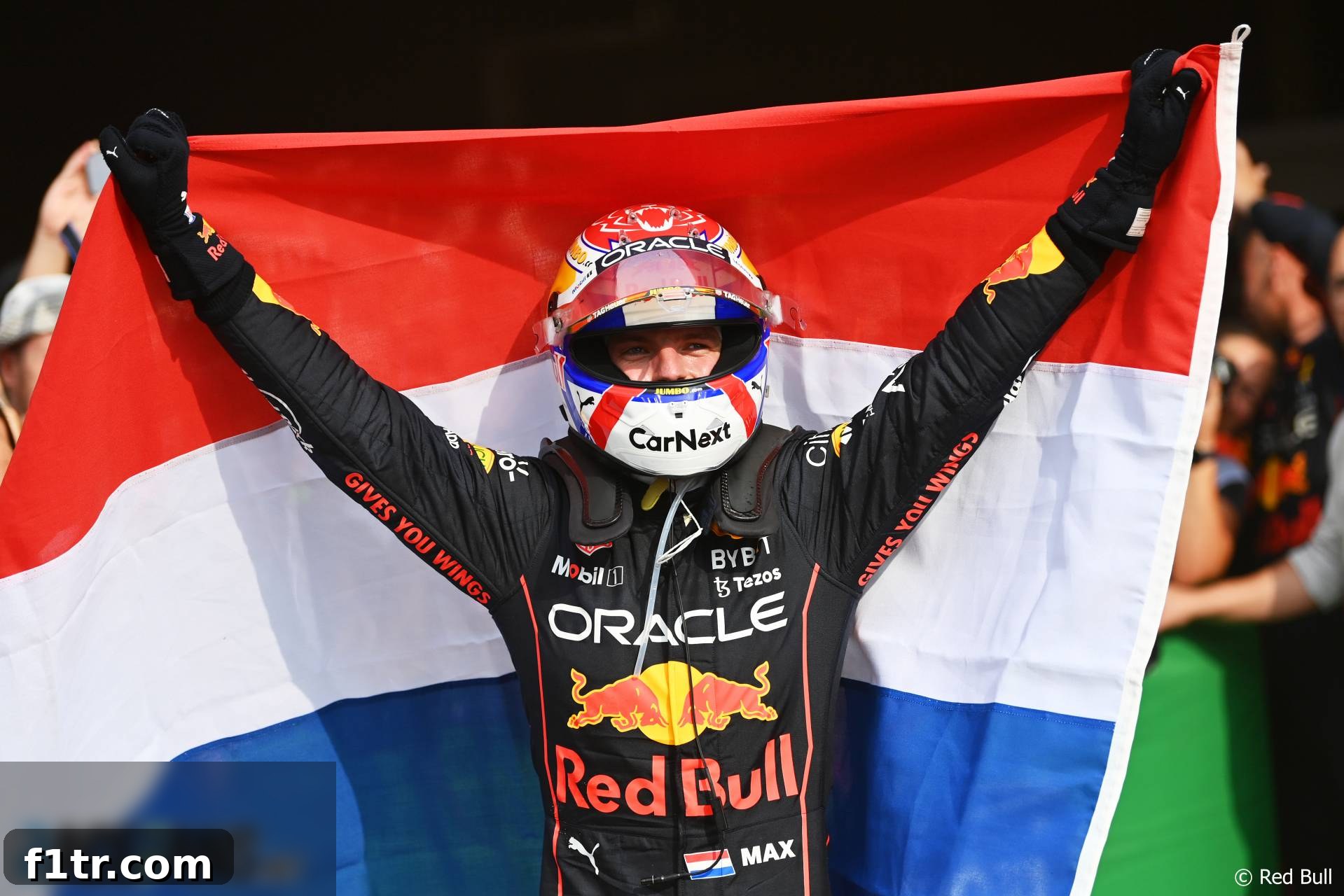
Max Verstappen Dominates Home Race at 2022 Dutch Grand Prix: A Strategic Masterclass
From the outset of the 2022 Formula 1 season, when teams unveiled their groundbreaking new cars for pre-season testing in Barcelona, Ferrari quickly emerged as the benchmark. Their impressive pace suggested they were the team everyone else would need to conquer to claim victory in this new era of F1 regulations. The Scuderia looked formidable, igniting hopes of a genuine championship challenge.
Advert | Become a Supporter & go ad-free
However, Red Bull Racing, fueled by the defending world champion Max Verstappen, willingly embraced this challenge. Despite experiencing a somewhat inconsistent start to their campaign, Red Bull and Verstappen mounted a relentless assault against their revitalized Italian rivals. By the summer break, Verstappen’s advantage in the drivers’ championship had grown so significantly that any realistic aspirations of a Ferrari resurgence in the latter half of the season had already begun to diminish.
The atmosphere at Zandvoort for the Dutch Grand Prix was electric, with over 100,000 passionate Dutch fans transforming the event into a symbolic coronation carnival for their soon-to-be two-time Formula 1 champion. Amidst this fervent support, even Ferrari were compelled to acknowledge a stark reality: not only was Red Bull demonstrably faster, but the Maranello squad was no longer the closest challenger to the championship leaders on track.
Ferrari’s Fading Challenge and Mercedes’ Strategic Gamble
The fortunes of Red Bull and Ferrari during the Dutch Grand Prix weekend presented a stark contrast. While Friday’s practice sessions hinted at Red Bull’s unusual vulnerability, leaving Ferrari sensing an opportunity, Saturday evening delivered a deflating blow. Charles Leclerc narrowly missed out on pole position by the season’s slimmest margin, a cruel twist denied by none other than Max Verstappen himself, much to the delight of his home crowd.
With Leclerc and his teammate Carlos Sainz Jnr starting directly behind Verstappen, the Ferrari drivers openly contemplated a strategic split. They mused over the prospect of employing different approaches to attack Verstappen at his home race, perhaps utilizing varying tire compounds to create an advantage. Yet, as the tire blankets were removed before the formation lap, all three leading cars – Verstappen, Leclerc, and Sainz – were equipped with soft tires.
It appeared that only Mercedes-AMG Petronas Formula One Team was willing to deviate from the consensus. George Russell lined up on the grid in sixth position sporting a fresh set of medium tires. Two places ahead of him, Lewis Hamilton sat intently, drumming his steering wheel as he awaited the start lights, his W13 also fitted with the yellow-walled medium compound. This bold, unconventional tire choice from Mercedes hinted at an alternative strategic path, promising to add another layer of intrigue to the race.
As the lights extinguished, the front four cars launched away with remarkable synchronicity. Verstappen, however, showcased his characteristic assertiveness, cutting across Leclerc on the run to Turn 1. This maneuver served both as a practical defense of his lead and a clear statement of intent. As Verstappen swept through the iconic Tarzan corner for the first time, he was met with a deafening roar from the thousands of his compatriots lining the circuit, a true hero’s welcome.
The leading five cars completed the opening lap without incident, maintaining their positions, while Lando Norris deftly moved into sixth place at the expense of Russell. Verstappen, benefiting from entirely new soft tires for his initial stint, aimed to maximize this advantage. In contrast, the Ferraris behind him were running on used soft sets carried over from qualifying. Red Bull, however, was cautious, keen not to squander this tire benefit too early in the demanding race.
Advert | Become a RaceFans supporter andgo ad-free
“Get onto that tyre management, Max,” Verstappen’s race engineer, Gianpiero Lambiase, instructed his driver over the radio. “At this stage, just increase that management.” This early advice underscored Red Bull’s disciplined approach, focusing on preserving tire life even with an initial performance advantage, a strategy that would prove crucial later in the race.
Once Russell had regained sixth place from Norris at the start of the fourth lap, the top six cars settled into a rhythm, all lapping consistently within the mid 1’16s. With teams meticulously monitoring and relaying the pace of their rivals, Leclerc briefly slipped into DRS range of Verstappen, marking the first time the Ferrari driver had been close enough to activate the drag reduction system since it became available. This moment briefly reignited hopes for a direct challenge.
However, almost as if personally offended by the Ferrari’s audacious proximity, Verstappen responded emphatically. He immediately unleashed a blistering 1’16.2 lap, swiftly extending his lead back to over 1.5 seconds and out of DRS range. Instead, it was Sainz who increasingly found himself under pressure, needing to frequently check his mirrors. Lewis Hamilton, despite his supposedly slower medium tires, was proving more than a match for the Ferrari, signaling Mercedes’ growing threat.
Strategic Twists, Pit Stop Drama, and Emerging Threats
Zandvoort’s notoriously compact pit lane played a significant role in pre-race strategic calculations, making both a one-stop and a two-stop strategy equally viable, heavily dependent on tire wear. Consequently, when Ferrari informed Leclerc that tire degradation was “lower than expected, but not enough for Plan C,” it became apparent that a single stop was unlikely to be their chosen path for the afternoon. The teams were locked in a delicate balance between pace and longevity.
This strategic ambiguity quickly clarified when Carlos Sainz, who had been gradually losing ground to his teammate, pitted at the end of lap 15. Ferrari’s hand was forced by Mercedes, who they believed were about to bring Hamilton in. Unfortunately for Sainz, it was his turn to endure one of Ferrari’s now-infamous pit lane mishaps. He was left stranded in his pit box, waiting for a new left-rear tire for a agonizing 10 seconds after the other three tires had been affixed to his car, a catastrophic delay.
Ferrari team principal Mattia Binotto later explained the chaotic sequence of events. “We tried to react simply to stay ahead of [Hamilton], which was the best way to keep track position,” Binotto stated. “We called our driver in, but that was when he was in the last corners and too late for the mechanics to be ready. So it was too late as a call.” This candid admission highlighted the communication breakdown that plagued Ferrari’s operational efficiency.
Red Bull also brought Sergio Perez in from fifth place around this time. Perez, exiting his pit box, had ample time to inadvertently run over Sainz’s left-rear wheel gun, adding insult to Ferrari’s injury while simultaneously gaining a position. Meanwhile, Verstappen continued to extend his lead out front, with Leclerc suddenly dropping off by half a second a lap. The Monegasque driver eventually pitted for mediums at the end of lap 17, rejoining the race behind both Mercedes cars, also running on the medium compound.
Advert | Become a RaceFans supporter andgo ad-free
Just two laps later, Red Bull briefly relinquished the lead by calling Verstappen into the pits for his stop. He had built a comfortable five-second advantage over Leclerc before the Ferrari driver’s stop, and crucially, he merged back onto the track with that lead still intact. Armed with fresh tires, Verstappen quickly devoured the gap to Russell ahead of him, reclaiming second place on the pit straight at the start of lap 28. Russell, recognizing the futility of resistance against a charging Verstappen, hardly bothered to offer any defense.
With Russell now dispatched, the “Oranje Army” in the grandstands became audibly animated, eagerly anticipating their hero, Max Verstappen, reclaiming the lead from Lewis Hamilton. However, they were denied this immediate satisfaction when Mercedes executed their strategic gamble at the end of lap 29, switching Hamilton onto the hard compound tires. With a daunting 43 laps remaining, it would be a monumental task for Hamilton to make it to the end on these tires, but it was certainly not the most challenging assignment Mercedes had ever handed their multiple world champion.
“Do I need to be pushing now?” Hamilton inquired over the radio, seeking clarification on his new mandate. “Affirm,” replied his race engineer, Peter Bonnington, confirming the aggressive approach required to make the hard tires work and potentially challenge for victory.
Once up to temperature, the fresh rubber on both Mercedes cars instantly transformed them into the fastest machines on track, by a considerable margin. While Verstappen and Leclerc continued to lap in the 1’16s on their 15-lap-old medium tires, Hamilton and Russell consistently pounded in rapid 1’15s lap after lap. This surge in pace from the Silver Arrows dramatically shifted the race dynamic, putting immense pressure on Red Bull and Ferrari.
In remarkably short order, Hamilton brought Sergio Perez into his sights. It wasn’t the first time in his illustrious career that Hamilton found it challenging to find a way past the second Red Bull. As Hamilton attempted to go around the outside at Tarzan at the start of lap 37, Perez locked up and ran wide, successfully defending his position. A lap later, the overtake was finally completed, though not without further drama. The lapped Sebastian Vettel caused a spike in blood pressure within the Mercedes garage by controversially refusing to yield to Hamilton under blue flags for the entire first sector. The stewards later intervened, penalizing the Aston Martin driver with a five-second time penalty for his obstruction.
With one Red Bull cleared, Hamilton, having lost four crucial seconds dealing with Perez, began his relentless pursuit of the 18 seconds separating him from the race leader, Max Verstappen. Both Mercedes drivers continued to lap significantly quicker than the two leaders, steadily, if not rapidly, closing the gap. The tension mounted as Mercedes’ audacious strategy began to pay dividends, hinting at a potential upset.
Safety Car Chaos and Verstappen’s Unstoppable Charge
Suddenly, the pit walls were jolted into rapt attention when Yuki Tsunoda slowed to a halt on the circuit on lap 44. The potential for a marshal intervention almost certainly implied the deployment of either a full Safety Car or a Virtual Safety Car. Ferrari, seizing the opportunity, immediately put their pit crew on standby, allowing them enough notice to have all four tires prepared this time around. However, to everyone’s surprise, Tsunoda was encouraged to restart his car and return to the pits, seemingly averting the immediate threat of a major disruption.
Advert | Become a RaceFans supporter andgo ad-free
Despite the track being cleared, Ferrari made a proactive decision to pit Charles Leclerc from second place for hard tires at the end of lap 45, with Carlos Sainz following suit. This strategic move promoted both Mercedes cars, Hamilton and Russell, to second and third positions respectively, as Hamilton continued his methodical grind to reduce Verstappen’s lead. Ferrari’s aggressive, perhaps premature, double-stack pit stop suggested an attempt to cover all bases, or perhaps an overreaction to the earlier Tsunoda incident.
After reaching the pits, Tsunoda was released back onto the circuit, only to be almost immediately instructed to pull over for a second and final time. This confirmed the need for intervention, and Race Director Eduardo Freitas activated the Virtual Safety Car (VSC). The enforced slower pace temporarily inflated Verstappen’s 13.7-second lead to over 19 seconds, offering a crucial window for strategic decisions. Red Bull wasted no time, pitting the race leader at the end of the lap for a second set of hard tires. Mercedes, in response, boxed both their cars for medium tires, aiming for maximum pace. While Hamilton initially celebrated what he believed to be a masterful call by his team, his optimism quickly deflated upon learning that Verstappen had also pitted ahead of him, maintaining his track position.
“That has stuffed our strategy,” Hamilton sighed, a sentiment of frustration evident in his voice as the realization dawned that their VSC advantage had been nullified. Once the green flags waved, the gap between Verstappen and Hamilton settled at 12.5 seconds, with just over 20 laps remaining. Mercedes theoretically held an advantage on the faster medium compound. Leclerc, in fourth, was a similar distance behind third-placed Russell, indicating that the VSC timing had not played into Ferrari’s favor either.
Just a handful of laps later, the race saw another significant disruption as Alfa Romeo suffered their now-customary technical failure. Valtteri Bottas’s car ground to a halt on the approach to Tarzan, pulling safely to a stop by the inside barrier rather than risking traversing the racing line to reach an escape road at the circuit’s fastest point. Bottas’s stoppage was initially covered under local yellow flags for a full lap before the Safety Car was deployed to neutralize proceedings once more. Despite having pitted just seven laps earlier, Verstappen demonstrated no hesitation.
Advert | Become a RaceFans supporter andgo ad-free
“Can we make a free stop, or not?” Verstappen calmly asked his engineer. “No,” Lambiase replied, his voice firm. “But we are boxing this lap, Max. Box this lap.” This swift decision from Red Bull showcased their aggressive strategic mindset, willing to sacrifice track position for superior tire performance in the final sprint.
Although he narrowly emerged from the pit lane behind George Russell, dropping to third place, Verstappen understood that this momentary loss of track position was not critical to Red Bull’s overarching strategy. He would possess a significant performance advantage when the race resumed on fresh soft tires, making the sacrifice a worthwhile gamble. As the leaders converged behind the Safety Car, Leclerc, Perez, and Sainz also seized the opportunity to pit, swapping their hard tires for softs in preparation for the final sprint.
With the field instructed to follow the Safety Car through the pit lane, George Russell made a remarkably bold, late call. “I’m losing the tyres. I think we need to put the softs on,” he radioed, rounding the banking at the end of the lap. Despite the eleventh-hour request, Mercedes responded with impressive speed, getting him out ahead of Leclerc, albeit at the cost of ceding second place to Verstappen. Watching this unfold in his mirrors, Lewis Hamilton experienced a sudden, sinking feeling.
“Why did you stop George?” he immediately questioned, his voice tinged with incredulity. “Er, don’t know Lewis,” Bonnington admitted, momentarily stumped. “I’ll let you know.” The confusion and uncertainty were palpable within the Mercedes garage, reflecting the high-stakes decisions being made under pressure.
“That was a mistake, mate,” Hamilton stated, the realization dawning on him. “We had track position. We had a buffer between us, now we don’t have that.” Hamilton acutely recognized the vulnerability of his position, now directly exposed to a rival on much fresher and faster tires, having lost the strategic advantage of being Mercedes’ lead car on track.
Advert | Become a RaceFans supporter andgo ad-free
What Hamilton did have instead was a mirror filled entirely with Max Verstappen’s menacing Red Bull. As he bunched up the field for the crucial restart at the end of lap 60, Hamilton knew he was facing a nearly impossible final 12 laps. He was tasked with resisting the relentless advances of the man whom 105,000 ticket holders had come to see claim victory, a challenge made even harder by his tire disadvantage.
However, as Hamilton floored the throttle out of Turn 13 at the restart, he was critically late to engage the ‘strat five’ engine mode that his race engineer, Peter Bonnington, had instructed him to use. He was immediately reminded over the radio, but this slight delay left him dangerously exposed to the formidable top speed of Verstappen’s RB18, which was now deep in his slipstream. The smallest error in execution proved costly in this high-pressure scenario.
“I was late to get to the race mode,” Hamilton explained afterward, reflecting on the crucial moment. “But I was on the race mode on the straight, but they were just so fast on the straights.” Sure enough, with almost comical ease, Verstappen breezed past the Mercedes, reclaiming the lead before even needing to contemplate braking for Tarzan. It was a definitive, almost effortless demonstration of Red Bull’s superior pace.
As the excitement in the grandstands reached a fever pitch, Hamilton could not suppress his frustration at seeing an outside chance of a first victory of the season slip away. He made his unhappiness known to Bonnington in no uncertain terms over the radio. However, Hamilton later retracted his initial impassioned claims that his team had “screwed” him, once the adrenaline of the intense race had subsided, offering a more measured perspective on the complex strategic decisions.
With Russell now on soft tires, there was little Hamilton could do to prevent his teammate from cruising up behind him and taking second place at the start of lap 64. Charles Leclerc quickly followed suit, demoting the former race leader entirely off the podium. Hamilton’s older medium tires proved no match for the newer, grippier soft compounds of his rivals, highlighting the decisive impact of tire strategy in the closing stages of the Grand Prix.
Verstappen’s Victory and the Championship Picture
The final laps of the race transformed into little more than a triumphant parade of honor for Max Verstappen. The entire event itself had felt like an early championship celebration for the dominant Red Bull driver. George Russell, despite his valiant effort, could do nothing to exert any pressure on the leader. Verstappen flawlessly completed the 72nd lap, taking the checkered flag to signal the ecstatic fans in the stands to finally unleash a smoky orange haze around the circuit – a fitting and vibrant tribute to the Dutch driver who had delivered nothing less than the best possible results for his adoring home public in both Dutch Grands Prix.
Yet, amidst the jubilant chaos, the calmest Dutchman in Zandvoort was Verstappen himself. “Yes! Haha,” he laughed across the line, his voice echoing over the team radio. “They threw everything at us, but we made the right calls, so very lovely result, guys!” His composure under pressure and the team’s decisive strategy had once again delivered a perfect outcome.
Beyond giving due credit to his sensational driver, Red Bull team principal Christian Horner had yet another compelling reason to lavish praise upon his team’s strategists, who had consistently excelled throughout the 2022 season.
Advert | Become a Supporter & go ad-free
“The Virtual Safety Car came out and we switched to the hard tyre because of how we’d seen it performing which just protected track position for Max,” Horner explained, detailing their initial tactical response. “But then the bigger call came towards the end of the race when there was the full Safety Car where you’ve got your home driver leading in front of 105,000 people and you decide to pit him for the soft tyres and concede track position behind two Mercedes…” Horner’s account underscored the immense pressure and courage involved in Red Bull’s winning strategy.
George Russell crossed the finish line four seconds later, expressing a sense of satisfaction. He achieved the best possible result anyone whose name was not Max Verstappen could realistically expect at Zandvoort. Yet, he also harbored a slight disappointment for Mercedes, feeling that they had genuinely been in a position to snatch a victory from Red Bull. “I think if you told me before the race, I’d be finishing P2, I’d have definitely been very happy with that,” Russell admitted. “But I think we, as a team, thought we had a shot at victory today.”
Charles Leclerc, who had looked so strong on Saturday until the very end of qualifying, was left with yet another disappointment in what was becoming an increasingly agonizing season for Ferrari. Their early season promise seemed to be fading under the weight of strategic missteps and declining pace.
“We just didn’t have the pace,” Leclerc put it bluntly, without mincing words. “We weren’t quick enough. So this is the main focus at the moment, to try and bring back the speed that we had at the beginning of the season. We seem to have lost it, a little bit of pace in the long runs especially.” His honest assessment underscored the growing concerns within the Ferrari camp regarding their car’s performance evolution.
Lewis Hamilton had to swallow his frustration at ultimately falling to fourth place, but he wisely chose to focus on the bigger picture and the significant turnaround from his disappointing Spa weekend. “We’ve got so many positives to take this weekend,” he stated, emphasizing the progress made by Mercedes. “Yes, we got fourth in the end. But the car felt great. If the car feels like this in the other races we’re going to be fighting for a win. And that’s amazing.” His renewed optimism provided a silver lining for the team.
Sergio Perez secured fifth place, once again finding himself out of reach of his dominant teammate, Max Verstappen. Fernando Alonso claimed vital points for Alpine in sixth, continuing his impressive season-long battle against Lando Norris and McLaren. Carlos Sainz was demoted to eighth at the finish after receiving a frustrating unsafe release penalty in the pits, compounding Ferrari’s woes. Esteban Ocon and Lance Stroll took the final points on offer, rounding out the top ten.
But arguably the most significant development of the race was not merely Verstappen’s expected victory nor Hamilton’s thwarted bid for a season-first triumph. It was Ferrari’s sobering realization that they might no longer possess the second-quickest car on the grid. As the Formula 1 circus prepared to move from Verstappen’s celebratory home race to their own hallowed grounds at Monza next weekend, this stark reality loomed large.
“It’s three races where we were not performing on the Sunday how we should,” team principal Mattia Binotto conceded, his words reflecting a growing concern within the team. “And no doubt I think it’s not only Red Bull but Mercedes which are faster than us.” This admission marked a pivotal moment, recognizing the resurgence of Mercedes as a genuine threat.
For champion-elect Max Verstappen, however, having emerged victorious from such a dynamic and strategically challenging race, the prospect of Monza in just seven days was almost more exhilarating for him than it was for the struggling Ferrari team. His confidence was unshakeable, and his focus remained firmly on extending his championship lead.
“I think if you look at the whole season, you have more tracks with kind of medium downforce levels and I think our car is very efficient,” Verstappen confidently asserted. “So that’s why I think we’re all looking forward to Monza.” His remarks hinted at Red Bull’s superior car concept and their adaptability across different circuit types, reinforcing their dominant position in the championship.
Become a RaceFans Supporter
RaceFans is run thanks in part to the generous support of its readers. By contributing £1 per month or £12 per year (or the same in whichever currency you use) you can help cover the costs of creating, hosting and developing RaceFans today and in the future.
Become a RaceFans Supporter today and browse the site ad-free. Sign up or find out more via the links below:
- Become a RaceFans Supporter
- RaceFans Supporter FAQ
2022 Dutch Grand Prix
- Ferrari’s season of missed chances led to “difficult” criticism for Binotto
- How many victory chances did Hamilton have in his first winless F1 season?
- Why F2’s role as F1’s sustainable fuel guinea pig ‘isn’t going to be a reliability issue’
- Straight-line speed deficit will continue to “bite” Mercedes in qualifying – Wolff
- Verstappen achieves his longest winning streak with second home victory
Browse all 2022 Dutch Grand Prix articles
F1 race reviews
- Antonelli lucks in for second win and becomes youngest F1 championship leader
- Emotional Antonelli grabs first Formula 1 victory in Chinese Grand Prix
- Russell sees off Ferrari threat to lead Mercedes one-two in Melbourne
- Norris clinches F1 title by two points as Verstappen wins finale at Yas Marina
- McLaren strategy blunder in Losail hands Verstappen crucial win and shot at title
Read all F1 race reviews