The thrilling prospect of the 2025 Formula 1 Drivers’ Championship evolving into a compelling three-way battle has ignited excitement across the motorsport world. This tantalizing scenario emerged following Max Verstappen’s dominant back-to-back victories in the most recent two rounds of the season. While these wins have injected a potent dose of hope and momentum into his title aspirations, the underlying reality presents an extraordinarily formidable challenge. Verstappen currently trails the championship leader by a significant 69 points, with a mere seven rounds remaining on the calendar.
This situation bears a striking, yet ultimately deceptive, resemblance to the predicament faced by his championship rival, Lando Norris, as last year’s season approached its midway point. In 2024, Norris also found himself 69 points adrift of Verstappen. However, a crucial difference was the sheer volume of opportunities available to him: he had twice as many events – 14 races – in which to close the gap. Despite this numerical advantage, Norris made only marginal progress by the conclusion of that season, underscoring the immense difficulty of overturning such a deficit against a relentless competitor.
The 2024 Season: Norris’s Unsuccessful Pursuit of Verstappen
Norris’s Challenge Following the Spanish Grand Prix
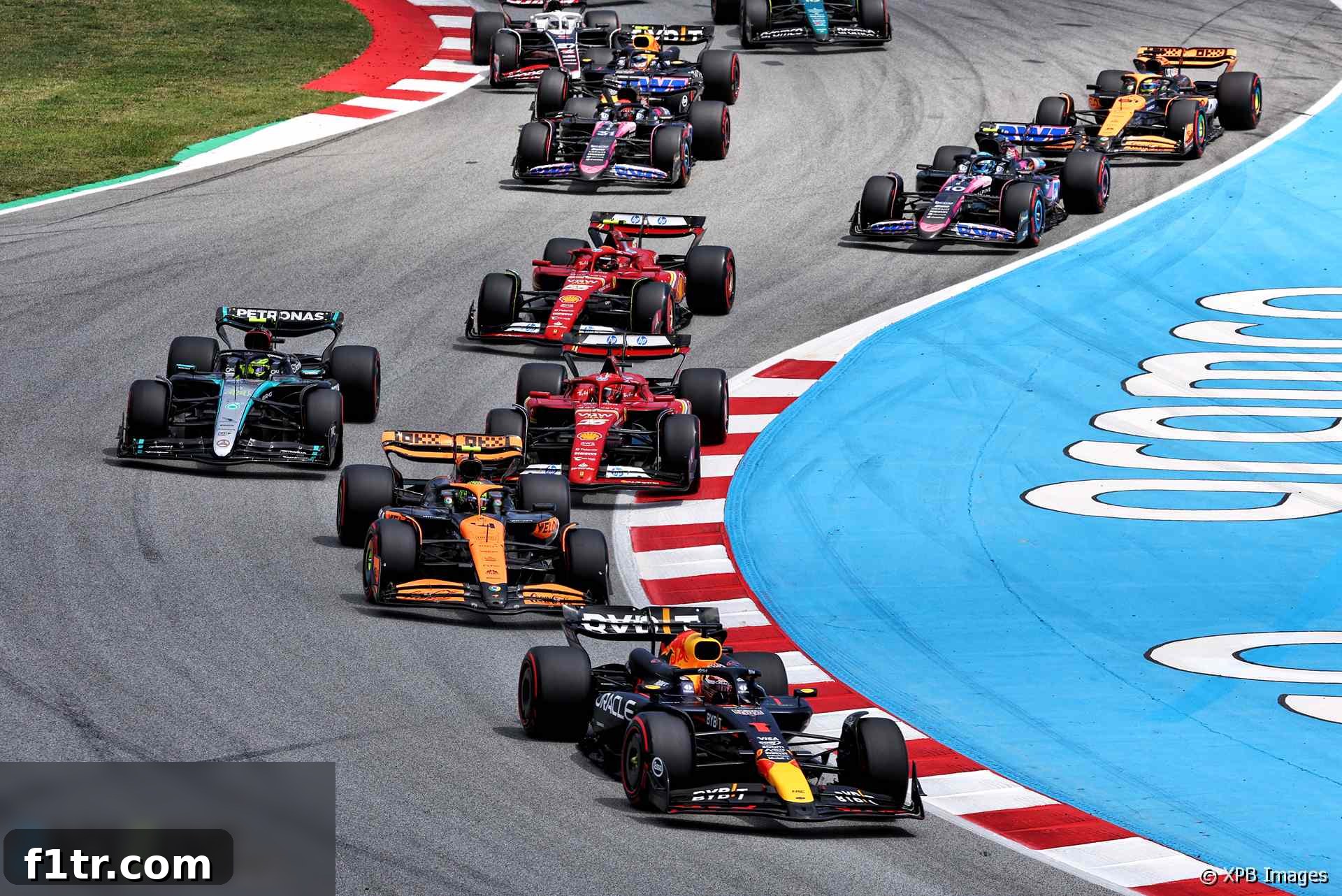
At a similar juncture in the 2024 season, following the Spanish Grand Prix, Max Verstappen appeared to be an unshakeable favorite for the championship title. His seventh victory from the first 10 races had established a commanding lead over Lando Norris. Norris, while having secured his first pole position of the season in Spain and a somewhat fortuitous victory in Miami aided by a well-timed Safety Car, was still firmly playing catch-up. With 14 rounds still to be contested, Norris, then 69 points behind, was undeniably emerging as Verstappen’s closest and most persistent challenger.
Verstappen, known for his acute racing instincts, immediately recognized the burgeoning threat. The very next round in Austria saw the two drivers engage in a fierce, wheel-to-wheel confrontation, culminating in a collision while battling for the lead. This incident was not merely an isolated moment; it set the combative tone for the remainder of their season-long rivalry. What followed was a testament to Verstappen’s relentless defense of his lead and Norris’s uphill struggle to make significant inroads.
Verstappen’s Resilience Against McLaren’s Pace
Despite McLaren often demonstrating periods of superior car performance, particularly in the latter half of the season, Norris consistently struggled to chip away at Verstappen’s formidable 69-point advantage. Far from immediately closing the gap, Norris initially found himself falling even further behind. Verstappen masterfully frustrated his every effort to gain ground, showcasing not only his own driving prowess but also the strategic strength of his Red Bull team, even on days when the McLaren chassis appeared to possess the raw speed advantage.
There were instances where Norris delivered commanding victories, such as in Zandvoort and Singapore, demonstrating McLaren’s peak capabilities. Yet, on both occasions, Verstappen meticulously managed to finish right behind his rival, effectively mitigating the damage to his championship lead. These tactical finishes meant that Norris’s powerful wins, while impressive, failed to inflict the serious points deficit on Verstappen that he desperately needed. Verstappen’s on-track maneuvers often pushed the boundaries of legality, notably in Mexico, where he forced Norris off the track in a high-speed corner. Although he incurred a penalty for this aggressive move, the delay proved sufficient to prevent Norris from challenging for victory, highlighting Verstappen’s willingness to take risks to protect his position.
The cumulative effect of Verstappen’s unwavering consistency and strategic aggression was that even during a period where he failed to win any of the 10 Grands Prix following his Spanish Grand Prix victory, Norris was unable to make substantial headway. The turning point, and effectively the final blow to Norris’s title aspirations, arrived in Brazil. Verstappen’s improbable victory from 17th on the grid delivered a crushing psychological and mathematical blow. He then definitively clinched the championship title at the subsequent round in Las Vegas, leaving Norris to ponder what might have been.
Max Verstappen’s 2025 Championship Dilemma: A Sharper Contrast
Fast forward to the present 2025 season, and Max Verstappen now finds himself staring down the barrel of the very same 69-point deficit that Lando Norris faced after the Spanish Grand Prix last year. However, beyond the identical points gap, the two scenarios diverge dramatically, presenting Verstappen with a unique and arguably more arduous challenge.
A Significantly Shorter Runway to Recovery
The most immediate and critical distinction lies in the sheer number of races remaining. Verstappen has a mere seven rounds left to bridge his 69-point gap. This is precisely half the number of events Norris had at his disposal in 2024. The maximum points available to be scored for Verstappen over these remaining races is 199. In stark contrast, when Norris was similarly behind last year, there were a much more generous 396 points still up for grabs. This drastically reduced opportunity window means Verstappen must perform at an almost flawless level, winning races and consistently outscoring his rivals by a considerable margin in nearly every remaining Grand Prix.
The Evolving Competitiveness of the Field
Another fundamental difference is the overall competitiveness of the 2025 championship. While Norris struggled to close the gap to Verstappen last year, it was partly due to Ferrari’s frequent contention for podium positions and even victories in the second half of the season, drawing points away from McLaren. In 2025, the field appears even tighter. Red Bull’s car performance has been inconsistent, although recent victories suggest a significant upturn. Laurent Mekies’ leadership within the team appears to have had a beneficial and stabilizing effect, potentially unlocking more of the Red Bull car’s inherent pace and reliability. However, this resurgence needs to be sustained and become outright dominant if Verstappen is to close such a substantial gap.
Crucially, Verstappen is not facing a single dominant rival, but rather two formidable opponents. He is currently 69 points behind Oscar Piastri, who leads the championship, and 44 points adrift of Lando Norris. This multi-front battle fundamentally alters the strategic landscape.
The Dynamics of a Three-Way Fight: Advantage Verstappen?
Paradoxically, the presence of two championship rivals within the same team could potentially play into Verstappen’s favor. Piastri and Norris are not only battling Verstappen for the title but are also engaged in an intense internal fight against each other. This dynamic risks McLaren having to manage a delicate balancing act, potentially leading to lost points or strategic compromises as their drivers vie for supremacy. In contrast, Verstappen benefits from the unequivocal and full support of his team mate, Yuki Tsunoda. Tsunoda’s recent declaration that he consciously held back from attacking the car ahead of him in the last race, specifically to avoid risking Norris’s progress, underscores the clear hierarchy and unified objective within the Red Bull camp. This unified front could be a significant strategic asset for Verstappen as the championship reaches its critical climax.
Last year, despite having 14 rounds, Norris managed to gain a mere six points on Verstappen over the latter half of the season. Given his current form, the trajectory of Red Bull’s car development, and the unique challenges presented by a two-pronged McLaren attack, expectations are high that Verstappen will gain significantly more than that this season. Should he continue this impressive surge, consistently narrowing the points deficit, McLaren will undoubtedly face immense pressure to re-evaluate their current policy of affording both drivers an equal opportunity in the title fight. The prospect of internal team orders, or a strategic shift to back one driver, becomes increasingly probable if Verstappen can make this championship truly competitive in the limited races remaining. The final rounds promise to be an exhilarating test of strategy, nerve, and raw driving talent, shaping the narrative of the 2025 Formula 1 season into one for the history books.