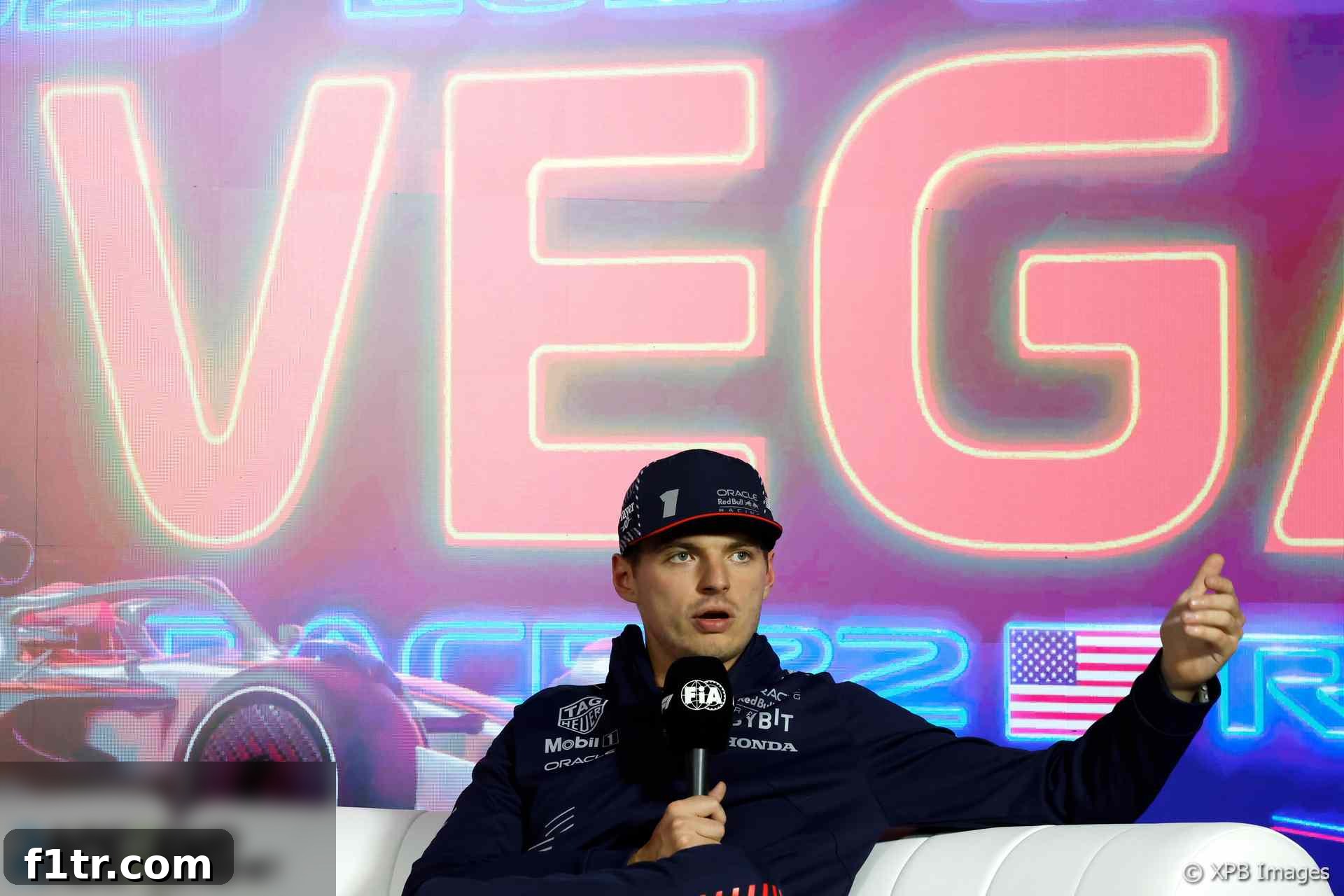
Max Verstappen, the reigning Formula 1 World Champion, has publicly expressed significant doubts regarding the long-term effectiveness of Liberty Media’s lavish new Las Vegas Grand Prix. Despite the colossal investment poured into this highly anticipated event, Verstappen questions its ability to genuinely attract and retain new fans, raising broader concerns about the sport’s evolving identity amidst its rapid global expansion.
The Las Vegas Grand Prix, strategically positioned as a cornerstone of F1’s aggressive push into the lucrative North American market, represents an unprecedented undertaking for Liberty Media. With an estimated investment potentially soaring up to half a billion dollars, the commercial rights holder meticulously transformed a stretch of the iconic Las Vegas Strip into a temporary street circuit. This ambitious project aimed to seamlessly blend the adrenaline-fueled excitement of top-tier motorsport with the unparalleled spectacle and entertainment for which the ‘Entertainment Capital of the World’ is renowned. However, even before its inaugural race weekend, the event ignited a fervent debate within the Formula 1 community, particularly concerning its delicate balance between authentic sporting competition and elaborate showmanship.
Max Verstappen’s Unfiltered View: The Essence of Racing vs. The Spectacle
Verstappen’s skepticism regarding the Las Vegas event became evident from the outset, culminating in his candid remarks following the qualifying session. He openly voiced his displeasure at being required to participate in an elaborate opening ceremony, an experience that made him feel like a “clown”. This sentiment encapsulates a deeper philosophical divergence concerning the direction and priorities of modern Formula 1. For Verstappen, the intrinsic allure of motorsport lies in its raw, unadulterated emotion and the purity of competitive racing, rather than in surrounding theatrical performances designed primarily to captivate a broader, potentially less informed, audience.
The Red Bull driver further elaborated on his perspective, emphasizing that his enduring passion for racing originated from the inherent thrill of the sport itself, rather than any ancillary spectacle. “Of course, a kind of show element is important,” he conceded, acknowledging the necessity of engagement, “but I like emotion and for me, when I was a little kid, it was about the emotion of the sport, what I fell in love with, not the show of the sport around it. Because I think, as a real racer, that shouldn’t really matter.” This powerful statement resonates with many traditionalists who fear that the relentless pursuit of entertainment might inadvertently dilute the sport’s fundamental competitive integrity and historical values.
Moreover, Verstappen expressed strong reservations about the suitability of street circuits for showcasing the pinnacle of motorsport. He contended, “A car, first of all, a racing car, a Formula 1 car anyway on a street circuit I think doesn’t really come alive. It’s not that exciting. I think it’s more about just the proper race tracks.” He starkly contrasted the often-constrictive and unyielding nature of temporary street circuits with the visceral, challenging experience offered by legendary venues such as Spa-Francorchamps or Monza. These historic tracks, he asserted, are imbued with profound emotion and a rich tapestry of passion, fostering an unparalleled connection between drivers, dedicated fans, and the very spirit of pure racing. “For me, seeing the fans there is incredible. And for us as well when I jump in the car there, I’m fired up and I love driving around these kind of places,” he shared, highlighting the symbiotic relationship between demanding circuits and the heightened motivation of the drivers.
Verstappen extended his critique to the nature of fan engagement observed in Las Vegas. While acknowledging the need for complementary activities, he suggested that the event disproportionately prioritized superficial entertainment over a deeper understanding and appreciation of the sport itself. “Most of them just come to have a party, drink, see a DJ play or a performance act. I can do that all over the world,” he lamented, underscoring the universality of such leisure activities. He drew a stark, provocative parallel, stating, “I can go to Ibiza and get completely shitfaced and have a good time. But that’s what happens and actually, people, they come and they become a fan of what? They want to see maybe their favourite artist and have a few drinks with their mates and then go out and have a crazy night out but they don’t actually understand what we are doing and what we are putting on the line to perform.” This pointed observation suggests that while such events may attract large initial crowds, they risk failing to convert these attendees into knowledgeable, enduring F1 enthusiasts who truly appreciate the intricate engineering, strategic depth, and immense skill inherently demanded by the sport.
Beyond the Glitz: Verstappen’s Vision for F1’s Future
Verstappen firmly believes that Liberty Media’s strategic focus should decisively shift from orchestrating extravagant shows to fundamentally enhancing the intrinsic appeal of Formula 1 as a pure sporting discipline. “If you would actually invest more time into the actual sport, what we’re actually trying to achieve here is to – as little kids, we grew up wanting to be a world champion – if I think the sport would put more focus onto these kind of things and also explain more what a team is doing throughout season, what they are achieving, what they are working for, these kind of things I find way more important to look at than just having all these random shows all over the place,” he eloquently articulated. This perspective advocates for a narrative that champions the journey of aspiration, relentless dedication, technological innovation, and sporting excellence inherent in Formula 1, rather than a fleeting, albeit dazzling, spectacle.
For Verstappen, the “passion and emotion” inextricably linked to authentic racing experiences are paramount, elements he finds conspicuously lacking in a venue like Las Vegas, despite his personal enjoyment of the city for leisure activities. “For me, it’s not what I am very passionate about. I like passion and emotion with these kind of places. I love Vegas, but not to drive an F1 car, I love to go out and have a few drinks, throw everything on red or whatever, be a bit crazy, have nice food,” he remarked, drawing a clear distinction between his private enjoyment and professional assessment. He starkly contrasted the superficial atmosphere with “old-school tracks,” where the palpable sense of history and the unadulterated thrill of pure racing create an unmatched, immersive experience. His blunt assessment of the track layout, which he had previously deemed “no fun to drive”, further underscored his deep dissatisfaction with its racing characteristics. Drawing a clear and impactful analogy, he declared, “I think Monaco is like Champions League. This is National League,” equating the venerable Monaco Grand Prix with the pinnacle of sporting prestige and challenge, while pointedly relegating Las Vegas to a less prestigious, and perhaps more overtly commercial, tier.
Carlos Sainz’s Challenging Start and the Quest for Balance
The highly anticipated debut of the Las Vegas Grand Prix suffered an unfortunate and chaotic start, further marred by a significant incident involving Carlos Sainz Jnr. His weekend took an immediate and unfortunate turn when his Ferrari sustained severe damage after colliding with a broken water valve cover during the initial practice session. This critical incident not only necessitated extensive, time-consuming repairs to his car but also resulted in a punitive 10-place grid penalty, a consequence that baffled many observers and highlighted significant operational shortcomings. The urgent necessity for track repairs led to the cancellation of the remaining practice sessions for spectators and a substantial delay for the second practice session, which was eventually conducted in the early hours with deserted grandstands. This chaotic and inauspicious beginning cast a noticeable shadow over the event, raising serious questions about F1’s preparedness and operational oversight for such a high-profile, globally broadcast debut.
Despite personally enduring such significant adversity, Sainz offered a more nuanced and ultimately optimistic perspective than his Red Bull counterpart, Max Verstappen. He firmly believes that Formula 1 possesses the inherent capacity to strike a harmonious and sustainable balance between its sporting integrity and its broad entertainment aspirations. “I think we need to learn to separate things,” he stated thoughtfully. “There’s the sport and there’s the show and I think you can have both in a good combination and harmony.” He views the Las Vegas Grand Prix, with its extravagant opening ceremony, seamlessly integrated hotel experiences, and extensive VIP access, as a monumental and indeed vital opportunity for F1’s continued global growth and expansive appeal. “I see this as a very good opportunity for F1. I think it’s a good thing that F1 is coming to Vegas and I’m enjoying the experience of coming to Vegas to do a Formula 1 race there,” Sainz affirmed, openly acknowledging the immense commercial potential and extensive reach that such a grand event can command.
However, Sainz was also quick to deliver a pointed critique of the operational execution of the event, particularly the handling of his debilitating incident. “As a sport we cannot fail in these important events. And I feel like we started on a very bad foot yesterday,” he emphasized, articulating the gravity of the early missteps. He argued that these initial blunders squandered a crucial opportunity to present Formula 1 in its best possible light to a vast new audience. “It was a very good opportunity to make a statement as a sport and to open Vegas with a very good image and with a very good attraction to everyone.” The widespread confusion generated by his grid penalty, especially among new spectators unfamiliar with F1’s complex regulations, further highlighted this flaw. “I have people that have never come to a race that are still asking me why am I getting a penalty for what happened. They’ve never been to an F1 race,” he explained, vividly illustrating how fundamental sporting rules can become an insurmountable obstacle for newcomers when not clearly communicated or when overshadowed by avoidable controversy.
Sainz reiterated his unwavering support for the show elements and the ambitious growth strategy of the sport, but underscored a critical, non-negotiable caveat: “Separating the two things I’m all for the show, all for growing of sport, but the sport has to be there. And I feel like yesterday we didn’t start on the right foot. I paid the price by far the most of it.” His hope remained steadfast that a thrilling and competitive race performance could ultimately redeem the entire weekend, allowing the spectacle of pure racing to decisively overshadow the early mishaps and operational failures. “I hope that tomorrow we have an exciting race, that F1 shows the whole world what we’re made of, what kind of racing we can produce, what kind of spectacle and what kind of sport we are on,” he concluded, aspiring for a profoundly positive overall impression despite his personal misfortune. “If this goes well tomorrow, hopefully FP1 would be forgotten – my penalty, not – but FP1 will be forgotten and we will enjoy a good weekend and I think overall, it will be a positive weekend for F1.”
Charles Leclerc’s Measured Optimism: Embracing Change Responsibly
Charles Leclerc, Carlos Sainz’s Ferrari teammate and the impressive pole-sitter for Saturday’s race, echoed a similar sentiment of disappointment regarding the initial criticisms surrounding the event, while simultaneously expressing a measured optimism for its inherent potential. “I was sad yesterday to see how much criticism there was around the track,” said the thoughtful Ferrari driver. He forthrightly acknowledged the operational shortcomings, stating unequivocally, “Of course it wasn’t good enough, and that is clear to everybody.” However, he urged a broader recognition for the monumental effort and countless hours of work that underpinned the entire undertaking: “But obviously we must not forget also how much work there has been from many, many people in order to make this event work.”
Leclerc, like Sainz, clearly recognized and appreciated the visual grandeur and immense potential of the Las Vegas venue. “I think it looks amazing. I really hope we have an exciting race tomorrow in order to really show what Formula 1 is,” he conveyed, underscoring the critical importance of the race itself in ultimately defining the event’s success and public perception. He firmly believes in the necessity of balancing F1’s core identity and rich heritage with innovative, forward-thinking approaches to fan engagement. “We are a sport, for sure, and we need to keep the DNA of the sport, which is the most important thing for everybody. At the same time, I believe that opportunities like this needs to be taken and a little bit of show around the track to attract people that maybe wouldn’t have come to a Formula 1 race is needed. So you always need to find the right balance between show and sport.” This nuanced perspective highlights the persistent and complex challenge for Formula 1 to evolve and expand its global appeal without alienating its traditional fanbase or compromising its fundamental sporting essence.
Despite his overall optimism and positive outlook, Leclerc shared a specific misgiving that aligned closely with Max Verstappen’s concerns about pre-race distractions. “I’m not so happy about the show before just before the race because I think this is a time where we need to focus on what really matters, which is racing,” he admitted, offering a candid glimpse into the drivers’ mindset. This candid observation indicates a palpable tension between the burgeoning demands of entertainment and the drivers’ critical need for intense focus and undisturbed preparation prior to competition. Nonetheless, he reaffirmed his profound appreciation for the sheer scale and ambition of the undertaking: “On the other hand, I think the venue and the event looks amazing and there’s been a lot of hard work in order to get there, which has to be appreciated.” He concluded with a clear, forward-looking commitment to continuous improvement: “At the end of the weekend, we’ll obviously look back at all the things that didn’t go well in order for these things to not happen because it is clear that it’s not acceptable what happened in FP1.”
The Evolving Identity of Formula 1: A Las Vegas Case Study
The inaugural Las Vegas Grand Prix stands as a vivid and compelling microcosm of the broader, ongoing debate surrounding Formula 1’s rapidly evolving identity. Liberty Media’s ambitious and undeniable vision to transform F1 into a preeminent global entertainment spectacle, particularly evident in its aggressive expansion into the strategically vital US market, has been met with both enthusiastic embrace and staunch, principled resistance. While the lavish spectacle of Las Vegas undoubtedly draws new eyeballs and promises significant commercial opportunities, as passionately advocated by figures like Carlos Sainz and Charles Leclerc, it simultaneously tests the very boundaries of what defines Formula 1 for its long-standing adherents and purists like Max Verstappen.
The multifaceted criticisms levied against the event – ranging from the perceived dilution of sporting integrity by excessive showmanship to the undeniable operational missteps that unfortunately marred the opening sessions – collectively highlight the inherent and complex challenges in balancing deeply rooted tradition with dynamic innovation. The critical incident involving Carlos Sainz’s car, in particular, served as a stark and timely reminder that even the most glamorous venues and meticulous planning cannot, and must not, overshadow the fundamental safety and operational standards that underpin the credibility of the sport. For Formula 1 to truly succeed in its new, bold endeavors, it must ensure that the “sport” remains unequivocally paramount, executed flawlessly, and comprehensively comprehensible to all, whether they are seasoned aficionados or first-time spectators initially drawn solely by the dazzling glitz and glamour.
Ultimately, the Las Vegas Grand Prix represents a pivotal and defining experiment in the annals of Formula 1. Its long-term legacy will not solely be judged by the commercial revenue it successfully generates or the celebrity attendance it attracts, but more profoundly, by its enduring ability to foster genuine enthusiasm and a deeper understanding for the intricate and demanding world of Formula 1 racing, all without sacrificing the authenticity, competitive spirit, and rich heritage that have powerfully defined it for decades. The varying yet crucial perspectives of its top drivers underscore this delicate and critical balancing act, providing invaluable insights into the future direction of a sport undeniably poised at a significant crossroads.
2023 Las Vegas Grand Prix Insights
- Tost blames track inspection oversight for Sainz’s damage in Las Vegas
- Hard to repeat “rare” combination of factors behind Vegas shunt – Norris
- Las Vegas Grand Prix “got a lot more hate than it deserved” – Sargeant
- Williams’ “incredible” Vegas qualifying made us “poor” in race – Vowles
- Piastri is first rookie to take two fastest laps in a season since Hamilton
Browse all 2023 Las Vegas Grand Prix articles