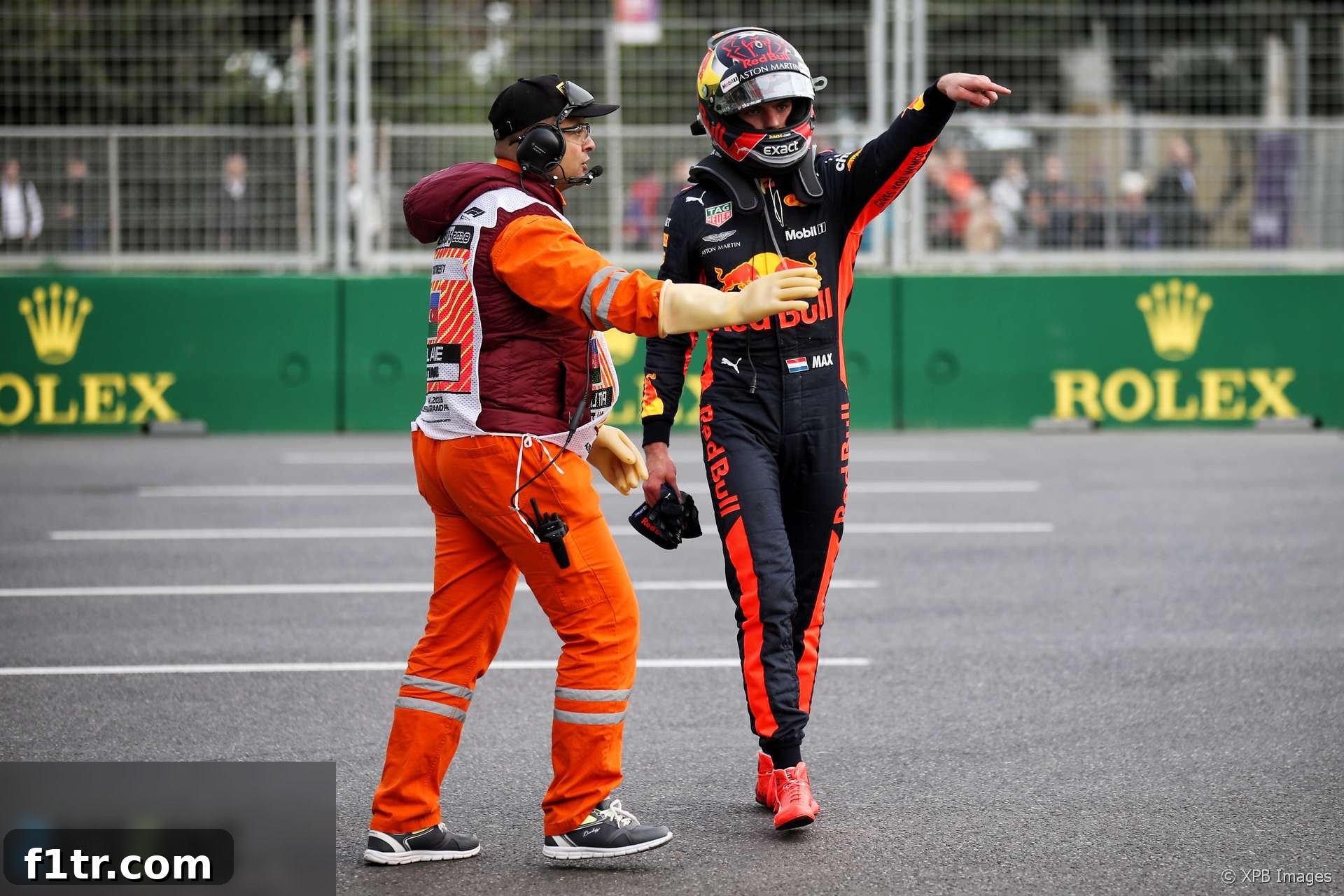
The exhilarating world of Formula 1 is often defined by a delicate balance between individual ambition and team success. For Red Bull Racing, this dynamic was starkly illustrated at the 2018 Azerbaijan Grand Prix, where teammates Max Verstappen and Daniel Ricciardo collided in a dramatic incident that sent both drivers out of the race. Despite the significant loss of championship points and the ensuing fallout, Max Verstappen firmly believes that the team should uphold its philosophy of allowing its drivers to race each other freely. This stance ignited a crucial debate within the team and across the F1 paddock about the fine line between fostering fierce competition and ensuring strategic team results.
Verstappen articulated his perspective clearly in the immediate aftermath of the Baku crash, stating, “I don’t think letting us not race any more is the way forward.” This declaration underscored his commitment to pure, unadulterated racing, a trait that has defined much of his career. While acknowledging the necessity of internal discussions to address the incident and its implications, his underlying message was a plea for Red Bull to maintain its competitive ethos. The incident served as a stark reminder of the inherent risks when two highly competitive drivers, both vying for supremacy, are given the freedom to push the limits against each other.
The Dramatic Baku Collision: An Unnecessary Double Retirement
The 2018 Azerbaijan Grand Prix at the challenging Baku City Circuit was already shaping up to be a chaotic and unpredictable affair. Known for its incredibly long main straight and tight, twisty castle section, Baku often produces thrilling racing and unexpected results. From the outset, the Red Bull garage found themselves in an unenviable position as their two star drivers, Max Verstappen and Daniel Ricciardo, engaged in an intense wheel-to-wheel battle for position, creating a spectacle for fans but a growing sense of dread for the pit wall.
Throughout much of the race, the two Red Bull cars were locked in a fierce duel, constantly overtaking and re-overtaking each other. The slipstream effect on Baku’s extensive straight played a crucial role, allowing each driver to catch up rapidly once the other pulled ahead. Verstappen himself commented on this dynamic, noting, “The tow was very strong so as soon as he was in front then I was catching up again. We were pretty similar speed and we were very close to each other.” This relentless pursuit and defense created a high-stakes environment where margins for error were minimal.
The tension escalated until a pivotal moment late in the race. Daniel Ricciardo, having just been overtaken by Verstappen, launched an aggressive move down the inside into Turn 1 at the end of the main straight. Verstappen defended his line, and as Ricciardo attempted to find a way past, the two cars converged. The contact was inevitable and catastrophic. Ricciardo’s front wing clipped the rear of Verstappen’s car, resulting in both cars sustaining irreparable damage. The immediate consequence was a devastating double retirement for Red Bull Racing, wiping out a significant haul of championship points and drawing widespread criticism.
Reflecting on the preceding laps, Verstappen described the racing as “hard but it was fair.” He even downplayed an earlier, minor brush of wheels, asserting, “Of course we had this little brush with the wheel but I think this is racing, that can happen. But what happened afterwards of course is not good.” This distinction highlights his view that while aggressive, their driving before the crash was within acceptable competitive boundaries, but the final incident crossed a line. The crash was a bitter pill for the team, as Verstappen lamented, “It’s just really disappointing for the team. We lost a lot of points today unnecessarily.”
Verstappen’s Unwavering Stance: The Core of Racing DNA
Max Verstappen’s insistence on continuing to allow drivers to race, even after such a costly incident, stems from a deep-seated belief in the essence of Formula 1. For many purists and drivers like Verstappen, the sport is fundamentally about the fastest individual prevailing on track, a test of skill, courage, and machinery against rivals, including teammates. The idea of implementing team orders to mitigate risks, while strategically sound in some scenarios, can be seen as compromising the very spirit of competition.
His argument posits that restricting drivers from racing each other not only diminishes the spectacle for fans but also potentially hinders the team’s long-term performance. When drivers are pushed by internal competition, it often drives innovation, forces both individuals to elevate their game, and can lead to a stronger overall team performance. This competitive tension, when managed effectively, can be a powerful motivator. Verstappen’s career has been defined by his aggressive, no-holds-barred approach, and he expects the same level of commitment and freedom from his teammates and the team leadership.
Furthermore, Verstappen’s perspective aligns with a common driver sentiment: that mistakes and incidents, while unfortunate, are an inherent part of motor racing. Rather than instituting blanket bans on racing, drivers often prefer to learn from such incidents, discuss them, and adjust their future approaches. He emphasized this point by stating, “I think we don’t need to speak about who’s at fault because at the end of the day we are racing for the team, we are racing other people and this happens. It’s just not good for both of us.” This shared accountability is a hallmark of professional sportsmanship, even in moments of high tension.
The Immediate Aftermath and Red Bull’s Dilemma
The repercussions of the Baku collision extended beyond the immediate points loss. The incident sparked intense discussions within the Red Bull camp, from the pit wall to the factory. Team Principal Christian Horner and motorsport advisor Helmut Marko faced the unenviable task of addressing the drivers and formulating a strategy for moving forward. The goal was clear: prevent a recurrence without stifling the competitive fire that had made Verstappen and Ricciardo such an formidable pairing.
One of the more reassuring aspects following the crash was the immediate interaction between the two drivers. Verstappen confirmed this, sharing, “Of course you’re not happy when you collide together as team mates but we are very fair to each other so we spoke immediately after.” This quick post-race conversation, free from the heat of the moment, suggested a degree of mutual respect and professionalism, crucial for repairing any potential rift. While emotions undoubtedly ran high, their ability to communicate directly and frankly was a positive sign for the team’s internal dynamics.
However, the question of blame, while downplayed by Verstappen, was unavoidable for the team leadership. Analyzing telemetry, driver inputs, and on-board footage became paramount to understanding the precise sequence of events that led to the collision. Red Bull’s history with driver rivalries, often allowing them considerable freedom, suddenly came under intense scrutiny. The fine line between encouraging thrilling racing and protecting constructors’ championship points became the focal point of their strategic planning. The pressure was on to demonstrate control and prevent such self-inflicted damage in future races, especially given the fierce competition from Mercedes and Ferrari.
Beyond Baku: The Broader Implications for Team Orders in F1
The 2018 Azerbaijan Grand Prix incident between Max Verstappen and Daniel Ricciardo served as a potent case study for the perennial debate surrounding team orders in Formula 1. While some argue that team orders detract from the spectacle and sporting integrity, others contend that they are a necessary evil in a constructors’ championship where every point counts. Teams invest hundreds of millions, and sacrificing points due to internal squabbles can have significant financial and competitive consequences.
Historically, Red Bull Racing has generally favored a policy of allowing its drivers to race, often resulting in thrilling battles but also occasional controversial moments. This approach aligns with their brand image of being a dynamic and aggressive force in motorsport. However, incidents like Baku force every team to re-evaluate their stance. The challenge lies in finding a balance that satisfies the drivers’ competitive instincts, entertains the global audience, and safeguards the team’s championship aspirations. Implementing strict team orders can demotivate drivers and potentially lead to a less exciting product, while unchecked aggression can be disastrous, as proven in Baku.
The incident also had long-term implications for the driver market. Daniel Ricciardo’s departure from Red Bull at the end of the 2018 season, though driven by multiple factors, was undoubtedly influenced by the intense rivalry with Verstappen and the perception of the team’s future focus. The dynamic of having two alpha drivers, both capable of winning races and championships, is a blessing and a curse for any F1 team. While it provides incredible performance, it also creates an inherent tension that requires masterful management.
Exploring the 2018 F1 Season and Beyond
The 2018 Formula 1 season, marked by this dramatic Red Bull clash, was a season of intense rivalries, unexpected twists, and significant technological advancements. It was a year where championship battles went down to the wire and internal team dynamics played a crucial role in the overall narrative. Understanding the context of the entire season provides a fuller picture of the pressures and decisions teams and drivers faced.
The technological developments, particularly regarding power units, were also a significant talking point. Teams like McLaren, navigating their transition with Honda engines, faced unique challenges, while Red Bull’s ongoing relationship with Renault, and later its shift to Honda, underscored the critical importance of engine performance. The strategic choices made by teams regarding their engine partners, and the development pathways pursued, often had profound impacts on their competitive standing for years to come. The discussions around how engine development aided by external divisions, such as Honda’s jet division, illustrate the breadth of innovation driving the sport.
Ultimately, Max Verstappen’s impassioned plea for continued freedom to race reflects a fundamental aspect of Formula 1: the relentless pursuit of victory, individually and collectively. While the Azerbaijan Grand Prix collision was a painful lesson in the potential costs of such freedom, it also reinforced the notion that the sport’s allure often lies in the unscripted drama and raw competitive spirit of its greatest talents. Red Bull’s subsequent management of its driver lineups and internal rivalries would continue to shape its trajectory, but the incident in Baku remains a potent symbol of the eternal tension between racing for oneself and racing for the team.
- F1 feared “death knell” for Drive to Survive after Ferrari and Mercedes snub
- McLaren staff told us we were “totally crazy” to take Honda engines in 2018 – Tost
- ‘It doesn’t matter if we start last’: How Red Bull’s junior team aided Honda’s leap forward
- Honda’s jet division helped F1 engineers solve power unit problem
- McLaren Racing losses rise after Honda split
Browse all 2018 F1 season articles