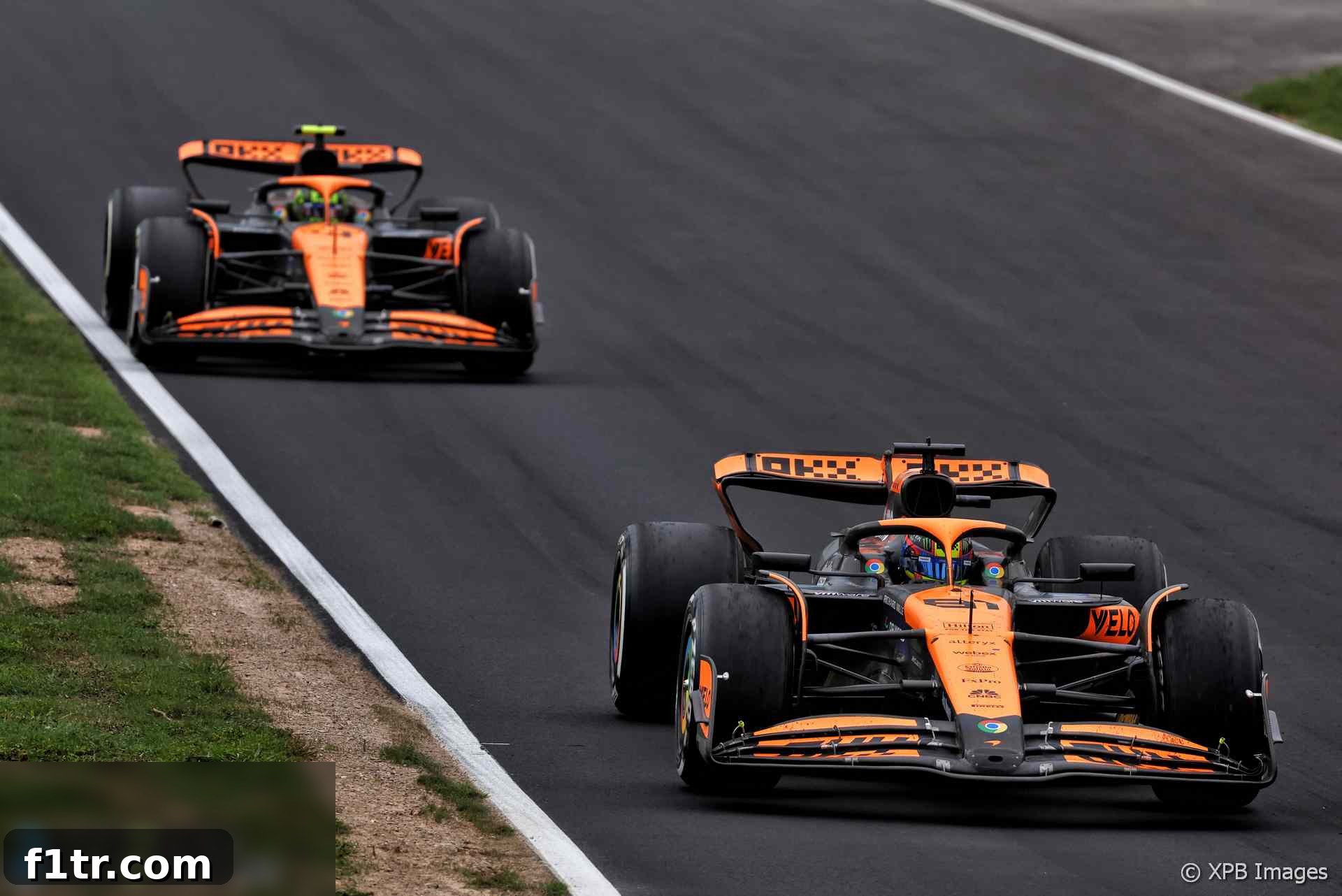
The hallowed grounds of Monza recently witnessed a captivating Formula 1 spectacle, yet the post-race discussion veered sharply from on-track action to strategic team decisions. Specifically, McLaren found themselves under intense scrutiny and criticism from various Formula 1 broadcasters and pundits for their steadfast refusal to impose team orders on their drivers, Lando Norris and Oscar Piastri. This decision, or rather the lack thereof, sparked a heated debate about team strategy, championship aspirations, and the delicate balance of nurturing talent versus maximizing points.
Advert | Become a Supporter & go ad-free
For the second time in four championship rounds, Lando Norris, widely regarded as the closest challenger to the dominant points leader Max Verstappen, crossed the finish line immediately behind his McLaren teammate. These instances, particularly the recent event at Monza, ignited calls for McLaren to intervene. Critics argued that had McLaren orchestrated a car swap in those two crucial races, Norris’s championship deficit to Verstappen would now stand at a more manageable 52 points, rather than the current 62. Even presenters on the official F1 channel openly poured scorn on McLaren, insisting that the team was failing to be “smart” by not instructing Oscar Piastri to cede position to Norris. However, it’s crucial to acknowledge that Formula 1 teams, operating at the pinnacle of motorsport, often possess a depth of information and strategic foresight that far surpasses external commentary.
The superficial logic advocating for McLaren’s intervention appears straightforward: maximize Norris’s points tally to keep his championship hopes alive. After all, few would dispute that Red Bull Racing would never permit Sergio Perez to consistently take points away from Max Verstappen, especially in a tight championship battle. This prevailing sentiment often forms the basis of the argument against McLaren’s current approach.
Yet, comparing McLaren’s situation to Red Bull’s reveals a fundamental difference in their team dynamics and championship positions. For Red Bull, team orders, particularly concerning Verstappen and Perez, have rarely been a major consideration. Out of the staggering 970 racing laps completed in Grand Prix events so far this season, Sergio Perez has been ahead of Max Verstappen for a mere 25 laps. This astonishing statistic underscores Verstappen’s near-total dominance over his teammate. No other driver who has started more than one race has led their team mate so infrequently – not even the recently departed Logan Sargeant. This clear hierarchy and consistent performance disparity mean that Red Bull seldom faces the dilemma of enforcing team orders, as Verstappen naturally leads the charge.
Indeed, if Red Bull team principal Christian Horner genuinely desired a stronger rival to Verstappen within their second car, he would hardly have offered Perez a new contract earlier this year. Horner’s actions, including dispelling suggestions (some partly inspired by his own comments) that Perez might be replaced during the summer break, sent an unambiguous message: Red Bull is prepared to prioritize Verstappen’s drivers’ championship crown, even if it means potentially sacrificing a more commanding lead in the constructors’ championship.
This contrasts sharply with the competitive landscape within McLaren. While Verstappen has led Perez for an overwhelming 97% of laps this year, Lando Norris’s advantage over Oscar Piastri stands at a considerably narrower 69%. This figure is much closer to the internal team battles observed at other leading teams: George Russell has led Lewis Hamilton for 64% of laps, and Charles Leclerc has led Carlos Sainz for 63%. These statistics highlight that the gap between Norris and Piastri is not as vast or consistent as that between Verstappen and Perez, which forms the crux of McLaren’s strategic conundrum.
Advert | Become a RaceFans supporter andgo ad-free
Norris’s current superiority over Piastri is far from the total dominance exhibited by Verstappen over his teammate. This distinction is critically important because once McLaren were to explicitly tell Piastri he is their ‘number two’ driver, they would have metaphorically crossed the Rubicon. Issuing an order for him to let Norris past just once would set a precedent. Subsequently failing to enforce similar orders throughout the remainder of the season would then be perceived as a clear and inconsistent failure of leadership, potentially undermining team morale and Piastri’s confidence.
The real question then becomes: how many times might McLaren be compelled to move Piastri out of Norris’s path? And, more importantly, might they end up doing it so frequently that they start to look as though they have, in the eyes of the public and perhaps even their own drivers, backed the wrong horse for the championship challenge? With 11 races still remaining on the calendar, including sprint events that offer additional points, the frequency of such interventions could become a significant factor. Piastri has already demonstrated his burgeoning talent, beating Norris in half of the last four races, and he is showing continuous improvement. Furthermore, as a testament to his raw speed, Piastri also out-qualified Norris in half of the final 10 races of the previous year, indicating his immense potential and direct competitiveness.
While Norris may currently trail Verstappen by 62 points in the drivers’ standings, it’s worth noting that Piastri is a mere 44 points behind Norris. If McLaren were to succumb to external pressure and start imposing team orders as some pundits suggest, they might discover that their intervention fails to decisively tip the balance in the primary championship fight against Verstappen. However, it would almost certainly ensure that Norris finishes ahead of Piastri in the internal team battle. The thought of Piastri potentially saying, “He only beat me because you kept telling me to let him past,” is undoubtedly a scenario the team wishes to avoid, given its potential to foster resentment and negatively impact team harmony.
Left to their own devices, allowing both drivers to compete freely, it is entirely plausible that Piastri could even out-score Norris by the end of the season, showcasing his true potential and growth within the sport. This potential internal shift makes McLaren’s non-interventionist stance more understandable.
| Position | Driver | Points |
|---|---|---|
| 1 | Max Verstappen | 303 |
| 2 | Lando Norris | 241 |
| 3 | Charles Leclerc | 217 |
| 4 | Oscar Piastri | 197 |
| Points available: 232 | ||
Advert | Become a RaceFans supporter andgo ad-free
To further illustrate the complexity, contrast McLaren’s current dilemma with, for example, the state of play between the Mercedes teammates at the 2018 Russian Grand Prix. In that instance, Valtteri Bottas was famously instructed to relinquish a victory to Lewis Hamilton. The points standings at that time clearly highlighted a vastly different scenario, where Hamilton was in a direct fight for the championship title against Sebastian Vettel, and Bottas was significantly further behind.
| Position | Driver | Points |
|---|---|---|
| 1 | Lewis Hamilton | 281 |
| 2 | Sebastian Vettel | 241 |
| 3 | Kimi Raikkonen | 174 |
| 4 | Valtteri Bottas | 171 |
| Points available: 156 | ||
In the 2018 Mercedes scenario, the decision to impose team orders on Bottas was, for many, a “no-brainer” given Hamilton’s clear and strong championship credentials. The undeniable fact that Norris’s championship credentials are not currently as robust is largely attributable to his own performance over the season. While a driver’s raw pace is one thing, converting that into consistent points and victories is another.
Despite having secured two impressive victories, several potential triumphs have regrettably eluded Norris in key races throughout the season. Instances in Canada, Spain, Austria, Britain, and Hungary saw opportunities slip through his grasp. To this list, we can now add Italy, where another chance to significantly reduce Verstappen’s points lead went uncapitalized. Furthermore, he squandered another valuable points-scoring opportunity in Belgium, compounding his championship deficit. Prior to the summer break, Norris himself candidly admitted that he hadn’t performed consistently enough to earn unequivocal ‘number one’ status within the team. His assessment was accurate then, and arguably, it remains the case now.
Therein lies a significant paradox in the argument that McLaren should impose orders on their drivers to boost Norris’s points. The very fact that he stands to gain so many points from such interventions implicitly suggests that he hasn’t been consistently ahead of Piastri to begin with. The infamous historical examples of team orders, such as Austria 2002 and Germany 2010, gained their notoriety precisely because they were such rare and shocking occurrences, not because they happened every other weekend. These were exceptional circumstances, often involving drivers with clear, established championship leads and significant performance disparities over their teammates.
Oscar Piastri is currently in only his second season in Formula 1. Logically, he should be further from reaching his ultimate performance potential than Lando Norris, who is now in his sixth year in the sport. How quickly Piastri might fully realize that immense potential is a question no one can definitively answer. However, McLaren, with all their internal data, detailed performance analyses, and daily interactions, are unquestionably better placed to judge this trajectory than any external pundit. Most critics and broadcasters, while valuable for their analysis, primarily have a stake in seeing a more thrilling and closely contested championship fight against Verstappen. McLaren, on the other hand, must balance short-term championship ambitions with long-term team stability, driver development, and brand reputation.
Advert | Become a RaceFans supporter andgo ad-free
McLaren’s strategy, therefore, is not a failure of intelligence but a deliberate choice rooted in a comprehensive understanding of their internal dynamics, driver potential, and championship realities. While the desire for a tighter championship battle is understandable, pushing team orders onto a rapidly developing talent like Piastri might win a few extra points in the short term, but could jeopardize team harmony, driver motivation, and McLaren’s future prospects. Their current stance reflects a belief in fair competition, the development of both their exceptional drivers, and a long-term vision that extends beyond immediate championship calculations.
Miss nothing from RaceFans
Get a daily email with all our latest stories – and nothing else. No marketing, no ads. Sign up here:
2024 Italian Grand Prix
- ‘I should have won last year but I did stupid stuff’: Norris out to avenge 2024 defeat
- Verstappen faces post-race investigation along with five other drivers and McLaren
- Red Bull lose constructors’ championship lead for first time in two years
- “Never had so much pain in a car”: How Colapinto impressed Williams on his debut
- F1’s most competitive season for 47 years? Four teams now have three wins each
Browse all 2024 Italian Grand Prix articles