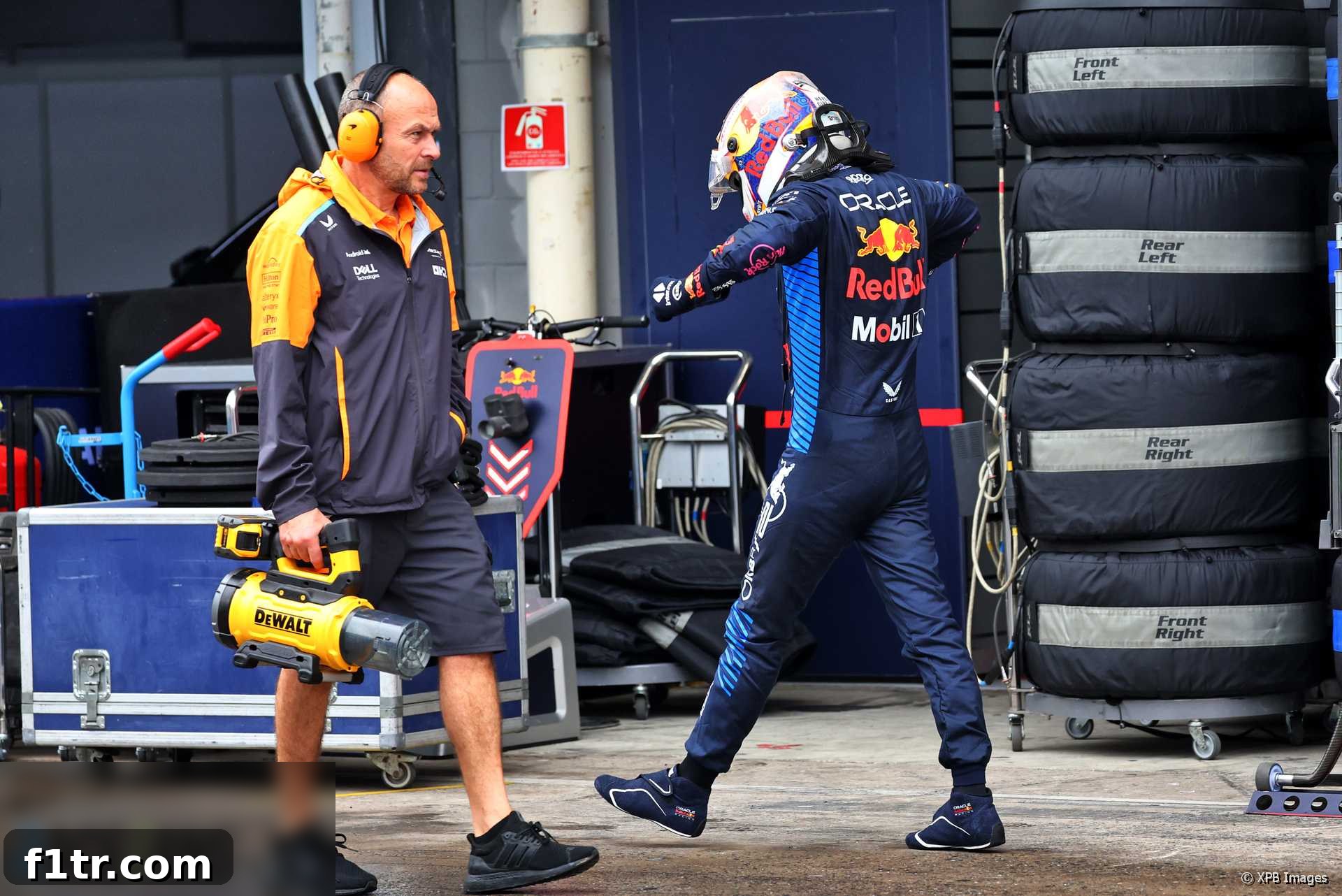
Verstappen’s Fury: Delayed Red Flag Timing Derails Brazilian GP Qualifying
In a dramatic and rain-affected qualifying session for the Brazilian Grand Prix, Max Verstappen found himself unexpectedly eliminated early in Q2, laying firm blame on the timing of a crucial red flag. The reigning world champion’s frustration was palpable, turning what should have been a routine progression into a contentious debate about race control procedures and sporting fairness.
Advert | Become a Supporter & go ad-free
The Unfolding Drama: Stroll’s Crash and the Critical Delay
The incident that triggered Verstappen’s early exit occurred during a treacherous Q2 session, where fluctuating wet conditions made tyre choices and track grip a constant challenge. Aston Martin driver Lance Stroll lost control of his car at the notorious Curva do Sol, a fast, sweeping right-hander, sending him into the barrier. The impact significantly damaged the right-hand side of his car, leaving debris and a stricken vehicle on the circuit.
Initially, race control responded to Stroll’s incident with waved yellow flags, a standard procedure indicating a hazard but allowing the session to continue. However, as Stroll attempted to rejoin the track and the extent of the incident became clearer, the decision to deploy a red flag was eventually made. This delay proved to be the catalyst for the controversy.
Verstappen was on track, preparing for his final flying lap, which he desperately needed to secure a spot in Q3. Yet, the red flag was shown with less than a minute remaining on the session clock. Given that it typically takes well over a minute for drivers to exit the pits, navigate the track, and begin a competitive lap, race control ultimately decided not to resume Q2. This decision sealed the fate of several drivers, including Verstappen, who were denied the opportunity to improve their times.
Verstappen’s Outrage and Calls for Immediate Action
The Red Bull driver was understandably infuriated by the sequence of events, believing that a more prompt response from race control could have altered the outcome for him and others. “It’s just the car hits the wall, it needs to be a straight red,” Verstappen articulated to Sky Sports, his voice laced with indignation. “I don’t understand why it needs to take 30 or 40s for a red flag to come out. It’s just bullshit.”
He further elaborated on his frustration, dismissing the situation as inherently flawed: “It’s so stupid anyway to talk about, it’s ridiculous.” Verstappen’s comments highlight a recurring point of contention in Formula 1: the balance between quickly addressing safety hazards and maintaining the flow and fairness of a sporting session. His argument hinges on the principle that once a car is significantly damaged and stationary on track, especially in unpredictable conditions, immediate cessation of running is paramount, overriding the desire to keep the session green.
The delayed red flag created a scenario where drivers who had already set a competitive lap were safe, while those like Verstappen, who were timing their final attempt for optimal track conditions, were unfairly penalized. This aspect of sporting integrity, coupled with driver safety, forms the core of Verstappen’s critique.
Compounding Challenges: Grid Penalties and Race Strategy
Verstappen’s qualifying woes are further exacerbated by an existing five-place grid penalty for Sunday’s race. This penalty stems from exceeding his allotted number of power unit components for the season, a strategic decision with long-term implications that now bites him particularly hard. With his Q2 elimination placing him 12th on the provisional grid, the additional five-place drop means he will start the Brazilian Grand Prix from a daunting 17th position.
This starting position presents a monumental challenge for the Red Bull driver, even for someone of Verstappen’s caliber. Overtaking at the challenging Interlagos circuit, especially from deep in the pack, requires a blend of aggressive driving, strategic brilliance, and a significant slice of luck. The adverse qualifying outcome forces Red Bull Racing to completely rethink their race strategy, potentially necessitating aggressive tyre management, opportunistic pit stops, and daring overtakes to climb through the field. The unpredictability of the weather at Interlagos could either offer opportunities for a rapid ascent or make a bad situation even worse.
Race Control Protocols and the Fine Line of Decision-Making
The controversy surrounding the red flag timing inevitably shines a spotlight on race control’s decision-making process. While drivers like Verstappen advocate for immediate red flags in clear-cut incident scenarios, race control operates under immense pressure, needing to quickly assess the severity of an incident, the safety implications, and the potential impact on the sporting spectacle. Decisions are made in milliseconds, often with limited immediate information.
The initial deployment of yellow flags often serves as a preliminary measure to slow down cars while further assessment occurs. However, the gap between yellow flags and a full red flag can be critical. Critics argue that safety should always take precedence, and any delay in red-flagging a session after a significant crash puts drivers and marshals at unnecessary risk. This incident could lead to further discussions within the FIA and F1 teams about refining the protocols for deploying red flags, especially in rapidly changing track conditions.
Consistency in such decisions is paramount for fairness across the grid. Drivers rely on predictable adherence to sporting regulations. When these decisions appear inconsistent or delayed, it erodes trust and can significantly impact the outcome of a race weekend for certain competitors, as seen with Verstappen’s Q2 exit.
Looking Ahead: The Brazilian Grand Prix Race
Despite the significant setback, Max Verstappen and Red Bull Racing will undoubtedly approach the Brazilian Grand Prix with a determination to salvage as many points as possible. Interlagos is known for delivering unpredictable and thrilling races, and starting from 17th could set the stage for a spectacular recovery drive from the Dutch driver. Historical precedent shows that impressive charges through the field are not uncommon at this circuit, particularly when rain or other unexpected events mix up the order.
Verstappen’s talent, combined with Red Bull’s strong car, means that a points finish, or even a push for the podium, cannot be entirely ruled out. However, it will require an error-free performance, precise strategy, and potentially some favorable circumstances to overcome the qualifying disadvantage and his grid penalty. The drama of qualifying has only heightened anticipation for what promises to be an enthralling race, with all eyes on how Verstappen navigates the pack and whether he can turn his frustration into a formidable comeback.
Advert | Become a RaceFans supporter andgo ad-free
Miss nothing from RaceFans
Get a daily email with all our latest stories – and nothing else. No marketing, no ads. Sign up here:
2024 Brazilian Grand Prix Coverage
Stay informed with our comprehensive coverage of the 2024 Brazilian Grand Prix:
- “I didn’t really want to come back” – Hamilton explains cryptic Brazil radio message
- Ocon’s role in Gasly’s Q2 exit was almost another ‘flare-up’ at Alpine – Oakes
- Interlagos must improve “very bad” new track surface for 2025, say F1 drivers
- “That’s how we silence them”: Verstappen’s stunning Brazil win from start to finish
- Verstappen now has as many wins as F1’s first six world champions combined
Browse all 2024 Brazilian Grand Prix articles