Advert | Become a Supporter & go ad-free
Max Verstappen and Red Bull Confront Canadian Grand Prix Challenges: Bumps, Rain, and Rivals at Circuit Gilles Villeneuve
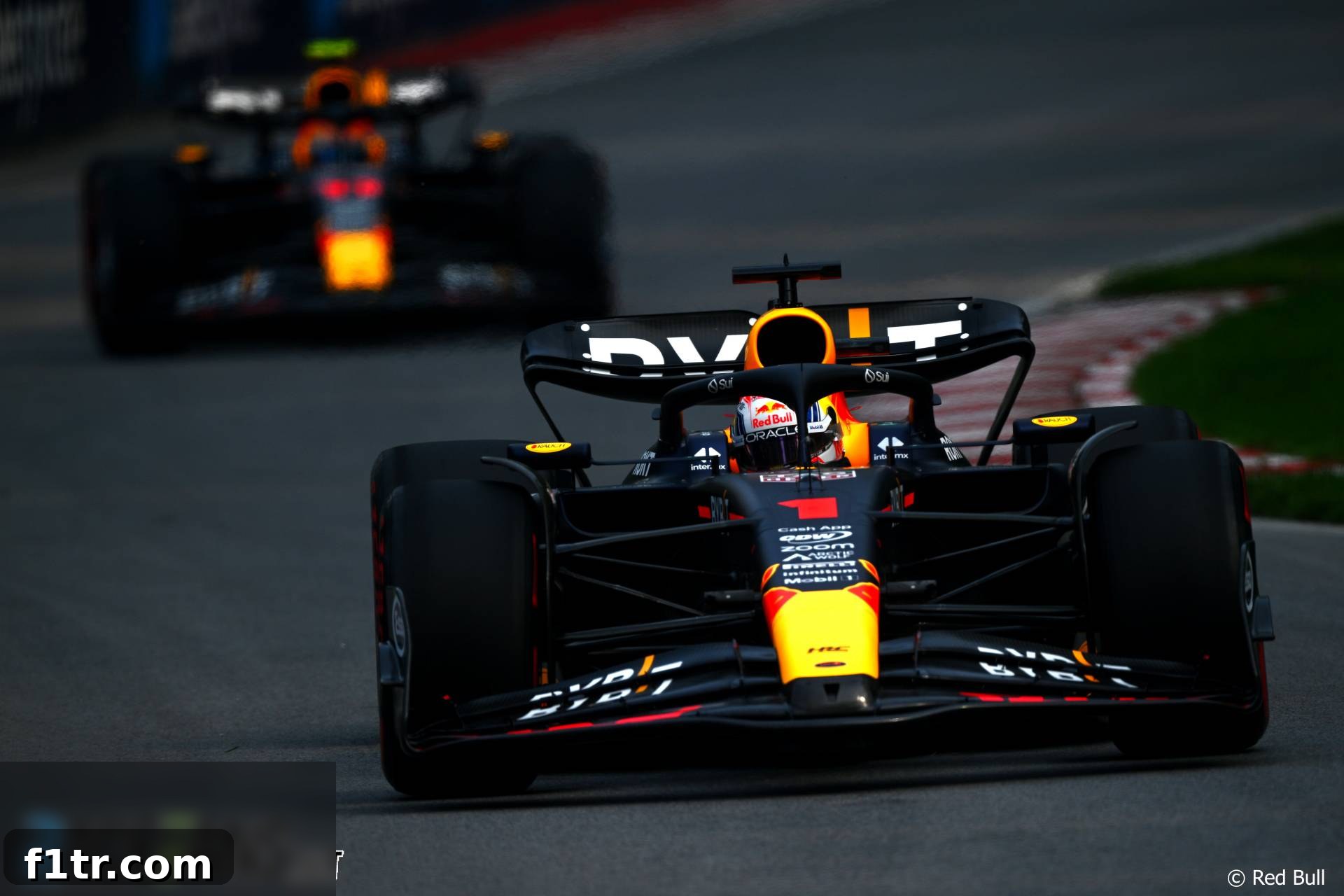
The aura of invincibility surrounding Max Verstappen and his dominant Red Bull Racing machine appeared to waver slightly as the first day of practice for the Canadian Grand Prix concluded. At the iconic Circuit Gilles Villeneuve, a track renowned for its unique blend of high-speed sections and unforgiving kerbs, both Verstappen and his teammate Sergio Perez found themselves uncharacteristically outside the top five on the timing sheets. This unusual start to the weekend has prompted questions about the suitability of Red Bull’s finely-tuned RB19 package for the Montreal circuit, with Verstappen himself admitting that the track’s distinctive characteristics are not playing to their strengths.
The reigning Formula 1 champion, Max Verstappen, finished a somewhat subdued sixth in the crucial second practice session, placing him four-tenths of a second adrift of the session’s pace-setter, seven-time world champion Lewis Hamilton. His teammate, Sergio Perez, trailed further behind in eighth position. A significant talking point for the drivers, including both Mercedes pilots, was the circuit’s notoriously bumpy surface and aggressive kerbs. These features, while adding to the challenge and character of the Circuit Gilles Villeneuve, seem to present a particular hurdle for the Red Bull car, which has otherwise been peerless throughout the 2023 season.
Unraveling Red Bull’s Practice Struggles in Montreal
Verstappen’s candid assessment of the day painted a clear picture of the team’s difficulties. “I think we didn’t have a good day,” he conceded, a rare admission from a driver who has, until now, navigated every challenge with remarkable ease. “We still have a bit of work to do, the car’s not fantastic at the moment.” This statement underscores the scale of the challenge facing Red Bull’s engineering team as they prepare for Saturday’s crucial qualifying session and Sunday’s race. The nature of the RB19, optimized for aerodynamic efficiency and a stable platform, seems to clash with the raw, physical demands of the Montreal track.
The unique characteristics of the Circuit Gilles Villeneuve are well-documented. As a semi-permanent street circuit, it features a mix of tight chicanes, heavy braking zones, and long straights, all encased by unforgiving concrete walls. Crucially, its surface is often described as aged and uneven, leading to significant bumps. Furthermore, drivers are required to aggressively attack the kerbs to maximize lap time, a tactic that can unsettle a stiffly-sprung car. Verstappen elaborated on this mismatch: “We know our limitations with the car, and probably on the track like it is now with the bumps and kerbs, it’s definitely not suiting our package for now. But we’ll try to find a few improvements.” This suggests a fundamental issue with how the car interacts with the track, rather than simple setup tweaks.
Impact of Disruptions: Lost Track Time and Shifting Conditions
The Free Practice 1 session for the Canadian Grand Prix was severely disrupted, offering very little meaningful running for any team. While all teams had to contend with this lost track time, Sergio Perez suggested it might have disproportionately affected Red Bull. The subsequent onset of rain towards the end of Free Practice 2 further complicated matters, reducing the valuable dry running time and limiting opportunities for teams to gather comprehensive data and fine-tune their setups. “It was a shame that we ended up losing FP1, I think we really needed it,” Sergio Perez remarked, highlighting the critical nature of early session data for a team looking to optimize their package for a challenging circuit. “And then FP2, towards the end conditions got a bit worse so it was a shame as well in that regard.”
The rapid changes in track conditions, from damp to drying and then back to wet, meant that consistent data acquisition was almost impossible. For a team like Red Bull, which relies on meticulous preparation and a deep understanding of their car’s behavior, this lack of consistent running could be particularly detrimental. The engineers face an intensive evening dissecting what little data they have, attempting to make significant setup changes without the usual array of information. Despite these hurdles, Perez remains confident in the underlying strength of the team, which has demonstrably won all seven races in the 2023 season. He believes they have a strong “base” from which to work and adjust the car before the final practice session and the all-important qualifying. “But I think we’ve got a good base, and we just have to make sure that we play a bit with the car. It was all in a bit of a hurry so I think there’s plenty for us to understand tonight.”
The Looming Specter of Rain and Its Unpredictable Influence
As the weekend progresses, the weather forecast for Montreal presents an additional layer of complexity and potential drama. Rain is heavily anticipated for Saturday’s qualifying session, a prospect that Max Verstappen believes could be a significant equalizer and a source of unexpected outcomes. “Probably tomorrow it’s going to be very wet,” Verstappen noted, recognizing the inherent unpredictability that wet conditions bring to Formula 1. “So that normally always brings a few surprises in qualifying and then we’ll see what the weather will do on Sunday.”
Wet weather qualifying sessions are often regarded as the ultimate test of driver skill and strategic acumen. With reduced grip, spray affecting visibility, and the ever-present risk of aquaplaning, the usual pecking order can be thoroughly shuffled. A driver who might struggle in dry conditions could find an unexpected advantage in the wet, while a dominant car might find its inherent superiority negated. For Red Bull, whose car has shown supreme performance in all conditions so far this season, a wet qualifying could either provide an opportunity to demonstrate their adaptability or introduce an element of risk that might prevent them from locking out the front row.
However, while Max Verstappen seemed to embrace the potential for a mixed-up grid, Sergio Perez expressed a preference for dry running, particularly after experiencing the extreme downpour at the end of FP2. He highlighted the significant safety concerns associated with heavy rain, where visibility becomes almost non-existent. “This level of rain, it gets really dark and visibility really poor,” Perez explained. “So I think these conditions become undriveable very quickly. If the rain comes, hopefully it’s not as much.” This sentiment reflects the fine line between exciting, challenging wet races and dangerous, undrivable conditions, a balance that race control constantly monitors.
Rivals Closing In: A Glimpse at the Competition
Sergio Perez also acknowledged that Red Bull’s nearest rivals appear to be in strong form heading into the weekend. While not explicitly naming teams, this likely refers to Mercedes, Aston Martin, and Ferrari, all of whom have shown flashes of pace at various points this season. Mercedes, in particular, with Lewis Hamilton topping FP2, seems to have found a setup that copes well with the bumpy nature of the Circuit Gilles Villeneuve. Their car, which has historically been more forgiving over kerbs and bumps, might find a natural advantage here. Similarly, Aston Martin and Ferrari, known for their strong chassis and power unit packages, will be eager to capitalize on any perceived weakness from the dominant Red Bull team, especially if the unpredictable weather plays into their hands.
The Canadian Grand Prix has a rich history of producing unexpected results and thrilling races, and this year’s edition is shaping up to be no different. The combination of a challenging circuit, Red Bull’s unusual struggles, and the ever-present threat of rain sets the stage for a compelling weekend of Formula 1 action. While Red Bull’s dominance in 2023 remains unquestioned, a single challenging weekend like this serves as a crucial test of their adaptability, engineering prowess, and the drivers’ ability to extract performance under pressure. The championship leader, Max Verstappen, faces a real fight to maintain his grip on the top spot, at least for qualifying in Montreal.
As teams work tirelessly through the night, analyzing data and preparing their cars, the focus will be on finding that elusive balance between outright pace and handling the circuit’s unique demands. Saturday’s final practice will be vital for any last-minute adjustments, before the drivers head into what promises to be an enthralling and potentially rain-soaked qualifying session. The outcome of the Canadian Grand Prix could be a significant moment, reminding everyone that even in an era of dominance, Formula 1 remains a sport of constant variables and thrilling unpredictability.
Advert | Become a RaceFans supporter andgo ad-free
2023 Canadian Grand Prix
- Norris ‘even more’ sure Canada penalty was wrong after review request fails
- McLaren seeking more than just downforce gains from major upgrade
- Winning more races won’t necessarily lead to F1 seat – Palou
- Red Bull’s testing restriction will “massively affect” 2024 car development
- Schumacher’s set-up input gives Mercedes a “super advantage” – Wolff
Browse all 2023 Canadian Grand Prix articles