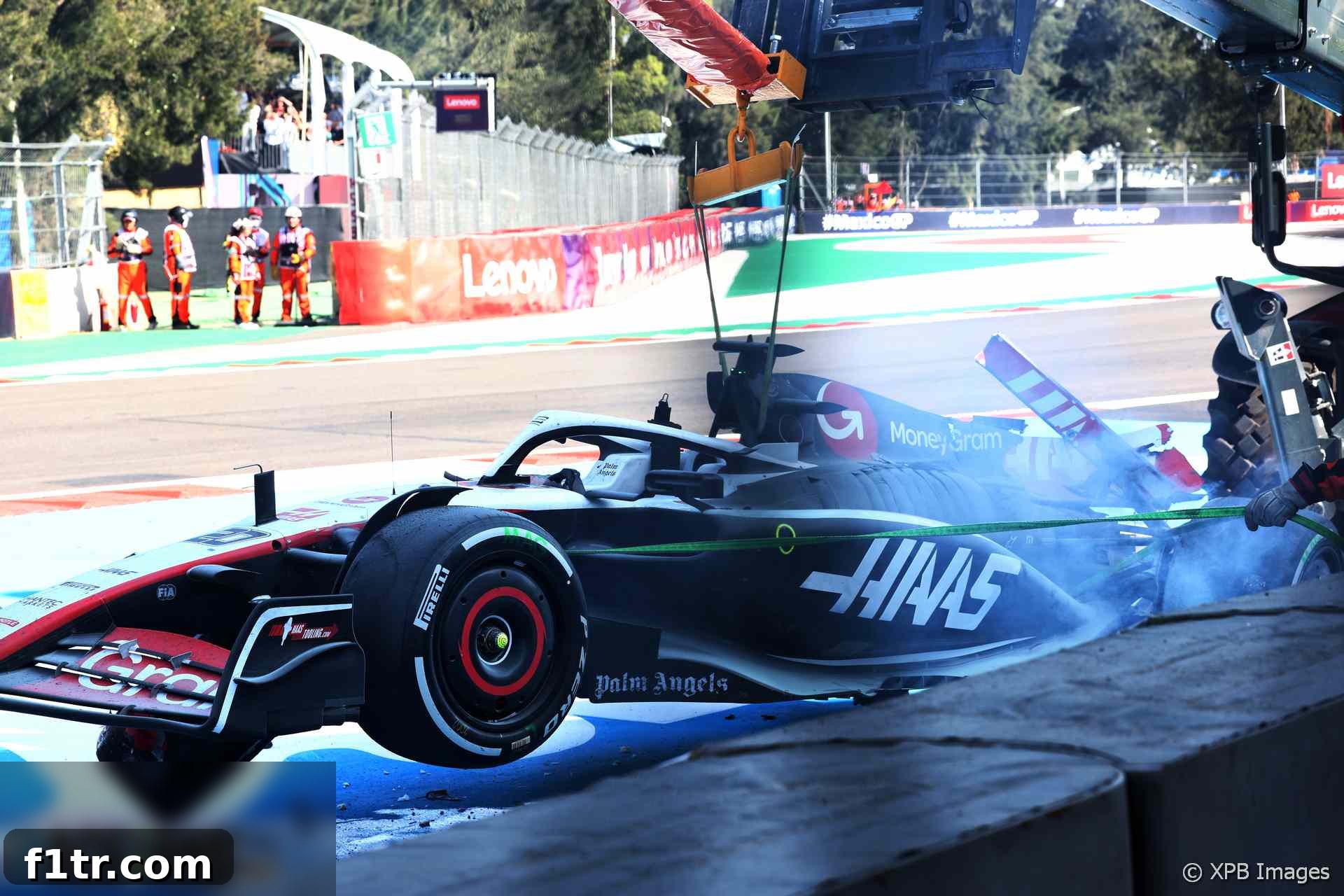
The Dramatic Turn of Events: Kevin Magnussen’s High-Impact Crash Halts the 2023 Mexican Grand Prix
The 2023 Formula 1 Mexican Grand Prix, a race celebrated for its electrifying atmosphere and high-altitude challenges, took a dramatic and unexpected turn shortly before its halfway point. The vibrant spectacle was brought to an abrupt halt following a severe crash involving Haas driver Kevin Magnussen, triggering a red flag that reshaped the entire complexion of the race.
The incident unfolded on lap 35 of the scheduled 71 laps. Magnussen, who had been battling hard in the midfield, lost control of his VF-23 at the notoriously demanding Turn 8 of the Autódromo Hermanos Rodríguez circuit. Initial assessments pointed towards an apparent failure at the left-rear of his car, a critical component failure that instantly compromised his ability to control the vehicle. This loss of control was particularly precarious as it occurred just after Magnussen had run wide at the preceding final corner, suggesting his car might have already been on the edge.
The VF-23 careened off the track, making a violent and unyielding contact with the state-of-the-art TecPro barrier on the outside of Turn 8. The impact was significant, underscoring the immense forces at play in Formula 1 racing. Despite the severity of the crash, a testament to modern F1 safety standards and Magnussen’s training, he was able to extract himself from the damaged cockpit. However, the intensity of the collision rendered his radio communication system inoperable, preventing him from immediately contacting his team and adding to the initial concern surrounding his well-being.
Immediate Response and Crucial Safety Protocols
The incident was immediately registered by fellow competitors and race control. Valtteri Bottas, driving for Alfa Romeo, witnessed Magnussen’s car slam into the barrier directly ahead of him. His swift observation and communication to his race engineer, Alex Chan, highlighted the seriousness of the situation: “A car crashed in front of me, it’s going to be a Safety Car,” he reported, his voice conveying the urgency of the moment.
Safety marshals were on the scene within seconds, their efficiency a crucial element in F1 race management. A brief but concerning fire ignited at the rear of Magnussen’s car, likely due to fuel or hydraulic fluid spillage, but the marshals acted decisively, quickly extinguishing the flames. Fortunately, no other drivers were involved in the crash, preventing a potentially more catastrophic multi-car incident. As per standard procedure, Kevin Magnussen was promptly transported to the circuit’s Medical Centre for comprehensive checks, confirming that he was, thankfully, uninjured despite the monumental impact.
The Safety Car was deployed almost instantaneously following the crash to manage the flow of traffic and allow marshals to assess the scene safely. However, the extent of the damage to the TecPro barrier quickly became apparent. These advanced barriers, designed to absorb massive amounts of energy and protect drivers, require meticulous inspection and often extensive repairs after such heavy impacts. Recognizing the time and resources needed to ensure the track was safe for racing again, the race director made the critical decision to red-flag the session on the 35th lap of the 71-lap Grand Prix.
Drivers Divided: Hamilton’s Call vs. Verstappen’s Frustration
The decision to red-flag the race, while prioritizing safety, inevitably sparked varied reactions among the drivers, each influenced by their position and strategic outlook at the time. Lewis Hamilton, who was running a strong third and eyeing a podium finish, communicated his thoughts to his Mercedes team just before the stoppage: “They should red flag this,” he stated, likely observing the debris and the severity of the barrier damage, his call reflecting a cautious approach centered on safety and potentially a strategic advantage for a fresh tire change.
In stark contrast, race leader Max Verstappen of Red Bull Racing, who had been dominating the proceedings, was visibly unimpressed and vocally critical of the red flag decision. Upon hearing the news, his immediate reaction was a dismissive “that’s a joke,” followed by a clear expression of bewilderment: “Red flag for what? I saw the car was a bit on fire, but it’s already all cleared.” Verstappen’s frustration stemmed from the interruption of his momentum, the potential for other teams to capitalize on a ‘free’ pit stop, and his perception that the track clear-up could have been handled under a Safety Car. For a driver in a commanding lead, a red flag can be a significant tactical disruptor, negating hard-won advantages.
The Mechanics of a Red Flag and F1 Safety Evolution
A red flag in Formula 1 is the most severe form of race stoppage, implemented when conditions are deemed too dangerous to continue, typically due to major accidents, extensive debris, or severe weather. The FIA’s protocols are stringent, prioritizing driver and marshal safety above all else. In this instance, the significant damage to the TecPro barrier was the primary catalyst. These specialized barriers, comprised of polyethylene blocks, are crucial for absorbing impact energy more effectively than traditional tire walls or concrete, drastically reducing deceleration forces on the driver. Repairing or replacing sections of such a critical safety installation is a complex and time-consuming task, justifying the red flag to allow marshals and track staff sufficient time to work without the threat of approaching race cars.
This incident served as a stark reminder of the continuous evolution of F1 safety. From the introduction of the HANS device and stronger survival cells to the meticulous design of circuits like the Autódromo Hermanos Rodríguez with expansive run-off areas and cutting-edge barriers, every element is geared towards mitigating risk. Magnussen’s ability to walk away from such a high-speed, high-impact crash is a testament to decades of relentless innovation in safety technology and regulations within the sport, reinforcing the notion that while racing remains inherently dangerous, every measure is taken to protect its gladiators.
The Race Paused: Anticipation and Restart Dynamics
During the red flag period, the atmosphere at the Autódromo Hermanos Rodríguez, typically buzzing with engines, shifted to one of tense anticipation. Teams frantically recalibrated strategies, analyzing tire choices and potential car adjustments for the restart. Drivers, having parked their cars in the pit lane, took a moment to reset mentally, some discussing the incident, others focused on the challenge ahead. The extensive repair work on the barrier was diligently carried out by track personnel, a silent but critical operation ensuring the integrity of the racing surface and safety infrastructure. The race director later announced that the race would restart at 3:13 pm local time, offering a clear timeline for teams and fans alike, and setting the stage for a thrilling second half of the Grand Prix.
Visual Retrospective: Kevin Magnussen’s Mexican GP Crash
Beyond the Incident: Impact on the 2023 Mexican Grand Prix and Magnussen’s Season
The red flag significantly impacted the remainder of the 2023 Mexican Grand Prix. With a standing start restart, the dynamics of the race were reset, providing opportunities for some drivers and challenges for others. Teams that had been struggling with tire wear could now take on fresh rubber without losing track position under green flag conditions, altering strategic calculations entirely. While the full outcome of the race extended beyond this single incident, the red flag became a defining moment, a pivot point that would be discussed for its strategic ramifications long after the checkered flag waved.
For Kevin Magnussen and the Haas team, the crash marked another challenging moment in what had been a difficult 2023 season. Despite his reputation for fierce racing and undeniable talent, Magnussen, like his team, had often found themselves battling in the lower midfield. This incident, while demonstrating the brutal realities of mechanical failures in F1, also highlighted Magnussen’s resilience and the robust safety measures that allowed him to walk away from such a significant impact without injury, ready to fight another day.
Conclusion: A Testament to Resilience and Unwavering Safety in F1
Kevin Magnussen’s dramatic crash at the 2023 Mexican Grand Prix served as a powerful reminder of both the inherent dangers and the extraordinary safety advancements in Formula 1. It showcased the rapid response of marshals and race control, the effectiveness of modern safety barriers, and the paramount importance of driver protection. While igniting varied reactions from the grid’s top drivers, the red flag decision ultimately upheld the sport’s unwavering commitment to safety. This incident, a defining moment of the Mexican Grand Prix, underscored the resilience required to compete at the pinnacle of motorsport and the constant evolution that keeps Formula 1 at the forefront of automotive safety innovation.
Explore More from the 2023 Mexican Grand Prix
Delve deeper into the thrills and spills of the season with our extensive coverage:
- ‘I’m so s*** in qualifying’: Norris berates himself despite pole-winning lap
- Ferrari reaping the benefits of having F1’s most closely-matched team mates
- Norris had “no chance” to beat Verstappen in Mexico even without Q1 exit
- Transcript: How Ricciardo’s race went awry soon after he was told to “bring it home”
- Mercedes see “very encouraging signs” from Austin floor update
Browse all 2023 Mexican Grand Prix articles