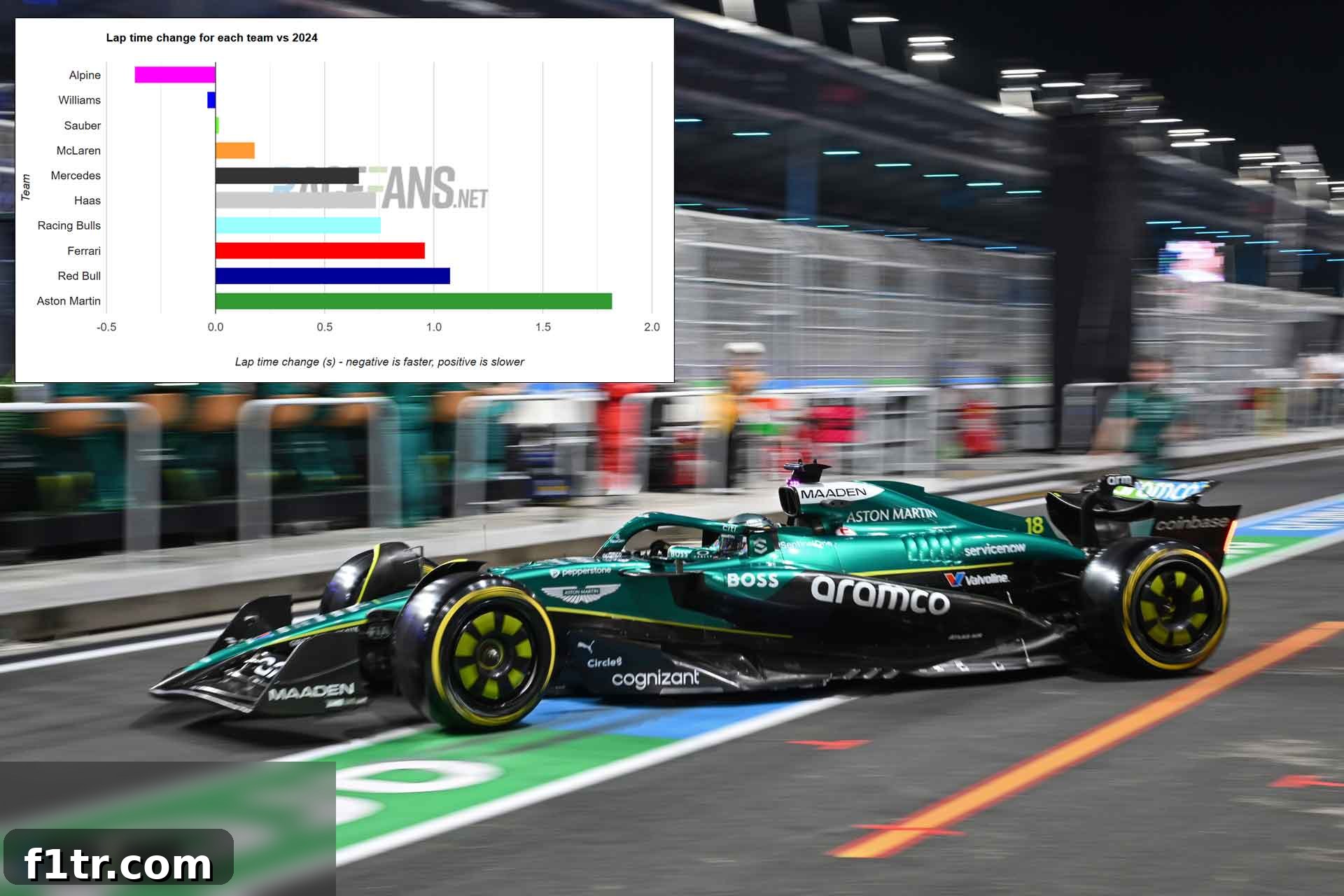
The Jeddah Corniche Circuit, a jewel in the crown of Formula 1’s modern calendar, once again played host to an exhilarating start to a Grand Prix weekend. Following the initial two practice sessions, the atmosphere was already buzzing with intrigue and anticipation. Remarkably, a select few teams demonstrated a breathtaking pace, managing to lap quicker than their best times from the entire race weekend here last year. This early show of speed underscores the relentless development in Formula 1 and sets a thrilling precedent for what promises to be a fiercely competitive Saudi Arabian Grand Prix.
However, not all teams enjoyed such a promising beginning. At the opposite end of the performance spectrum, Aston Martin endured a particularly challenging start to their practice program. Their deficit compared to their expected 2024 pace was significantly larger than any other team, raising immediate concerns within the Silverstone-based outfit. This stark contrast in fortunes highlights the unpredictable nature of early-season performance and the constant battle for supremacy in the world of F1.
Understanding Teams’ 2024 Performance in Context
Evaluating a team’s current performance requires a careful look at historical data and the specific conditions of the Jeddah circuit. When we contextualize the 2024 season’s early performance against previous years, especially the 2023 Saudi Arabian Grand Prix, a clearer picture begins to emerge. Last year, this race was only the second round of the season, and Red Bull had already established a commanding lead, showcasing a dominant package that would define their championship campaign. Their rivals, while striving to close the gap, found themselves constantly playing catch-up.
In 2023, Aston Martin was undeniably the third-fastest team, enjoying a renaissance thanks to a significantly improved car. Fernando Alonso, a driver renowned for extracting every ounce of performance from his machinery, delivered one of their standout results of the season here, securing a coveted spot on the second row of the grid in qualifying and converting that into a strong fifth-place finish in the race. This strong baseline from 2023 makes their current struggles in practice all the more perplexing and concerning for the team and their fans.
Analyzing Teams’ Progress Year-on-Year
A hypothetical “Teams’ Progress vs. 2024” chart would typically illustrate the delta in lap times compared to the previous year, adjusted for various factors. On paper, every team should naturally expect to improve their lap times compared to the previous season. This improvement isn’t solely attributable to the 12 months of intensive development work on their sophisticated cars, which brings aerodynamic refinements, engine upgrades, and chassis optimizations. Another critical factor contributing to faster lap times this year is Pirelli’s tire allocation; they have brought compounds that are one stage softer than those used in the 2023 Grand Prix. Softer compounds generally offer more grip and faster single-lap performance, albeit often at the cost of durability.
However, the softer Pirelli tires proved to be a double-edged sword during Friday practice. Drivers reported difficulties in extracting their absolute maximum performance over a single flying lap, suggesting a narrow operating window or specific setup challenges. Adding to Aston Martin’s woes, Fernando Alonso encountered significant traffic during his crucial qualifying simulation runs. Navigating slower cars on a high-speed street circuit like Jeddah can severely compromise a lap time, and this factor undoubtedly contributed to Aston Martin’s seemingly uncharacteristic struggles on Friday. It provides some explanation for their larger-than-expected deficit, but the underlying pace of the car still needs to be unlocked.
In a surprising turn of events, Alpine, a team that has faced its own share of challenges recently, showed the most encouraging year-on-year improvement by the end of Friday. Pierre Gasly notably topped the first practice session, a significant confidence boost for the French outfit. While this improvement is impressive, it’s crucial to remember their starting point: Alpine was the slowest team at this very race last year, by over three tenths of a second. Therefore, while their progress is commendable, they are still working from a lower performance baseline, and the true extent of their competitiveness will only become clear in qualifying and the race.
Go ad-free for just £1 per month>> Find out more and sign up
2024 and 2025 Times: A Glimpse into the Future
A hypothetical “Teams’ 2024 and 2025 times” chart would typically allow for direct comparison of current performance against projections or even simulated future data, providing valuable insights into a team’s development trajectory. However, focusing on the immediate present, Red Bull’s typical Friday modus operandi involves running further off their true potential pace compared to their rivals. This tactical approach often sees them collecting data, refining long-run setups, and not showing their full hand until qualifying. Despite this, their performance in practice at Jeddah indicated a strong underlying pace. Yuki Tsunoda, in particular, demonstrated impressive speed, clocking a single-lap time significantly closer to Max Verstappen’s benchmark than he managed in the Bahrain Grand Prix. Furthermore, Verstappen set his quickest lap time earlier in Friday practice than several of his key rivals, suggesting confidence in their setup and a less frantic approach to extracting pace. Having ended Saturday’s sessions (if we consider the provided text’s slight temporal jump) as the second-fastest team, Red Bull appears to be in far better shape than they were just last week in Bahrain, indicating they’ve quickly adapted to the unique demands of the Jeddah Corniche Circuit.
First and Second Practice Sessions: Detailed Analysis
Advert | Become a RaceFans supporter andgo ad-free
The practice sessions are crucial for teams to fine-tune their cars, assess tire degradation, and allow drivers to familiarize themselves with the challenging circuit. Let’s delve into the detailed times from the first two practice sessions, which offer a snapshot of the pecking order and individual performances:
| P. | # | Driver | Team | FP1 time | FP2 time | Gap | Laps |
|---|---|---|---|---|---|---|---|
| 1 | 4 | Lando Norris | McLaren-Mercedes | 1’29.246 | 1’28.267 | 46 | |
| 2 | 81 | Oscar Piastri | McLaren-Mercedes | 1’29.341 | 1’28.430 | 0.163 | 47 |
| 3 | 1 | Max Verstappen | Red Bull-Honda RBPT | 1’29.818 | 1’28.547 | 0.280 | 49 |
| 4 | 16 | Charles Leclerc | Ferrari | 1’29.309 | 1’28.749 | 0.482 | 50 |
| 5 | 55 | Carlos Sainz Jnr | Williams-Mercedes | 1’29.779 | 1’28.942 | 0.675 | 50 |
| 6 | 22 | Yuki Tsunoda | Red Bull-Honda RBPT | 1’29.821 | 1’28.963 | 0.696 | 45 |
| 7 | 63 | George Russell | Mercedes | 1’29.618 | 1’28.973 | 0.706 | 42 |
| 8 | 10 | Pierre Gasly | Alpine-Renault | 1’29.239 | 1’29.106 | 0.839 | 47 |
| 9 | 27 | Nico Hulkenberg | Sauber-Ferrari | 1’29.916 | 1’29.193 | 0.926 | 46 |
| 10 | 23 | Alexander Albon | Williams-Mercedes | 1’29.606 | 1’29.220 | 0.953 | 46 |
| 11 | 12 | Andrea Kimi Antonelli | Mercedes | 1’29.934 | 1’29.242 | 0.975 | 40 |
| 12 | 6 | Isack Hadjar | Racing Bulls-Honda RBPT | 1’30.011 | 1’29.306 | 1.039 | 32 |
| 13 | 44 | Lewis Hamilton | Ferrari | 1’29.815 | 1’29.371 | 1.104 | 50 |
| 14 | 30 | Liam Lawson | Racing Bulls-Honda RBPT | 1’29.907 | 1’29.488 | 1.221 | 41 |
| 15 | 14 | Fernando Alonso | Aston Martin-Mercedes | 1’29.976 | 1’29.662 | 1.395 | 42 |
| 16 | 87 | Oliver Bearman | Haas-Ferrari | 1’30.595 | 1’29.754 | 1.487 | 40 |
| 17 | 7 | Jack Doohan | Alpine-Renault | 1’30.183 | 1’29.912 | 1.645 | 46 |
| 18 | 18 | Lance Stroll | Aston Martin-Mercedes | 1’30.583 | 1’30.007 | 1.740 | 41 |
| 19 | 31 | Esteban Ocon | Haas-Ferrari | 1’31.029 | 1’30.019 | 1.752 | 43 |
| 20 | 5 | Gabriel Bortoleto | Sauber-Ferrari | 1’31.038 | 2.771 | 23 |
The practice times reveal a fascinating narrative. McLaren clearly set the pace, with Lando Norris topping FP2 with an impressive 1’28.267, closely followed by his teammate Oscar Piastri. This McLaren 1-2 is a strong statement of intent and suggests they have found a sweet spot with their MCL38 on the high-speed Jeddah circuit. Max Verstappen, despite Red Bull’s typical conservative Friday approach, was only a mere 0.280 seconds off Norris’s pace, indicating that the reigning champions are very much in contention and likely have more pace in hand.
Charles Leclerc of Ferrari, consistently a strong performer, secured fourth place, underscoring Ferrari’s potential. An interesting observation from the table is the pace of Carlos Sainz Jnr (listed here with Williams-Mercedes, but known to be with Ferrari for 2024), who managed to slot into fifth, demonstrating competitive speed and adaptability. Yuki Tsunoda’s P6, very close to Verstappen’s time, is another highlight, showcasing a significant improvement for the young Japanese driver and for the Racing Bulls team.
Mercedes, with George Russell in P7, appears to be in the mix, but perhaps not yet challenging for the very top spots. The gap of over seven tenths to Norris suggests they still need to unlock more single-lap performance. Pierre Gasly’s P8 for Alpine further consolidates their improved showing, especially after topping FP1. Nico Hulkenberg of Sauber also put in a commendable performance, rounding out the top nine.
Further down the order, Alexander Albon (Williams-Mercedes) and Andrea Kimi Antonelli (listed with Mercedes, potentially a test driver for the future) showed promising pace to be just outside the top ten. Lewis Hamilton (listed with Ferrari in this data, though confirmed with Mercedes for 2024), appears to be further back than expected, suggesting perhaps he focused more on long-run simulations or faced specific setup challenges. The Aston Martin drivers, Fernando Alonso and Lance Stroll, found themselves in P15 and P18 respectively, confirming their initial struggles and the significant challenge they face to improve their car overnight. Haas drivers, Oliver Bearman (listed here) and Esteban Ocon (listed here for Haas) were at the tail end, along with Gabriel Bortoleto (listed with Sauber), indicating a tough battle for points for these teams.
The “Gap” column vividly illustrates the tight competition. While McLaren leads, the top few teams are separated by fine margins. The consistent improvement from FP1 to FP2 across most drivers, as expected with rubber laid down and track evolution, also shows that teams were effectively learning and optimizing their setups. The number of laps completed by each driver also provides insight into their session focus, with many drivers clocking over 40 laps, indicating a balance between performance runs and data collection for race strategy.
Looking Ahead: Prospects for Qualifying and the Race
Advert | Become a RaceFans supporter andgo ad-free
With Friday’s practice sessions now concluded, the focus shifts squarely to qualifying. McLaren’s dominant performance in FP2 positions them as strong contenders for pole position, with both Norris and Piastri demonstrating exceptional speed. Red Bull, with Max Verstappen’s raw talent and the team’s ability to consistently find pace, will undoubtedly be a force to be reckoned with. Ferrari also shows promising signs, and it would be unwise to count them out from the front row battle. For Aston Martin, the night will be a frantic scramble to analyze data, make crucial setup changes, and find the elusive pace they need to climb up the grid. Their ability to recover will be a major storyline heading into Saturday.
The tight gaps throughout the midfield suggest that qualifying will be incredibly close, with fractions of a second potentially making the difference between advancing to Q3 and an early exit. The softer tire compounds will continue to challenge teams to manage tire performance over a single lap, adding another layer of complexity to the qualifying strategy. The high-speed nature of Jeddah also means that any small error can be severely punished, making precision and confidence paramount for all drivers. As the weekend progresses, the strategic implications of tire wear and potential safety car periods will become critical factors in determining the outcome of the Saudi Arabian Grand Prix.
Miss nothing from RaceFans
Get a daily email with all our latest stories – and nothing else. No marketing, no ads. Sign up here:
2025 Saudi Arabian Grand Prix
- Red Bull made tactical decision not to avoid a penalty in Jeddah, Horner confirms
- Norris’s starts were far poorer than Verstappen’s last year but the balance is shifting
- McLaren’s rivals “just one upgrade away from being the lead car” – Brown
- Russell told race control what he thought of Verstappen’s first lap corner cut
- Doohan’s final corner pass on Bortoleto was F1’s closest fight for last place in seven years
Browse all 2025 Saudi Arabian Grand Prix articles