In the high-octane world of Formula 1, where every millisecond counts, even the most dominant teams relentlessly pursue perfection. This unwavering commitment to excellence was recently highlighted by three-time world champion Max Verstappen, who publicly praised Red Bull’s control engineer Michael Manning for significant improvements in the team’s standing start performance. Following a commanding victory in a recent sprint race, Verstappen’s radio message underscored the critical role that specialized engineering plays in maintaining a competitive edge, even for a team that has largely dominated the 2023 season.
The Critical Art of the F1 Standing Start
Standing starts in Formula 1 are a ballet of precision and power, demanding perfect synergy between driver, machine, and engineering. From the moment the five red lights extinguish, drivers must manage a colossal amount of torque through a delicate clutch mechanism, all while anticipating the reactions of 19 other cars. Factors such as track temperature, tire compound, and even the slightest gradient of the starting grid can dramatically influence the getaway. For Red Bull, despite their overwhelming success throughout the 2023 campaign, inconsistencies in their standing starts had emerged as one of the few discernible areas for improvement. This seemingly minor aspect can dictate the entire trajectory of a race, potentially costing crucial track position and forcing a more challenging strategic recovery.
Addressing a Rare Weakness in a Dominant Season
Red Bull’s 2023 season has been characterized by unprecedented dominance, with Max Verstappen setting new records and securing the Drivers’ Championship with races to spare. Yet, no team is without its challenges, and for Red Bull, the standing start proved to be a peculiar area of variability. For instance, in the sprint race at Losail just two weeks prior, Verstappen notably lost two places off the line. While this was partly attributed to rivals starting on softer, more advantageous tire compounds, it nonetheless highlighted a potential vulnerability. Earlier in the season, at Silverstone, Lando Norris famously surged past Verstappen from pole position, demonstrating how even a slight stumble at the start can open the door for competitors. These instances served as stark reminders that in Formula 1, the margin for error is razor-thin, and continuous refinement is paramount, regardless of one’s position at the top.
Michael Manning: The Unsung Hero of Red Bull’s Starts
The man at the heart of Red Bull’s start performance optimization is Michael Manning, the team’s Senior Trackside Control Engineer. Manning, who joined the formidable Red Bull Racing outfit in 2011, plays a pivotal role in fine-tuning the intricate systems that govern the car’s launch control. His work involves countless hours of data analysis, simulation, and on-track testing, translating complex engineering principles into actionable improvements. He collaborates closely with drivers, engineers, and strategists to understand the nuances of each circuit and condition, developing bespoke solutions to ensure the best possible getaway. In a sport where technological sophistication reigns supreme, the dedicated efforts of specialized engineers like Manning are absolutely indispensable. Their behind-the-scenes contributions often go unnoticed by the broader public, yet they are fundamental to a team’s success, transforming raw data into tangible performance gains.
Austin’s Sprint Race: A Testament to Improved Starts
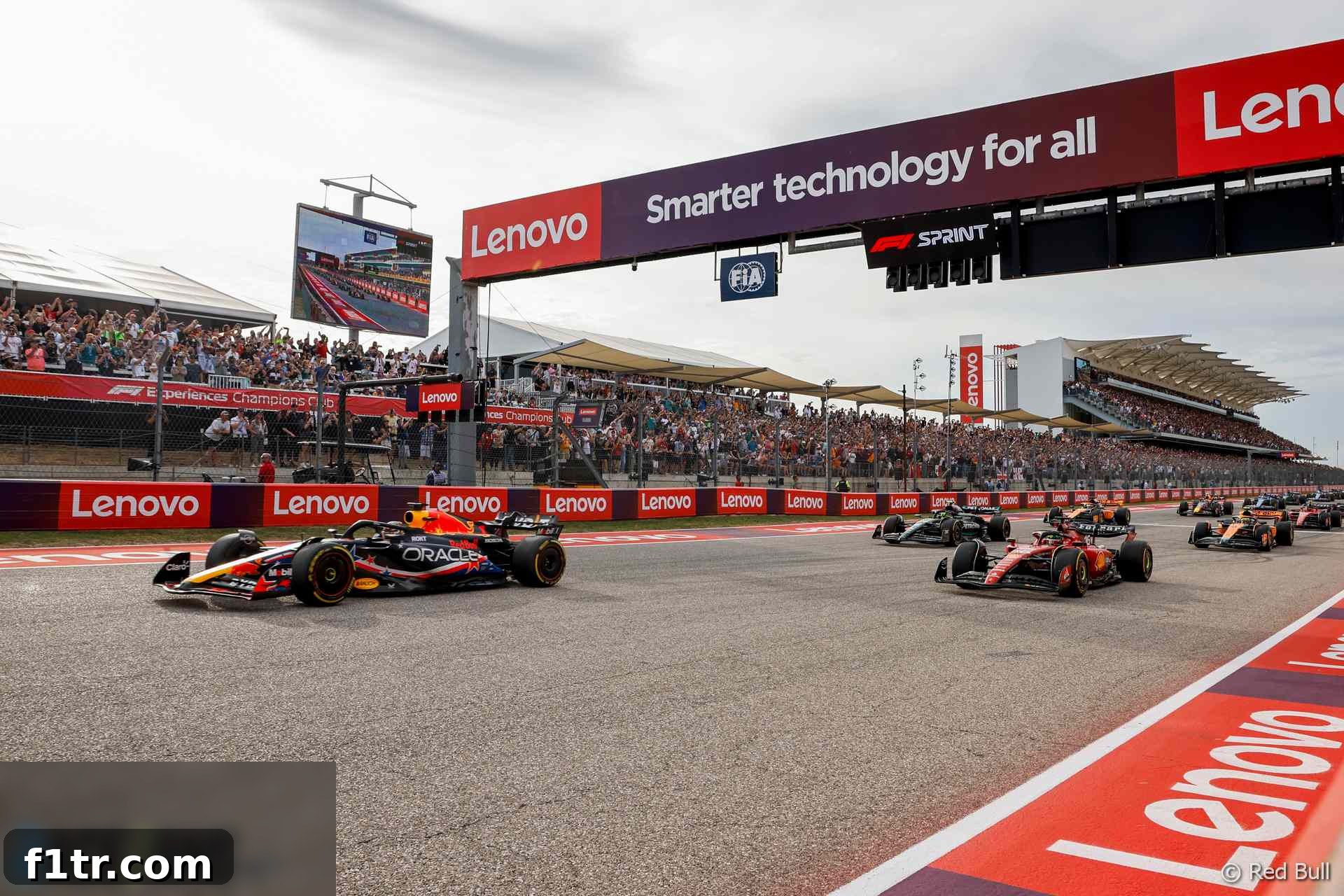
The recent sprint race in Austin provided a clear demonstration of the progress made in Red Bull’s start performance. Starting from pole position, Max Verstappen executed a flawless getaway, immediately sweeping across the track to the left. This decisive maneuver effectively neutralised any potential threat from Charles Leclerc, who was poised to attack from the inside. Verstappen’s proactive defensive action, made possible by a strong initial launch, not only preserved his lead but also showcased the efficacy of the team’s recent efforts. This perfectly executed start laid the foundation for his eventual victory, reinforcing the notion that even a fraction of a second gained at the start can profoundly impact the outcome of a race, particularly in the condensed format of a sprint.
Verstappen’s Public Praise and Team Dynamics
Following his impressive sprint race triumph in Austin, Max Verstappen took to the team radio, offering a rare and specific commendation: “Well done Manning, great job there.” This direct praise for his “start guy” was not just a passing comment but a meaningful acknowledgment of the intensive work that had gone into improving this particular area. Verstappen later elaborated on his remarks, humorously stating that “the poor guy has had a few tough races, so I was just joking like that it wasn’t too bad this time.” This light-hearted remark, while delivered with typical Verstappen candour, subtly hints at the immense pressure faced by engineers in Formula 1, where every performance metric is scrutinized. It also highlights the close, often familial, bonds that form within a championship-winning team, where drivers and engineers operate as a single, interdependent unit.
Red Bull team principal Christian Horner echoed Verstappen’s sentiments, acknowledging the team’s ongoing efforts to address inconsistencies in their start performance throughout the season. Horner described the radio exchange as “a bit of banter that Max is giving to one of his performance engineers that focuses on start control,” further underscoring the strong personal relationships within the team. He added, “It’s light-hearted banter that shows the tight relationship that there is within the team.” However, Horner also humorously pointed out the unique challenge of such public acknowledgments in F1: “The only problem is there’s about two billion people listening to it.” This quip perfectly encapsulates the public nature of Formula 1, where every word, every gesture, and every performance detail is amplified across a global audience, making public praise like Verstappen’s even more significant for team morale and individual recognition.
The Pursuit of Perfection: Continuous Improvement in F1
Verstappen’s commendation of Michael Manning’s work is more than just a passing remark; it’s a window into the relentless pursuit of perfection that defines Formula 1. Even when a team is as dominant as Red Bull was in 2023, the drive to find marginal gains never ceases. Every component, every process, and every strategic decision is continually evaluated and refined. This culture of continuous improvement is what sets F1 apart and ensures that even the smallest perceived weakness is transformed into a strength. The collaboration between drivers, engineers, and strategists is a testament to the complex, data-driven environment of modern motorsport, where human ingenuity and cutting-edge technology converge to push the boundaries of performance. Manning’s success in refining Red Bull’s starts is a prime example of how crucial specialized expertise is in the quest for ultimate speed and reliability, reinforcing the idea that even in seemingly dominant periods, there is always room for growth and optimization.
Verstappen’s Radio After Sprint Race Win
| Speaker | Message |
|---|---|
| Gianpiero Lambiase | Well done, Max. |
| Max Verstappen | Simply, simply lovely that. |
| Christian Horner | Yeah that was a very strong Saturday, Max, well done mate. |
| Verstappen | Yeah pace was good. |
| Lambiase | It’ll be a bit more fun tomorrow, mate. |
| Verstappen | Oh and well done Manning, great job there. |
| Lambiase | Okay so easy on the way in please, Max. Pick up where you can. That was a well-driven race the in the first few laps, mate. Tactically done. Nice job. Worked well I think, that. |
| Verstappen | Yeah, the DRS was quite strong at the beginning but it was okay. |
2023 United States Grand Prix Related Articles
- US GP was Mercedes’ best race of 2023 despite disqualification – Wolff
- Singapore and Austin retirements cost me top 10 championship place – Ocon
- United States Grand Prix result unchanged as FIA rejects Haas’ call for review
- Sargeant admits he’s ‘struggled to use all the downforce at times’ in F1
- Mercedes’ Brazilian GP set-up was “conservative” after US GP disqualification
Browse all 2023 United States Grand Prix articles