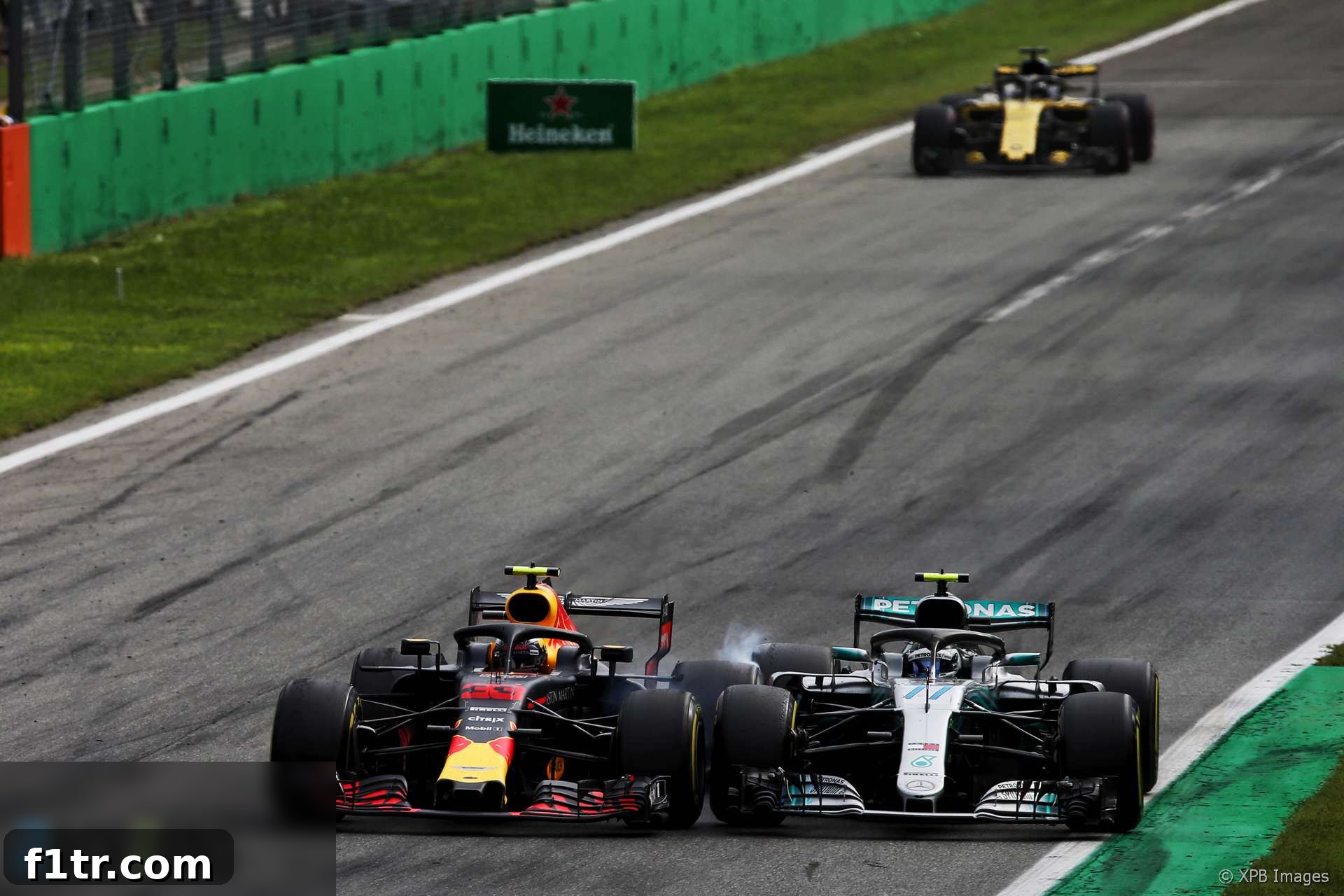
Max Verstappen and Romain Grosjean have notably accumulated more penalty points than any other Formula 1 driver since the system’s introduction. This mechanism, designed to monitor and regulate driver conduct on track, has become a significant element of F1 regulations, prompting debate and discussion among competitors and officials alike. Its implementation aimed to foster safer racing and more disciplined driving, particularly after a series of high-profile incidents.
Advert | Become a Supporter & go ad-free
The penalty points system has been an integral part of Formula 1 for the past five seasons, establishing a clearer framework for assessing driver infractions. During this period, a total of 13 drivers have accrued 10 or more penalty points, highlighting the frequency of on-track incidents and the strictness with which regulations are enforced. Among these drivers is Pastor Maldonado, whose name still surfaces in discussions about penalty points despite him not having started an F1 race since the 2015 season. This illustrates how persistent a driver’s record can be within the system, carrying over even after their active participation ceases to be a factor.
Understanding the F1 Penalty Points System
The core objective of the Formula 1 penalty points system is to deter repeat offenders and ensure a consistent standard of driving conduct across the grid. Drivers accumulate points for various infringements, ranging from causing collisions and unsafe driving to ignoring flag signals or exceeding track limits. The severity of the infraction dictates the number of points assigned, typically ranging from one to three points per incident. These points remain on a driver’s super license for a rolling 12-month period. A critical threshold exists: if a driver reaches 12 penalty points within this 12-month window, they face an automatic one-race ban. This significant consequence underscores the seriousness with which the FIA (Fédération Internationale de l’Automobile) approaches driver discipline.
Despite the system being in place for half a decade, no driver has yet reached the critical 12-point threshold within a 12-month period, which would trigger an automatic race suspension. This suggests that while penalties are frequently handed out, drivers generally manage to stay below the maximum accumulation limit, or points expire before reaching the ban trigger. Max Verstappen and Romain Grosjean both concluded a recent season with seven active penalty points on their licenses. However, their cumulative career totals stand at a remarkable 19 points each. This stark difference between active and career points illustrates the system’s rolling nature; points gradually expire, preventing a permanent accumulation but ensuring that habitual offenders remain under scrutiny.
Driver Criticism and the Quest for Fair Play
Both Max Verstappen and Romain Grosjean have been vocal critics of F1’s penalty points system, expressing concerns about its proportionality and perceived fairness. Their criticisms often stem from the feeling that minor infractions, which might warrant a time penalty or a reprimand, can disproportionately lead to penalty points that carry long-term implications. As Verstappen famously stated in Austin, “I hate these stupid penalty points.” He further elaborated, “Maybe you deserve a penalty, but it’s not that bad that you deserve a penalty point. For me that’s a bit out of proportion.” This sentiment highlights a common frustration among drivers who believe that the system sometimes lacks nuance, treating different types of infringements with similar point allocations irrespective of their actual impact on the race or safety.
Romain Grosjean, who has had his own share of encounters with the stewards, also expressed reservations about the system. He has openly admitted that while some of his penalty points were deserved, many of the incidents for which he received penalty points should not have been penalised. Grosjean’s perspective is particularly poignant given that the penalty points system was notably introduced in the wake of his own one-race ban for triggering a multi-car collision at the start of the 2012 Belgian Grand Prix. This background has given him a unique insight into the necessity of such a system, while also making him acutely aware of its potential drawbacks and the subjective nature of stewarding decisions.
The debate around penalty points often revolves around the fine line between aggressive, hard racing and genuinely dangerous or unsporting conduct. Drivers operating at the very limit of performance naturally push boundaries, and distinguishing between an honest racing incident and a negligent infraction can be challenging for stewards. The pressure to avoid accumulating points can also subtly influence racing decisions, potentially leading to less daring overtakes or more cautious defensive moves, which some argue might diminish the spectacle of F1 racing.
FIA’s Stance: Clarity and Consistency
In response to driver criticisms and public debate, FIA race director Charlie Whiting (who sadly passed away in 2019) offered a clear explanation of the system’s intent. He clarified that penalty points are “there to make a habitual offender take notice.” This emphasizes that the points are not immediate penalties in themselves, but rather a tracking mechanism designed to identify and caution drivers who repeatedly transgress the rules. Whiting meticulously pointed out, “Penalty points are not a penalty. They are just there to track a driver’s record.” This distinction is crucial for understanding the system’s philosophy.
Whiting further elaborated on the separation between immediate race penalties and the accumulation of penalty points. He stated, “They’re completely separate. When you have a penalty you always get a penalty point. Except for a reprimand, you don’t get penalty points for reprimands. I know some people are a bit confused [but] applying points is not a penalty as such.” This clarification aimed to dispel common misconceptions. A driver might receive a time penalty, a grid drop, or even disqualification for an incident, and in most cases, this will also result in penalty points. However, a reprimand, which is a formal warning for a minor infringement, does not contribute to the penalty point tally. This hierarchy of consequences seeks to apply appropriate sanctions while maintaining a record for consistent offenders.
The FIA’s rationale is rooted in enhancing safety and maintaining the integrity of the sport. By identifying and monitoring drivers who consistently fall foul of the regulations, the system acts as a preventative measure. The threat of an eventual race ban serves as a strong deterrent, encouraging drivers to reflect on their conduct and adjust their approach to racing. This proactive element is vital in a high-speed, high-stakes environment like Formula 1, where driver error can have severe consequences for all competitors.
Statistical Insights and Driver Records
Since their introduction, F1 stewards have issued a considerable total of 287 penalty points across the various Grand Prix weekends. This translates to an average of approximately 2.87 penalty points distributed per race weekend. These statistics provide a clear picture of the frequent interactions between drivers and race stewards, underscoring the dynamic and often contentious nature of F1 competition. The consistent application of points, while sometimes debated, reflects the FIA’s commitment to upholding its regulatory framework.
While many drivers have accumulated points over the seasons, it is also noteworthy to highlight those who have maintained impeccable records. For instance, two prominent drivers concluded a recent season with completely clean licenses: Lewis Hamilton and Charles Leclerc. Hamilton, a multi-time world champion, is renowned for his precise and often incident-free racing, a testament to his experience and judgment. Leclerc, a younger talent, has also demonstrated remarkable discipline and control early in his career. Their ability to navigate competitive races without accumulating penalty points speaks volumes about their driving style, their awareness of the rules, and perhaps their strategy to avoid contentious situations.
The distribution of penalty points often correlates with driver aggression, risk-taking, or even inexperience. Younger drivers, still learning the nuances of F1 racing and the stringent regulations, might be more prone to collecting points. Conversely, veteran drivers might develop a better sense of how to push the limits without crossing the line, though even they are not immune, as illustrated by Verstappen and Grosjean’s totals. The system, therefore, provides an interesting lens through which to analyze driver performance not just in terms of speed, but also in terms of their adherence to sporting conduct.
Advert | Become a RaceFans supporter andgo ad-free
The Impact and Future of F1 Penalty Points
The Formula 1 penalty points system undeniably adds another layer of complexity to the already intense world of motorsport. Its potential to lead to a race ban means that points accumulation is not just a statistic but a genuine threat that can influence championship dynamics. Imagine a scenario where a championship contender is forced to miss a crucial race due to accumulated points – the impact on their title hopes and the overall excitement of the season could be immense. This ‘sword of Damocles’ hanging over drivers ensures they remain acutely aware of their conduct at all times, adding a strategic dimension to their racing that extends beyond pure speed.
Beyond individual drivers, the system influences team strategies and the broader perception of fairness in the sport. Teams often monitor their drivers’ penalty point tallies closely, sometimes even advising a more cautious approach if a driver is nearing the 12-point limit. For fans, the system provides a tangible metric for assessing driver conduct, often sparking debates about whether a specific penalty was justified or whether the system itself is functioning optimally. The quest for consistency in stewarding decisions, a perennial challenge in any subjective sport, remains a key talking point in relation to penalty points.
As Formula 1 continues to evolve, so too might its regulatory framework. Discussions about potential refinements to the penalty points system are ongoing. These might include reviewing the number of points allocated for specific offenses, adjusting the 12-month expiry period, or even introducing different tiers of warnings before points are issued. The goal would always be to strike a delicate balance: ensuring driver safety and upholding sporting integrity without unduly stifling aggressive, thrilling racing. The system, while sometimes contentious, has undeniably contributed to a greater emphasis on disciplined driving and remains a cornerstone of the FIA’s efforts to govern Formula 1 effectively.
Related Articles: 2018 F1 Season Insights
- F1 feared “death knell” for Drive to Survive after Ferrari and Mercedes snub
- McLaren staff told us we were “totally crazy” to take Honda engines in 2018 – Tost
- ‘It doesn’t matter if we start last’: How Red Bull’s junior team aided Honda’s leap forward
- Honda’s jet division helped F1 engineers solve power unit problem
- McLaren Racing losses rise after Honda split
Browse all 2018 F1 season articles