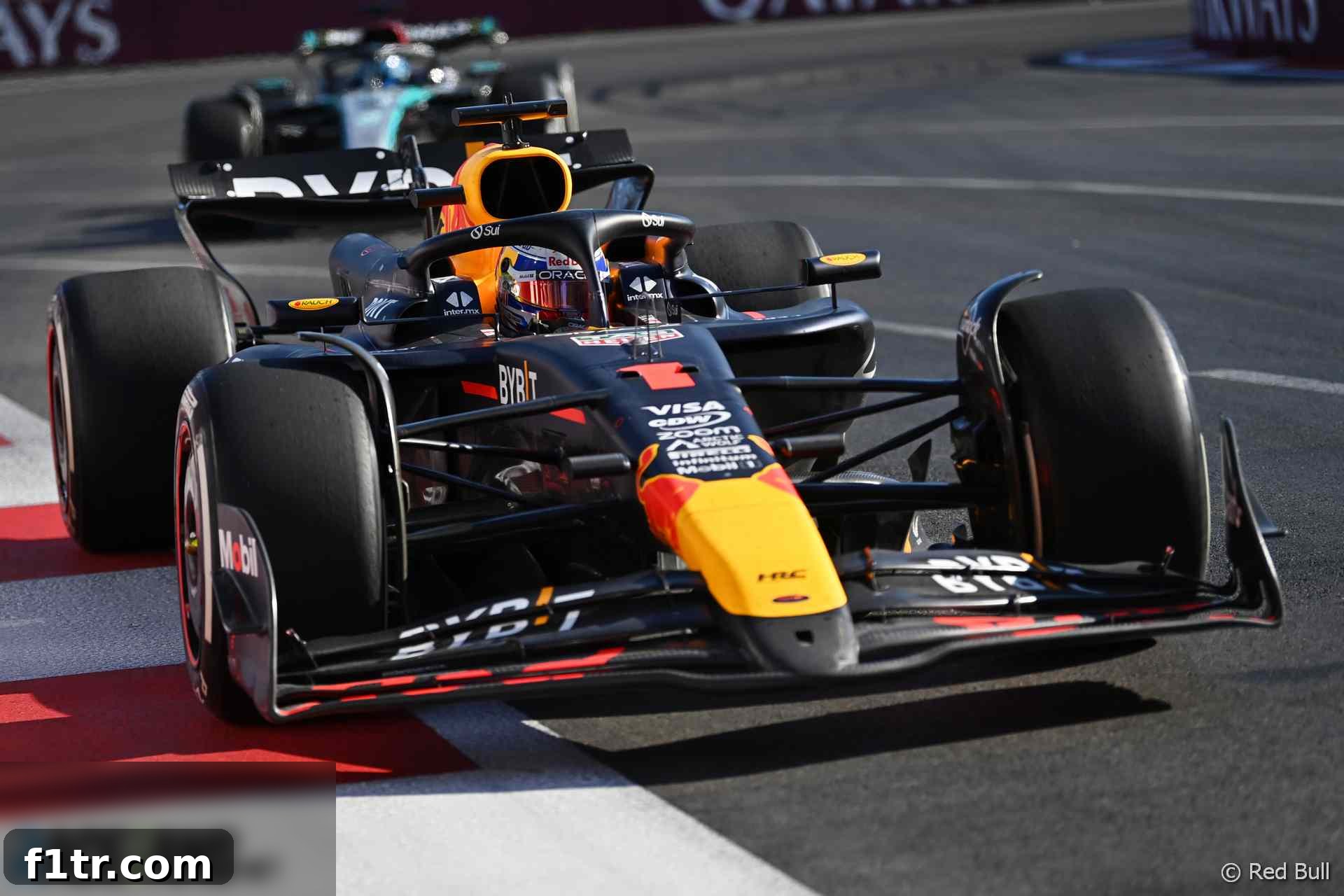
The exhilarating world of Formula 1 rarely sees its reigning champions struggle, yet the recent Azerbaijan Grand Prix presented an uncharacteristically challenging weekend for Max Verstappen and Red Bull Racing. The Dutch maestro, renowned for his seamless command of the fastest machines on the planet, found himself grappling with a car he described as “very difficult” to drive, plagued by severe handling issues that saw his wheels physically lose contact with the ground in Baku’s demanding corners. This unexpected downturn sparked significant discussion within the F1 paddock, highlighting the delicate balance required to maintain peak performance in the fiercely competitive sport.
Advert | Become a Supporter & go ad-free
Red Bull had arrived in Baku with a clear objective: to address the persistent handling problems that had somewhat hampered their drivers in previous rounds. A series of car updates were introduced, aimed at improving stability and overall grip. While initial feedback suggested some positive strides were made in understanding the car’s nuanced behaviour, Verstappen’s experience quickly deteriorated following crucial setup changes made before qualifying. These adjustments, intended to fine-tune the RB20 for the unique demands of the Baku City Circuit, inadvertently unbalanced his car, setting the stage for a weekend of unforeseen challenges.
Verstappen’s frustration was palpable as he recounted his race experience. “It was not enjoyable,” he stated plainly, articulating the immense difficulty he faced behind the wheel. The car’s unpredictable behaviour was the root cause of his woes, manifesting as a disconcerting sensation of the car “jumping around.” This wasn’t merely a matter of slight instability; it was a fundamental issue where the car was literally losing its vital connection with the asphalt. For a driver of Verstappen’s caliber, who thrives on precision and absolute control, such a lack of harmony with his machine proved to be a significant impediment to performance.
The core of the problem, as Verstappen elaborated to Viaplay, was a consistent loss of contact with the Tarmac, particularly in low-speed corners. “There was always one wheel on each axle coming off the ground,” he explained. This phenomenon, often referred to as ‘wheel lift,’ is detrimental in Formula 1. When a wheel loses contact, even momentarily, the car’s ability to generate grip is compromised. This translates directly into a loss of traction, making it impossible to carry optimal speed through corners and hindering acceleration out of them. The result for Verstappen was a significant and continuous loss of lap time, accumulating throughout the race and pushing him further down the order.
The issues weren’t confined to cornering alone. “On the braking as well, the car was jumping and just a lot of sliding because of that,” Verstappen added. Braking stability is paramount in Formula 1, especially on a street circuit like Baku with its high-speed straights leading into tight hairpins. A car that is unstable under braking forces the driver to brake earlier and with less aggression, further eroding lap time. The subsequent sliding exacerbated tire degradation, a critical factor in race strategy, and forced Verstappen to adopt a more conservative driving style, which is inherently contrary to his aggressive, attacking nature. This spiral of difficulties ultimately made his race an uphill battle from start to finish, preventing him from extracting the car’s full potential and highlighting the critical importance of a stable platform in modern F1 machinery.
Adding to the unusual nature of Verstappen’s race, he found himself trailing his Red Bull stablemate, Sergio Perez, for the vast majority of the grand prix. This is a rare sight, given Verstappen’s customary dominance over his teammates. The internal team battle had an unexpected resolution when Perez, who had been running strongly, crashed out on the penultimate lap. While Perez’s exit moved Verstappen up a position, it did little to alleviate the underlying performance issues he was experiencing. The race took a further twist when Lando Norris, Verstappen’s championship rival, executed a brilliant drive from a lowly 15th on the grid to overtake Verstappen for fourth place with just three laps remaining. Norris’s charge through the field, coupled with Verstappen’s struggles, underscored the competitive intensity of the current season and the fine margins separating success from frustration.
Advert | Become a RaceFans supporter andgo ad-free
Verstappen conceded there was simply “no way” he could have held off the charging McLaren of Norris. The difference in tire strategy proved to be the decisive factor in their late-race duel. Norris had switched to a fresh set of medium compound tires for his final stint, providing him with superior grip and performance. In stark contrast, Verstappen was navigating the final laps on an aging set of hard compound tires, which offered significantly less adhesion and were already past their optimal operating window. “It was tough,” Verstappen admitted, acknowledging the insurmountable disadvantage. “Already our race was just not very good and then, of course, he was on the softer compound to the end [of the race] with light fuel so the degradation was also less of a problem. So it was not great.” The lighter fuel load on Norris’s McLaren further minimized tire degradation, allowing him to push harder and extract maximum performance, culminating in a decisive overtake that highlighted McLaren’s strategic prowess and their car’s impressive late-race pace.
In a desperate bid to salvage something from a challenging weekend, Red Bull opted to pit Verstappen immediately after Norris’s overtake, fitting a fresh set of soft tires. The intention was clear: to challenge for the bonus point awarded for setting the fastest lap time of the race. This strategic gamble is a common tactic in Formula 1, particularly when championship points are at stake. However, fate intervened in the form of Sergio Perez’s untimely crash. The incident triggered a safety car period, or at least disrupted the track conditions significantly, preventing Verstappen from making a proper attempt at setting a scorching final lap. To add insult to injury, it was Lando Norris who ultimately claimed the fastest lap point, further widening the gap to Verstappen in the championship standings and underscoring the Red Bull driver’s profoundly frustrating outing.
The Azerbaijan Grand Prix served as a stark reminder that even the most dominant teams and drivers can face unexpected hurdles. For Red Bull, it highlighted ongoing challenges with car balance that require urgent attention to maintain their championship aspirations. For Max Verstappen, it was a rare glimpse into the struggles of wrestling an uncooperative machine, an experience that will undoubtedly fuel his determination to overcome these technical issues. The performance disparity between Verstappen and Norris also signaled McLaren’s growing threat, positioning them as serious contenders not just for race wins, but potentially for the championship itself. As the season progresses, the development race between these top teams will be crucial, with every detail of car setup and strategy potentially swinging the balance of power. The lessons learned in Baku will be pivotal for Red Bull as they aim to restore their characteristic dominance and provide Verstappen with a car capable of consistently performing at his formidable best.
Miss nothing from RaceFans
Get a daily email with all our latest stories – and nothing else. No marketing, no ads. Sign up here:
2024 Azerbaijan Grand Prix
- Verstappen: “Important” for FIA to clarify legality of McLaren’s ‘mini DRS’ wing
- Hamilton explains suspension set-up change behind “miserable” Baku weekend
- Piastri needs “crazy” results to become title contender despite Baku win
- FIA taking new look at flexing bodywork amid intrigue over McLaren’s rear wing
- Norris knew Verstappen broke VSC rules in Baku because he did the same in Melbourne
Browse all 2024 Azerbaijan Grand Prix articles