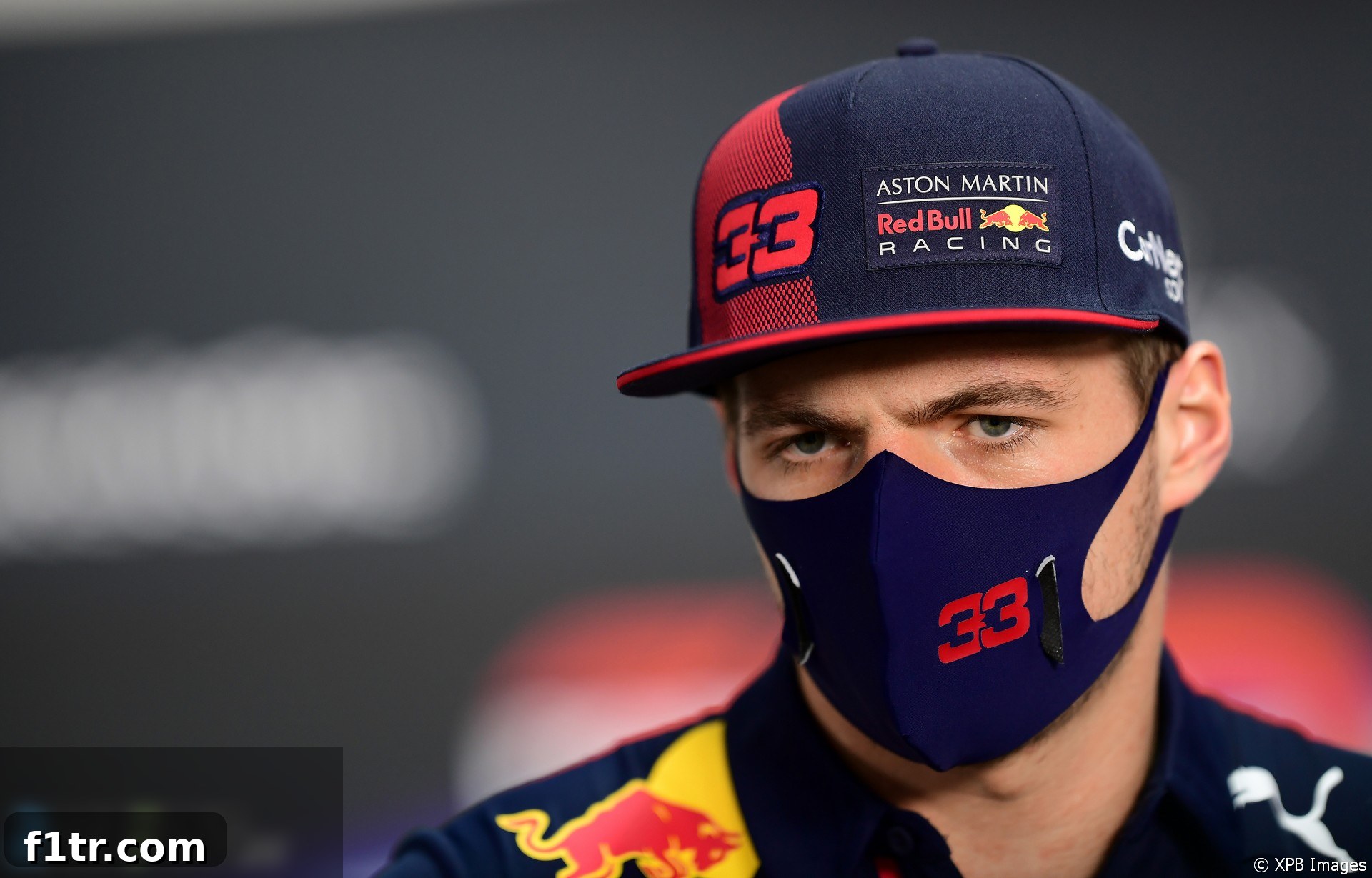
Max Verstappen has clarified comments he made in the immediate aftermath of Romain Grosjean’s terrifying crash at the Bahrain Grand Prix, stating that his remarks were “misunderstood” by many.
Advert | Become a Supporter & go ad-free
The incident at the Bahrain International Circuit saw Grosjean’s Haas car pierce through a barrier, ignite into a fiery inferno, and split in two. Miraculously, Grosjean escaped the wreckage with relatively minor injuries, primarily burns to his hands, which subsequently ruled him out of the following Sakhir Grand Prix. The race on that fateful Sunday was halted for nearly an hour and a half as emergency crews worked to clear the crash site and repair the damaged barrier.
During this extended suspension, several replays of the harrowing crash were shown repeatedly on television, a decision that drew criticism from some drivers and viewers alike who found it insensitive given the unknown condition of Grosjean at the time. However, in the post-race press conference, Verstappen offered a somewhat contentious opinion, suggesting that he would ‘kick out’ any driver who refused to race following such a serious incident.
Clarifying the Intent: Verstappen on Driver Mentality and Risk
“I think people misunderstood what I meant,” Verstappen explained ahead of the subsequent Sakhir Grand Prix weekend, taking the opportunity to provide context to his earlier statements. “What I was trying to say is that as drivers we know the risks when we get in the car and if anyone has doubts they should consider stopping racing.”
Verstappen’s clarification sought to underscore the inherent understanding of danger that comes with being a Formula 1 driver. He emphasized that every competitor stepping into a Grand Prix machine is acutely aware of the potentially life-threatening consequences of their profession. This raw honesty, he suggested, forms a fundamental part of a driver’s mindset. For Verstappen, the expectation is that once committed to the sport, a driver must possess the unwavering courage to perform, even after witnessing the worst-case scenario unfold on track. He acknowledged that while individual comfort levels might vary, the professional demands of the sport require a certain level of mental fortitude.
The Red Bull driver was keen to stress that his initial comments were not made without empathy. He clarified that his perspective would have been drastically different had Grosjean’s injuries been more severe or, tragically, fatal. “There is nothing wrong with that if you feel uncomfortable to race but we are part of a team and they rely on us to do our job which is drive the car. Had Romain not walked away obviously things would have been very different on Sunday,” Verstappen elaborated. This nuance highlighted that while he expects professionalism and dedication, he is also human enough to understand the gravity of more dire outcomes.
A Glimpse into F1’s Dangerous Past and Present Safety Marvels
Verstappen further contextualized his stance by drawing parallels to Formula 1’s earlier, far more perilous eras. “I think back in the sixties and seventies it was way more dangerous and the drivers of that era were still going out on track because they knew it was their job and that’s what they loved to do, even though they knew the risk was very high of losing their friends around them. The safety in place now is incredible and I respect everyone’s own decisions but that is how I feel,” he stated.
This historical reflection serves as a powerful reminder of the evolution of safety in motorsport. Decades ago, Formula 1 was a brutal crucible where fatalities were tragically commonplace. Drivers like Jim Clark, Jochen Rindt, and Ronnie Peterson lost their lives pursuing their passion, yet their contemporaries continued to race, driven by an unyielding spirit and a profound love for the sport. This era forged a certain stoicism and resilience among drivers, a legacy that Verstappen clearly believes still resonates with the core ethos of racing at the highest level.
Today’s Formula 1, while still inherently dangerous, is a testament to relentless innovation and an unwavering commitment to driver safety. Modern F1 cars incorporate advanced carbon fiber monocoques, sophisticated crash structures, and mandatory safety devices like the HANS (Head and Neck Support) system and, most notably, the Halo cockpit protection device. The Halo, introduced in 2018, was initially met with mixed reactions, but Grosjean’s crash provided irrefutable proof of its life-saving efficacy, preventing potentially catastrophic head injuries. Circuit designs have also evolved significantly, incorporating extensive run-off areas, improved barrier technology, and state-of-art medical facilities positioned trackside. Verstappen’s acknowledgement of this “incredible” safety underscores the remarkable progress made, allowing drivers to push the limits with a higher degree of protection than ever before, yet never fully eliminating the danger.
Ultimately, Verstappen concluded his clarification by emphasizing the paramount importance of Grosjean’s well-being. “Nobody ever wants to see an accident like that but all that really matters is that Romain is okay.” This statement serves to ground his earlier, more assertive comments in a fundamental human concern for a fellow competitor’s safety, reassuring that his professional outlook does not diminish his empathy.
Advert | Become a RaceFans supporter andgo ad-free
Verstappen and Hamilton’s Full Press Conference Response
The initial exchange that prompted Verstappen’s later clarification occurred during the Sunday post-race press conference, where both he and Lewis Hamilton were asked about driver options following such a traumatic event.
Question: “To Lewis and Max if they could each answer. Do you think drivers should… given what happened and thankfully, Romain is relatively fine, but given what happened and the shock of seeing that, do you think drivers should be given the option, whether they want to race, continue that race?”
Hamilton: “I don’t think so. I mean, we’re not the safety regulators. So we’re here to do a job and we rely on the FIA who are aware of safety and we trust them implicitly. So, no, I do not think so.”
Lewis Hamilton, ever the statesman, offered a measured response, deferring to the authority and expertise of the FIA (Fédération Internationale de l’Automobile), the sport’s governing body. His view underscored the professional nature of their roles; drivers are employed to race, and the responsibility for assessing and managing safety risks lies with the regulators. This stance reflects a trust in the system and an acceptance of the professional obligations that come with being an F1 driver. Hamilton’s response highlighted a philosophy centered on professional duty and collective trust in the safety protocols established by the sport’s custodians.
Verstappen: “I don’t get why you wouldn’t race. If I would be the team boss I would kick him out of the seat.”
In stark contrast, Max Verstappen’s immediate reaction was blunt and uncompromising, reflecting his intensely competitive and direct personality. His statement, delivered without hesitation, indicated a deeply ingrained belief that a driver’s commitment should be absolute. To him, the concept of a driver voluntarily withdrawing from a race due to emotional distress, even after a severe incident, was unfathomable. This firm stance immediately sparked a reaction from Hamilton, leading to a memorable, albeit light-hearted, exchange.
Hamilton: “Hmm?”
Verstappen: “If the guy wouldn’t race, if I would be the team boss I would tell him ‘then you never sit in the seat again’.”
Hamilton: “I hope you’re never my team boss…”
Verstappen: “I hope I will never be a team boss anyway!”
Hamilton: “I feel sorry for anyone that is going to be your driver in the future!”
This candid exchange, complete with Hamilton’s witty retort, perfectly encapsulated the differing philosophies between the two championship rivals. While Hamilton leaned towards a more collective, systematic approach to safety and professional conduct, Verstappen championed an individualistic, almost gladiatorial, interpretation of a driver’s duty. His later clarification served to soften the harshness of his initial words, explaining the underlying rationale rather than retracting the sentiment entirely. It highlighted the complex interplay between a driver’s personal feelings, their professional obligations, and the unique, high-stakes environment of Formula 1 racing, where courage and resilience are as much a part of the job description as skill and speed.
2020 F1 season
- Grosjean to make F1 test return tomorrow for first time since Bahrain horror crash
- Pictures: Wrecked chassis from Grosjean’s Bahrain fireball crash to go on display
- Bottas vs Rosberg: Hamilton’s Mercedes team mates compared after 78 races each
- F1 revenues fell by $877 million in Covid-struck 2020 season
- Hamilton and Mercedes finally announce new deal for 2021 season
Browse all 2020 F1 season articles