The intense world of Formula 1 racing often sees the finest margins determine victory or defeat, but sometimes, sheer luck plays a crucial role. This was unmistakably the case for two-time reigning champion Max Verstappen during the action-packed sprint race at the Baku City Circuit. A high-stakes collision with Mercedes driver George Russell threatened to prematurely end Verstappen’s race, a sentiment echoed by his Red Bull Racing team.
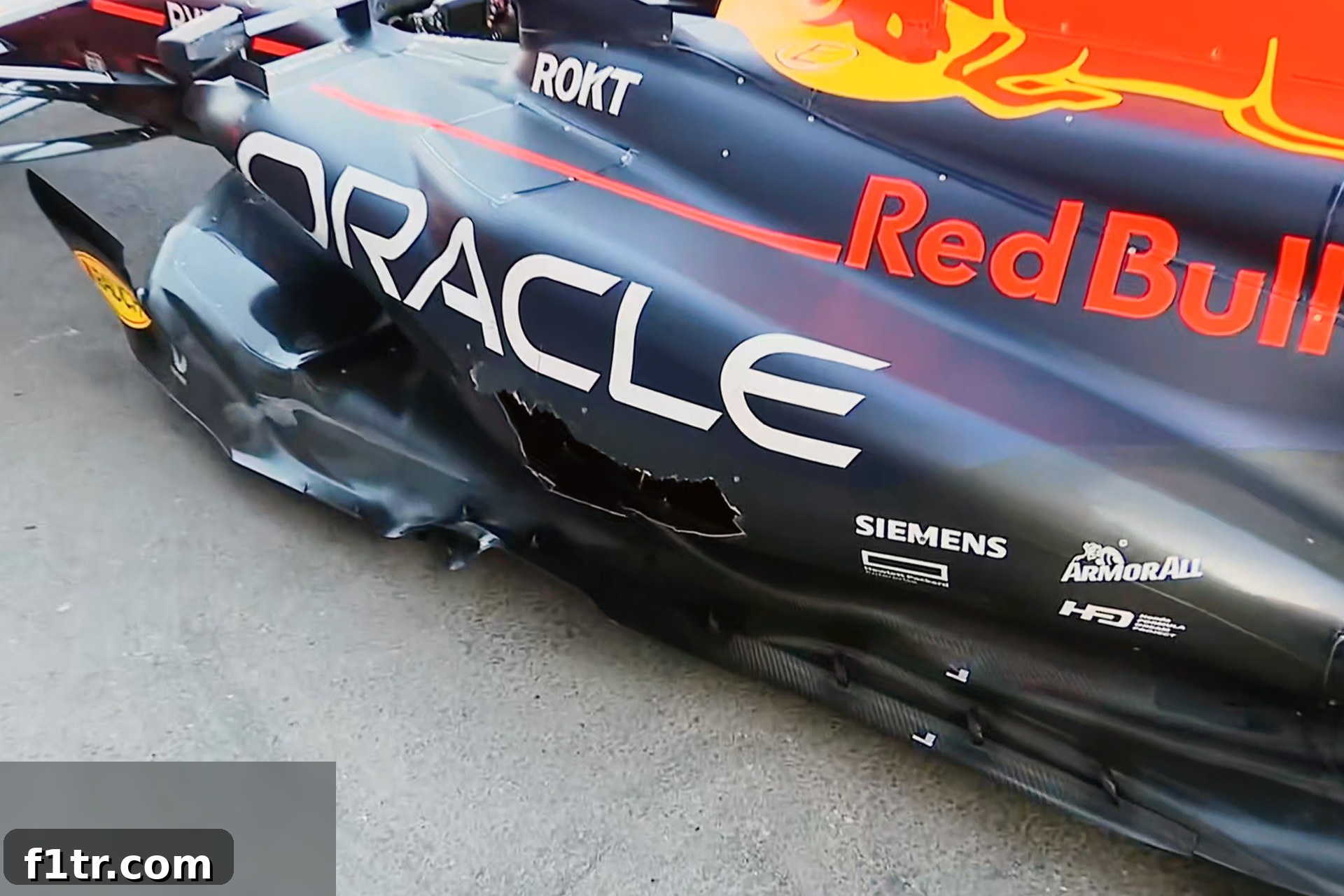
The incident unfolded on the opening lap at Turn Two, a notoriously tricky section of the street circuit known for its unforgiving walls and tight apexes. As the pack surged forward, Russell’s front-right wheel made contact with the left-hand side of Verstappen’s formidable RB19. What initially appeared to be a minor brush quickly revealed itself to be a significant blow, leaving the Dutchman’s car with noticeable damage to its intricate floor and a gaping hole in its sidepod.
Advert | Become a Supporter & go ad-free
In the aftermath, Red Bull’s chief engineer of car engineering, Paul Monaghan, highlighted the severity of the situation. Speaking to media outlets, including RaceFans, Monaghan revealed just how close Verstappen was to a race-ending retirement. “The physical damage was to the bodywork,” he explained. “Fortunately, it missed the radiator situated just underneath the ancillaries. Had it struck there, we would have been punted out of the race entirely.” This candid assessment underscores the fine line between continuing and crashing out in the unforgiving world of Formula 1, where every component is meticulously placed and highly vulnerable.
Despite the significant damage, Verstappen remarkably managed to continue, battling through the remainder of the sprint race to secure a third-place finish. While a podium spot is always commendable, it was a result that left Verstappen visibly frustrated, especially when compared to the flawless performance of his teammate, Sergio Perez. Perez, in the sister Red Bull, executed a brilliant drive, effortlessly passing Charles Leclerc’s Ferrari to clinch a dominant victory.
The disparity in performance between the two Red Bull cars was a clear indicator of the toll the damage had taken on Verstappen’s RB19. Monaghan articulated the extent of the impact, describing the aerodynamic loss suffered by Verstappen’s car as “massive.” He admitted the difficulty in precisely quantifying such a loss without simulating a damaged car in a wind tunnel, but affirmed its undeniable presence on the track. “On lap time, it was notable, yes,” he confirmed, emphasizing that the stopwatch doesn’t lie when it comes to performance degradation.
Modern Formula 1 cars are paragons of aerodynamic engineering, designed to manipulate airflow with incredible precision to generate maximum downforce. Even a minor disruption to this delicate balance can have catastrophic consequences for performance. The floor of an F1 car is particularly critical, generating a substantial portion of the overall downforce through the ‘ground effect’ phenomenon, where air is accelerated beneath the car to create a low-pressure zone that sucks the car to the track. Damage to this area, such as a hole or cracks, severely compromises the efficiency of these intricate venturi tunnels, leading to a significant reduction in grip and stability.
Similarly, a hole in the sidepod, while perhaps less critical than the floor, still disrupts the carefully managed airflow around the car’s body. Sidepods are designed to channel air towards the rear wing and diffuser, cooling internal components while also contributing to overall aerodynamic efficiency. A puncture can lead to turbulent air impacting other aerodynamic surfaces, further compounding the downforce loss and making the car less predictable at high speeds and through corners. This combination of floor and sidepod damage created a substantial handicap for Verstappen, turning what should have been a straightforward chase into a desperate struggle for grip.
Monaghan further elaborated on the impact of the damage, stating, “We estimate the balance shift from it, but it’s also a load loss.” He pointed out the slight silver lining, noting, “It’s near the middle of the car so fortunately, we didn’t have terminal oversteer or understeer. But the load loss was notable and very obvious.” This distinction is important: while the car’s overall balance might not have been terminally compromised in terms of handling characteristics (like an uncontrollable tendency to oversteer or understeer), the sheer reduction in aerodynamic load meant less grip available to the tires. Less grip translates directly to slower cornering speeds, increased tire degradation, and a reduced ability to extract maximum performance, explaining why Verstappen couldn’t effectively challenge Leclerc even as the Ferrari’s pace began to drop off later in the sprint race.
Red Bull had faced a rare challenge earlier in the Baku weekend, being beaten to pole position for the first time this year by Leclerc’s Ferrari. However, Perez’s commanding sprint race victory unequivocally demonstrated the strength of their car on race day. The team remained steadfast in their confidence regarding their car’s setup, which is always a delicate compromise between pure qualifying pace and robust race performance, especially on a unique circuit like Baku.
Monaghan elaborated on this strategic choice: “We have set our car up to do what we perceive as the best compromise for qualifying the race.” He acknowledged the inherent risks and rewards of such decisions. “Your qualifying performance you can distort a little bit if you choose to do so, but it might come back to haunt you on Sunday afternoon.” This philosophy emphasizes the long game, aiming for consistency and strength over an entire race distance rather than just a single fast lap, a strategy that has often paid dividends for Red Bull.
Baku, with its distinctive combination of ultra-fast straights and incredibly tight, slow-speed castle section, presents a unique challenge for engineers. Teams must balance low-drag for top speed with high-downforce for stability in corners. “This track’s a little bit different from all the ones we’ve been through so far,” Monaghan admitted. “So I’m not surprised at the steps the others have made and where they are relative to us. As I say, we made our choice.” This statement alludes to the differing approaches taken by various teams, some potentially opting for a more qualifying-focused setup, which might explain Ferrari’s strong Saturday performance.
The team’s commitment to their setup choice, made during the limited practice session on Friday morning, was unwavering. “We get one go at it on the Friday morning. We stuck with our choice and we’ll either be proven right or wrong later today,” Monaghan stated, referring to the upcoming main Grand Prix. This highlights the pressure on F1 teams to make crucial setup decisions with minimal track time, particularly in sprint race weekends where the format compresses the traditional schedule.
Ultimately, while Verstappen’s sprint race was marred by an unfortunate incident, the Red Bull team emerged with valuable data and a clear understanding of their car’s potential – and its vulnerabilities. The fortunate escape from terminal damage allowed them to analyze the real-world impact of aerodynamic loss, further refining their understanding of the RB19’s capabilities. Despite the setback for one driver, the team’s overall performance in Baku, especially Perez’s dominant win, reaffirmed their strong position in the championship battle. It served as a stark reminder that even the smallest contact in Formula 1 can dictate the fate of a race, yet a robust car and strategic foresight can still deliver strong results in the face of adversity.
Bringing the F1 news from the source
RaceFans strives to bring its readers news directly from the key players in Formula 1. We are able to do this thanks in part to the generous backing of our RaceFans Supporters.
By contributing £1 per month or £12 per year (or the equivalent in other currencies) you can help cover the costs involved in producing original journalism: Travelling, writing, creating, hosting, contacting and developing.
We have been proudly supported by our readers for over 10 years. If you enjoy our independent coverage, please consider becoming a RaceFans Supporter today. As a bonus, all our Supporters can also browse the site ad-free. Sign up or find out more via the links below:
- Become a RaceFans Supporter
- RaceFans Supporter FAQ
Advert | Become a RaceFans supporter andgo ad-free
2023 Azerbaijan Grand Prix
- Aston Martin radio messages reveal how “older brother” Alonso helps Stroll
- How slashing practice to a single hour in Baku tripped up F1 teams
- Bottas: “Rapid improvement needed” at Alfa Romeo
- Red Bull could become first team to score 1,000 points in a season
- Aston Martin hoping DRS fix works in Miami after Stroll manages fault in race
Browse all 2023 Azerbaijan Grand Prix articles