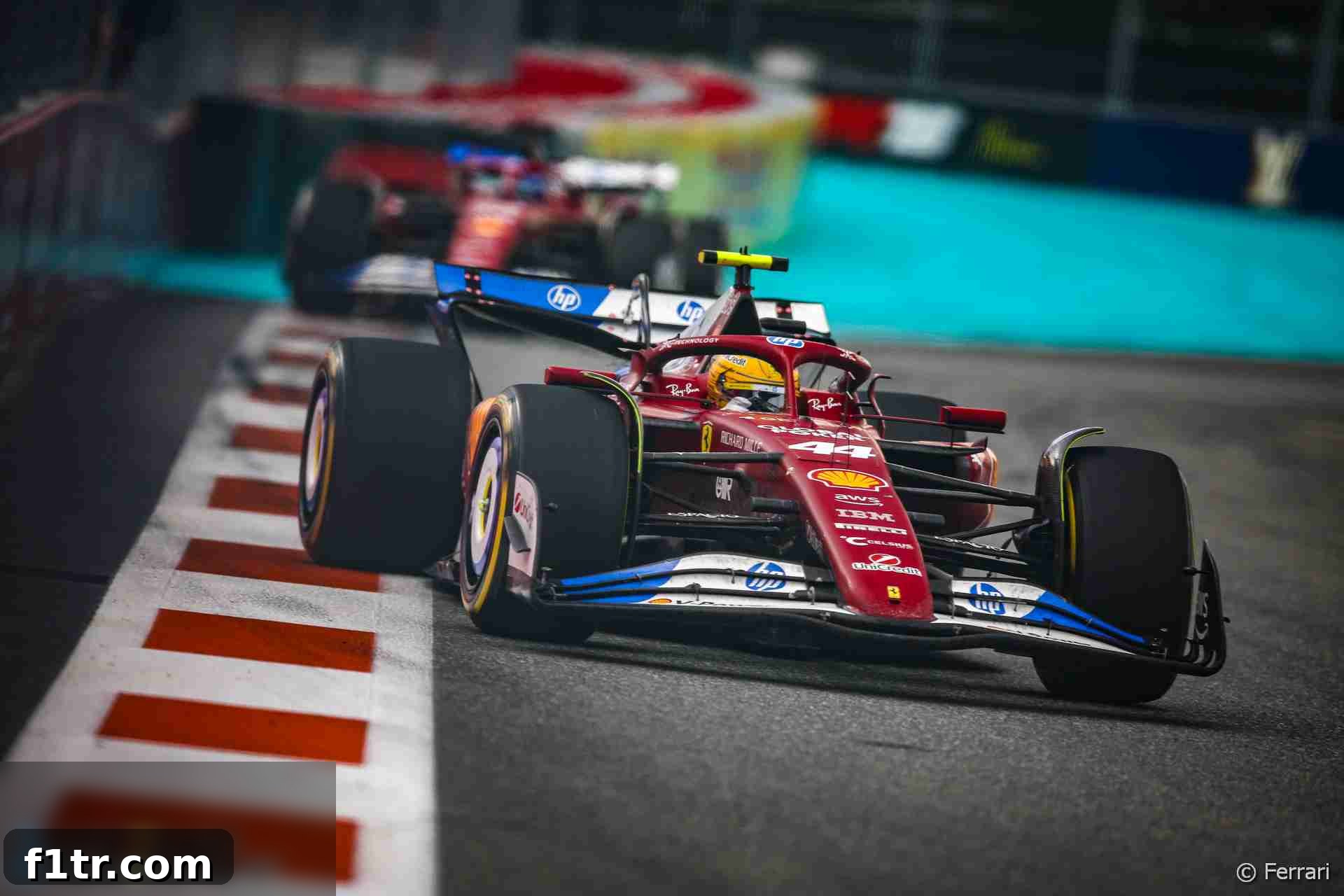
Frederic Vasseur Stands Firm on Ferrari’s Miami GP Team Orders Amidst Driver Dissent
Scuderia Ferrari Team Principal Frederic Vasseur has unequivocally defended the controversial strategic decisions made during the recent Miami Grand Prix, including the much-discussed double swap of his drivers. Despite clear expressions of dissatisfaction from both Lewis Hamilton and Charles Leclerc during and after the race, Vasseur maintains that the team’s actions were justified and that the matter is now closed internally.
The Miami GP proved to be a challenging weekend for the Italian outfit, not only in terms of outright pace but also in managing its drivers on track. The incident in question involved instructing Lewis Hamilton to allow Charles Leclerc to pass, only to reverse the decision later in the race, prompting frustration from both seasoned competitors. Such orders, while not uncommon in Formula 1, often stir debate, particularly when they appear to hinder a driver’s individual race performance or when their rationale isn’t immediately clear to those in the cockpit. This strategic dilemma often places team principals in a tight spot, balancing individual driver ambitions with overarching team objectives.
The Controversial Team Order Saga in Miami
The sequence of events unfolded during a crucial phase of the Miami Grand Prix, where Ferrari found themselves locked in close combat with other midfield contenders rather than consistently challenging at the very front. Initially, Charles Leclerc was asked to let Lewis Hamilton through. Leclerc voiced his concern over team radio, highlighting that this decision placed him dangerously close to his teammate, Carlos Sainz Jnr, potentially compromising his race and positioning against rivals. The delay in issuing this instruction also drew criticism from Hamilton, who complained about how long the team took to issue the original instruction, suggesting valuable time had been lost in the process of deciding the optimal strategy.
However, the drama didn’t end there. Later in the race, the instruction was reversed, with Hamilton then told to yield his position back to Leclerc. This second directive further compounded the frustration for the seven-time world champion, who was visibly unimpressed by the fluctuating strategy calls. Both drivers were clearly dissatisfied with the perceived ambiguity and inconsistency of the directives, which they believed impacted their ability to advance on track. Neither Hamilton nor Leclerc managed to overtake Andrea Kimi Antonelli, who was ahead of them, despite Leclerc closing within a mere one-and-a-half seconds of the young Mercedes driver by the checkered flag. The lack of forward progress, coupled with the internal communication issues, cast a shadow over Ferrari’s race day and left many questioning the efficacy of their pit wall decisions.
Vasseur’s Unwavering Stance: “The Chapter is Closed”
When pressed on the matter during yesterday’s FIA press conference, Frederic Vasseur remained resolute in his defense of the team’s strategy. “We don’t have to learn something,” he asserted, dismissing suggestions that significant lessons needed to be drawn from the incident. Vasseur emphasized that the decision was his to make, and he stands by it unequivocally. “I took a decision – I think it was a good one – and then we explained the decision to the drivers. We checked the end and the chapter was closed.”
His firm “chapter closed” stance, while aimed at projecting confidence and authority, also highlights the internal workings and leadership style of a top-tier F1 team. For Vasseur, once a strategic call is made, executed, and subsequently reviewed with the drivers, it is considered a resolved issue. This approach is crucial for maintaining a unified front, preventing prolonged internal disputes, and shielding the team from the intense scrutiny that invariably accompanies every move made by an iconic team like Ferrari. However, for the media and the passionate Tifosi, such incidents often remain a topic of fervent discussion, as fans seek deeper explanations or public acknowledgments of potential missteps. Vasseur’s dismissal of ongoing external debate suggests a clear intent to focus on future challenges rather than dwelling on past tactical choices.
Ferrari’s Inconsistent Performance: A Cause for Deeper Concern
Beyond the driver swaps, a more fundamental issue facing Ferrari this season is their erratic performance. The team has struggled to consistently replicate the strong form that saw them finish the previous year on a high note, raising eyebrows among pundits and fans alike. While they have shown flashes of brilliance, such as a very strong race performance in Jeddah, other circuits, like Miami, have exposed significant weaknesses. Vasseur openly acknowledged this discrepancy, pointing out the stark contrast in competitiveness.
“If you have a look at our performance, I think in Jeddah in the race we were in a very strong position – we did a very strong race – and in Miami, it was not the case at all,” Vasseur explained. The team’s inability to maintain a high level of performance across different track characteristics is a major hurdle in their quest for championship contention. In Miami, the gap to their rivals was stark, to the extent that they found themselves battling with and even being beaten by teams like Williams at certain points – a worrying sign for a team with the storied history and championship aspirations of Ferrari. This inconsistency makes it incredibly challenging to mount a sustained title challenge against the likes of Red Bull and McLaren, who have demonstrated greater stability in their performance.
Understanding the Technical Challenges and Tyre Management
Vasseur’s comments underscore the inherent complexity of modern Formula 1 car development and setup. He stressed the imperative need to “understand this and make better usage of the car and the tyres if we want to be more consistent and try to catch up a little bit with McLaren.” This statement points to several critical areas that Ferrari must address comprehensively. Firstly, understanding *why* their car performs differently on various tracks involves deep data analysis, aerodynamic evaluation, and precise chassis setup optimization. The unique characteristics of circuits – encompassing high-speed corners, low-speed technical sections, varying tyre-wear profiles, and diverse track surfaces – all play a significant role in how a car behaves and extracts performance.
Secondly, “better usage of the car and the tyres” suggests that the team might not always be extracting the maximum potential from their entire package. This could relate to nuanced driver feedback, critical engineering decisions, or even the fundamental design philosophy of the SF-24 itself, which might favor certain conditions over others. Tyre management, in particular, is a perennial and often decisive challenge in F1, and effectively getting the tires into their optimal operating window while simultaneously minimizing degradation is frequently the difference between securing victory and falling short. Ferrari’s struggle in this crucial area could explain their fluctuating competitiveness, especially when compared to rivals like McLaren, who have shown remarkable consistency and blistering pace in recent races, highlighting a potential advantage in tyre understanding and car setup.
Impact on Driver Morale and Team Dynamics
The Miami incidents, coupled with the team’s ongoing inconsistent form, inevitably raise questions about driver morale and the broader team dynamic within Scuderia Ferrari. Both Charles Leclerc and Lewis Hamilton are fiercely competitive individuals, accustomed to fighting for victories and championships. While Vasseur has stated the internal “chapter is closed,” the public expression of dissatisfaction from two highly respected and influential drivers cannot be entirely overlooked. Trust between a driver and their race engineer, and indeed the entire strategy team, is paramount in Formula 1. When team orders are perceived as suboptimal, confusing, or detrimental to a driver’s race, it can gradually erode that crucial trust, making future strategic calls significantly more challenging and potentially fostering internal tensions.
For Leclerc, who is widely viewed as Ferrari’s long-term future and a potential world champion, clear and consistent strategy is vital for his confidence and development. For Hamilton, who is preparing for his highly anticipated move to Ferrari in 2025, observing these strategic missteps and performance inconsistencies from his future team could certainly be a point of reflection, even if his current focus remains solely on Mercedes. While professionalism dictates he will always give his best for his current team, the performance and operational efficiency of Ferrari are undoubtedly on his radar as he looks ahead to his next chapter. A cohesive team, where drivers feel consistently confident in the decisions made from the pit wall, is an indisputable cornerstone of championship success.
The Road Ahead for Scuderia Ferrari
As the Formula 1 season progresses, Ferrari faces a critical period that will define their aspirations for the year. The ambition to challenge for both the Constructors’ and Drivers’ Championships requires not only a fast car but also flawless execution, consistent performance, and strategic brilliance that leaves no room for error. Vasseur’s task is multifaceted and demanding: he must meticulously iron out the inconsistencies in the SF-24’s performance across diverse tracks, refine the team’s race strategies to be both agile and effective, and crucially, ensure robust internal cohesion and unwavering belief within the team.
Learning from races like Miami, despite Vasseur’s firm assertion that there’s “nothing to learn,” often involves a meticulous and data-driven review of every aspect: communication protocols, strategic planning processes, and driver feedback integration. The ultimate goal for Ferrari is not merely to be an occasional podium contender but to consistently close the gap to the front-runners and firmly establish themselves as perpetual challengers. The coming races will be crucial in demonstrating whether Ferrari can truly understand their current package, unlock the consistency required to challenge McLaren and Red Bull at every circuit, and transform their championship dreams into a tangible reality.
Further Insights into the 2025 Miami Grand Prix
- Nothing for Ferrari to learn from Miami team orders episode – Vasseur
- Hamilton proud of Ferrari as ‘we’re taking a beating from media and people’s comments’
- McLaren legality never in doubt says Piastri as FIA’s post-race check clears car
- Albon did not disobey team orders in Miami says Vowles after Sainz’s complaint
- McLaren score their most emphatic win since Hamilton’s 2008 Silverstone triumph
Browse all 2025 Miami Grand Prix articles