Formula 1’s Mid-Season Aerodynamic Battle: Unpacking the US Grand Prix Updates
The United States Grand Prix, often a highlight on the Formula 1 calendar, presented a unique challenge and opportunity for teams in a sprint race format. With only a single hour of practice available, the decision to introduce significant car updates became a high-stakes gamble. Yet, remarkably, half of the F1 grid arrived in Austin armed with a fresh batch of aerodynamic revisions, signaling a critical phase in the 2023 season and a determined look towards 2024 development paths.
These weren’t merely minor adjustments; many teams unveiled substantial overhauls, particularly around the crucial floor area. The tight schedule of a sprint weekend, which severely limits track time for validation, underscores the confidence—or perhaps desperation—behind these development pushes. Teams are not only fighting for immediate championship positions but also using these late-season races as vital testbeds to understand and verify the aerodynamic philosophies that will underpin their designs for the next generation of F1 cars.
The Strategic Imperative: Balancing Current Performance with Future Vision
In the fiercely competitive world of Formula 1, development never truly stops. However, the timing and nature of upgrades can reveal much about a team’s current standing and future ambitions. The 2023 season, characterized by stable aerodynamic regulations, has seen a relentless pursuit of performance, primarily through the optimization of ground effect aerodynamics. The car’s floor, in particular, remains the single most powerful aerodynamic device, generating the vast majority of downforce and significantly influencing the car’s handling characteristics.
Bringing major updates to a sprint weekend is a testament to the urgency felt across the paddock. With limited data gathering opportunities, teams must rely heavily on simulation and wind tunnel work, hoping their virtual gains translate seamlessly onto the track. This commitment reflects a dual-pronged strategy: improving current car performance to secure better championship standings, while simultaneously gathering invaluable data to inform and validate the foundational concepts for their 2024 challengers. The insights gained from real-world testing, even if brief, are irreplaceable in an era of strict cost caps and limited development tokens.
Aston Martin’s Fight for Fourth: A High-Stakes Development Push
Aston Martin, a team that began the year with surprising strength and consistent podium finishes, found themselves under immense pressure in the latter half of the season. McLaren’s dramatic resurgence had brought them within striking distance for fourth place in the Constructors’ Championship, turning the battle for position into a high-stakes affair. Consequently, Aston Martin introduced a comprehensive suite of changes at the US Grand Prix, all meticulously designed to enhance the performance of their car’s floor.
The team had previously acknowledged that their in-season development trajectory hadn’t been as successful as some of their rivals, a factor contributing to their mid-season dip in form. Technical director Dan Fallows articulated the critical nature of these late-season races, stating they were essential not just for maximizing the potential of the current car, but crucially, for deepening their understanding to guide next year’s development. This strategic focus highlights how immediate performance gains and long-term insights are intricately linked, especially for a team aiming to solidify its place among the front-runners.
Mercedes’ Continuous Pursuit of Understanding
Aston Martin wasn’t alone in leveraging the US Grand Prix for future learning. Mercedes, a team with its own aspirations for challenging Red Bull, also brought a notable floor update. Lewis Hamilton, a vocal advocate for continuous improvement, echoed the sentiment of using current developments to inform future designs. In the pre-race press conference, Hamilton explicitly linked Mercedes’ floor update to gaining crucial understanding for their 2024 car, underscoring the universal strategic value of late-season upgrades across the grid.
Mercedes’ approach has often been about incremental gains and a deep analytical understanding of their car’s behavior. Their updates tend to be precisely targeted, aiming to refine specific aspects of aerodynamic flow rather than wholesale overhauls. This philosophy ensures that every modification contributes to a clearer picture of the car’s performance envelope, which is vital for a team striving to return to championship-winning form.
Haas’ Home Ground Revamp: A Red Bull-Inspired Overhaul
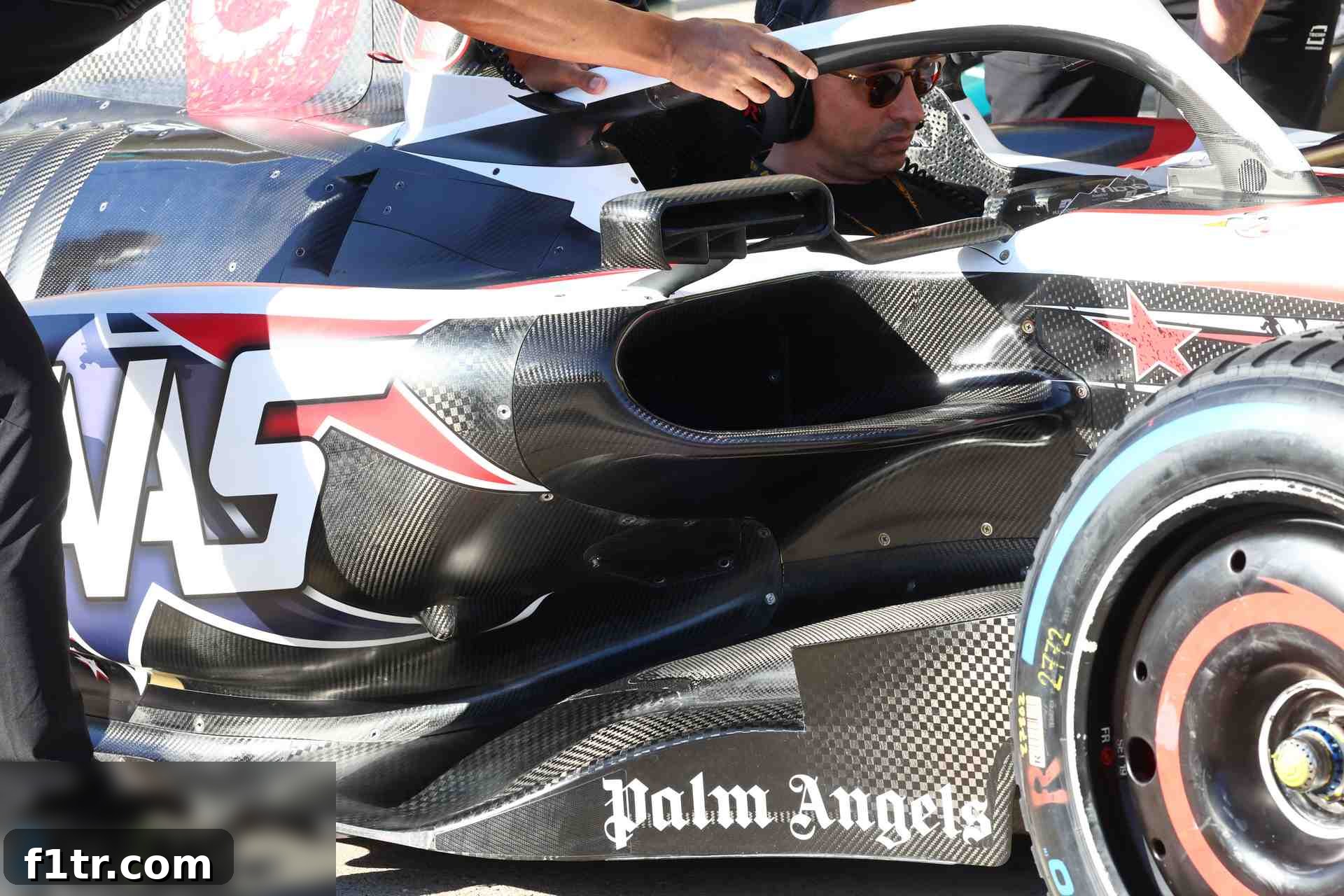
For Haas, the United States Grand Prix represented more than just another race; it was a significant home event, providing the perfect platform to unveil their most substantial update package of the season. With only five rounds remaining, the timing of such a comprehensive revamp was telling. As previously indicated by the team, the reshaped VF-23 bore a clear resemblance to Red Bull’s dominant RB19, particularly in the critical areas of its sidepods and floor. This strategic shift indicated Haas’ bold ambition to fundamentally alter their car’s aerodynamic characteristics.
The team’s primary goals with this extensive update were twofold: to reduce the car’s aerodynamic sensitivity and to improve its overall efficiency. Aerodynamic sensitivity refers to how consistently a car performs across different speeds, yaw angles, and ride heights. A less sensitive car is generally easier to drive and more predictable, allowing drivers to extract more performance. Improved efficiency, meanwhile, means generating more downforce for less drag, a holy grail in Formula 1 aerodynamics. The Red Bull-inspired direction was a clear signal of Haas’ intent to chase these fundamental performance attributes.
AlphaTauri’s Ascent from the Rear: Incremental Gains for Future Success
AlphaTauri, having endured a challenging season fighting at the back of the grid, had recently shown encouraging signs of progress with their upgrade packages. The team expressed satisfaction that their previous updates had performed as expected, validating their development processes. At Austin, another batch of parts arrived as the Faenza-based squad intensified its efforts to climb away from the bottom of the Constructors’ Championship standings.
Consistent with the overarching trend, the floor remained a key area of focus for AlphaTauri. Their efforts concentrated on refining the quality of airflow into the floor to enhance its performance. Additionally, the engine cover received a rework, specifically aimed at improving cooling efficiency. Given that Austin, much like Qatar, can present high ambient temperatures, and the subsequent Mexican Grand Prix often features cooling as a primary concern due to its altitude, these thermal management updates were strategically vital for both performance and reliability.
Detailed Technical Analysis: Unpacking the 2023 United States Grand Prix F1 Teams’ Updates
The intricate world of Formula 1 aerodynamics demands precise explanations for every change. Here, we delve into the specific modifications brought by each team to the United States Grand Prix, outlining their stated reasons, the physical differences, and the expected aerodynamic benefits.
Mercedes: Refining the W14’s Ground Effect
Floor Body: Optimizing Flow Conditioning
Mercedes introduced a modification to the floor body, specifically targeting the floor’s leading edge and the subsequent tunnel roof profiling. The primary reason for this alteration was performance, focusing on flow conditioning. By raising the floor’s leading edge, the team aimed to alter the loading distribution on the outer fence. This adjustment was designed to improve the quality of airflow to the rear of the car, consequently generating increased rear downforce. Enhanced flow quality is crucial for maintaining stable and efficient aerodynamic performance across varying car attitudes.
Floor Edge: Enhancing Local Load
Another significant update for Mercedes involved extending the forward floor edge flap rearwards. This modification was implemented to boost local aerodynamic load. By increasing the extent of the high-cambered forward section of the floor edge wing, Mercedes sought to increase the localized load in this area. This, in turn, contributes to a greater forward floor load, which is critical for balancing the car’s overall downforce distribution and improving front-end grip and stability.
Alfa Romeo: Building on Previous Progress
Floor Edge: Increasing Downforce and Efficiency
Alfa Romeo brought a redesigned edge to the rear part of their floor. This specific floor update was not a standalone change but rather a continuation and integration of a broader upgrade package first introduced at the Singapore Grand Prix. The overarching goal of these modifications was to further increase the car’s total downforce and enhance its aerodynamic efficiency. By refining the floor edge, Alfa Romeo aimed to better manage the airflow around and under the car, improving the generation of ground effect and overall grip while minimizing drag.
Aston Martin: A Comprehensive Floor-Focused Overhaul
Aston Martin’s package was extensive, demonstrating their commitment to tackling their mid-season development challenges.
Floor Edge: Redefining Underside Aerodynamics
Aston Martin introduced a revised floor edge geometry, featuring a longitudinal slot and an outboard wing. Notably, this outboard wing was previously located under the floor. This modification formed a key part of a larger development package designed to increase the loading on the floor. By strategically altering the local flow conditions on the underside of the car, the team aimed to enhance the effectiveness of the floor in generating crucial downforce.
Diffuser: Maximizing Rear Downforce
The team also presented a new diffuser with a revised side-view expansion. Similar to the floor edge, this diffuser update was integral to the comprehensive development package focused on augmenting floor loading. Modifying the diffuser’s geometry is a direct way to influence the extraction of airflow from beneath the car, thereby impacting the pressure differential that generates ground effect downforce. The revisions aimed to optimize these crucial underside local flow conditions.
Coke/Engine Cover: Integrated Aerodynamic Solutions
Aston Martin’s bodywork received revisions, notably with a larger undercut alongside the newly modified floor edge. This change to the coke bottle area and engine cover was another component of the overarching development strategy to increase the loading on the floor. The intricate interaction between the bodywork and the floor is critical; shaping the engine cover and sidepod contours can significantly influence how air flows to the rear of the car and interacts with the diffuser and beam wing, optimizing the underside local flow conditions for downforce generation.
Beam Wing: Synergy with the Diffuser
Rounding out Aston Martin’s aerodynamic package was a new beam wing, featuring revised profiles and incidence. This new beam wing was specifically designed to work in conjunction with the updated diffuser. The beam wing plays a vital role in connecting the airflow from the diffuser to the main rear wing elements. Its modifications were intended to further contribute to the package’s goal of increasing the loading on the floor by precisely modifying the local flow conditions around the rear of the car.
Haas: A Bold Step Towards a New Aerodynamic Philosophy
Haas’s extensive upgrade package touched multiple key areas of the car, reflecting a significant shift in their aerodynamic concept.
Front Corner: Improved Wake Management
The front brake duct inboard exit on the Haas VF-23 received small geometrical changes. This modification was primarily aimed at improving wake management. By enhancing the flow characteristics coming from the front brake duct’s inboard exit, the team sought to gain aerodynamic load with improved efficiency. Effective wake management is crucial for ensuring clean airflow to downstream aerodynamic surfaces, preventing performance degradation.
Floor Body: Stability and Efficiency
The floor body on the Haas car was modified in the latter part of the diffuser section. These changes were implemented to optimize the expansion and contraction of the floor body, ensuring less aerodynamic sensitivity across different car states. Furthermore, the new design aimed to improve sensitivity in the event of strong side winds. A stable and less sensitive floor body means more consistent downforce generation, which is highly beneficial for driver confidence and overall car performance.
Floor Edge: Optimizing Underfloor Flow
Haas introduced a completely new floor edge and a new floor edge wing as part of their revised floor design. The new shape of the floor edge element was engineered to guarantee a more efficient path for the airflow driven by the underfloor. This, in turn, directly contributes to an increase in aerodynamic efficiency, allowing the car to generate more downforce with less drag and providing a stronger, more consistent ground effect.
Sidepod Inlet: Harmonizing with New Floor Design
The sidepod inlet on the VF-23 was modified to work in harmony with the new floor edge design. The new shape of the sidepod inlet aims to improve the airflow around the sidepod itself, crucially maintaining the same cooling feeding as the previous configuration. This integrated approach ensures that changes to one aerodynamic area do not inadvertently compromise performance or reliability in another, particularly vital for managing cooling requirements.
Coke/Engine Cover: Enhanced Airflow Interaction
In conjunction with the revised cooling inlet, the surfaces of the engine cover, sidepod, and coke panel were all revised. The new sidepod shape is designed to allow for a better interaction of the airflow along the side of the car and, importantly, in the area between the rear wheels. Additionally, the engine cover features an increased cooling exit. These changes collectively optimize airflow management around the rear of the car, which is critical for both aerodynamic performance and thermal management.
Cooling Louvres: Circuit-Specific Thermal Management
Haas also designed new louvre panels for their updated bodywork. These new louvre panels, along with different blanking options, allow the team to set various cooling levels as required on a race-by-race basis. The new louvres are smaller than the previous solution, a change made possible by the increased central engine cover cooling exit in the new bodywork. This flexibility in cooling configurations is essential for optimizing performance and reliability across diverse circuit characteristics and environmental conditions.
AlphaTauri: Targeted Improvements for Performance Boost
AlphaTauri’s upgrades focused on refining specific areas to extract more performance and climb the grid.
Floor Body: Improving Local Load Generation
Relative to their baseline geometry, AlphaTauri modified the forward central floor. These specific changes were made in direct conjunction with alterations to the floor fences located beneath. The primary objective of these integrated modifications was to improve the local load generation capabilities of the forward floor, meaning a more efficient and stronger generation of downforce in that critical area.
Floor Fences: Managing Front Wheel Wake
AlphaTauri’s floor fences also saw revisions, specifically in their camber distributions when viewed from above, relative to the baseline. Most notably, the outermost fence was significantly increased in size. These changes to the fence geometry combine with the floor body modifications to deliver an increase in local loading. The enlarged outermost fence plays a crucial role in keeping the disruptive front wheel wake losses further away from the forward floor by generating higher static pressure on its outboard side. The resulting improvement in the energy of the flow field to the forward floor leads directly to an increase in local downforce.
Floor Edge: Increasing Mass Flow Underfloor
The forward part of AlphaTauri’s floor edge wing was also modified relative to the baseline geometry. The revised design features increased camber in the forward section of the floor edge wing. Furthermore, the highly loaded forward part of this wing has been extended further rearward compared to its previous iteration. Both of these changes are intended to lower the static pressure local to that part of the floor edge, which effectively helps to draw an increased mass flow of air under the forward floor between the fences, thereby enhancing ground effect.
Coke/Engine Cover: Balancing Cooling and Aerodynamic Performance
The central bodywork exit geometry of AlphaTauri’s coke/engine cover was modified. The revised shape provides an increase in cooling performance. Crucially, this improvement was achieved without any detriment to the loading of the rear wing assembly located behind it. This highlights a successful balancing act between managing engine temperatures and maintaining efficient aerodynamic performance at the car’s rear.
Rear Corner: Enhancing Diffuser Performance
AlphaTauri’s rear corner saw modifications to the ‘BDR’ lower winglets, relative to their baseline geometry. The revised shape of these winglets aims to increase their local load. This increase in loading has a knock-on effect of improving diffuser performance by pushing lower wheel wake losses further outboard, ensuring a cleaner and more effective flow of air through the diffuser for greater downforce.
Other – Chassis: Generating Local Load
Finally, AlphaTauri also modified the forward chassis lower surfaces relative to their baseline geometry. These revised surfaces, localized to the inboard front suspension, are designed to increase the local velocity of the airflow. By doing so, they generate an increase in local load on the chassis itself, contributing to the overall aerodynamic efficiency and downforce generation of the car.
Conclusion: The Road Ahead for Formula 1 Development
The influx of significant aerodynamic updates at the United States Grand Prix, despite the restrictive sprint race format, underscores the relentless pursuit of performance and the strategic importance of every track session. From Aston Martin’s aggressive push to secure P4 in the constructors’ championship, to Haas’s bold Red Bull-inspired overhaul, and AlphaTauri’s incremental but promising gains, each team’s modifications reveal a dual focus: optimizing current performance while simultaneously laying the groundwork for their 2024 challengers. The insights gathered from these real-world tests are invaluable, shaping the aerodynamic philosophies that will define the next chapter of Formula 1. As the season progresses, the impact of these US GP updates will undoubtedly be scrutinized, providing crucial clues about the trajectory of each team’s development path and their prospects for the highly anticipated 2024 campaign.
Further Reading: 2023 United States Grand Prix
- US GP was Mercedes’ best race of 2023 despite disqualification – Wolff
- Singapore and Austin retirements cost me top 10 championship place – Ocon
- United States Grand Prix result unchanged as FIA rejects Haas’ call for review
- Sargeant admits he’s ‘struggled to use all the downforce at times’ in F1
- Mercedes’ Brazilian GP set-up was “conservative” after US GP disqualification
Browse all 2023 United States Grand Prix articles