McLaren’s Strategic Shift: Integrating Mercedes Power for the 2021 F1 Season
Formula 1 is a sport defined by relentless innovation, strategic alliances, and the pursuit of ultimate performance. As the 2021 season approaches, McLaren finds itself at the precipice of a significant transformation, embarking on its third change of power unit supplier since the V6 hybrid turbo era commenced six years ago. This pivotal move sees the Woking-based outfit rekindle its long-standing partnership with Mercedes, a decision that carries both immense promise and unique challenges given the extraordinary circumstances of the current F1 landscape.
Advert | Become a Supporter & go ad-free
James Key: The Architect of Transition
Overseeing this complex transition is McLaren’s technical director, James Key, whose experience makes him uniquely suited for the task. Having joined the team last year, Key brings a wealth of knowledge from his previous tenure at Toro Rosso, where he navigated switches between three different power unit suppliers. His insights are invaluable as McLaren integrates the 2021 Mercedes power unit, a process that, according to Key, is “fully up to speed” with meticulous planning and execution.
The return to Mercedes engines marks a significant chapter for McLaren. While this is their third engine supplier change in seven years, their historical ties to Mercedes run deep, spanning two decades and featuring a period as a works F1 operation. Key notes that this renewed partnership feels like picking up “almost from where it left off.” He emphasizes the collaborative spirit, stating, “I know we’re not a works operation, but certainly a very close technical and personal link in some cases. They’ve shared all the information we need very quickly. They’ve been open to questions, suggestions and ideas which was within the scope of the agreement to help us out.” This seamless exchange of information underscores the mutual trust and shared ambition between the two iconic brands.
Navigating Unprecedented Challenges: The 2021 F1 Season
The upcoming 2021 F1 season presents McLaren with a particularly intricate challenge, largely due to the profound disruptions caused by the global Covid-19 pandemic. The original roadmap envisioned the switch from Renault to Mercedes power coinciding with a radical overhaul of technical regulations. However, these sweeping new rules have been postponed by a full 12 months as a crucial cost-saving measure for the sport.
Consequently, teams have collectively agreed to largely carry over their 2020 chassis designs into the next season. While some modifications are permitted, these are strictly governed by a ‘token’ system, where each team has a limited number of tokens to spend on specific areas of car development. McLaren, uniquely positioned as the only team changing power unit suppliers for 2021, faces an unavoidable predicament: they must expend all their allocated tokens on making the fundamental structural changes required to accommodate the Mercedes engine. This inherent constraint severely limits their ability to pursue other performance-enhancing upgrades to the chassis. Adding to their difficulties, the team lost several critical weeks of work on their 2021 project when their factory had to close during the extensive lockdown period, further compressing their development timeline.
Advert | Become a RaceFans supporter andgo ad-free
Key acknowledges the immense pressure McLaren is under, stating, “[Mercedes] know that we are under pressure and under a short time period as well with the inability to work on it earlier this year in a big way. So it’s started off very well. We’ve been doing some R&D testing with them at their facilities to make sure that our systems are installed in a way that works for both. That seems to be going okay and we’re fully on top of the programme in that respect.” This proactive engagement with Mercedes has been crucial in mitigating potential integration issues and keeping the project on schedule, despite the tight deadlines and external pressures.
The Technicalities of Engine Integration: No Nasty Surprises
Despite the inherent complexities, Key describes the design work involved in adapting the MCL35 chassis to accept a Mercedes power unit instead of a Renault as “pretty normal, actually, in terms of going from one engine to another.” His extensive experience in such transitions has provided him with a valuable perspective. “I’ve kind of become familiar with how this transition works,” he says. “And it’s pretty similar to the sorts of work that you have to do from one power unit to the next.”
He elaborates that while there are “some fundamental architectural differences between the way power units are laid out,” it ultimately boils down to a methodical process of “picking it up and installing it accordingly.” Crucially, Key confirms, “no nasty surprises, no negative points have popped up at all. It’s all been pretty normal and some pleasant surprises, actually, in some cases.” This positive outlook suggests that the initial phase of integration has progressed smoothly, laying a solid foundation for the next stages of development.
Compromises and Aerodynamic Implications for the MCL35M
While the prospect of gaining F1’s benchmark power unit is undoubtedly exciting, McLaren acknowledges that some compromises are unavoidable, primarily due to the mandate to carry over the core of their current car. “This is where a bit of a bit of compromise comes in,” admits Key. “So on top of the lack of chassis token capability, we’ve also had to try and install the engine with minimal changes to the car because, of course, you’re supposed to carry the car over. We can’t do that because we’re not retaining an engine.”
This critical constraint means McLaren cannot fully capitalize on one of the Mercedes power unit’s most significant advantages: its more compact dimensions. Typically, a team would exploit a smaller engine package to achieve substantial aerodynamic gains by creating a tighter, more efficient rear-end design. However, McLaren’s hands are tied by the regulations for 2021.
Advert | Become a RaceFans supporter andgo ad-free
Key elaborates on this: “In normal times you’d install it and use the benefits of a tighter package – which is what you get with the architecture of Mercedes engine – to the full. Whereas we’ve had to make minimal changes to our car to allow us to effectively put a Mercedes engine in our car designed for our current engine.” This necessitates a careful balancing act, working closely with the FIA to ensure the changes remain within the spirit of the ‘minimal changes’ rule. “So whilst that’s been very well discussed with the FIA, we’ve come to a good agreement on how to keep those changes realistic for us, but also within the bounds of minimal changes, that has worked. But typically, you wouldn’t do that. You’d go further than that and exploit it a little bit more. So there’s been a few compromises there.”
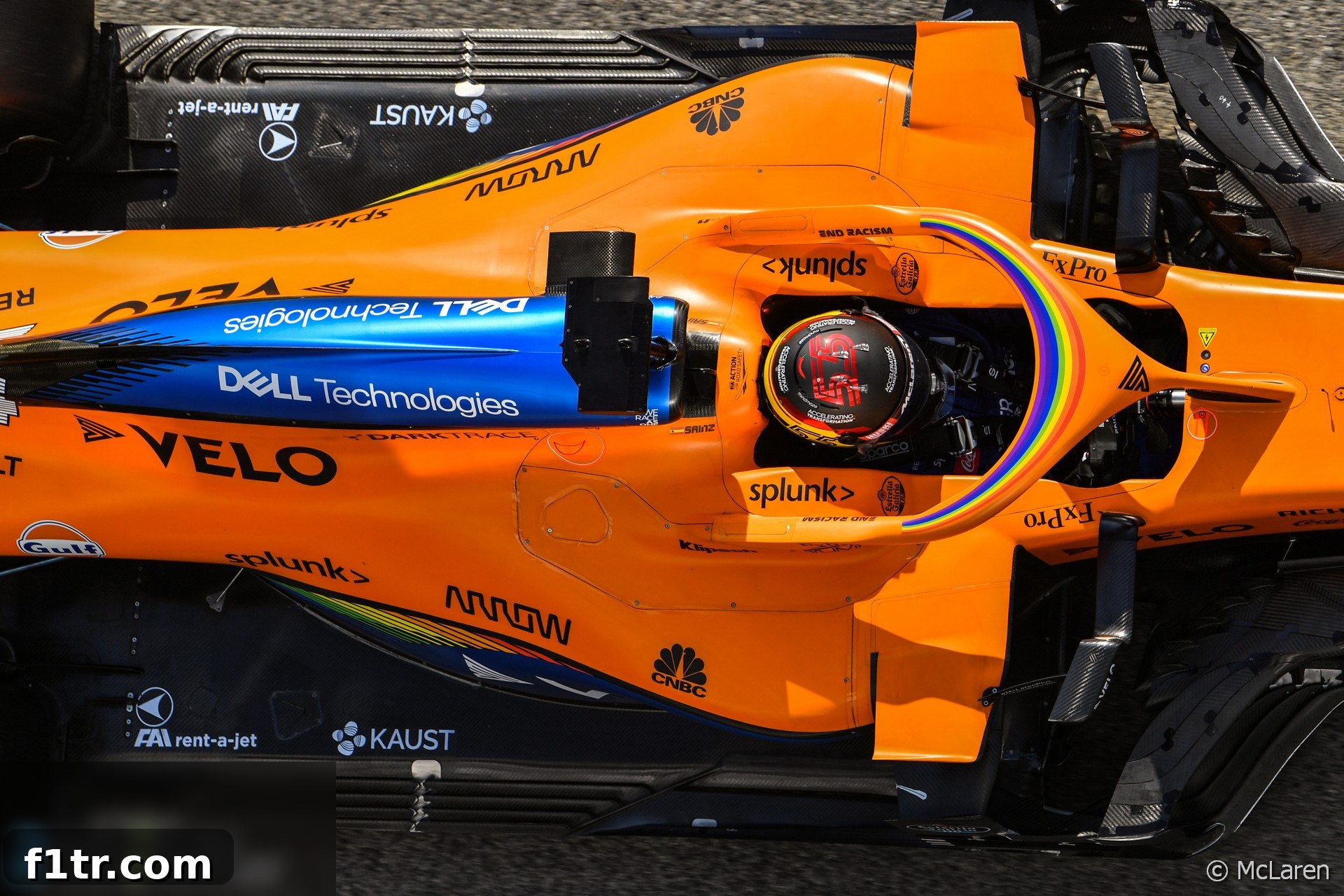
The 2021 McLaren will be officially designated the ‘MCL35M’, a clear indication of its lineage. Key succinctly describes it as “the current car with a Mercedes engine in it, when all’s said and done. There’s a couple of changes to architecture necessary by the shape of the engine compared to this year’s. But it’s not fundamentally different.”
Crucially, the team has managed to preserve the car’s fundamental aerodynamic philosophy without major concessions. Key notes, “There’s been a couple of small dimensional changes which the engine installation has led to which will lead to a minor tweak on aero surfaces. But it hasn’t actually affected aero particularly negatively. Because we stuck with a minimum amount possible to try and squeeze the engine it means that the basics of the aero surfaces are pretty similar. There’s no philosophical change, I’d say, to that.” This ability to maintain their aero concept, even with an engine change, speaks to the adaptability of their design team and the careful planning involved.
Nonetheless, Key admits that some aerodynamic potential will remain untapped in 2021. “Had we been able to exploit it further and you really go to town with an engine installation, which in normal times you would and you will be able to in future as well, then probably we would have squeezed a bit more out of it. But I don’t think we’ve been left with anything that we feel as a compromise.” This measured approach reflects the extraordinary circumstances, ensuring a functional and competitive package rather than an entirely optimized one for the transitional year.
The FIA’s role in this process has been critical. Key expresses satisfaction with the fairness of the distinction drawn by the governing body between necessary changes for power unit integration and opportunistic tweaks for performance gains. “Whenever we’ve discussed with the FIA areas which will have an impact on aero for the purposes of installing the engine – that’s predominately through the cooling system side of things – that sort of thing, they’ve always recognised that where we’re trying to do the best thing to make sure it works and doesn’t exploit things that other people can’t exploit, for example,” he explains. “It’s not a process you’d want if you had a choice but given the extraordinary times we’re in, it’s been a fair process.”
Performance Expectations: A Step Forward with the Gold Standard
The most pressing question remains: what magnitude of gain can McLaren realistically expect from fitting F1’s undisputed best power unit next year, especially with the design concessions mandated for the MCL35M? Key maintains a cautious optimism regarding specific performance numbers. “I hesitate to be too accurate with simulation numbers right now,” he states. “The final performance levels of the ’21 engine are still being worked on and arrived at with Mercedes. I haven’t personally seen that data yet, I don’t think we’ve got it. So I think we’ll know later in the year when we have that data where it sort of sits on a pure performance point of view.”
Despite the lack of concrete figures, the expectation within McLaren is clear: “We obviously expect it to be good.” Key also acknowledges the significant progress made by their current supplier: “I have to say the Renault performance has been also strong of late, as well. The engines are much closer than they were back in 2014 when there were huge discrepancies. It is definitely closer now, but we hope it will be a little bit of a step forward.” This indicates that while the gap has narrowed, Mercedes still holds an edge that McLaren aims to leverage.
However, the gains McLaren anticipates aren’t solely confined to raw power. Key highlights another crucial aspect: “Mercedes have been working very hard. They’ve got a few things they’ve found which they’re hopeful will make a difference from this year to next. So when that data comes through we will know a little bit more.” More significantly, Key points to Mercedes’ established reputation as “the gold standard for a while now.” He explains, “They started off that way. They invested early and cracked on with it and were very successful in 2014 and beyond with not just the performance, but also the reliability of their power units has been outstanding as well.”
This emphasis on reliability is paramount in Formula 1, where a single power unit failure can cost a team valuable points and momentum. Key articulates this desire for dependability: “I think it’s things like that where we will hopefully just feel we can fit and forget really over a weekend, which will be a great place to be So we’ll see where we go.” For McLaren, the Mercedes power unit represents not just a potential performance upgrade, but also a significant boost in operational confidence and reduced weekend stress, allowing the team to focus purely on race strategy and car setup.
Looking Ahead: A Resurgent McLaren
The integration of the Mercedes power unit into the MCL35M marks a defining moment for McLaren. Despite the constraints imposed by the carry-over regulations and the token system, the team remains confident in its ability to extract a significant advantage from this strategic shift. The meticulous planning, James Key’s experienced leadership, and the strong collaborative spirit with Mercedes signal a promising future. While the full aerodynamic potential may be realized in future seasons with new regulations, the immediate gains in raw performance and, crucially, reliability, are expected to provide McLaren with a solid foundation to further climb the competitive ladder in Formula 1. The 2021 season will undoubtedly be a fascinating test of this renewed partnership, as McLaren aims to re-establish itself among the sport’s elite.
Join the RaceFans Supporters Drive!
If you’ve enjoyed RaceFans’ motor sport coverage during 2020, please take a moment to find out more about our Supporter Drive.
We’re aiming to welcome 3,000 new Supporters to help fund RaceFans so we can continue to produce quality, original, independent motorsport coverage. Here’s what we’re asking for and why – and how you can sign up:
- Join the RaceFans Supporters Drive!
Latest Interviews from RaceFans
- What’s changed in F1 25 – and why? In-depth Q&A with Codemasters’ Gavin Cooper
- F1 24 director Mather on anti-cheat measures and the last-gen tech debate
- F1 24 director Lee Mather on physics, in-race goals and revamped career mode
- Exclusive: Horner on Red Bull’s success, believing in Perez and why 2024 will be closer
- ‘Some days I think ‘why the hell do I do this?’: Steiner on Haas’ future – and Andretti
Browse all Interviews