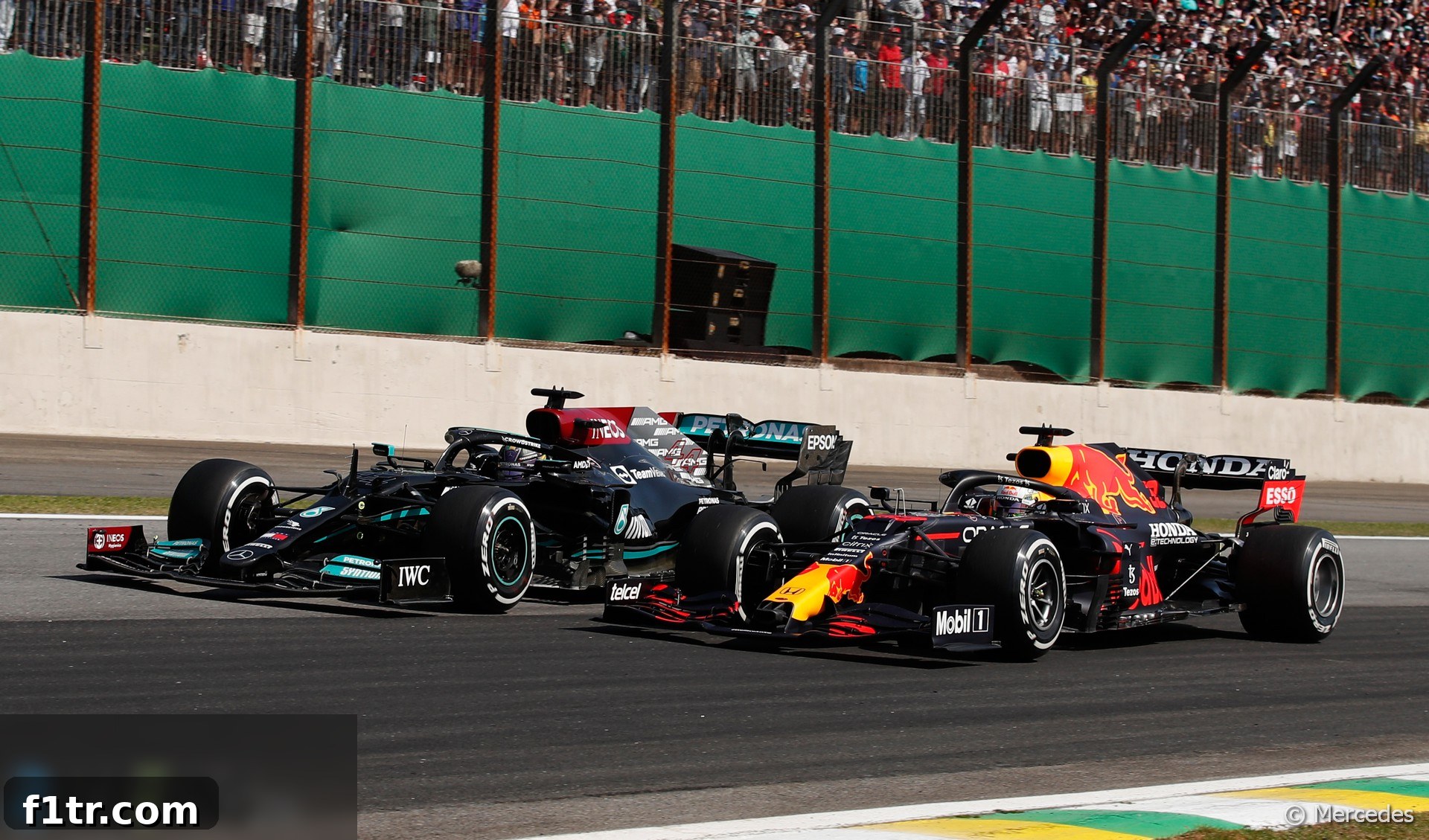
The aftermath of the controversial Interlagos Grand Prix decision, where stewards opted not to penalise Max Verstappen for his audacious lap 48 maneuver against Lewis Hamilton, continues to send ripples of consternation throughout the Formula 1 paddock. This pivotal incident, which saw Verstappen and Hamilton run wide while battling for position, became a flashpoint, igniting a fervent debate among drivers and teams regarding the consistency and clarity of racing regulations.
Advert | Become a Supporter & go ad-free
As Hamilton attempted an overtake on Verstappen’s outside approaching Descida do Lago, the Red Bull driver braked significantly earlier than expected and ran off the circuit, forcing his rival wide and effectively retaining his track position. To the surprise of many, the stewards not only allowed Verstappen to keep his position but also declined to initiate an investigation into the incident, leaving a vacuum of explanation and stirring widespread speculation.
The opportunity for reconsideration arose during the Qatar Grand Prix weekend, when Mercedes lodged a formal request for review, presenting previously unseen onboard footage from Verstappen’s car as new evidence. However, this hope for public clarification was dashed when the stewards, on Friday in Qatar, firmly spurned the chance to revisit the hotly-disputed decision, confirming their original stance and leaving many questions unanswered.
Despite the stewards’ refusal to re-examine the case publicly, the matter was far from settled. It dominated the agenda of the drivers’ regular briefing with FIA Formula 1 Race Director Michael Masi, held on Friday evening in Qatar. The meeting, which extended beyond an hour, highlighted the deep divisions and varied interpretations among the competitors. Predictably, the two championship contenders, Verstappen and Hamilton, subsequently offered starkly contrasting accounts of the discussions and their outcomes.
Verstappen conveyed an impression of a highly productive session, suggesting that the meeting was primarily “all about sharing their opinions, and then the FIA explaining their process of thought behind it.” The Red Bull driver expressed satisfaction, feeling that “we came a long way, it was a very long briefing, I think at the end it was pretty clear.” His words painted a picture of a successful dialogue leading to a unified understanding.
Hamilton, however, flatly contradicted Verstappen’s optimistic assessment, underscoring the persistent lack of clarity and the widespread confusion among his peers. “No, it’s not clear,” Hamilton insisted, reflecting the frustration that many drivers shared. “Every driver, except for Max, was asking just for clarity. Most drivers were asking for clarity, but it wasn’t very clear.” He further elaborated on the core issue, stating, “It’s still not clear what the limits of the track are. It’s clearly not the white line anymore, when overtaking. But we just go for it. We just ask for consistency.” Hamilton also pointed out a concerning admission from the FIA: decisions “could be different with different stewards, is what they said.” This statement, implying a potential lottery in rulings, only exacerbated the calls for greater uniformity.
At this juncture, Verstappen interjected, expressing his clear displeasure regarding the public dissemination of the meeting’s sensitive discussions. “We discuss these kind of things and they don’t need to go to the media,” he asserted. “We talk to the experts and I think it’s more important that we discuss these things with the experts and not just throw things around on social media for nothing.” His viewpoint highlighted a desire for internal, private resolution of complex racing issues, away from public scrutiny and potential media sensationalism.
Advert | Become a RaceFans supporter andgo ad-free
Despite Verstappen’s request for discretion, many of their rivals were surprisingly open and willing to air their views on the discussion, echoing Hamilton’s sentiment that the meeting had failed to bring much-needed clarity to a critical area of the sport’s regulations. The sentiment was that fundamental questions about fair racing and the boundaries of competitive maneuvers remained unaddressed.
“I don’t think we got really an explanation like what we actually can do, or not,” commented Valtteri Bottas, Hamilton’s Mercedes teammate. Bottas, while acknowledging that drivers now at least “know what Lewis and Max ended up having in Brazil, that is okay,” suggested this minimal understanding was far from comprehensive guidance for future racing scenarios. Other drivers, however, felt even less had been concretely established, indicating a pervasive sense of ambiguity.
Among those calling for clearer rules was Fernando Alonso, a veteran driver with no direct ties to the championship battle, who has repeatedly voiced his own grievances over stewards’ decisions throughout the season. Alonso reiterated his firm belief that Formula 1 is plagued by too many grey areas in its rulebook, leading to inconsistent application and frustration. “I think we are all agreed on that we need more consistency,” he stated, emphasizing the collective desire for definitive guidelines.
Alonso passionately argued for “black and white rules because when they are grey sometimes you feel you are benefiting from them and sometimes you’ve been the idiot on track again. So it’s better when it’s black and white.” This sentiment resonates deeply within the driver community, highlighting the subjective nature of current rulings and the perceived unfairness it can create. He added, “Let’s see if we can improve altogether. I think it’s not only an FIA issue, it’s drivers, teams, FIA, all we need to work together to have better rules.” This broad call for collaboration underlines the complexity of the problem, suggesting it requires a multi-faceted solution involving all stakeholders.
While justifications for the Verstappen decision were offered by the officials during the briefing, Alonso noted that drivers quickly highlighted inconsistencies when comparing the Interlagos ruling to past calls. “Obviously when they explain it they say why they do this and with the reason. So, okay, understandable. But we are all saying ‘but why other times you thought the opposite?’” he explained, perfectly encapsulating the core of the drivers’ frustration. With a wry laugh, he added, “But they are always right, that is the problem.” His comment underscored the inherent power dynamic and the drivers’ perceived inability to truly challenge or change the stewards’ ultimate authority.
Carlos Sainz Jnr of Ferrari believes that the matter is far from settled and anticipates further extensive discussions regarding this fundamental aspect of racing regulations. The lack of resolution from the Qatar meeting signals that this debate will likely extend into the off-season, prompting deeper consideration of the core principles of wheel-to-wheel combat.
“It looks like over the winter there’s going to be some more deep conversations about how we go racing as a sport, if the car in the inside should leave space to the car on the outside, in any case or not,” said the Ferrari driver. He articulated the pressing need to rethink the entire approach to racing conduct, particularly when cars are side-by-side. “We need to rethink a bit the whole approach because the way it’s been working this year, I think it’s pretty clear that the drivers really don’t fully understand what is going to happen depending on what you do.” This admission of widespread driver confusion is a stark indictment of the current regulatory framework.
Sainz further highlighted a comparable case from the Austrian Grand Prix earlier in the season, where Lando Norris received a five-second time penalty for forcing Sergio Perez wide into a gravel trap. This incident was repeatedly cited as a direct example of how the Verstappen decision at Interlagos strikingly contradicted previous rulings by the stewards, creating a precedent of inconsistency that perplexed many.
“Let’s see [in the final races], hopefully there are not too many more episodes like this, like what happened in Brazil or in Austria to the contrary, and see if we can improve as a sport for next year,” Sainz said, expressing a hope for immediate improvement. He stressed the fundamental need for drivers to understand the consequences of their actions: “We need to know, I need to know if I can push the car on the outside wide, and what am I going to get if I do so.” The lack of predictability creates a challenging environment for drivers, who are constantly pushing the limits of their machinery and their rivals.
Sainz continued his detailed questioning of the decision-making process: “Do you have a warning coming if you do it once? Do you have actually a possibility to do it a couple of times and then you get a warning and then you can do it a fourth time? Are you going to get a penalty straight away, like in Austria?” These specific questions underline the arbitrary nature drivers currently perceive in the application of penalties, which directly impacts their racing strategy and confidence. He concluded, “This is what we don’t know as a sport or as drivers. We were seeking for answers. We more or less got some from Michael, but we know that sometimes Michael and stewards are not always exactly the same. So we will see going into next year. I think next year we should do a good step. These last three races we will see.” His statement hints at a potential disconnect between the race director’s guidance and the stewards’ ultimate decisions.
Advert | Become a RaceFans supporter andgo ad-free
Lando Norris, whose own penalty in Austria was a point of comparison, surmised that the crucial difference in the Verstappen-Hamilton incident at Brazil was the type of run-off area. He concluded that Verstappen went unpunished at Interlagos because the run-off was asphalt, allowing Hamilton to rejoin safely, whereas Norris was penalised because Perez was forced into a gravel trap at Austria. The McLaren driver felt this distinction was unfair, arguing that a penalty should not hinge on the nature of the run-off area. Sainz agreed with this perspective, stressing the need for consistency regardless of track design.
“In my humble opinion as a racing driver, it should be no difference because [of the] outside of the track,” Norris asserted. “We’re always going to have different run-off areas and we should try, for the fans to understand the sport, for the drivers to understand the racing, it shouldn’t [be affected by] what’s on the other side of the kerb.” This call highlights the importance of fair play and clear rules that are not contingent on external factors, promoting a more equitable and understandable sport for both participants and spectators.
Other drivers emphasized Hamilton’s role in preventing a collision, underscoring the potential for a much more severe outcome had he not taken evasive action. “Lewis was watching the mirror and avoided a crash,” pointed out Yuki Tsunoda, who himself received a penalty for a separate incident with Lance Stroll in the same race. Tsunoda’s comparison was particularly poignant: “If he was not looking, like Stroll, definitely they would have had a crash. And they didn’t give any penalty and I get 10 seconds penalty, which is a massive difference, so it’s quite inconsistent, to be honest.” His remarks lay bare the perceived double standards and the resulting frustration among drivers.
Daniel Ricciardo also weighed in, stating that the issue “still seems unclear” following the Qatar meeting. However, he found some semblance of consistency in another incident from the Brazilian Grand Prix involving the Ferrari drivers, Charles Leclerc and Carlos Sainz, comparing it to the Verstappen-Hamilton encounter. “In a way they were consistent with two of the same moves in Brazil, with Charles [Leclerc] and Carlos, and Max and Lewis. They didn’t give penalties or make them swap positions for those two. Whether that was right or wrong, at least they showed consistency in two very, very similar incidents.”
Ricciardo drew further parallels to an incident in Austria last year where Lance Stroll forced him off track, gaining a position that the stewards allowed him to keep. However, a subsequent meeting with Masi led Ricciardo to believe that the stewards later changed their minds about the decision, highlighting the fluctuating nature of interpretations even post-race. His analysis of the Interlagos situation was pointed: “I think the fact that he attempted the past and didn’t make it – he went off track and that’s not a pass.”
He continued, “So there’s no way someone should be able to keep a position by lunging from miles back and not stay on-track.” Ricciardo emphasized the fundamental principle of racing: a maneuver must be executed cleanly within the track limits. “Now if he stayed on track and I went off, that’s hard racing, but that’s fair. He still made the corner and it’s my fault for leaving the door open. But if I had less awareness and just turned in on him, then we have a crash and he probably is getting a penalty and it’s maybe the same as the situations [in Interlagos].” His perspective highlights the fine line between aggressive racing and exceeding the bounds of what is considered fair.
Verstappen’s team mate, Sergio Perez, echoed the widespread sentiment for enhanced consistency and clarity from the stewards. “Just the same penalties throughout, you know, no difference from one race or the other,” he articulated, capturing the essence of the drivers’ demand for uniform application of the rules. “What we’ve been trying to push is just to have more consistency out there, which is obviously very hard because every circuit is very different.” Perez’s acknowledgement of the inherent difficulty in achieving consistency across diverse track layouts underscores the complexity of the challenge facing the FIA.
In response to the drivers’ concerns, Michael Masi acknowledged the clear disagreement over the Interlagos decision, yet maintained that “it’s been made clear to them what is expected.” He further elaborated on the diverse opinions within the paddock: “I think the other part is some of them agree, some of them disagree, and always with each and every one of them they have agreed and disagreed all the way through.” Masi indicated that general guidance had been provided, but crucially, he reiterated the principle that “each and every case will be judged on its merits.” This individual case-by-case assessment, while intended to be fair, is often seen by drivers as the root cause of inconsistency.
Masi also confirmed that the type of run-off area at a given corner would indeed influence decisions regarding when drivers are allowed to force rivals wide. “You need to look at the whole situation and scenario: weather, run-off et cetera, et cetera,” he explained. This admission directly supports Norris’s hypothesis regarding the distinction between asphalt and gravel run-offs affecting penalties. However, Masi clarified that as the Race Director, the ultimate authority on what constitutes a legal move rests not in his hands, but with the independent panel of stewards.
The core of the problem remains the fact that since the Verstappen incident was never investigated, there was no formal explanation from the stewards themselves as to why they waved ‘play on’. This lack of transparency has fueled much of the confusion. For instance, did the stewards feel Hamilton had over-committed to the corner and wouldn’t have made it cleanly, regardless of Verstappen’s actions? Masi conceded, “I don’t know. I can’t give you the exact consideration. I wasn’t sitting in there when they made that decision. I was sitting in the first part of the right of review as an observer but nothing more.” His inability to provide insight into the stewards’ deliberation process highlights their independent, and at times opaque, role.
“There is a panel of independent stewards,” Masi emphasized, “Contrary to what many people think, I’m not the one sitting there as judge and jury, we have a panel of stewards that review each and every incident, and then as we saw last weekend, they determine if it’s worthy of an investigation. If they do, it gets investigated and then determine if there’s a breach or not a breach.” This organizational structure, while designed to ensure impartiality, has paradoxically led to the current crisis of confidence among drivers, largely due to the stewards’ decision not to even investigate the Interlagos incident, leaving the racing rules shrouded in a cloud of uncertainty that Friday’s meeting did little to dissipate, despite Verstappen’s assertion otherwise.
The Losail International Circuit was never expected to be a hotbed of wheel-to-wheel racing, and indeed, it proved to be a track where the Interlagos case, which had puzzled so many drivers, was not put to the test. This meant the profound questions surrounding track limits and aggressive defending remained unanswered on track.
The pressing question now looms large: will these unresolved issues be tested in the intensely competitive final rounds of the season? And more critically, could the ongoing ambiguity surrounding stewarding decisions play a decisive, and potentially controversial, role in determining the finely-poised championship fight, risking the integrity and perception of fairness in Formula 1?
Go ad-free for just £1 per month>> Find out more and sign up
2021 Qatar Grand Prix – Related Articles
- Pirelli’s investigation into Qatar tyre failures indicates kerbs caused punctures
- Horner rejects talk of title fight pressure after criticism over marshal comment
- “I don’t know how much slower I can go”: Inside Ricciardo’s unnecessary economy run
- ‘No regulator in the world will be popular’ with a title fight this intense – Masi
- Why drivers backed Hamilton’s call for clarity after meeting over Verstappen incident
Browse all 2021 Qatar Grand Prix articles