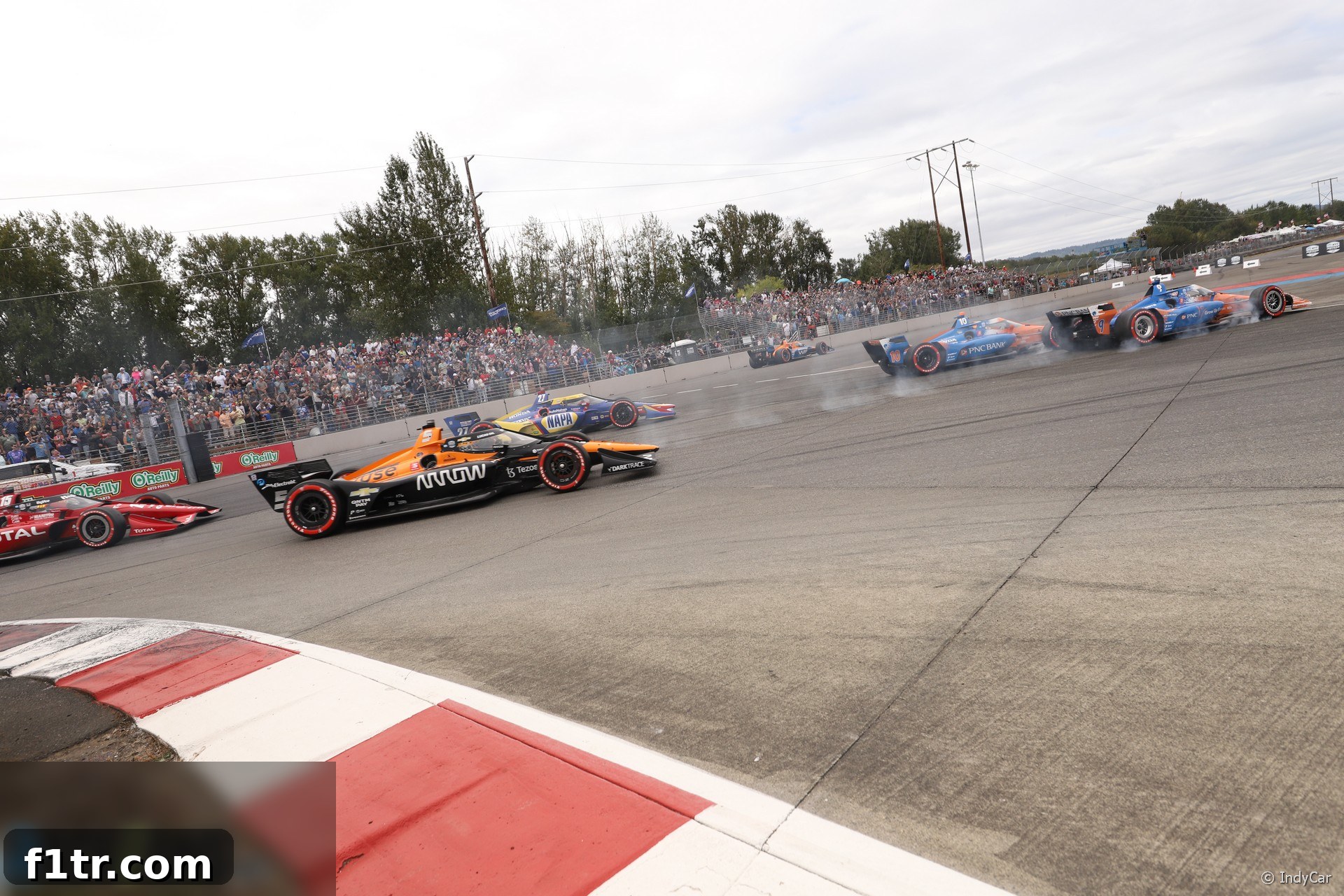
First-Lap Carnage at Portland: IndyCar Stars React to Turn 1 Chaos
The exhilarating world of open-wheel racing often promises high-octane drama, and the Portland International Raceway delivered in spades – though perhaps not in the way many had hoped. Mere hours after Formula 1 witnessed a championship flashpoint at Monza’s Variante del Rettifilo, the IndyCar series served up its own dose of first-lap pandemonium at Portland’s challenging Turn 1-2 chicane. This notoriously tight right-left sequence quickly became the scene of a multi-car pile-up, leaving several of IndyCar’s most experienced competitors distinctly unimpressed with the conduct of certain rivals.
The Chaos Unfolds: A Domino Effect at Turn 1
The tension was palpable as the field thundered towards the demanding first corner. Pole-sitter Álex Palou and his Chip Ganassi Racing teammate Scott Dixon led the charge, navigating the initial braking zone. Behind them, a chain of events began to unravel with alarming speed. Felix Rosenqvist, eager to make up ground, attempted to pass Alexander Rossi for third place. As Dixon strategically moved right, aiming to challenge Palou, Rosenqvist darted left, resulting in an immediate contact with Dixon’s left-rear wheel. This impact critically unsettled Dixon’s car under heavy braking, forcing both Dixon and Palou to take evasive action by short-cutting the infield portion of the chicane to avoid further contact.
Rosenqvist, caught in the sequence, was left with little recourse but to drive straight through the escape road. “I didn’t really have a choice but to go straight,” Rosenqvist later recounted, “I couldn’t have really done anything so it was out of my hands, which is a shame.” However, the repercussions were far from over. The incident at the front had a devastating ripple effect through the mid-pack, transforming the chicane into a bottleneck of accelerating and decelerating machines.
The heart of the chaos further back saw Romain Grosjean, known for his aggressive racing style, approach the braking zone with too much speed. He subsequently struck the right-hand side of James Hinchcliffe’s car. Hinchcliffe himself had just checked up sharply to avoid running into the back of Sébastien Bourdais, setting up the unfortunate collision. Simultaneously, IndyCar debutant Callum Ilott, reacting to the rapidly unfolding drama, locked up his rear wheels in an attempt to avoid hitting Scott McLaughlin. This uncontrolled slide sent Ilott directly into the path of championship contender Will Power and four-time Indianapolis 500 winner Hélio Castroneves. To complete the picture, Oliver Askew also locked his rear wheels, desperately trying to prevent a side-impact collision with his team-mate, Graham Rahal.
Immediate Aftermath and Lingering Damage
While the potential for total destruction was immense, the immediate aftermath left five drivers stranded on track as the caution flag was deployed: Will Power, Oliver Askew, Hélio Castroneves, Romain Grosjean, and James Hinchcliffe. Power and Askew, remarkably, managed to resume racing after their cars were reset. However, the other three drivers suffered significant and terminal damage, their hopes for a strong finish vanishing within the first few hundred feet of the race.
Veteran Voices: Frustration and Disbelief
Hélio Castroneves’ Torpedo Analogy
Among those severely impacted was motorsport icon Hélio Castroneves, making his first Portland start since the 2001 CART IndyCar season. His frustration was palpable, echoing the sentiments of many seasoned drivers who understand the delicate balance of aggression and caution required in Turn 1. “Obviously, it’s Turn 1, and everybody knows it’s going to be a problem, right?” exclaimed the visibly upset Brazilian. “So we’ve got to use common sense.”
Castroneves continued, painting a vivid picture of the unfolding chaos: “I just saw somebody coming like a torpedo! The experienced guys start backing off, and I don’t know who it was, that just came and started hitting everybody. I guess the guy from the right side got hit, hit me, I end up hitting somebody on the left and bent the suspension.” The veteran’s comments highlighted a perennial issue in racing: the contrast between aggressive newcomers and the more measured approach of those with years of experience under their belt. Despite extensive repairs by his Meyer Shank Racing crew, Castroneves was many laps down, turning the remainder of his race into an impromptu test session for the upcoming challenge at Laguna Seca. He was ultimately classified 23rd, a distant 19 laps behind the leaders.
Hinchcliffe’s Heartbreak and Career Crossroads
For James Hinchcliffe, the incident at Portland carried a heavier weight than mere race results. At the end of a frustrating season with Andretti Autosport, his driving future in the series hung precariously in the balance. Unable to continue after limping his stricken number 29 Dallara/Honda back to the garage, Hinchcliffe was left in 27th and last place in the running order. For a multiple race winner fighting for his career, this was precisely what he did not need.
Hinchcliffe vented his profound frustrations pointedly towards Grosjean during a television broadcast. “It’s comical at this point. It’s so sad,” he began, his voice laced with disappointment. “You watch the replay, Romain wasn’t going to make the corner no matter what. I don’t know why he decided to brake so late, starting where we were with a 110-lap race. I’m sure he’s just as upset as everyone else. I mean, it’s an easy mistake to make. But I just can’t believe we keep being on the receiving end of this stuff, you know?” His anguish was clear, stemming from a season marred by misfortune and the added sting of a rival’s perceived recklessness. “We nearly got in the back of Bourdais, I avoided getting any contact there, and then we just got absolutely clobbered. It’s just so frustrating, it’s so disappointing. It would have been fun to see what we could do, but now we’re just, kind of on the sidelines watching.”
Grosjean’s Contrition and Rookie Battle
Romain Grosjean, whose early Formula 1 career was sometimes overshadowed by a reputation for first-lap incidents, was quick to acknowledge his role in the collision and offer a sincere apology. His move to IndyCar had largely seen a more mature and measured approach, often praising the respectful nature of the racing. This incident, therefore, was a stark reminder of the fine margins in motorsport.
“Portland was definitely not the weekend that we were hoping for,” Grosjean commented. “Qualifying was not easy and I made a mistake going into Turn 1 at the start. I’m sorry to everyone that was involved.” He expressed regret over the missed opportunity: “It’s too bad because we had really good pace, but we lost too much time at the beginning. Hopefully we do better next week at Laguna Seca.” The incident proved costly beyond just race position, impacting his fight with Scott McLaughlin for top rookie honors in the series. Finishing 15 laps down in 23rd position, Grosjean headed to Laguna Seca trailing McLaughlin by a significant 38 points with only two races remaining, making his path to the top rookie title considerably harder.
The Anatomy of a First-Lap Incident in Motorsport
First-lap incidents, particularly at tight chicanes like Portland’s Turn 1-2, are an unfortunately common occurrence in racing. They stem from a volatile mix of factors: the sheer number of cars vying for position, the cold tires offering reduced grip, the natural aggression of drivers eager to gain an early advantage, and the inherent compression of the field into a narrow bottleneck. Even the most experienced drivers can be caught out by a small misjudgment or, as Castroneves pointed out, a “torpedo” from behind. These moments are a harsh reminder of the fine line between calculated risk and outright chaos, often defining the trajectory of a race and, sometimes, a championship. They underscore the importance of not just raw speed, but also race craft, spatial awareness, and the ability to anticipate danger in a split second. While regrettable, they are an integral part of the narrative and spectacle that draws fans to the sport, serving as dramatic lessons learned for all involved.
Looking Ahead: Redemption at Laguna Seca
As the IndyCar series packed up from Portland, the immediate focus shifted to the upcoming race at Laguna Seca. For Castroneves, the opportunity to use the Portland race as a test session provided some solace, giving his team valuable data for the next challenge. For Hinchcliffe, Laguna Seca would be another critical opportunity to showcase his talent and secure his future in the series, hoping to leave the Portland debacle firmly in the rearview mirror. And for Grosjean, it represented a chance for redemption, to demonstrate his true pace and claw back some ground in the rookie championship battle, proving that his Portland error was an isolated misstep rather than a return to old habits. The drama of IndyCar racing, even in its most chaotic moments, always promises another chance for glory.
IndyCar News and Analysis
- IndyCar driver McLaughlin cleared of injury after crashing through barrier at Barber
- Schumacher says his IndyCar feels like ‘an F2 car, just with better tyres’
- IndyCar “way faster than Formula 1” in some corners, says Grosjean
- FIA to award more F1 superlicence points to IndyCar drivers from 2026
- Schumacher to race full-time in IndyCar with RLL in 2026
Browse all IndyCar articles