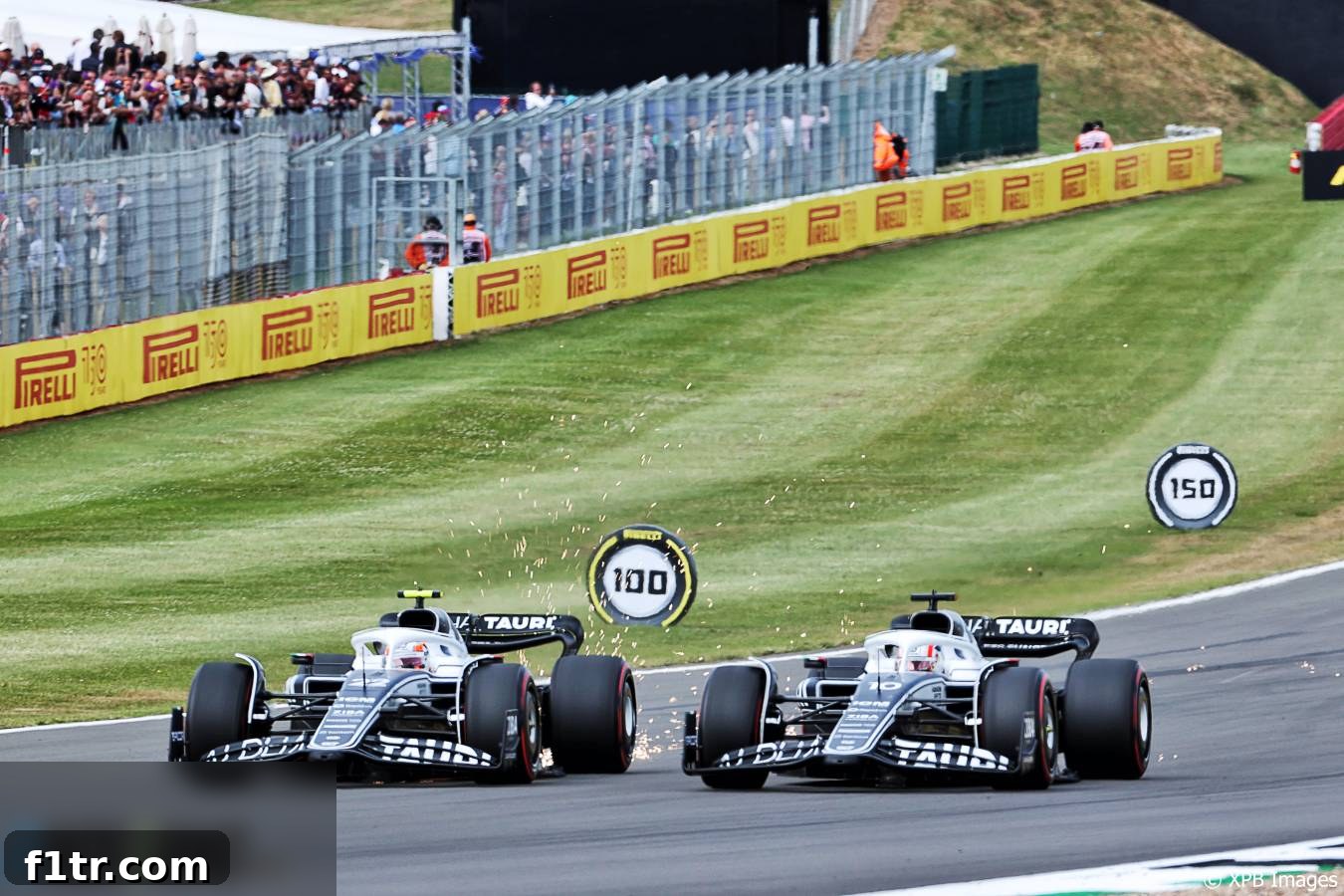
As the 2022 Formula 1 season reached its halfway point, a compelling narrative was unfolding within the AlphaTauri garage: had Yuki Tsunoda truly elevated his performance in his sophomore year, or was he merely benefiting from a streak of good fortune compared to his seasoned teammate, Pierre Gasly? The early races presented a mixed picture, where Gasly, a proven race winner, could point to several unfortunate encounters with Tsunoda as direct reasons for the surprisingly narrow five-point gap separating them after the initial 13 rounds.
Gasly’s frustration with Tsunoda was palpable on more than one occasion. The qualifying session in Australia saw tensions rise, and later in Monaco, Gasly’s promising practice pace — which hinted at a rare points haul for the uncompetitive AT03 chassis — was inadvertently compromised by a teammate incident. However, the most direct and costly clash occurred at Silverstone. In a moment of aggression, Tsunoda was directly responsible for knocking Gasly off the track at Village, an error that not only cost both drivers crucial points but also underscored a lingering immaturity in Tsunoda’s race craft that many observers had noted during his rookie year.
Yuki Tsunoda’s Ascent: From Raw Talent to Polished Performer in 2022
Despite these early season skirmishes and the initial uncertainty, as the 2022 season progressed towards its conclusion, a clearer picture emerged: the “rough diamond” that Yuki Tsunoda appeared to be in 2021 had indeed undergone significant polishing. While he may not have consistently matched Gasly’s top-tier performances, the raw speed and inherent talent that AlphaTauri identified when they promoted him from Formula 2 at the end of 2020 became increasingly evident. This maturation was particularly striking in their qualifying head-to-head. After suffering a dominant 19-1 qualifying defeat to Gasly in 2021, Tsunoda managed to conclude the 2022 season with a qualifying record that was almost level with his highly-rated teammate. This dramatic shift was a testament to his improved consistency, better understanding of the AT03, and a more disciplined approach to race weekends.
Tsunoda’s development wasn’t solely about raw pace; it encompassed a broader understanding of Formula 1 racing dynamics, including crucial aspects like tire management, strategic thinking, and emotional control – areas where he had previously struggled. His enhanced ability to extract single-lap pace, often on par with Gasly, showcased a driver growing in confidence and technical acumen. This newfound composure, while not entirely eradicating all his previous tendencies for error, certainly reduced their frequency and impact, allowing him to convert his qualifying potential into more credible race performances, even if consistent points finishes remained elusive for the team as a whole due to the car’s limitations. This steady progress painted a promising picture for his long-term future in the sport, hinting at a driver who was genuinely learning and adapting to the elite demands of F1.
Pierre Gasly’s Challenging 2022 Season: Incidents, Penalties, and Missed Opportunities
While Tsunoda showed marked improvement in qualifying, Pierre Gasly, in contrast, continued to deliver more consistently on race days, particularly when it came to converting opportunities into championship points. In a season where points finishes were exceptionally hard to come by for AlphaTauri, Gasly concluded the year with nearly double his teammate’s points tally. His standout performance was a commendable fifth-place finish in Baku, which not only represented AlphaTauri’s best result of the year but also highlighted his enduring ability to maximize an underperforming car on circuits that suited his driving style. This result, achieved early in the season, served as a poignant reminder of Gasly’s talent and experience, contrasting sharply with Tsunoda’s struggle to break into the top ten, which he managed only once after the Spanish Grand Prix in May.
However, Gasly’s 2022 campaign was not without its own set of self-inflicted challenges, which arguably prevented him from widening the points gap to Tsunoda even further. On several occasions, Gasly found himself in trouble through his own actions, leading to penalties that impacted his race results and, critically, his accumulated penalty points. A notable incident occurred in Mexico, where he incurred a five-second time penalty for an unnecessary collision with Lance Stroll. This wasn’t their first tangle; Gasly had also been penalized for an incident involving Stroll in Australia earlier in the season. Such missteps meant that in Mexico, he crossed the finish line in 11th position, agonizingly less than a second behind Valtteri Bottas, thereby missing out on a valuable championship point. These recurring incidents underscored a degree of frustration that seemed to permeate Gasly’s season, possibly exacerbated by the AT03’s inconsistent performance.
The cumulative effect of these penalties became a significant concern as he ended the year precariously close to the 12-penalty point threshold, which automatically triggers a race ban. This looming threat undoubtedly added immense pressure to his final races with AlphaTauri and would be a considerable point of concern for his new team, Alpine, as he prepared for his transfer. It highlighted a potential area for improvement in Gasly’s own race management, particularly when battling in the dense midfield where margins are tight and patience is paramount. While Gasly’s raw speed and experience were unquestionable, his propensity for collecting penalties posed a strategic risk that needed to be addressed for his future success.
Race-by-Race Performance Snapshot: Gasly vs. Tsunoda in 2022
While a detailed race-by-race table for their 2022 season performance is beyond the scope of a static HTML representation, a summary of their competitive dynamic reveals key trends. Gasly consistently demonstrated a knack for navigating race day chaos and optimizing strategy, often turning difficult starting positions into stronger finishes. His fifth-place in Baku was a prime example, achieved through a combination of speed and smart racing. Tsunoda, conversely, showed flashes of brilliance, particularly in qualifying, but sometimes struggled to maintain that performance over a full race distance, occasionally falling victim to race incidents or tire degradation issues that plagued the AT03.
In Bahrain and Saudi Arabia, Gasly showed his experience by bringing home points, while Tsunoda struggled with consistency. Australia, as mentioned, saw the start of their on-track clashes. Imola and Miami were challenging for both, but Gasly generally had the edge in race execution. Monaco was a lost opportunity for Gasly, compromised by a Tsunoda incident after showing strong practice pace. Azerbaijan was Gasly’s undisputed highlight. Throughout the middle of the season – Canada, Great Britain (where Tsunoda caused the collision), Austria, France, and Hungary – Gasly largely outscored Tsunoda, consistently battling for the lower points positions, even if the car wasn’t always up to the task. As the season neared its end in races like Singapore, Japan, USA, Mexico, Brazil, and Abu Dhabi, the points difference widened further in Gasly’s favor, though Tsunoda’s qualifying pace often kept him in contention.
The Evolving Dynamic and Future Implications for AlphaTauri Drivers
The partnership between Pierre Gasly and Yuki Tsunoda, despite its complexities and on-track incidents, ultimately proved to be mutually beneficial in some respects. Gasly, with his experience, clear leadership, and benchmark-setting performances, consistently pushed Tsunoda to refine his skills and elevate his game. Conversely, Tsunoda’s rapid improvement and burgeoning speed kept Gasly on his toes, preventing any complacency and demanding his absolute best. It is a testament to the significant growth Tsunoda experienced that he expressed sincere disappointment at their parting of ways, acknowledging the positive influence Gasly had on his development as a Formula 1 driver. This sentiment speaks volumes about the professional respect that grew between the two, transcending the occasional on-track skirmishes.
With Gasly moving on to Alpine for the 2023 season, a new chapter begins for Tsunoda at AlphaTauri. He now steps into a more senior role, albeit with a fresh challenge in the form of his incoming teammate, Nyck de Vries. De Vries, a former Formula E champion and Mercedes reserve driver, brings a wealth of experience and a fresh perspective to the team, having impressed greatly with a points-scoring performance in his one-off F1 debut. For Tsunoda, the upcoming season will be absolutely crucial. He must continue to build on his 2022 progress, demonstrating not just flashes of speed but consistent, mature performances to firmly persuade Red Bull’s decision-makers that he possesses the mettle, consistency, and race craft required for a potential promotion to the sport’s elite team. This will involve minimizing errors, maximizing every opportunity, and decisively outperforming his new teammate, laying a clear claim for a future at the highest level of Formula 1.
AlphaTauri’s 2022 Performance Context: A Challenging Season
It is important to view both drivers’ performances within the broader context of AlphaTauri’s 2022 season. The AT03 was, by most accounts, not a front-running car. It often struggled for consistent pace, especially compared to its main midfield rivals, and proved to be a difficult package to extract maximum performance from. This inherent lack of competitiveness placed additional pressure on both Gasly and Tsunoda to extract every ounce of potential from the machinery, making points finishes genuinely hard-earned. Gasly’s ability to secure a fifth-place in Baku was a masterclass in maximizing an uncompetitive package, showcasing his ability to capitalize on specific track characteristics and strategic opportunities.
Tsunoda’s improved qualifying performances, even when not always converting to points, highlighted that the car did possess moments of potential, which he was increasingly able to tap into as he gained experience. The team’s overall position in the constructors’ championship reflected these struggles, ultimately finishing ninth. Both drivers had to contend with a car that was often on the back foot, demanding precision, strategic acumen, and exceptional driving to even contend for the lower points-scoring positions. Their individual battles and growth trajectories must therefore be assessed against this backdrop of a challenging season for the AlphaTauri team as a whole, underlining the resilience and talent required to compete in Formula 1.
The dynamic between Yuki Tsunoda and Pierre Gasly in 2022 provided a fascinating subplot to the Formula 1 season. Tsunoda’s growth from a raw, error-prone rookie to a more refined and consistently quick driver was undeniable, especially evident in his qualifying form. Gasly, despite his moments of brilliance and superior race day execution, faced a challenging year marked by an uncompetitive car and a troubling accumulation of penalty points. As Gasly embarks on a new challenge with Alpine and Tsunoda takes on increased responsibility at AlphaTauri alongside Nyck de Vries, the lessons learned from their shared season will undoubtedly shape their respective paths forward in the highly competitive world of Formula 1. The 2022 season served as a critical crucible for both drivers, forging their character and laying the groundwork for future successes.
Explore More from the 2022 F1 Season
For more in-depth insights and comprehensive analyses from the intriguing 2022 Formula 1 season, delve into our extensive archives. Discover detailed race reports, exclusive driver interviews, and technical deep dives that defined a memorable year in motorsport.
Browse all 2022 F1 season articles