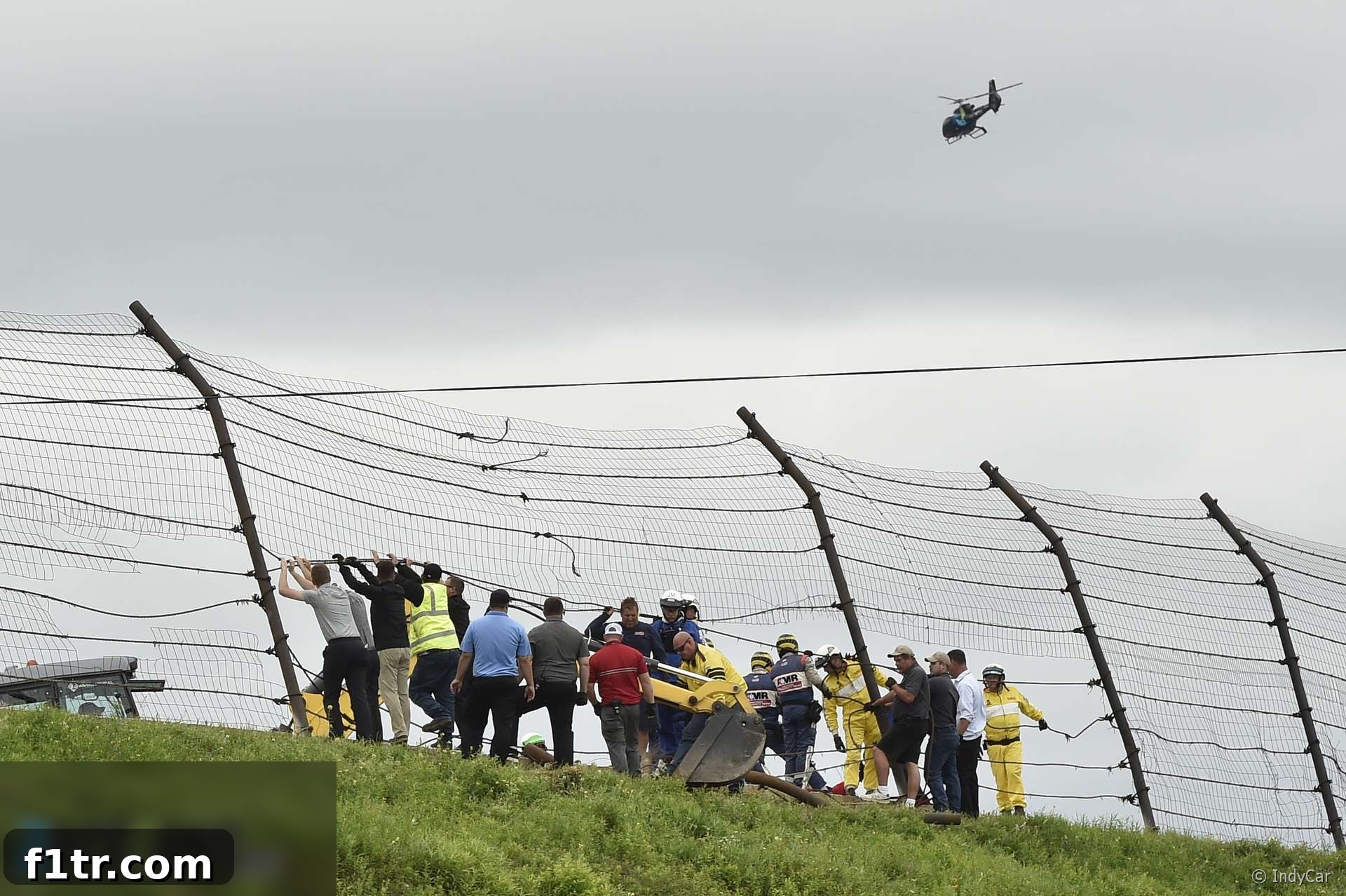
In the high-octane world of IndyCar racing, where speed thrills and risks are inherent, safety remains a paramount concern. Following a harrowing crash involving rising star Robert Wickens at the 2018 Pocono 500, motorsport veteran and 2003 Champ Car champion Paul Tracy issued a passionate plea for immediate and substantial improvements to safety protocols at oval tracks. Tracy’s call to action resonated deeply within the racing community, reigniting critical discussions about track design, barrier technology, and the ultimate well-being of drivers.
The incident at Pocono Raceway sent shockwaves through the motorsport world. During the fiercely contested race, Robert Wickens, then a promising rookie, was involved in a multi-car collision that saw his Schmidt Peterson Motorsports car launched violently into the catchfence at Turn 2. The sheer force of the impact tore the car apart and inflicted extensive injuries upon Wickens, including a thoracic spinal fracture, fractures to both legs, both hands, and his right forearm, as well as a pulmonary contusion. The horrifying spectacle, broadcast live, starkly underscored the brutal realities of open-wheel racing at such high speeds.
Paul Tracy, who was providing expert commentary for NBCSN during the race, witnessed the terrifying events unfold firsthand. His post-race comments on social media were not merely observations but a powerful demand for change. “I’m so relieved that Robert Wickens will be OK,” Tracy posted, reflecting the universal relief that Wickens survived the horrific crash. However, he quickly pivoted to the underlying issue: “But that again was too close for comfort. It’s long overdue for the racing industry to start looking into a new way of retaining the cars inside the track without poles, fence and cable.”
Tracy’s criticism specifically targeted the conventional chain-link fencing and their supporting posts, which are standard at many oval circuits. These fences, while designed to contain debris and protect spectators, pose a severe secondary threat to drivers whose cars collide with them. The posts can act as rigid, unforgiving obstacles, and the netting itself can snag or tear at a car, leading to unpredictable and often catastrophic outcomes. Tracy’s sentiment that he “would have much rather gone out of the park” than face the dangers of the fence encapsulates a profound preference for a controlled exit over the unpredictable violence of a barrier collision.
This was not an isolated concern but echoed a dark chapter in IndyCar’s history. Tracy poignantly referenced the loss of fellow driver Dan Wheldon, who tragically died in a multi-car crash at Las Vegas Motor Speedway in 2011 after his car struck a catchfence post. That incident led to significant safety reviews and changes in IndyCar, yet the Pocono crash indicated that more work was needed. Tracy also mentioned Dario Franchitti, a four-time IndyCar champion, who survived a similar terrifying crash at Houston in 2013 where his car launched into a catchfence, narrowly avoiding critical injury. These historical precedents highlight a recurring danger that the sport, despite its continuous safety advancements, had yet to fully mitigate.
The engineering challenges of designing safer barriers for high-speed oval tracks are immense. While innovations like the SAFER (Steel and Foam Energy Reduction) barrier have dramatically improved frontal and side impacts with concrete walls, the issue of cars going airborne and impacting catchfences remains complex. Modern solutions might involve developing stronger, more pliable, and less rigid fence materials, or exploring entirely new containment systems that absorb impact more effectively without presenting snagging hazards. The goal is to safely dissipate energy and keep cars within the track boundaries without creating new dangers for the drivers. Tracy stressed that this search for new solutions must be a collaborative effort, involving engineers, drivers, team owners, and track operators to find the “best solution and most cost-effective one.”
Adding another layer of urgency to Tracy’s comments was the immediate aftermath of Wickens’ crash. The race was red-flagged for an agonizing two hours as track crews worked to replace a damaged fence post. During this delay, Tracy’s former rival and fellow driver, Sebastien Bourdais, openly voiced concerns that the hastily executed repair job was inadequate. Bourdais’ courage to speak out while preparing to re-enter the race was significant. Tracy later lauded Bourdais, saying, “Kudos to Sebastien Bourdais for saying how it was and having the balls to get back in and have one of his best oval drives ever.” This incident underscored the immediate, tangible fears of the drivers and the critical need for robust, reliable safety infrastructure.
Paul Tracy’s “rant,” as he modestly termed it, was a heartfelt plea from a veteran who deeply understands the perils of the sport. His insistence that “racing is a dangerous game and we know the risks, but it can always be better” perfectly encapsulates the ongoing tension between the thrill of competition and the imperative of safety. The IndyCar community, including its dedicated fans, bears the collective responsibility to push for these advancements. Every incident, especially those as severe as Robert Wickens’, serves as a painful reminder and a catalyst for continuous improvement.
IndyCar has consistently been at the forefront of motorsport safety innovation, from head and neck restraints to advanced chassis designs and, more recently, the implementation of the Aeroscreen. However, the events at Pocono demonstrated that the journey toward ultimate driver safety is never truly complete. The dialogue initiated by Paul Tracy, reinforced by the experiences of Wickens, Wheldon, and Franchitti, spurred further investigation into safer track barriers, promising that the sport would continue its relentless pursuit of a future where high-speed racing is as safe as it is exhilarating. The spirit of innovation and dedication to driver well-being remains a cornerstone of IndyCar racing.
IndyCar
- IndyCar driver McLaughlin cleared of injury after crashing through barrier at Barber
- Schumacher says his IndyCar feels like ‘an F2 car, just with better tyres’
- IndyCar “way faster than Formula 1” in some corners, says Grosjean
- FIA to award more F1 superlicence points to IndyCar drivers from 2026
- Schumacher to race full-time in IndyCar with RLL in 2026
Browse all IndyCar articles