Advert | Become a Supporter & go ad-free
Formula 1’s Persistent Battle: Redefining Track Limits at Portimao
The exhilarating world of Formula 1 consistently pushes the boundaries of speed, technology, and human skill. Yet, amidst this relentless pursuit of performance, a fundamental challenge often emerges: defining the precise limits of the racing surface. This perennial issue came sharply into focus at the Autodromo do Algarve, the home of the Portuguese Grand Prix. During the initial practice sessions, the circuit, known for its undulating nature and sweeping corners, presented a significant headache for both drivers and race control regarding track limit enforcement. The sheer volume of infringements necessitated an immediate and decisive review, highlighting the critical balance between allowing drivers to extract maximum performance and maintaining sporting integrity.
The Portimao Predicament: Over 100 Violations Spark Urgent Rule Review
The first day of action at the picturesque Portuguese track quickly revealed a systemic issue. Over the course of Friday’s two 90-minute free practice sessions, a staggering 125 lap times were deleted by the stewards. The primary culprits for these widespread violations were identified as Turns One and Four, two critical corners where drivers naturally sought to maximize their exit speed and carry momentum onto the subsequent straights. The initial strict policing mechanism dictated that any deviation beyond the white lines marking the very edge of the circuit at these points would result in the immediate invalidation of the lap time. This strict interpretation, while clear in its intent, led to widespread frustration and a significant number of lost laps, making it challenging for teams to gather meaningful data and for drivers to find a consistent rhythm.
The nature of the Autodromo do Algarve’s layout, with its fast, open corners and generous run-off areas, often tempts drivers to explore the very limits of the tarmac. While these run-offs are crucial for safety, they can inadvertently offer drivers an incentive to push beyond the official track boundaries without immediate penalty, leading to a constant battle for millimetres. The high count of invalidated laps at Turns 1 and 4 underscored the need for a practical and fair solution that respected both the competitive spirit of F1 and the overarching principles of fair play. The situation demanded a nuanced approach, acknowledging that while rules must be upheld, an overly zealous application could detract from the sporting spectacle and create unnecessary confusion during a crucial Grand Prix weekend.
Adapting the Rulebook: Race Control’s Swift Response to Track Limit Enforcement
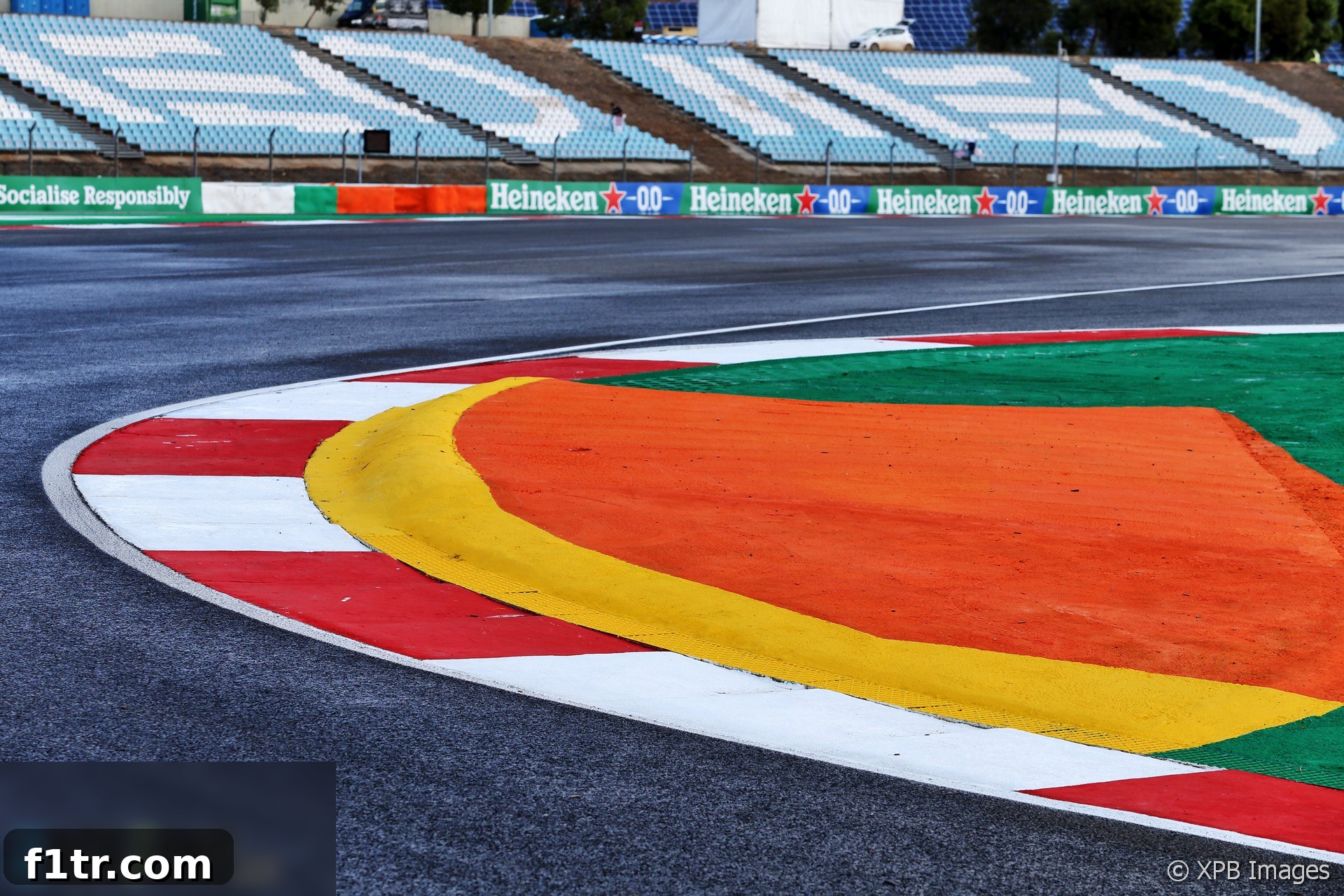
Recognizing the immediate need for clarity and a more pragmatic approach, Formula 1 race director Michael Masi promptly issued revised instructions to the teams and drivers. Effective from the final practice session onwards, the boundary for track limit infringements at Turns One and Four was significantly relaxed. Under the updated directive, drivers are now permitted to run beyond the white line, provided they maintain continuous contact with the distinctive red and white kerb positioned immediately beyond the track’s white edge. This adjustment aimed to offer drivers a clearer visual and tactile reference point, allowing them to push closer to the absolute limit without fear of instant penalty, as long as they respected the physical boundaries of the kerb.
Masi’s updated notes, disseminated to all competitors, precisely articulated this new interpretation: “A lap time achieved during any practice session or the race by leaving the track and cutting behind the red and white kerb on the exit of turn one [or turn four] will result in that lap time being invalidated by the stewards.” This distinction is crucial; merely touching or running on the kerb is now permissible, but completely leaving the kerb behind and gaining an advantage by cutting the corner aggressively remains an offense. This clarification sought to provide a common-sense solution, ensuring that drivers could exploit the full width of the circuit, including the initial part of the kerb, while still penalizing blatant attempts to shortcut the corner or gain an unfair advantage by running wide onto the run-off areas. The change reflected F1’s ongoing commitment to finding workable solutions that balance strict enforcement with the dynamic realities of top-tier motorsport.
Navigating Turn 15: A Specific Challenge at Portimao’s Final Corner
Beyond the initial focus on Turns One and Four, race control also issued specific guidance for Turn 15, the circuit’s crucial final corner. This corner, which leads onto the long main straight, is vital for setting up fast lap times and optimizing overtaking opportunities into Turn 1. The revised instructions clarify that at Turn 15, drivers will “be judged to have left the track if no part of the car remains in contact with the track.” This phrasing is designed to be less ambiguous than a simple white line rule, accommodating the slight variations in car trajectory and contact with the very edge of the tarmac or indeed, with the kerb itself. It implies a ‘four wheels off’ rule, meaning that as long as at least one wheel maintains contact with the racing surface or its immediate physical boundary (such as the painted kerb), the driver is considered to be within the track limits. This bespoke instruction for Turn 15 underscores the intricate, corner-by-corner analysis that often goes into defining acceptable track usage across different circuits, ensuring that rules are tailored to the unique characteristics of each section of the track.
The Enduring Challenge of Track Limits in Formula 1
The adjustments made at Portimao are a microcosm of a larger, ongoing debate within Formula 1 regarding track limits. The concept itself is fundamental to motorsport: a defined racing surface where competitors must remain. Historically, natural barriers like gravel traps and grass verges served as clear, self-policing deterrents against exceeding track limits. A mistake meant a loss of time, potential damage, or even retirement. However, modern circuit design, prioritizing safety and driver escape routes, has seen many traditional hazards replaced by vast asphalt run-off areas. While significantly enhancing safety, these expansive paved areas inadvertently offer drivers an incentive to push beyond the official track boundaries without immediate punitive consequences, leading to the ongoing “track limits” problem.
The FIA’s overarching objective is to ensure fair play and prevent drivers from gaining an unfair advantage by running wide, shortcutting corners, or exceeding the natural confines of the circuit. This involves various policing methods, from the white lines painted on the track edge to electronic sensors embedded in kerbs that detect infringements, and continuous monitoring by race control and stewards. The challenge lies in finding a universally consistent and equitable application of these rules across diverse circuits, each with its unique characteristics, kerb designs, and corner profiles. Portimao’s situation exemplified this struggle, where initial strict adherence to white lines proved impractical given the circuit’s design and the drivers’ natural instincts to exploit every millimetre of available grip.
Driver Perspectives and the Pursuit of Perfection
For Formula 1 drivers, the pursuit of the perfect lap is an obsession, and every millisecond counts. This often means pushing the car and themselves to the absolute limit, right to the edge of what’s permissible. Track limits represent a constant psychological battle: how far can I go without incurring a penalty? Drivers frequently express frustration with inconsistencies in track limit enforcement, arguing that what’s acceptable at one corner or circuit might be penalized elsewhere. The rapid pace of modern F1 cars, coupled with the high-grip characteristics of many circuits, means that running slightly wide can indeed offer a tangible, albeit small, time advantage, especially on corner exits that lead onto long straights.
The revised rules at Portimao, particularly the “contact with the kerb” stipulation, offered a clearer, more tactile reference point, which drivers often prefer. They understand that rules must be in place, but they advocate for clarity, consistency, and a system that minimizes ambiguity. The challenge for drivers is immense: navigating a high-speed corner while simultaneously ensuring that their tires remain within a precise, often invisible, boundary. The difference between a valid lap and an invalidated one can sometimes be just a few centimetres, adding another layer of complexity to an already demanding sport. Their feedback and experiences are invaluable in helping race control refine and adapt the rules for optimal sporting fairness.
The Delicate Balance: Race Control, Stewards, and the Sporting Code
The responsibility for managing track limits ultimately rests with the FIA Race Director, currently Michael Masi, and the panel of stewards. Their role is multi-faceted: to interpret and apply the Sporting Regulations, to ensure consistent enforcement across all sessions and races, and to make real-time decisions that impact the outcome of a Grand Prix weekend. The situation at Portimao underscored the dynamic nature of this role; initial observations led to a high volume of penalties, which in turn prompted a re-evaluation and adaptation of the rules. This adaptability is crucial in F1, where unique circuit characteristics can often present unforeseen challenges.
Stewards rely on a combination of visual evidence from multiple camera angles, timing loop data, and increasingly, sophisticated sensor technology embedded in the track or kerbs. Their decisions are scrutinized intensely by teams, drivers, and fans alike, making consistency paramount. The goal is not merely to punish infractions but to ensure that the spirit of fair competition is maintained and that no driver gains an unfair advantage. The delicate balance between allowing drivers to race hard and policing the boundaries of the track is a continuous challenge, requiring ongoing communication, clear directives, and sometimes, immediate revisions to ensure the smooth and fair running of a race weekend.
Beyond the White Lines: Impact on Competition and Future Prospects
Track limit infringements can have significant repercussions throughout a Grand Prix weekend. In practice sessions, deleted lap times can hinder a team’s ability to gather crucial data, impacting setup work. In qualifying, a deleted lap can mean the difference between pole position and a mid-pack start, or even failure to progress to the next session. During the race, repeated violations can lead to time penalties, ranging from five-second sanctions to drive-through penalties, potentially altering race outcomes and championship standings. The Portimao scenario, where rules were clarified mid-weekend, serves as a stark reminder of how quickly track limit policies can influence the competitive landscape.
Looking ahead, the debate surrounding track limits is likely to continue evolving. Circuit designers are increasingly considering this issue during the planning phase, attempting to create layouts that are both safe and naturally self-policing, perhaps through more strategically placed gravel traps or adverse camber changes that inherently penalize running wide. The development of advanced monitoring technologies may also play a role in making enforcement more precise and less prone to human error. Ultimately, the objective remains the same: to define a clear and fair playing field for the world’s fastest drivers, ensuring that the spectacle of Formula 1 is judged on skill and speed within clearly defined sporting boundaries.
Don’t miss anything new from RaceFans
Follow RaceFans on social media:
- Join RaceFans on Facebook
- Follow RaceFans on Twitter
- Get daily email updates from RaceFans
2020 F1 season
- Grosjean to make F1 test return tomorrow for first time since Bahrain horror crash
- Pictures: Wrecked chassis from Grosjean’s Bahrain fireball crash to go on display
- Bottas vs Rosberg: Hamilton’s Mercedes team mates compared after 78 races each
- F1 revenues fell by $877 million in Covid-struck 2020 season
- Hamilton and Mercedes finally announce new deal for 2021 season
Browse all 2020 F1 season articles