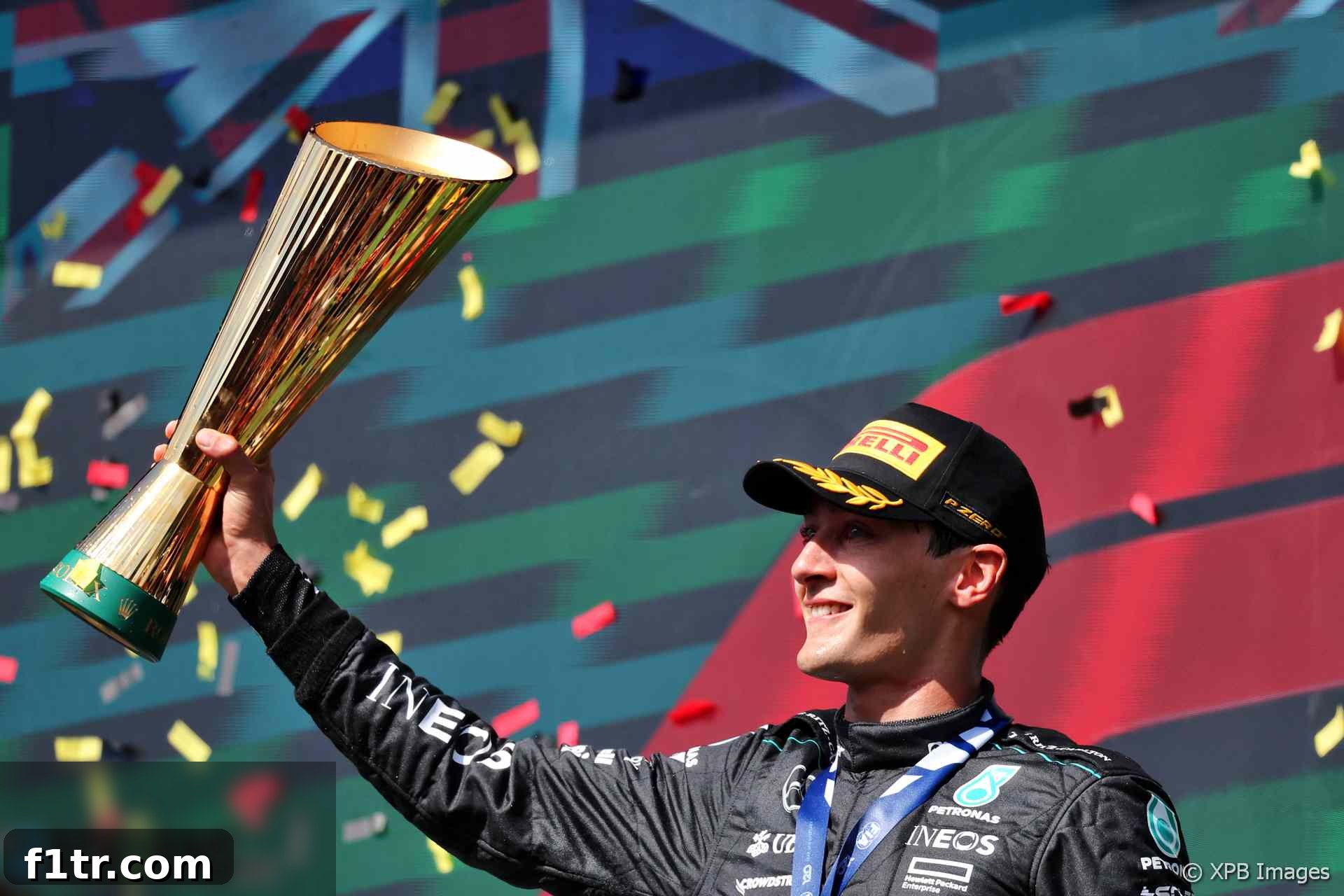
In the high-stakes world of Formula 1, where milliseconds define victory and defeat, adherence to regulations is paramount. While winning on the track is the ultimate goal, sometimes the celebrations are short-lived. The disqualification of an on-the-road winner is an exceptionally rare and often controversial event, sending ripples through the paddock and rewriting the history books. This dramatic turn of events unfolded for the sixth time in Formula 1 history during the 1,115th round of the world championship, casting a shadow over what was initially a jubilant victory.
The latest driver to experience this bitter reversal of fortune was George Russell, who tragically lost his hard-fought victory at the Belgian Grand Prix. His disqualification, like two of the previous five instances, stemmed from his car falling below the minimum weight limit, in this case by a mere 1.5 kilograms. This seemingly minor infraction carries significant weight in Formula 1, as the regulations are meticulously designed to ensure a level playing field and prevent any car from gaining an unfair aerodynamic or performance advantage through lightness.
The Weight of Victory: Russell’s Disqualification and Its Precedents
The stringent minimum weight regulations in Formula 1 are a cornerstone of fair competition. Every component, from the chassis to the smallest bolt, contributes to the car’s overall mass. Falling even slightly below the mandated limit can indicate that a team has exploited a loophole or designed a car that is technically illegal, even if unintentionally. For Russell, the 1.5kg deficit was a devastating blow, transforming a career-defining win into a technical infringement.
Russell’s experience tragically echoes that of legendary driver Alain Prost, who also lost a Grand Prix victory due to an underweight car. At the 1985 San Marino Grand Prix, Prost’s McLaren-TAG Porsche was found to be 2kg shy of the minimum weight after he ran out of fuel as he crossed the finish line. Despite the unfortunate circumstances of his fuel depletion, the rules are absolute: the car must meet the minimum weight requirements at the end of the race, regardless of its operational status. This highlights the unforgiving nature of F1 technical regulations.
Even more dramatically, three years prior to his own underweight disqualification, Prost inherited victory at the 1982 Brazilian Grand Prix under extraordinary circumstances. The original winner, Nelson Piquet, and second-placed Keke Rosberg were both disqualified for failing the minimum weight check. This infamous incident involved the use of “water ballast” – a clever but ultimately illegal tactic where teams would fill their cars with water that would then be expelled during the race, allowing them to run underweight for performance gains, only to be refilled for post-race scrutiny. This widespread practice led to a significant controversy and subsequent rule changes, underlining the constant battle between innovation and regulation in F1.
Beyond Weight: Other Noteworthy Disqualifications
Russell’s disqualification arrived exactly 30 years to the race since the last time a driver was disqualified after winning a Formula 1 Grand Prix. Michael Schumacher lost his 1994 Belgian Grand Prix win when his Benetton’s floor plank failed a post-race thickness check. The “plank rule,” introduced just two races earlier, was designed to prevent cars from running excessively low ride heights, which could provide an aerodynamic advantage. The plank, a wooden strip attached to the underside of the car, would wear down if the car ran too low, making the infringement easily detectable. This particular disqualification was highly contentious at the time, adding to the turbulent and often controversial 1994 season.
The very first driver to be disqualified after winning a race was the charismatic James Hunt, who famously lost victory in the 1976 British Grand Prix. His transgression was switching to his spare car before the race was restarted after an initial first-lap incident. This period of F1 was known for its more relaxed rules and often chaotic race weekends, but even then, such a fundamental rule breach was met with disqualification. Interestingly, Hunt had also been disqualified after winning the Spanish Grand Prix earlier that year due to his McLaren’s wing being judged too wide, but he was later reinstated on appeal, illustrating the sometimes subjective and often convoluted nature of F1 rule enforcement in that era.
The only other driver besides Russell, Prost, Schumacher, and Hunt to suffer the ignominy of a post-win disqualification was the legendary Ayrton Senna. His controversial penalty at the 1989 Japanese Grand Prix remains one of the sport’s most debated moments. Senna was disqualified for rejoining the track via an escape road after tangling with his fierce team mate and championship rival, Alain Prost. The stewards deemed his re-entry illegal, a decision that effectively handed the world championship to Prost and ignited a firestorm of controversy that reverberated for years.
The Inherited Victory: A Twist of Fate for Teammates and Rivals
While disqualifications are rare, the act of inheriting a victory from another driver, particularly a teammate, is an even more unique occurrence. Until Russell’s recent misfortune, only one such instance stood in the Formula 1 record books. In 1990, Ayrton Senna inherited victory in the Canadian Grand Prix from his team mate Gerhard Berger. Berger, who had taken the chequered flag first, received a one-minute penalty for jumping the start. This unexpected turn of events showcased how even a minor procedural error can completely alter the outcome of a race and the destiny of its contenders.
Now, Lewis Hamilton can lay claim to having inherited a victory from his team mate, adding another fascinating chapter to his illustrious career. Hamilton’s experience with inherited wins and lost victories is remarkably diverse. Not only has he now benefited from his teammate’s disqualification, but he also inherited a win from a rival at the Circuit Gilles Villeneuve – the very track where Berger lost his victory – when Sebastian Vettel received a time penalty in 2019 for an unsafe rejoin. Conversely, Hamilton himself lost a Belgian Grand Prix victory due to a penalty in 2008, proving that the capricious nature of F1 regulations can swing both ways, impacting even the most dominant drivers.
Russell’s disqualification at the Belgian Grand Prix transformed what would have been the closest winning margin of the year – a mere 0.526 seconds ahead of his teammate – into a win for Hamilton. Instead, Hamilton claimed victory from Oscar Piastri by 0.647 seconds, which still stands as the closest winning margin of the current season. This dramatic shift underscores the profound impact a post-race ruling can have on race statistics and championship narratives.
The Ripple Effect: Shifting Fortunes in the 2024 Season
Hamilton’s inherited win marked his 105th Grand Prix victory, further cementing his status as one of the sport’s all-time greats. Crucially, it also made him the first driver this year, other than Max Verstappen, to win more than one round. This statistic highlights a subtle but significant shift in the competitive landscape, hinting at a potential challenge to Verstappen’s previously unchallenged dominance.
The Belgian Grand Prix also saw other dramatic shifts in fortune. The Red Bull driver, Max Verstappen, should have secured pole position last weekend. However, a 10-place grid penalty, incurred for a strategic power unit change, relegated him to 11th on the grid. For the second consecutive year at this very race, Charles Leclerc inherited pole position, a testament to his qualifying prowess and sometimes fortuitous circumstances. Sergio Perez was subsequently promoted to the front row, providing a glimmer of hope for Red Bull. This was Leclerc’s 25th career pole position, placing him uniquely in 12th place in the all-time ranking, a significant milestone for the Monegasque driver. Adding to Red Bull’s mixed fortunes, Perez went on to set the fastest lap of the race, the 12th of his career, placing him alongside esteemed names like Alberto Ascari, Jack Brabham, Rene Arnoux, and Juan Pablo Montoya in terms of fastest lap tallies.
For Max Verstappen, the Belgian Grand Prix marked his fourth consecutive race without a win. This represents his longest win-less streak since 2020, a season where he endured 11 rounds without a victory. Furthermore, he failed to reach the podium for the first time in consecutive races since the 2021 British and Hungarian Grands Prix. These statistics, while not indicating a total collapse, certainly suggest a tightening of the competitive field and a challenging period for the reigning champion, making the 2024 season increasingly unpredictable and exciting.
Over to You
The world of Formula 1 is a captivating blend of speed, strategy, and stringent regulations. George Russell’s disqualification serves as a potent reminder that winning on the track is only half the battle; the car must also pass the rigorous post-race technical inspection. These rare but impactful events not only rewrite the record books but also fuel intense debate and reshape the narratives of entire seasons. What other interesting stats and facts from the Belgian Grand Prix did you spot? Share them in the comments below.
2024 Belgian Grand Prix
- Lost Spa win last year was ‘the best race I’ve ever done in Formula 1’ – Russell
- Belgian GP was “still a win” for Russell despite disqualification
- High plank wear also a factor in Russell’s disqualification, say Mercedes
- Russell is sixth F1 driver to be disqualified after winning a grand prix
- Unheard radio shows why Hamilton missed Russell’s (almost) race-winning strategy
Browse all 2024 Belgian Grand Prix articles