McLaren Unveils Striking New MCL36 Livery for Bahrain F1 Pre-season Test
As the Formula 1 world converges on the Bahrain International Circuit for the final pre-season test, McLaren Racing has captured significant attention by revealing a substantially revised livery for its 2022 challenger, the MCL36. This updated aesthetic, showcased during a crucial filming day, marks a notable evolution from the initial design presented just weeks ago and signals a dynamic approach to the brand’s visual identity for the highly anticipated new season.
The strategic timing of this reveal, coinciding with the last opportunity for on-track preparation before the 2022 season opener, underscores the importance of both visual presence and technical fine-tuning. For McLaren, a team steeped in racing heritage and known for its distinctive papaya orange, every detail, from paint scheme to aerodynamic contour, contributes to its championship aspirations.
From Initial Unveil to Track Debut: The MCL36’s Aesthetic Journey
McLaren initially launched its 2022 Formula 1 car in February, presenting a livery that sought to balance the team’s iconic papaya orange with more prominent accents of blue and black. This design philosophy was not exclusive to their F1 entry; a similar visual identity was adopted across McLaren’s other racing ventures, including their IndyCar and Extreme E programs, aiming to create a cohesive global brand presence.
The original 2022 colour scheme, while retaining the essence of McLaren’s vibrant heritage, introduced a greater proportion of blue and black, somewhat tempering the dominance of the distinctive papaya bodywork. This initial iteration of the MCL36 was subsequently seen in action during a promotional filming day immediately following its launch, and critically, throughout the three days of pre-season testing held at the Circuit de Catalunya in Barcelona. These early outings provided the first real-world glimpse of how the new regulatory era cars would look on track, with McLaren’s initial livery drawing varied opinions from fans and pundits alike regarding its modern interpretation of the brand’s colours.
Decoding the Visual Transformation: What’s New on the MCL36?
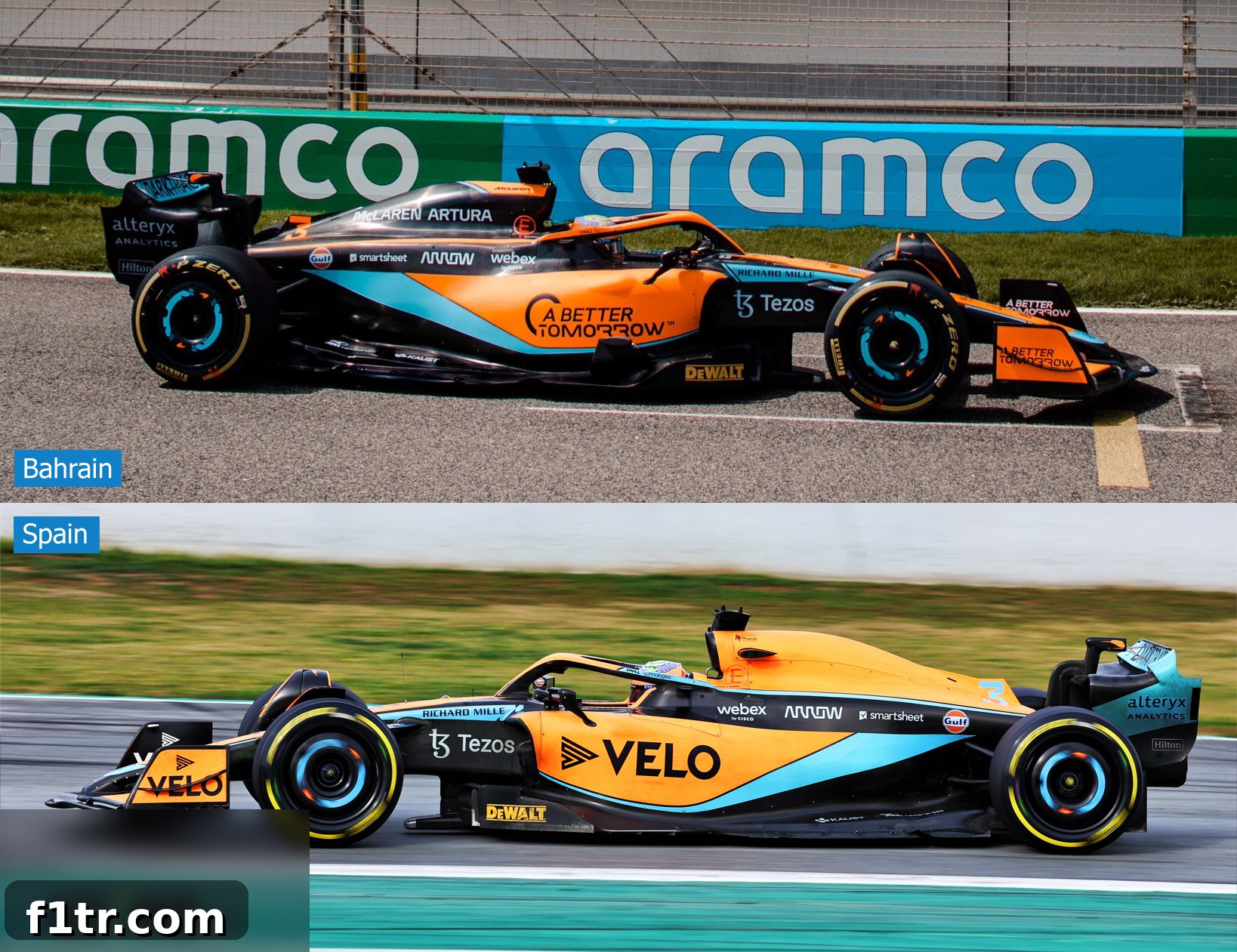
The revised livery, which debuted during a filming day at the Bahrain International Circuit, presents a striking departure from its predecessor, notably increasing the use of black across various sections of the car. This shift creates a more aggressive and streamlined appearance, signifying a refined aesthetic direction for the Woking-based outfit.
A direct comparison between the launch specification and the updated MCL36 reveals several key modifications. The original car featured a largely papaya engine cover, complemented by flashes of turquoise and black tracing down the sidepods. In contrast, the livery now running in Bahrain showcases a predominantly black engine cover, giving the car a more stealthy and powerful profile. This extensive use of black is subtly broken by a sleek orange swoop that gracefully extends over the sidepods, running along the length of the car’s rear section, providing a dynamic visual link to McLaren’s traditional colour.
Further enhancements for improved visibility and branding include the drivers’ numbers, which are now significantly more prominent. Changing from a blue-on-orange scheme, they are now presented in a vibrant orange against the new black background, making them instantly more discernible on track. The rear wing endplates have also received a re-paint, now featuring a solid black finish that contributes to the car’s overall darker, more resolute aesthetic. These deliberate changes suggest not only a stylistic update but potentially a strategic decision to optimize the car’s appearance for broadcast, photography, and partner branding opportunities, which are paramount in modern Formula 1.
More Than Skin Deep: The Interplay of Livery and Aerodynamics
While the visual changes to the MCL36 are undeniably impactful, McLaren’s update extends beyond mere aesthetics. Crucially, there are discernible signs of significant aerodynamic revisions beneath the new paint scheme. Specifically, observers have noted a revised, more heavily contoured floor at the edge of the sidepods, a stark contrast to the design observed on the car during the Barcelona test.
This technical modification is particularly noteworthy given the comprehensive overhaul of Formula 1’s regulations for the 2022 season. The new rules place a strong emphasis on ground effect aerodynamics, with stringent restrictions imposed on the dimensions and shaping of bodywork in critical areas, such as the floor and sidepods. Teams are working tirelessly to interpret these regulations and unlock maximum performance, making every millimetre of bodywork design crucial. A more aggressively sculpted floor and sidepod edge indicates McLaren’s ongoing efforts to generate optimal downforce and manage airflow around the car, potentially addressing lessons learned from the initial Barcelona running.
The timing of such a technical update, arriving in conjunction with a livery refresh, highlights the relentless development cycle inherent in Formula 1. Teams are constantly innovating, bringing new parts and concepts to the track even during pre-season testing. Often, visual changes can either mask or, in this case, coincide with functional aerodynamic improvements, underscoring the dynamic relationship between car design, performance, and presentation in motorsport.
McLaren’s Evolving Identity: A Strategic Approach
In response to inquiries regarding the updated livery, the McLaren team informed RaceFans that the MCL36’s livery had indeed “evolved” since its initial launch. Furthermore, they indicated that this evolution is not a one-off change but is likely to “continue over the course of the 2022 season.” This statement reveals a strategic and flexible approach to their brand identity, allowing for continuous refinement and adaptation.
Such an adaptive strategy can serve multiple purposes. It allows McLaren to optimize the car’s visual impact under various lighting conditions, accommodate new sponsorship agreements, or even make subtle adjustments based on fan feedback or internal preferences. In a sport where innovation is key, extending that philosophy to the car’s aesthetic, which is a powerful representation of the team’s identity, makes strategic sense. It demonstrates a proactive stance, ensuring the MCL36 remains fresh and visually engaging throughout what is expected to be a highly competitive and visually distinct new era of Formula 1.
The Crucial Bahrain Test: Performance and Presentation
The filming day in Bahrain, where the revised livery and technical updates were first revealed, held particular significance for McLaren. It marked the second of only two such promotional days permitted for the team during the entire 2022 season, making its utilization critical for both data gathering and showcasing the latest iteration of the MCL36. These days are invaluable for shakedowns, systems checks, and capturing promotional material, often serving as a discreet platform for teams to trial new components before full public scrutiny.
The subsequent three-day pre-season test in Bahrain represents the final opportunity for all teams to validate their designs, understand tyre behaviour, and refine their operational procedures before the opening Grand Prix. For McLaren, the new livery and associated aerodynamic updates will undergo intense scrutiny during these sessions. The performance of the MCL36, coupled with its refreshed appearance, will undoubtedly set the tone for McLaren’s campaign in the new regulatory landscape of Formula 1.
The Broader Significance of F1 Liveries and Branding
In the high-stakes world of Formula 1, a car’s livery is far more than just a paint job; it is a powerful canvas for branding, a declaration of identity, and a crucial tool for sponsor visibility. For McLaren, the papaya orange has become synonymous with its legacy of success and an instantly recognizable symbol for fans worldwide. The decision to adjust and evolve this livery reflects a nuanced understanding of how visual communication works in modern sport.
The shift towards a greater black presence in the MCL36’s livery can be interpreted in several ways: perhaps to convey a more aggressive, cutting-edge image, to better highlight specific sponsor logos, or simply to align with contemporary design trends in motorsport. This constant evolution underscores how F1 teams, including McLaren, are not just engineering marvels but also sophisticated marketing entities, meticulously crafting their image to resonate with a global audience and secure vital commercial partnerships.
As the grid prepares for a new chapter in Formula 1, McLaren’s dynamic approach to its livery and car development positions them as a team ready to adapt and innovate on all fronts. The MCL36, now sporting its evolved colours and refined aerodynamics, stands ready to tackle the challenges of 2022, embodying McLaren’s enduring pursuit of excellence.
2022 F1 season
- Mercedes told me “you’re wrong” about 2022 car’s problems – Hamilton
- FIA confirms all 10 F1 teams complied with 2022 cost cap
- Steiner “not ashamed” of panning “slow” Schumacher in Drive to Survive
- Albon believes year out of F1 improved him as a driver
- Hamilton sees diversity gains in F1 years on from his ‘traumatising’ experience of racism
Browse all 2022 F1 season articles