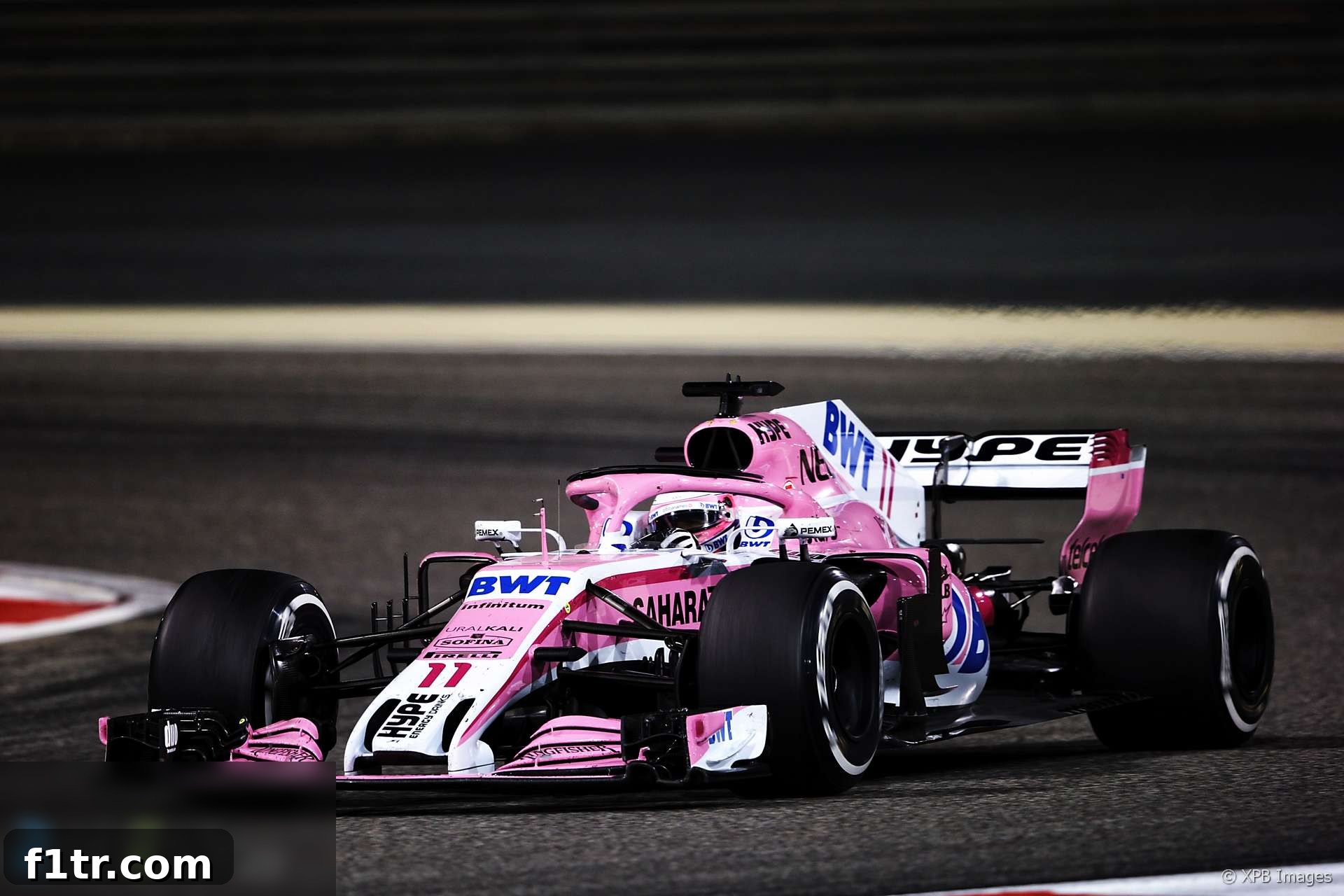
Sergio Perez’s Formation Lap Penalty: A Deep Dive into F1 Rules and Driver Frustration
The intricate world of Formula 1 regulations often presents drivers with unexpected challenges, and the 2018 Bahrain Grand Prix served as a prime example. Force India driver Sergio Perez found himself at the center of a post-race controversy, receiving a 30-second penalty for an incident during the formation lap. This penalty, which significantly altered his race classification, left Perez “surprised” and prompted his intention to seek clarification from FIA Race Director Charlie Whiting regarding the application of the rules.
The incident in question involved Perez overtaking Brendon Hartley of Toro Rosso on the formation lap. While such minor positional adjustments can occasionally occur as drivers prepare for the race start, the subsequent failure of Hartley to re-take his original position led to penalties for both drivers. Perez, a seasoned veteran in Formula 1, vehemently argued that he made multiple attempts to allow Hartley to pass him back, adhering to what he understood as common practice in such scenarios.
Advert | Become a Supporter & go ad-free
The Bahrain Formation Lap Incident Unpacked
Perez’s Perspective: A Misunderstanding on Track
Recounting the sequence of events, Sergio Perez explained his version of the formation lap mix-up. “On the formation basically off the line I overtook him, but then he didn’t re-take back the position,” Perez stated, highlighting the critical aspect of the infraction. He elaborated on his confusion regarding Hartley’s inaction: “He didn’t realise that I overtook him, he thought I was always in front of him.” This lack of awareness from Hartley was central to the unfolding penalty.
Perez underscored that brief positional changes on the formation lap, particularly right off the starting grid, are not uncommon. Drivers might need to gain momentum, warm their tires, or adjust their spacing. The established protocol, according to Perez, dictates that the driver who has momentarily gained a position should then allow the original car to re-establish its grid slot. “I’ve been overtaken many times, I overtake many times, but always the car behind retakes his position,” he added, emphasizing that this dynamic was absent in Bahrain. “Hartley didn’t do it, and we both got the penalty.”
The Force India driver further revealed his proactive attempts to rectify the situation on track. He recounted making deliberate efforts to slow down, providing Hartley ample opportunity to pass him back and restore the correct grid order. “You can see on my video that I really slowed down a couple of times to make him pass but I thought he had a problem,” Perez explained, suggesting he initially believed Hartley might be experiencing a technical issue rather than simply being unaware of the positional error. This proactive measure, in Perez’s view, should have mitigated his culpability.
Hartley’s Role and Admission of Fault
Adding another layer to the incident, Brendon Hartley also received a 30-second penalty for not being in the correct order before the Safety Car line. Crucially, according to Perez, Hartley took responsibility for the mix-up. “We spoke after the race. He just apologised, he knew it was all his fault,” Perez disclosed. This admission by Hartley was significant, as it corroborated Perez’s account of the events and pointed towards a clear misunderstanding rather than a deliberate infraction.
Perez further detailed Hartley’s confession to the race stewards. “When we went to the stewards he just told them ‘listen, I didn’t realise Checo should be in front of me’,” Perez added. This direct acknowledgment from Hartley during the stewards’ inquiry presented a compelling argument for Perez, suggesting that the primary failure to restore grid order lay with Hartley’s oversight. Despite this admission, the stewards’ decision remained unchanged, applying the stringent rules of the sport.
Understanding Formation Lap Regulations in Formula 1
The formation lap, often perceived as a mere formality before the lights go out, is in fact governed by a strict set of regulations designed to ensure fairness and safety. Its primary purposes include allowing drivers to warm their tires and brakes, check all vehicle systems, and navigate to their designated grid slots in the correct order. Any deviation from the prescribed grid order during this lap can be penalized, as seen in the case of Perez and Hartley.
According to the FIA Formula 1 Sporting Regulations, drivers must maintain their grid positions throughout the formation lap. Overtaking is generally prohibited, with very specific exceptions. For instance, if a car stalls on the grid, other cars are allowed to pass it to reach their designated positions. Similarly, if a car is forced off track during the formation lap and loses position, it may be permitted to regain its original position, provided it does so safely and without gaining an unfair advantage. However, even in such instances, the maneuver must be clear and unequivocally understood by all parties and race control.
The strict enforcement of these rules stems from the need to prevent drivers from gaining an advantage before the race even begins. A driver intentionally out of position could potentially benefit from warmer tires, better spacing, or a clearer run to Turn 1. The 30-second penalty, which is often applied as a time addition to a driver’s final race time, is a standard punishment for such infractions, reflecting the FIA’s zero-tolerance policy for breaches that could compromise the integrity of the start.
The Aftermath: Impact and Quest for Clarification
For Sergio Perez, the 30-second penalty, while dropping him from 12th to 16th in the final results, “didn’t change anything” in terms of championship points, as he finished outside the top ten. However, the principle of the matter and the circumstances surrounding the penalty clearly bothered him. His intention to “speak with Charlie on this one” highlights a broader desire for clarity and potentially a more nuanced interpretation of such incidents in the future.
Discussions with Charlie Whiting, the highly respected FIA Race Director, are crucial for drivers seeking to understand the precise application of regulations. Whiting’s role involves overseeing all aspects of race operations, including the interpretation and enforcement of sporting rules. Perez’s goal is likely not to overturn the penalty itself, but rather to gain a deeper understanding of why his attempts to allow Hartley to pass were not deemed sufficient to avoid a penalty, especially given Hartley’s admission of fault. Such dialogue between drivers and race control is vital for maintaining transparency and ensuring consistency in stewarding decisions across the season.
Broader Implications for Driver Conduct and Stewarding Consistency
Incidents like the one involving Sergio Perez and Brendon Hartley often spark debate among fans and within the paddock about the consistency of stewarding decisions and the level of scrutiny applied to seemingly minor infractions. While rules are in place for a reason, drivers frequently express frustration when what they perceive as an honest mistake or a common on-track maneuver results in a severe penalty.
Perez’s “surprise” at receiving the penalty, despite his efforts to rectify the situation, reflects a common sentiment among drivers who feel that context and intent should sometimes play a greater role in the stewards’ deliberations. The fine margins in Formula 1 mean that even a slight misjudgment or communication breakdown can have significant consequences. This incident serves as a reminder of the relentless pressure on F1 drivers to adhere to every single rule, from the moment they leave the garage until the checkered flag.
Furthermore, such penalties can influence driver behavior. If drivers are penalized for attempting to correct a positional error, it might deter them from trying to be courteous or helpful on the formation lap, potentially leading to more rigid adherence to grid positions even if a slight advantage could be gained or lost. The ongoing dialogue between drivers, teams, and the FIA is therefore essential to ensure that the rules are applied fairly, consistently, and with an understanding of the dynamic environment of a Grand Prix weekend.
Go ad-free for just £1 per month>> Find out more and sign up
2018 F1 season
- F1 feared “death knell” for Drive to Survive after Ferrari and Mercedes snub
- McLaren staff told us we were “totally crazy” to take Honda engines in 2018 – Tost
- ‘It doesn’t matter if we start last’: How Red Bull’s junior team aided Honda’s leap forward
- Honda’s jet division helped F1 engineers solve power unit problem
- McLaren Racing losses rise after Honda split
Browse all 2018 F1 season articles