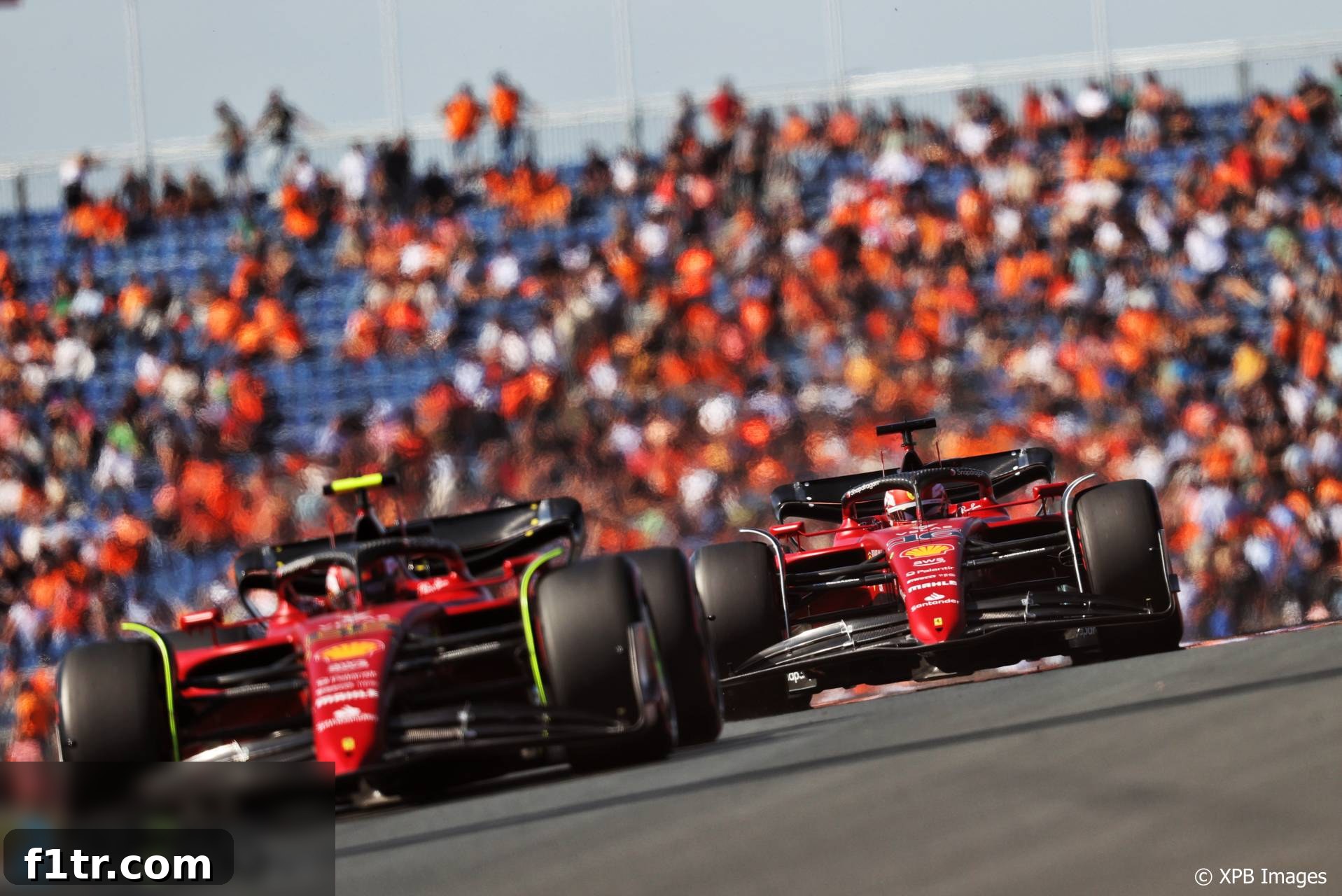
The legendary Zandvoort circuit, a historic gem in the world of Formula 1, underwent extensive, multi-million Euro renovations to meet the stringent standards required for the revival of the Dutch Grand Prix. This monumental effort transformed its infrastructure, modernized the pit lane facilities, upgraded grandstands, and enhanced safety measures, bringing it firmly into the modern era of motorsport. Yet, despite these significant upgrades, the track’s inherently challenging nature and tight layout proved a decisive factor in a nail-biting qualifying session, setting the stage for an unpredictable and thrilling race day.
Following a dramatic qualifying for the second Grand Prix to be held at the revitalized venue, Charles Leclerc might have been forgiven for a moment of profound frustration at the circuit operators. His thoughts might have drifted to the possibility of a track layout shortened by a mere 80 metres. It was over precisely this minuscule distance, at the very end of the demanding 4.259-kilometre lap, that reigning world champion Max Verstappen managed to shave off just enough time to edge out the Ferrari driver for pole position. He crossed the chequered flag in Q3 with an almost imperceptible advantage, leaving Leclerc agonizingly close.
Verstappen’s second home pole position in as many attempts at Zandvoort marked a truly remarkable turnaround for Red Bull Racing. His weekend began with significant challenges, as he missed most of Friday’s crucial first practice session and subsequently found himself nearly seven-tenths of a second adrift of his Ferrari rival. This stunning recovery from a difficult start underscores not only his incredible talent and unwavering focus but also the Red Bull team’s exceptional ability to analyze data, make crucial adjustments, and fine-tune the car under immense pressure. However, the session was equally a missed opportunity for Leclerc, who had demonstrated a consistent quarter-second advantage over Verstappen through much of qualifying, only to see that crucial lead dissipate through a minor error in turns nine and ten in the demanding middle sector. Such fine margins define success and failure at the pinnacle of motorsport.
Upon hearing from his team that Verstappen had snatched pole by an agonizing 0.021 seconds – an almost invisible gap that represented the tightest margin of the entire season – Leclerc’s audible shout of frustration resonated, a familiar sound for him during this tumultuous championship season. He openly admitted his surprise and profound disappointment that such a relatively minor error had ultimately cost him pole position to his fiercest rival, especially given their comparative pace throughout the build-up to Saturday afternoon’s exhilarating qualifying shootout. “Obviously you always target to be on pole and, looking at my lap, in turn ten I did a mistake,” Leclerc reflected candidly after the session. “To be honest, looking at the gap with Max today, I did not expect that coming into Q3.” His honest assessment underscored the microscopic margins that define Formula 1 at its peak, where perfection is relentlessly pursued.
For Max Verstappen, a pole position at his home Grand Prix is always a cherished achievement, but securing it after a particularly challenging Friday, and in front of an electrifying crowd of over 100,000 passionate Dutch fans, made this one particularly satisfying. His seemingly unstoppable charge towards a second consecutive world championship continued unabated, fuelled by the roaring, orange-clad support of his compatriots. “It was a special qualifying, especially after yesterday,” Verstappen beamed, referring to his struggles to find pace and balance during Friday’s practice sessions.
“It was really tough, we had to change the car around quite a bit, because we didn’t really have any information from Friday,” he explained, shedding light on the intensity of the engineering challenge. “Basically this morning was still about learning quite a bit of the car and all about just trying to fine-tune it a bit towards qualifying. When I started my lap, I felt like the tyres were not really switched on, but I managed to recover a bit in sector two and that was just enough for pole.” This candid admission revealed the sheer dedication, intricate data analysis, and precise driving required to extract maximum performance from an F1 car, even for a driver of Verstappen’s exceptional calibre and experience.
After consecutive races where Verstappen started further down the grid, this weekend sees both Ferraris – Leclerc and Carlos Sainz Jnr – lining up directly behind him on the starting grid. This marks the first time since the Austrian Grand Prix that this specific scenario has unfolded, a race at the Red Bull Ring where Ferrari notably held a distinct advantage in race pace and successfully outpaced Verstappen to claim a dominant victory. Starting third, Sainz is cautiously optimistic that Sunday’s Dutch Grand Prix could unfold in a similar fashion, allowing Ferrari to mount a formidable challenge for the win and apply significant pressure on the pole-sitter.
“In qualifying, we’ve been within a tenth of each other,” Sainz noted, emphasizing the incredibly tight competition that has defined much of the season. “So in the race, if it’s like that for 70 laps, it’s going to be a tight race. Normally, the Red Bull lately on Sundays – together with Mercedes – seem to have something there that we haven’t had recently. But if we go back to France and Austria, we had something on Sunday. So hopefully it is more like those two races and we can challenge Max during the whole race.” His insightful remarks reveal a strategic mindset, carefully analyzing past performances to project future outcomes, and a belief in Ferrari’s inherent potential to compete at the sharp end of the grid.
However, Zandvoort presents a stark contrast to the sprawling, high-speed Red Bull Ring, which features minimal corners and long straights conducive to aggressive overtaking manoeuvres. Zandvoort, by comparison, is renowned for its narrow layout, punishing high-speed turns, and distinct lack of traditional overtaking zones, offering significantly fewer natural opportunities for passing. While an extended DRS zone introduced for this year may offer some assistance, the race start itself is expected to be even more crucial than typical this season, potentially determining the race leader for a substantial portion of the grand prix on a circuit where track position is king.
Evidence from the Formula 2 sprint race, where Marcus Armstrong leapt into the lead despite starting on the ‘dirty’ side of the grid (the same side Leclerc will occupy on Sunday), suggests that this position isn’t necessarily an insurmountable disadvantage. Nevertheless, Ferrari strategists are acutely aware of Verstappen’s crucial advantage: an extra set of fresh soft tyres. This additional grip and performance off the line could provide him with the best possible launch, a critical factor on a circuit where gaining and maintaining track position is paramount. “Obviously Max with a new set of softs is going to be strong whenever he uses it,” Sainz commented, acknowledging the Red Bull’s potential edge. “Because here from scrubbed to new [tyres], at least for our car, is quite a bit of a difference as the degradation is very high.” This insightful observation underscores the critical importance of tyre management and strategic deployment in a race predicted to feature significant tyre wear and tactical battles.
Pirelli, the official tyre supplier for Formula 1, has indicated that a one-stop strategy, beginning on the soft compound tyres and switching to the hard compound, is “perfectly viable” for the Dutch Grand Prix. However, they also cautioned that this approach would leave teams on a one-stop strategy operating at the very margins of tyre wear over their two prolonged stints, demanding meticulous management from drivers. Consequently, a two-stop strategy is widely considered the fastest theoretical route to the chequered flag, offering greater flexibility and performance. This faster strategy, however, necessitates two sets of unused medium tyres, which critically, Red Bull, Ferrari, and Mercedes all have at their disposal, thereby opening up diverse strategic possibilities and potential chess matches between the top teams on Sunday.
With both Ferraris starting directly behind Verstappen, the Italian team could strategically opt to split their tyre strategies between Charles Leclerc and Carlos Sainz. This tactical move would undoubtedly present a significant headache for Verstappen and his highly astute strategists on the Red Bull pit wall during the race, forcing them to react to multiple threats and adapt their plan on the fly. Both Leclerc and Sainz expressed their belief that this is indeed the intelligent approach to maximizing their chances against the dominant Red Bull. “Let’s see after the first few laps,” Leclerc stated, outlining the initial wait-and-see approach, “but probably splitting the cars is a good thing to do when we are in this situation.” This sentiment highlights Ferrari’s intent to apply multifaceted pressure and diversify their attack against their championship rivals.
Sainz further emphasized the arduous task awaiting all drivers in keeping their tyres in optimal working condition throughout the punishing Zandvoort race. “It is very tough out there, especially with these heavier cars,” he explained, detailing the challenges. “The track is really demanding on the tyres; we have a lot of overheating in the lap, a lot of degradation even in the long runs. So I think tomorrow is going to be interesting. There’s going to be a lot going on, even if it’s a difficult track to overtake, there’s going to still be many options with the strategies.” His words paint a vivid picture of a physically and strategically demanding race, where tyre management and adaptable tactics will be absolutely paramount to success.
It would be a significant oversight to discount the potential impact of the Mercedes-AMG Petronas F1 Team. After a particularly challenging weekend at Spa-Francorchamps, where they seemed to fall back into a purgatorial performance slump, both Lewis Hamilton and George Russell showed considerably stronger pace at Zandvoort. Indeed, they might have been much closer to the front row on the timesheets had it not been for the unfortunate timing of Sergio Perez’s spin during qualifying, which severely disrupted their crucial final flying laps. With Hamilton starting an impressive fourth on the grid, he conveyed a clear sense of optimism that Sunday’s race should prove a far more enjoyable and competitive affair for the Silver Arrows, possibly even presenting an unexpected podium opportunity.
“I’m definitely optimistic,” Hamilton affirmed, his voice resonating with confidence. “I’ve not done a long run but George did and it looked quite good. The car was feeling strong today and I felt like I could go quicker, so I hope that translates to tomorrow. But I’ll definitely be pushing as hard as I can to get a podium.” His belief in the car’s potential, despite earlier season struggles, underscores the consistent progress Mercedes has been striving for since their difficult start to the season and their recent Belgian Grand Prix performance.
However, his teammate Russell did not quite mirror Hamilton’s level of overt enthusiasm, adopting a more pragmatic and realistic stance. “We’re still lacking probably a couple of tenths of base performance,” Russell admitted, acknowledging the enduring gap to the very front of the field. “Obviously it’s a short track here so the gaps don’t look as big. I think, as a team, we truly understand why we were so slow in Spa and why from the get-go we showed more promising performance this weekend. But ultimately Max and Red Bull are too quick for us. Our fight and battle is with Ferrari at the moment.” This measured assessment suggests Mercedes is realistic about their current position, focusing on maximizing their potential and targeting Ferrari for a strong points finish rather than outright victory.
Zandvoort, by its very design, is a narrow and tight circuit that affords very little margin for error. The unforgiving nature of its banked corners and close barriers means even the slightest misjudgment or lapse in concentration can lead to significant consequences. Despite this inherent challenge, last year’s race notably saw no Safety Car interventions, a testament to the drivers’ extraordinary precision and the circuit’s robust safety features. However, all it takes is one mistake – a car in the gravel trap or a brush with the barriers – and the carefully laid strategies of every team could be instantly thrown into disarray, leading to unpredictable outcomes and potentially reshaping the entire race.
Beyond the typical racing incidents, one final, truly unique factor could come into play at Zandvoort: an unusual environmental hazard. This isn’t merely the handful of thoughtless spectators occasionally lobbing contraband flares onto the circuit, which regrettably triggered a red flag in qualifying due to debris, but rather the local birdlife. These feathered residents have already proven to be the most unexpected and, at times, dangerous element of the race weekend for drivers and for themselves. Both Formula 2 drivers Marcus Armstrong and Theo Pourchaire notably struck pigeons during their race, highlighting a peculiar and potentially disruptive hazard unique to this seaside circuit.
“It’s very odd,” Russell mused, reflecting on the avian encounters with a hint of bewilderment. “It’s just at that one corner, turn seven, these pigeons are just standing on the apex. Ross Brawn’s probably happy there’s not so much outwash from the cars. Last year we would’ve blown the pigeons away…” As humorous as the observation might seem, it carries a serious undertone that cannot be ignored in a high-stakes competition. Verstappen himself lost a potential race victory earlier this season at Silverstone due to striking debris, a stark reminder of how seemingly minor incidents can have major consequences. The hope remains that these feathered friends do not inadvertently swing the outcome of Sunday’s eagerly anticipated race, adding an unforeseen twist to the championship battle.
With the top six cars poised to be incredibly close over the full race distance, even the smallest unexpected hazard – be it a safety car deployment, a sudden change in weather conditions, or an unfortunate bird strike – could play a disproportionately large role in determining whether the fervent Zandvoort fans leave the circuit satisfied or saddened on Sunday evening. Yet, whatever the variables and unforeseen challenges, the championship leader, Max Verstappen, appears exceptionally well-equipped to take any challenge in his characteristic calm and determined stride.
“I think it will be close, but basically for most of the races this year it has been like that,” Verstappen acknowledged, demonstrating his characteristic calm and unwavering confidence. “So I’m looking forward to it and I hope that we can have a good race.” His expectation of a tight battle mirrors the sentiments across the entire paddock, promising a thrilling spectacle for all Formula 1 enthusiasts.
Qualifying Results in Detail: The Fight for Pole
The qualifying session at Zandvoort was a testament to the razor-thin margins and intense competition prevalent in modern Formula 1. Below are the detailed results from the session, meticulously showcasing the incredible pace and the minuscule differences that separated the top contenders, particularly in the decisive Q3.
| Position | Number | Driver | Team | Q1 time | Q2 time (vs Q1) | Q3 time (vs Q2) |
|---|---|---|---|---|---|---|
| 1 | 1 | Max Verstappen | Red Bull | 1’11.317 | 1’10.927 (-0.390s) | 1’10.342 (-0.585s) |
| 2 | 16 | Charles Leclerc | Ferrari | 1’11.443 | 1’10.988 (-0.455s) | 1’10.363 (-0.625s) |
| 3 | 55 | Carlos Sainz Jnr | Ferrari | 1’11.767 | 1’10.814 (-0.953s) | 1’10.434 (-0.380s) |
| 4 | 44 | Lewis Hamilton | Mercedes | 1’11.331 | 1’11.075 (-0.256s) | 1’10.648 (-0.427s) |
| 5 | 11 | Sergio Perez | Red Bull | 1’11.641 | 1’11.314 (-0.327s) | 1’11.077 (-0.237s) |
| 6 | 63 | George Russell | Mercedes | 1’11.561 | 1’10.824 (-0.737s) | 1’11.147 (+0.323s) |
| 7 | 4 | Lando Norris | McLaren-Mercedes | 1’11.556 | 1’11.116 (-0.440s) | 1’11.174 (+0.058s) |
| 8 | 47 | Mick Schumacher | Haas-Ferrari | 1’11.741 | 1’11.420 (-0.321s) | 1’11.442 (+0.022s) |
| 9 | 22 | Yuki Tsunoda | AlphaTauri-Red Bull | 1’11.427 | 1’11.428 (+0.001s) | 1’12.556 (+1.128s) |
| 10 | 18 | Lance Stroll | Aston Martin-Mercedes | 1’11.568 | 1’11.416 (-0.152s) | |
| 11 | 10 | Pierre Gasly | AlphaTauri-Red Bull | 1’11.705 | 1’11.512 (-0.193s) | Missed by 0.084s |
| 12 | 31 | Esteban Ocon | Alpine-Renault | 1’11.748 | 1’11.605 (-0.143s) | Missed by 0.177s |
| 13 | 14 | Fernando Alonso | Alpine-Renault | 1’11.667 | 1’11.613 (-0.054s) | Missed by 0.185s |
| 14 | 24 | Zhou Guanyu | Alfa Romeo-Ferrari | 1’11.826 | 1’11.704 (-0.122s) | Missed by 0.276s |
| 15 | 23 | Alexander Albon | Williams-Mercedes | 1’11.695 | 1’11.802 (+0.107s) | Missed by 0.374s |
| 16 | 77 | Valtteri Bottas | Alfa Romeo-Ferrari | 1’11.961 | Missed by 0.135s | |
| 17 | 3 | Daniel Ricciardo | McLaren-Mercedes | 1’12.081 | Missed by 0.255s | |
| 18 | 20 | Kevin Magnussen | Haas-Ferrari | 1’12.319 | Missed by 0.493s | |
| 19 | 5 | Sebastian Vettel | Aston Martin-Mercedes | 1’12.391 | Missed by 0.565s | |
| 20 | 6 | Nicholas Latifi | Williams-Mercedes | 1’13.353 | Missed by 1.527s |
Key Sector Times
Delving deeper into the qualifying performance reveals precisely where precious hundredths of a second were won and lost around the challenging Zandvoort circuit. The sector times below intricately highlight individual driver strengths and weaknesses over the three demanding sections of the track, offering a granular view of their on-track execution.
| Driver | Sector 1 | Sector 2 | Sector 3 |
|---|---|---|---|
| Max Verstappen | 24.229 (4) | 24.556 (1) | 21.557 (2) |
| Charles Leclerc | 24.155 (1) | 24.569 (2) | 21.461 (1) |
| Carlos Sainz Jnr | 24.176 (3) | 24.627 (4) | 21.631 (3) |
| Lewis Hamilton | 24.252 (5) | 24.574 (3) | 21.705 (6) |
| Sergio Perez | 24.165 (2) | 24.872 (8) | 21.765 (8) |
| George Russell | 24.278 (6) | 24.759 (5) | 21.665 (4) |
| Lando Norris | 24.281 (7) | 25.003 (11) | 21.693 (5) |
| Mick Schumacher | 24.467 (10) | 25.062 (12) | 21.751 (7) |
| Yuki Tsunoda | 24.519 (12) | 24.772 (6) | 21.994 (15) |
| Lance Stroll | 24.321 (9) | 25.095 (14) | 21.848 (10) |
| Pierre Gasly | 24.635 (16) | 24.996 (10) | 21.808 (9) |
| Esteban Ocon | 24.806 (19) | 24.835 (7) | 21.890 (12) |
| Fernando Alonso | 24.469 (11) | 24.952 (9) | 21.945 (13) |
| Zhou Guanyu | 24.606 (14) | 25.067 (13) | 21.954 (14) |
| Alexander Albon | 24.606 (14) | 25.238 (19) | 21.851 (11) |
| Valtteri Bottas | 24.856 (20) | 25.106 (15) | 21.999 (16) |
| Daniel Ricciardo | 24.604 (13) | 25.147 (16) | 22.183 (19) |
| Kevin Magnussen | 24.742 (18) | 25.183 (17) | 22.034 (17) |
| Sebastian Vettel | 24.285 (8) | 25.214 (18) | 22.158 (18) |
| Nicholas Latifi | 24.653 (17) | 25.871 (20) | 22.402 (20) |
Speed Trap Analysis
Maximum speed is a critical factor on any Formula 1 circuit, and Zandvoort is no exception. While the track prioritizes aerodynamic grip and high-speed cornering, outright speed on the short straights and through the DRS zones can still make a tangible difference. The speed trap data from qualifying reveals which cars were punching through the air most efficiently, providing insights into their aerodynamic setup choices.
| Pos | Driver | Car | Engine | Speed (kph/mph) | Gap |
|---|---|---|---|---|---|
| 1 | Sergio Perez | Red Bull | Red Bull | 330.7 (205.5) | |
| 2 | Fernando Alonso | Alpine | Renault | 327.4 (203.4) | -3.3 |
| 3 | Max Verstappen | Red Bull | Red Bull | 327.3 (203.4) | -3.4 |
| 4 | George Russell | Mercedes | Mercedes | 325.7 (202.4) | -5.0 |
| 5 | Mick Schumacher | Haas | Ferrari | 324.0 (201.3) | -6.7 |
| 6 | Pierre Gasly | AlphaTauri | Red Bull | 323.9 (201.3) | -6.8 |
| 7 | Carlos Sainz Jnr | Ferrari | Ferrari | 323.7 (201.1) | -7.0 |
| 8 | Nicholas Latifi | Williams | Mercedes | 323.4 (201.0) | -7.3 |
| 9 | Yuki Tsunoda | AlphaTauri | Red Bull | 323.3 (200.9) | -7.4 |
| 10 | Alexander Albon | Williams | Mercedes | 322.8 (200.6) | -7.9 |
| 11 | Esteban Ocon | Alpine | Renault | 322.2 (200.2) | -8.5 |
| 12 | Lando Norris | McLaren | Mercedes | 322.0 (200.1) | -8.7 |
| 13 | Zhou Guanyu | Alfa Romeo | Ferrari | 321.9 (200.0) | -8.8 |
| 14 | Charles Leclerc | Ferrari | Ferrari | 321.3 (199.6) | -9.4 |
| 15 | Lance Stroll | Aston Martin | Mercedes | 320.5 (199.1) | -10.2 |
| 16 | Kevin Magnussen | Haas | Ferrari | 319.5 (198.5) | -11.2 |
| 17 | Daniel Ricciardo | McLaren | Mercedes | 319.5 (198.5) | -11.2 |
| 18 | Sebastian Vettel | Aston Martin | Mercedes | 319.1 (198.3) | -11.6 |
| 19 | Lewis Hamilton | Mercedes | Mercedes | 319.1 (198.3) | -11.6 |
| 20 | Valtteri Bottas | Alfa Romeo | Ferrari | 317.9 (197.5) | -12.8 |
Your Predictions for the Dutch Grand Prix
As the grid lines up for what promises to be an enthralling and fiercely contested Dutch Grand Prix, the questions abound: Will Max Verstappen consolidate his championship lead with another commanding home victory, delighting the orange army? Can Ferrari’s strategic flexibility, particularly with potentially split strategies between their two strong drivers, finally translate into a decisive win and halt Red Bull’s momentum? Or will Mercedes, buoyed by their improved performance in qualifying, launch a serious challenge for the podium, or even an unlikely victory, upsetting the established order?
The unique characteristics of the Zandvoort circuit, coupled with the ongoing intensity of the championship battle and the unpredictable external factors, guarantee a race brimming with excitement, strategic intrigue, and perhaps a few unexpected twists. Share your insights, bold predictions, and reasoned opinions on who will emerge victorious and what moments will ultimately define the 2022 Dutch Grand Prix.
Share your views on the Dutch Grand Prix in the comments below.
Support RaceFans: Go Ad-Free and Fuel F1 Journalism
RaceFans thrives thanks to the generous and dedicated support of its loyal readers. By contributing a small monthly or annual sum, you can directly help us cover the significant costs of creating high-quality, in-depth Formula 1 content, maintaining our robust digital platform, and actively developing new features and improvements for the future of F1 journalism.
Become a RaceFans Supporter today and enjoy an entirely ad-free browsing experience across the entire site, enhancing your enjoyment of our content. Learn more about the benefits and easily sign up via the links provided below:
- Become a RaceFans Supporter
- RaceFans Supporter FAQ
More from the 2022 Dutch Grand Prix
- Ferrari’s season of missed chances led to “difficult” criticism for Binotto
- How many victory chances did Hamilton have in his first winless F1 season?
- Why F2’s role as F1’s sustainable fuel guinea pig ‘isn’t going to be a reliability issue’
- Straight-line speed deficit will continue to “bite” Mercedes in qualifying – Wolff
- Verstappen achieves his longest winning streak with second home victory
Browse all 2022 Dutch Grand Prix articles