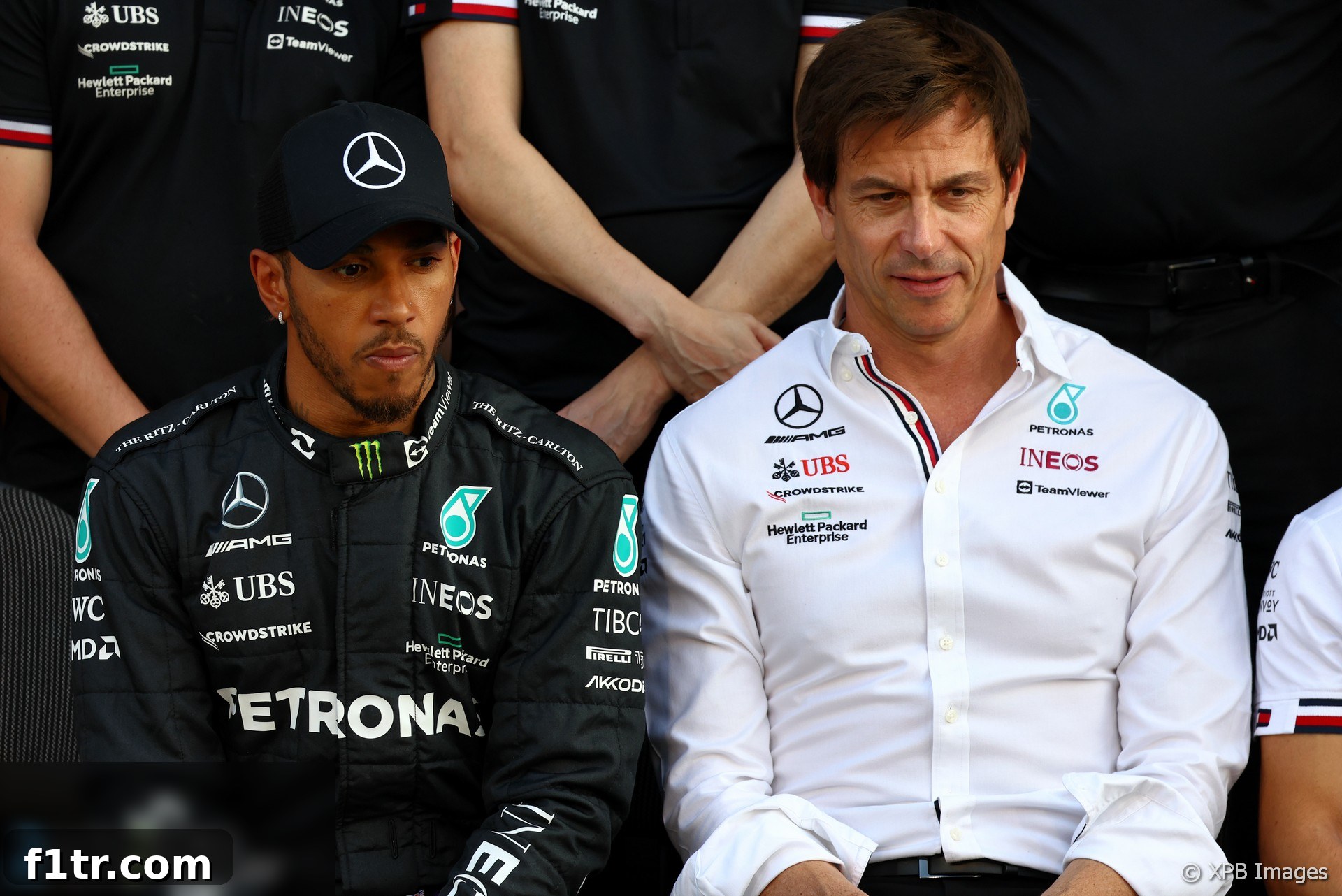
Mercedes-AMG Petronas F1 Team Principal Toto Wolff has offered a deeply personal and candid comparison of the two most challenging recent periods for the Silver Arrows, asserting that the controversial conclusion to the 2021 Formula 1 season inflicted a far deeper wound than their uncharacteristic struggles in 2022. While the team’s failure to contend for championships this past year certainly stung, Wolff explains that the nature of their 2021 defeat, perceived as being unjustly ‘taken away,’ made it an incomparable emotional ordeal that still resonates deeply within him.
Advert | Become a Supporter & go ad-free
Toto Wolff: 2021 Championship Loss Inflicted Deeper Pain Than Mercedes’ 2022 Performance Dip
Mercedes, a team synonymous with unparalleled dominance in the hybrid era, saw their historic streak of eight consecutive Constructors’ Championship titles dramatically conclude in 2022. The W13 chassis, meticulously crafted under Formula 1’s radical new technical regulations, proved problematic from its very inception. Plagued by persistent performance issues, most notably the disruptive phenomenon of ‘porpoising,’ the car struggled to unlock its potential throughout the season. After securing a remarkable nine victories in 2021, the 2022 campaign yielded only a single win, a hard-fought triumph by George Russell at the penultimate round in Brazil. Yet, despite this stark and unexpected drop in competitive form, Wolff’s emotional barometer points to an earlier, more contentious period as the true benchmark of pain and profound disappointment.
The 2021 season itself concluded with Mercedes once again claiming the Constructors’ Championship, a testament to their overall strength, engineering prowess, and consistent performance across the entire season. However, this team triumph was inextricably overshadowed by the heart-wrenching loss of the Drivers’ Championship by Lewis Hamilton in a final race universally acknowledged as being marred by unprecedented controversy. This pivotal moment, rather than the subsequent year of underperformance where the team simply lacked pace, remains a source of unique emotional distress and a deep sense of injustice for Wolff and the entire Mercedes outfit.
The Lingering Shadow of 2021: A Championship Unjustly Denied
When asked to reflect on the stark differences between the emotional impact of the two seasons, Wolff unequivocally stated, “Last year was much worse. The situation, that one event, [was] much worse than the whole season because last year it was taken away not by our own wrongdoing. But this year, we lost it on merit. We just weren’t good enough.” This powerful distinction between an externally imposed defeat and a self-inflicted one lies at the very heart of Wolff’s perspective. The 2021 Abu Dhabi Grand Prix epitomized this feeling, with Lewis Hamilton leading comfortably for the vast majority of the race, seemingly poised to secure a record-breaking eighth Drivers’ Championship title, a feat that would have cemented his legacy even further.
However, a late-race safety car deployment and the subsequent, highly scrutinized decisions by race control fundamentally altered the outcome. In a sequence of events that sent shockwaves through the Formula 1 community and sparked widespread debate, the final lap restart was orchestrated in clear violation of the established sporting regulations concerning lapped cars being permitted to unlap themselves. This controversial and immediate decision allowed Max Verstappen, on significantly fresher tires, to directly challenge Hamilton in a one-lap shootout, ultimately snatching the championship on the very last lap. For Mercedes, and particularly for a fiercely competitive and principled individual like Wolff, this felt like an external, arbitrary force had intervened to deny them a rightful and deserved victory.
Wolff vividly recalled the abrupt and shocking nature of the defeat: “Last year [we were] strong and how it ended within a couple of seconds, we knew that that’s it. And it’s out of [your] control, out of your hands.” The profound feeling of powerlessness, of having a championship snatched away through circumstances entirely beyond their command, deeply impacted Wolff. He openly admitted to losing control in the immediate aftermath of the title fight, an experience he described as “the first time since I was an adolescent.” This raw, visceral reaction stemmed from a fundamental clash with his deeply held values and sense of fairness: “In my sense of fairness, that was totally against my values,” he explained, underscoring the profound sense of injustice felt not only by him but by the entire team and fan base.
Navigating the 2022 Challenges: A Self-Inflicted Struggle on Merit
In stark contrast to the enduring emotional turmoil and perceived injustice of 2021, Mercedes’ uncompetitive 2022 season, while certainly disappointing and frustrating for a team accustomed to winning, elicited a fundamentally different emotional response. Wolff noted that it “was not as peaky in terms of the emotions” because the team quickly came to terms with the harsh reality that they were simply not championship contenders. The introduction of new ground effect regulations for 2022 brought with them unforeseen aerodynamic challenges, most notably the severe ‘porpoising’ – a violent vertical oscillation that plagued the W13 car, particularly at high speeds. This issue severely hampered outright performance, compromised handling, and significantly impacted driver comfort and confidence.
“We knew from the get-go, at the beginning that the car was just not good enough,” Wolff candidly stated. The initial pre-season tests and early races quickly revealed that the W13 lacked the fundamental pace, stability, and predictability required to consistently compete at the front of the grid. The dedicated engineering team at Brackley and Brixworth embarked on a relentless and exhaustive journey of understanding, diagnosis, and development, a complex process Wolff aptly likened to “peeling one layer of the onion off.” Each solution seemed to uncover yet another underlying problem, requiring continuous adaptation, meticulous analysis, and innovative solutions throughout the entire season, without the usual quick fixes.
Understanding and Adapting the W13: A Season of Relentless Development
Mercedes engineers painstakingly worked to correlate the car’s nuanced performance characteristics, diligently identifying tracks where the W13 could surprisingly exhibit its strengths and others where it would inherently struggle. This intricate understanding led to a pragmatic strategy of “damage limitation” at more challenging venues, focusing on maximizing points and learning opportunities where possible, rather than chasing unrealistic victories that were clearly out of reach. The team’s unwavering dedication to improvement and their persistent efforts eventually bore significant fruit, culminating in George Russell’s magnificent maiden Formula 1 victory at the Brazilian Grand Prix – a hard-earned reward for their tireless work and a much-needed beacon of hope and validation for future seasons. It demonstrated that, despite its flaws, the W13 had genuine potential.
Crucially, Wolff recognized and fully accepted the self-made nature of their 2022 predicament. “And I think we know it was our doing. Last year Abu Dhabi wasn’t our doing, this was our doing. We knew we got it wrong [this year], we are conscious that others did a better job and this is an absolute meritocracy how the season, how the season panned out. So that is okay.” This profound acceptance of responsibility, while undoubtedly difficult for such a proud and successful team, allowed for a more rational, constructive, and forward-looking approach to problem-solving. There was no external villain or unfair decision to blame; only the cold, hard facts of engineering execution and competitive performance. This clarity, ironically, provided a clearer path forward.
Wolff’s Emotional Calculus: The Profound Difference Between Injustice and Underperformance
The core of Wolff’s profound distinction lies in the fundamental concepts of control, fairness, and accountability. The 2021 season’s dramatic and controversial conclusion, perceived as an arbitrary and rule-violating imposition by race control, left an indelible mark of injustice on the team. It was a championship denied, not through a lack of effort, superior competitor performance over a sustained period, or strategic missteps, but by a decision made in a matter of moments under highly contentious circumstances. This type of defeat, where the outcome feels stolen and manipulated, can be far more psychologically damaging, harder to process, and ultimately more challenging to reconcile. It fundamentally challenges the very principles of fair competition and sporting integrity that underpin elite-level sport.
Conversely, the 2022 season, despite its undeniable struggles and the frustration of being off the pace, offered a much clearer and more straightforward path to acceptance. Mercedes simply wasn’t fast enough. Their primary competitors, Red Bull Racing and Ferrari, had developed more effective and compliant cars under the new technical regulations. While deeply disappointing for a team accustomed to winning, this form of defeat is inherently easier for a data-driven, engineering-focused organization to process. It points directly to tangible areas for improvement: aerodynamic philosophy, suspension design, power unit integration, operational efficiency, and vehicle dynamics. The emotional sting is tempered by the rational understanding that the challenge is internal, and therefore, inherently fixable through hard work and innovation.
The striking difference in emotional response highlighted by Wolff underscores the psychological complexities inherent in elite competition. To lose when you feel you’ve been unfairly treated and denied a just outcome can lead to deep-seated resentment, prolonged anger, and a struggle for genuine closure. It can erode trust and belief in the system. To lose when you know you simply weren’t good enough, while undeniably painful and frustrating, can paradoxically foster a stronger sense of determination, a clear mandate for self-improvement, and a renewed focus on fundamental principles. It allows the team to channel their energy into tangible solutions and future development rather than grappling indefinitely with abstract feelings of unfairness and injustice.
The Road Ahead: Learning, Adapting, and Rebuilding for Future Success
Mercedes’ 2022 season, while a significant and uncomfortable departure from their decade of unprecedented dominance, has paradoxically laid a clearer and more solid foundation for their future resurgence. By confronting their own technical shortcomings head-on, the team gained invaluable and hard-won insights into the new generation of F1 cars and critically, into their own development processes and methodologies. The pain of 2022, born from their own doing and within their control, offers concrete, actionable lessons that the team can directly apply to the design and development of their future challengers, starting with the next season’s car.
The unwavering commitment of Toto Wolff, the incomparable Lewis Hamilton, the rising star George Russell, and the entire dedicated Mercedes-AMG Petronas F1 Team remains resolute. Their illustrious history is replete with numerous examples of overcoming adversity, adapting to new challenges, and ultimately returning stronger than before. The profoundly different experiences of 2021 and 2022, though distinct in their nature and emotional impact, have both undeniably contributed to the team’s intrinsic resilience, their deep-seated character, and their relentless, uncompromising pursuit of excellence. The Silver Arrows are undoubtedly determined to reclaim their rightful position at the very pinnacle of Formula 1, armed with the invaluable, hard-won wisdom gleaned from two incredibly challenging but ultimately illuminating seasons.
Advert | Become a RaceFans supporter andgo ad-free
Related Articles: 2022 Abu Dhabi Grand Prix
- Norris dissatisfied with solitary podium finish: “One isn’t enough”
- Verstappen achieves most dominant title win since Vettel in 2013
- Magnussen’s experience makes him ‘positive’ ousted Schumacher can return to F1
- Overtaking still difficult at Yas Marina despite 2021 track changes, say drivers
- Depressing to consider points lost says Gasly after AlphaTauri slump to ninth
Browse all 2022 Abu Dhabi Grand Prix articles