F1 Mid-Season Aerodynamic Upgrades: Williams and Racing Point’s Push for Performance
The dawn of the V6 hybrid turbo era in Formula 1 promised a new benchmark for power and efficiency, and initially, customer teams benefiting from Mercedes power units enjoyed a competitive edge. Fast forward five years, however, and the landscape of Formula 1 has dramatically shifted. The field has converged, and the sheer power of an engine alone is no longer a guaranteed ticket to competitiveness. This tightening of the grid has brought into sharp focus the immense importance of chassis design, aerodynamic efficiency, and relentless development.
For Mercedes-powered customer teams like Williams and Racing Point, the 2019 season has presented distinct and formidable challenges. Williams, enduring what can only be described as a severely disappointing season, has consistently struggled, frequently failing to advance beyond the Q1 qualifying session. Racing Point, grappling with the repercussions of their car’s design phase occurring during their period of administration in the previous year, has similarly found itself on the back foot, with only sporadic appearances in Q2.
In the high-stakes environment of Formula 1, stagnation is not an option. Both teams have significant upgrades earmarked for the upcoming German Grand Prix, signaling a concerted effort to reverse their fortunes. Before that major push, however, the British Grand Prix at Silverstone, their home race, provided a crucial opportunity for detailed, albeit smaller, refinements aimed at extracting every possible ounce of performance.
Williams FW42: A Renewed Development Drive for Performance
Williams’ journey through the 2019 season has been a testament to resilience in the face of adversity. Progress has been painstakingly slow, yet the team remains committed to an intensive development program for their FW42 challenger. The mid-season period marks a critical escalation in these efforts, with Silverstone receiving a package of updates primarily focused on the sidepod inlet area, incorporating modifications to the crucial mirror design.
The Evolving Mirror Design: A Quest for Aerodynamic Advantage
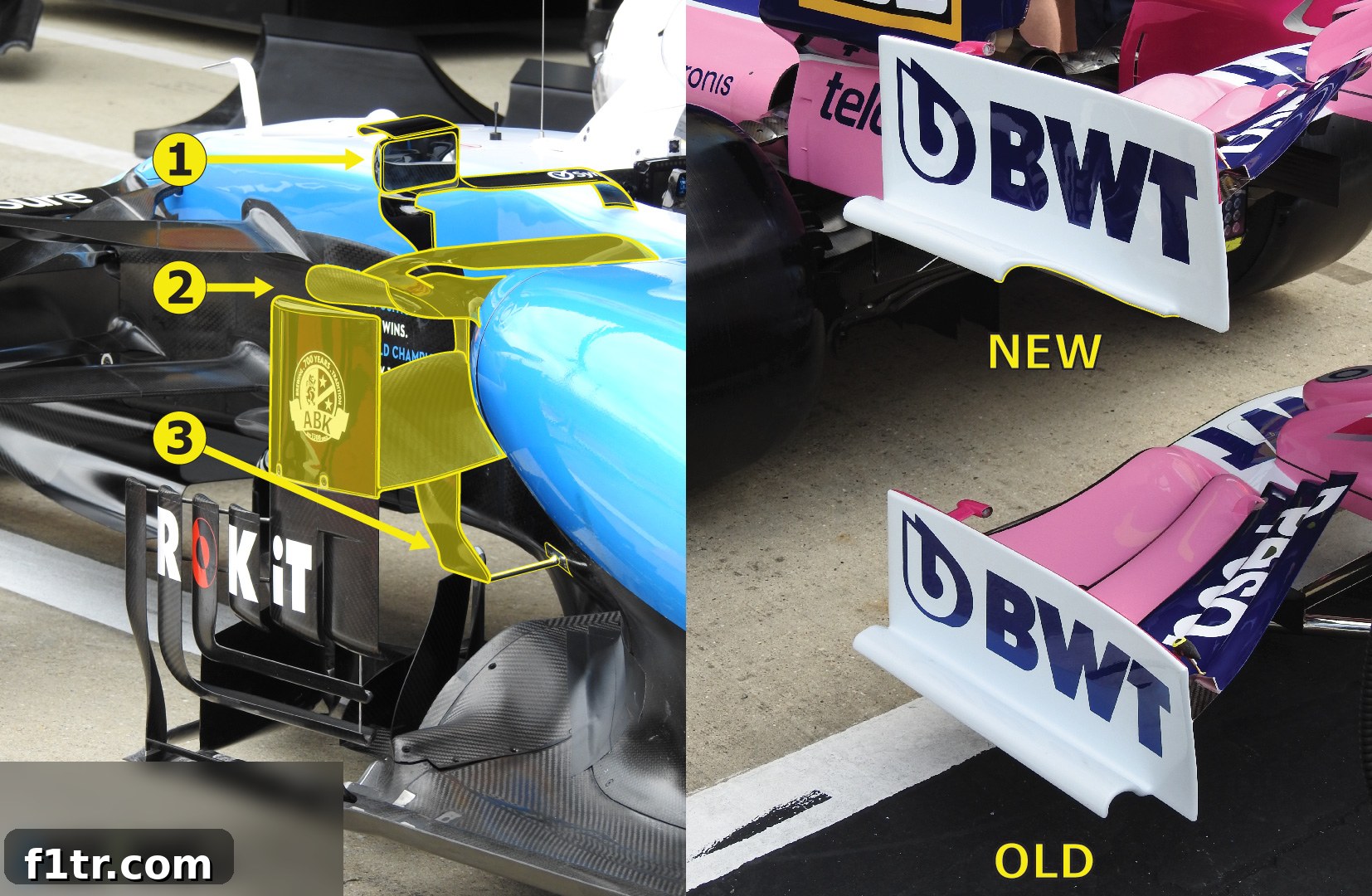
The seemingly innocuous mirrors on an F1 car are far from simple reflections of the track; they are intricate aerodynamic components. For the FW42, the Silverstone race marked the introduction of its third iteration of mirror design for the season. Early curved mirrors, tested at the beginning of the year, were deemed to have pushed the regulatory boundaries too far and were swiftly replaced before the first race with a less contentious, more conventional design.
The second version has now given way to a sophisticated pod-and-flap design, a concept widely adopted across the grid by many leading teams. This latest iteration retains the strategic use of two mounting elements, vital for their aerodynamic contribution. However, the mirror pod itself is now more exposed, and a precisely sculpted small flap has been integrated over it. This flap is engineered to further enhance the crucial downwash effect generated by the horizontal mounting, carefully guiding airflow over and around the sidepods to improve overall aerodynamic efficiency and downforce generation.
Redesigned Sidepod Inlet Package: Chasing Airflow Efficiency
Adjacent to the re-engineered mirrors, the vanes forming the sidepod inlet (often referred to as the ‘turning vanes’) have undergone a significant reshaping. Previously, these vanes converged to form a sharp 90-degree bend, a common design approach. The new specification sees these elements separated, with the upper horizontal component now featuring a distinctive flick-up, reminiscent of designs seen on aerodynamically successful cars like the Red Bull. Correspondingly, the vertical vane has been subtly shortened to complement this revised geometry.
Furthermore, a notable addition has been made to the lower horizontal vane: an auxiliary vane now hangs beneath it. This component is a clear indicator of the immense forces exerted by the airflow through the sidepod undercut region – an area vital for managing turbulent air and generating clean flow to the rear of the car. The aerodynamic load on this new vane is so substantial that it necessitates a small stay for structural support, highlighting the extreme precision and engineering required in modern F1 aerodynamics.
Looking Ahead: German Grand Prix Expectations for Williams
Given the specific and contained scope of the Silverstone changes, they are not expected to catapult Williams dramatically into the thick of the midfield battle immediately. The team acknowledges that these are incremental steps rather than a revolutionary leap. However, these refinements are crucial data points for future development. The true test and anticipated performance uplift are slated for the German Grand Prix, where considerably larger and more comprehensive updates are due to be introduced on the FW42. Despite the season’s struggles, a tangible sense of optimism persists within the Williams camp, driven by the belief that they are now firmly back on the right development track and making genuine strides towards regaining competitiveness.
Racing Point RP01: Strategic Refinements Amidst Recovery
In contrast to Williams’ extensive list of updates for Silverstone, Racing Point adopted a more measured approach, introducing fewer changes to its RP01 challenger for its home Grand Prix. This was somewhat atypical for the team, which traditionally brings a significant update package at this juncture of the season. However, this cautious strategy can be contextualized by the team’s unique circumstances following its transition out of administration, which undoubtedly impacted early season development and resource allocation.
Focusing on the Front Wing Endplate: A Critical Aerodynamic Element
For Silverstone 2019, the primary aerodynamic modification on the RP01 was directed at the front wing endplate. The front wing is arguably the most critical aerodynamic component on an F1 car, responsible for initiating the airflow structure that dictates performance across the entire vehicle. The endplate, in particular, plays a crucial role in managing the vortices generated at the wing tips, influencing how air flows around the front tires and subsequently downstream to the rest of the car.
Racing Point’s previous design, similar to Haas F1 Team’s approach, involved truncating the front wing endplate foot section, cutting it short of its trailing edge. The new specification takes this concept a stage further. The footplate has been cut back even more aggressively, featuring a new diagonal section removed from its design. This modification aims to precisely control the outwash effect – the redirection of airflow outwards from the front tires – and optimize the strength and position of the vortex shed from the endplate. Such fine-tuning of the front wing can have a profound impact on downstream aerodynamic components, potentially improving airflow to the bargeboards, sidepods, and eventually the diffuser, thus unlocking additional overall downforce and reducing drag.
The Broader Context for Racing Point’s Development Strategy
The focused nature of Racing Point’s Silverstone upgrade package underscores a strategic approach, likely influenced by the challenges faced during the car’s initial design phase. Developing a competitive F1 car requires immense resources and a stable environment, which the team lacked during its period of administration. Consequently, their 2019 car, the RP01, started the season with a foundation that was already somewhat compromised compared to fully developed rivals. In this context, even subtle, highly targeted aerodynamic refinements, like the front wing endplate alteration, become vital. They represent a methodical effort to incrementally improve performance, gather crucial data, and build towards more substantial packages later in the season, enabling the team to systematically address its car’s performance shortcomings and climb the highly competitive F1 grid.
The Relentless F1 Upgrade Race: A Constant Evolution
The updates brought by Williams and Racing Point for Silverstone perfectly illustrate the relentless nature of Formula 1 development. In a sport where fractions of a second can separate triumph from anonymity, every millimeter of aerodynamic surface is scrutinized, redesigned, and tested. Teams operate on an ongoing development cycle, continuously pushing the boundaries of engineering and physics. From mirrors that double as aerodynamic guides to front wing endplates that precisely sculpt airflow, every component plays a role in the intricate dance between downforce and drag. Even minor modifications, when expertly integrated, can yield meaningful performance gains, highlighting the technical sophistication and strategic planning required to compete at the pinnacle of motorsport. The continuous quest for aerodynamic perfection is what defines the cutting edge of F1 technology, making the upgrade race a compelling and ever-evolving spectacle.
Related F1 Technology Articles
- McLaren, Red Bull and Ferrari bring rear corner updates to Imola
- Ferrari, McLaren and Red Bull bring upgrades again for Saudi Arabian Grand Prix
- McLaren introduce major floor upgrade for Norris’ car at Mexican Grand Prix
- McLaren, Mercedes and Red Bull detail upgrade packages for United States GP
- Red Bull remove engine cover ‘cannons’ in major RB20 update – but they may return
Browse all F1 technology articles
Ultimately, the Silverstone upgrades for both Williams and Racing Point, while varying in scale and focus, represent crucial steps in their respective journeys to improve competitiveness. Williams’ comprehensive sidepod and mirror revisions lay the groundwork for more significant developments, fueled by a renewed sense of purpose. Racing Point’s precise front wing adjustments demonstrate a strategic, resource-conscious approach to optimizing existing components. Both teams understand that in the fiercely contested world of Formula 1, continuous evolution is paramount, and these mid-season aerodynamic battles are key to unlocking future success on the track.