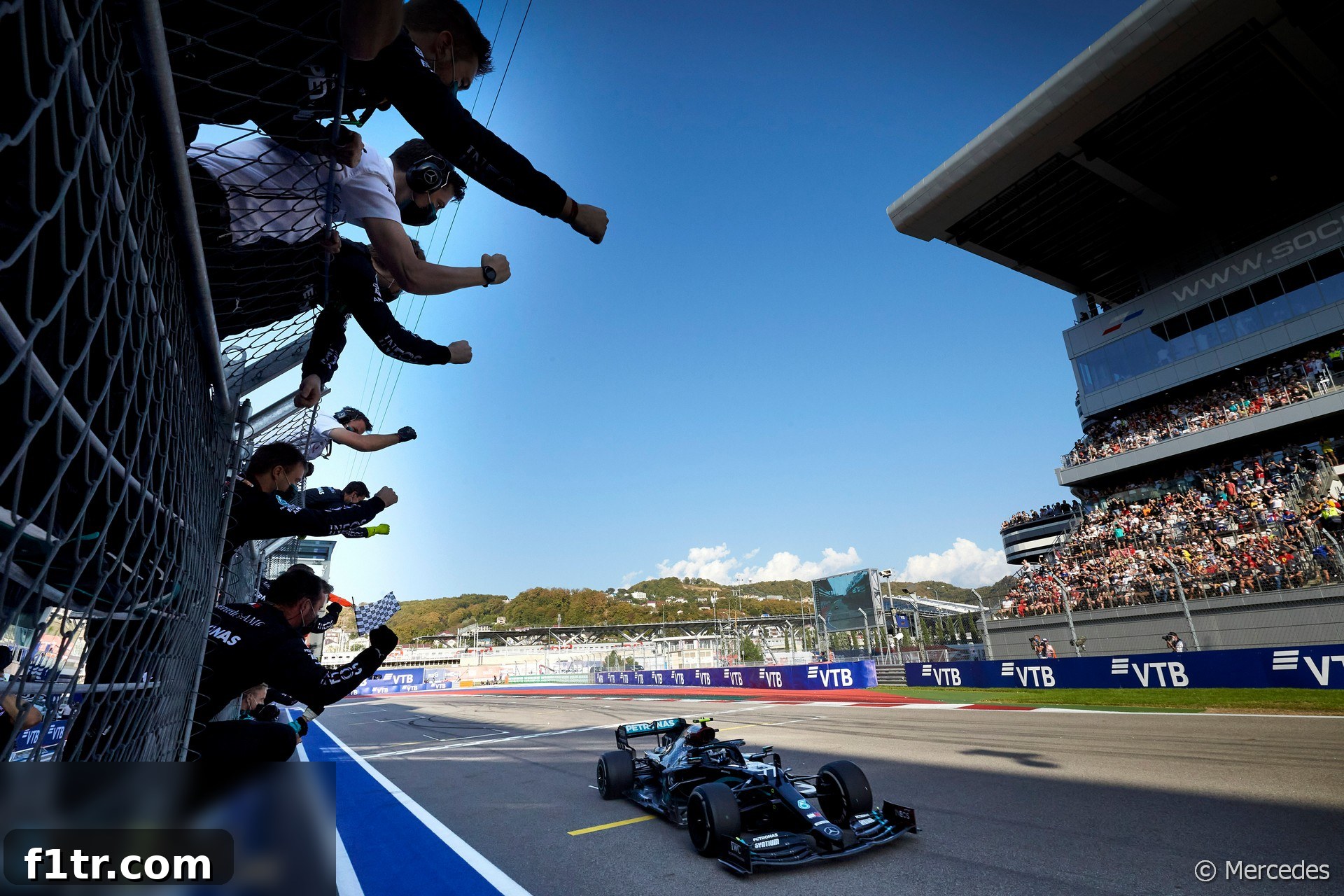
Mercedes-AMG Petronas Formula 1 Team has officially etched its name into the annals of motorsport history, becoming the longest-running holders of the constructors’ championship title. This monumental achievement sees them break the record previously held by the iconic Scuderia Ferrari, marking a new era of dominance in Formula 1.
Advert | Become a Supporter & go ad-free
Mercedes’ Unprecedented Reign: Setting a New Benchmark in Formula 1
With the current constructors’ championship still actively being contested, Mercedes proudly holds the crown they first secured at the Russian Grand Prix a remarkable 2,178 days ago. This enduring reign underscores their engineering prowess, strategic brilliance, and the consistent excellence of their driver lineup. Since clinching their inaugural constructor title in 2014, Mercedes has been an unstoppable force, consistently pushing the boundaries of performance and setting new standards for success in the pinnacle of motorsport.
Breaking Ferrari’s Historic Record
The previous record for the longest continuous reign as constructors’ champions belonged to Ferrari. Their formidable run began when they secured the 1999 title at the Suzuka circuit, a victory that marked the start of a golden era for the Italian team. Ferrari maintained their grip on the championship until Renault claimed the crown in the dramatic 2005 season finale in Shanghai, exactly 2,177 days later. For over a decade and a half, Ferrari’s six consecutive titles stood as the benchmark for team supremacy in Formula 1. Mercedes has not only matched Ferrari’s impressive streak of six consecutive titles but is now poised to extend this record to an unprecedented seven championships this year. With only seven races remaining in the current season, Mercedes commands a substantial 174-point lead over their closest competitors, Red Bull Racing. Red Bull is notable as the only other team to have secured the constructors’ title in the past decade, highlighting the exceptional longevity and consistency of Mercedes’ success.
Mercedes’ unparalleled success in the turbo-hybrid era, which began in 2014, has been attributed to a perfect storm of factors: superior engine development, aerodynamic efficiency, strategic decision-making, and the talent of their drivers, particularly Lewis Hamilton and Nico Rosberg initially, and now Valtteri Bottas. This era has seen them adapt to regulations more effectively than any other team, consistently delivering a package that is both dominant and reliable. Their ability to maintain this level of performance over such an extended period is a testament to the team’s organizational structure, leadership under Toto Wolff, and unwavering commitment to innovation.
Russian Grand Prix: Bottas Triumphs, Hamilton Faces Penalties
While Mercedes celebrated their constructors’ record, the Russian Grand Prix itself delivered its share of drama and significant talking points. Valtteri Bottas secured a crucial victory, his second of the season, marking a triumphant return to the top step of the podium. This win held particular significance for Bottas, as it was at this very track two years prior that he was instructed to yield his lead to teammate Lewis Hamilton. For Bottas, this victory in Sochi undoubtedly carried a degree of personal satisfaction, a feeling of “payback” for past team orders and a vital boost to his confidence and championship aspirations.
Meanwhile, Lewis Hamilton’s race was overshadowed by an unusual series of penalties. He received two five-second time penalties for practicing a start outside the designated area before the race. This was a rare occurrence and initially resulted in two penalty points being added to his superlicence. Had these points stood, Hamilton would have been perilously close to a one-race ban, needing only two more points to trigger the automatic suspension. However, in an equally unprecedented move, the stewards later rescinded these penalty points, ruling that the team had instructed him to perform the illegal practice start. This decision, a first of its kind, shifted the blame from driver to team and sparked considerable debate within the F1 community regarding penalty consistency and driver responsibility.
Advert | Become a RaceFans supporter andgo ad-free
Bottas’s Career Milestones and Sochi Autodrom Dominance
Valtteri Bottas’s victory in Russia was not just a standalone win; it also brought him level with some esteemed names in Formula 1 history. This marked the ninth win of his career, placing him alongside Max Verstappen – with whom he was tied on eight wins before the 70th Anniversary Grand Prix – and former Red Bull star Mark Webber. Furthermore, Bottas impressively snatched the fastest lap of the race for the 15th time in his career, an achievement that puts him on par with legendary figures such as Jackie Stewart, Clay Regazzoni, and Felipe Massa. These statistics highlight Bottas’s undeniable talent and his growing legacy in the sport.
Mercedes’ triumph in Russia also extended their impeccable, undefeated streak at the Sochi Autodrom. Since the circuit was added to the Formula 1 calendar in 2014 – coincidentally the same year Mercedes claimed their first constructors’ championship – they have won every single race held there. This perfect record of seven consecutive victories at the Sochi Autodrom underscores the unique synergy between the Mercedes car and the characteristics of the Russian track, making it a fortress for the Silver Arrows.
Driver Milestones and Enduring Legacies
The Russian Grand Prix was a race filled with significant milestones for various drivers across the grid. Sebastian Vettel, the four-time world champion, started his 250th Grand Prix, joining an exclusive club as only the tenth driver in Formula 1 history to reach this remarkable landmark. This achievement speaks volumes about his enduring commitment and sustained presence at the highest level of motorsport over many years.
Further up the list of career longevity, Kimi Räikkönen, often dubbed “The Iceman,” equaled Rubens Barrichello’s record to become the most experienced driver in the sport’s illustrious history. Both drivers have now started an incredible 322 Formula 1 races. This figure represents approximately 31.3% of all world championship races ever held since the sport’s inception. It’s worth noting that when Barrichello concluded his F1 career at the end of 2011, his 322 starts accounted for an astonishing 37.5% of all races at that time, a reflection of how the F1 calendar has expanded over the decades.
While both drivers share the record for starts, their total number of entries differs slightly due to non-starts. Rubens Barrichello officially entered 326 races but did not start four of them: San Marino in 1994 (due to an injury sustained in qualifying), Belgium in 1998 (eliminated in a mass collision before the re-started race), Spain in 2002 (a gearbox problem prevented him from starting), and France in 2002 (electrical issues sidelined him). Similarly, Kimi Räikkönen entered 325 races but missed three starts: Belgium in 2001 (retired before the re-started race was declared), USA in 2005 (withdrew on the formation lap due to significant tire safety concerns), and Malaysia in 2017 (an engine failure on the grid prevented him from taking part).
Other Notable Race Outcomes
Beyond the records and milestones, the Russian Grand Prix also saw some interesting dynamics unfold for other teams. Max Verstappen secured a strong second place for Red Bull Racing, earning them their first-ever podium finish at the Sochi Autodrom. This result was a positive step for the team, demonstrating their improving form and ability to challenge Mercedes, even on tracks where they historically haven’t excelled. Conversely, it was a challenging weekend for McLaren, as they failed to score any points. This marked their first non-score since the Mexican Grand Prix of the previous year, highlighting the fierce competition in the midfield and the unforgiving nature of Formula 1.
Go ad-free for just £1 per month>> Find out more and sign up
The Russian Grand Prix delivered a captivating mix of historic achievements, dramatic incidents, and pivotal moments for various drivers and teams. Mercedes’ record-breaking constructors’ reign firmly establishes them as one of the most dominant forces in Formula 1 history, while individual driver milestones continue to remind us of the incredible talent and dedication required to compete at this elite level.
Did you uncover any other fascinating statistics or facts from the Russian Grand Prix? We invite you to share your insights and observations in the comments section below!
2020 Russian Grand Prix Insights and Analysis
- Despite F1 drivers’ concerns, stewards don’t give penalty points for “minor infringements”
- 2020 Russian Grand Prix Star Performers
- “Slower” Ferrari only beat us because of Q3 tyre rule – Tost
- “I may not always get it right” says Hamilton after penalty criticism
- Why did the stewards make their second U-turn this year on a Hamilton penalty call?
Browse all 2020 Russian Grand Prix articles