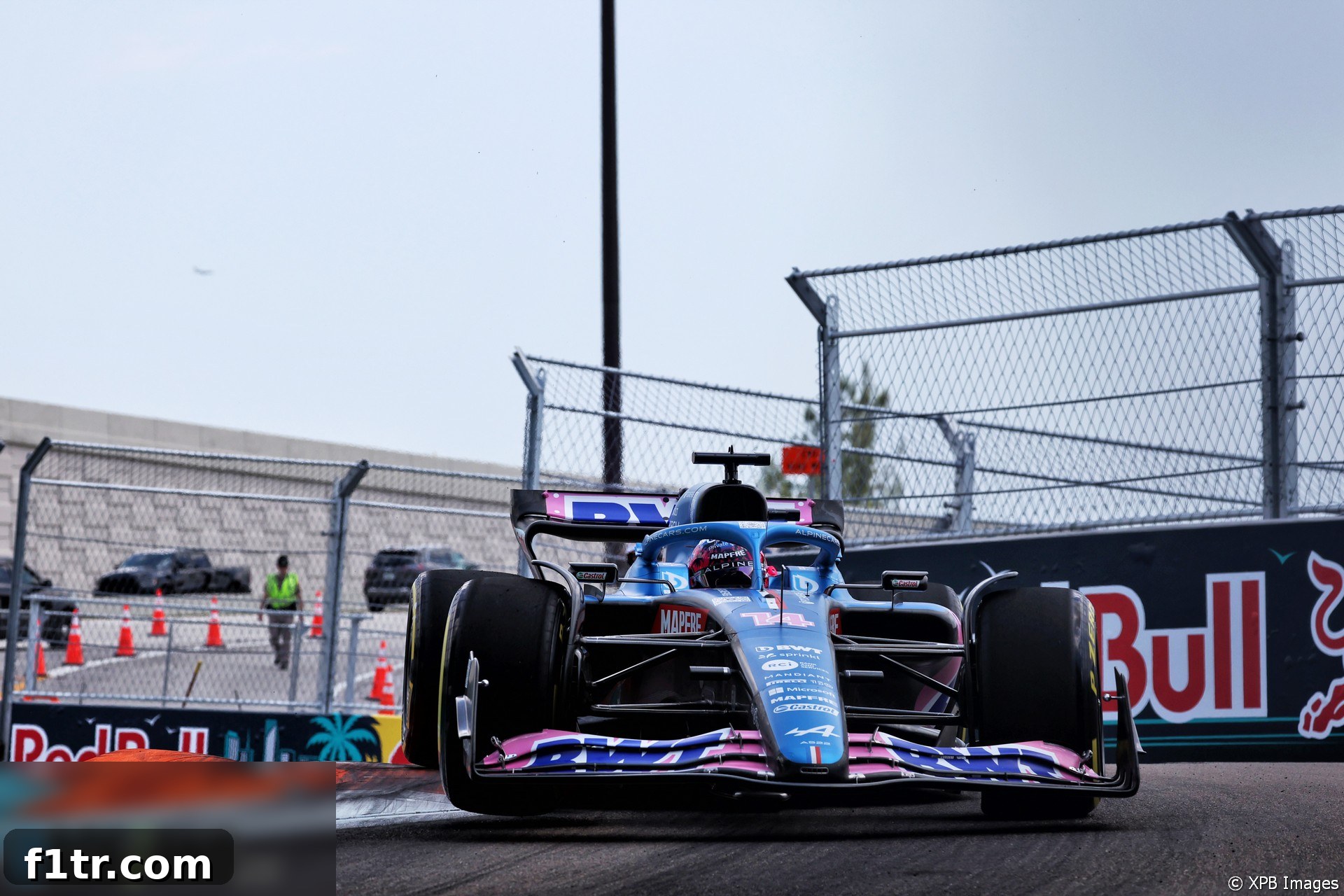
Fernando Alonso endured a challenging Miami Grand Prix weekend, particularly marked by a pair of five-second time penalties. While one was issued for a collision with Pierre Gasly, it was the second penalty – for supposedly gaining an advantage by cutting the turn 15 chicane – that ignited considerable debate and left his Alpine team deeply frustrated.
Advert | Become a Supporter & go ad-free
The veteran Alpine driver found himself under scrutiny twice for transgressing the track limits at the same turn 14 and 15 chicane during the race, specifically on laps 53 and 56. Curiously, the race stewards deemed him guilty of infringing the rules on the first occasion, penalizing him, but decided against any further action for the second, identical incident. This perceived inconsistency fueled the controversy that followed the race.
Having already conceded one position due to the penalty for his earlier contact with Gasly, the subsequent five-second sanction for the chicane incident proved devastating for Alonso. It stripped him of his hard-earned points entirely, relegating him to 11th in the final classification, a mere tenth of a second behind Lance Stroll. This outcome effectively erased his promising performance and left Alpine questioning the application of the regulations.
The Alpine team vocalized their significant dissatisfaction regarding Alonso’s second penalty. This article delves into the specifics of both incidents, examining whether the stewards’ decisions were justified, exploring the nuances of the “gaining a lasting advantage” rule, and considering the broader implications for consistency in Formula 1 officiating.
The Controversial Incident – Lap 53
On lap 53, shortly after the Safety Car period concluded and racing resumed, Alonso was navigating the demanding Miami International Autodrome in eighth position. He was approximately two seconds adrift of Valtteri Bottas ahead, while simultaneously defending from Mick Schumacher, who was less than a second behind. Schumacher had consistently remained within DRS (Drag Reduction System) range of Alonso’s Alpine for the preceding nine consecutive DRS zones, yet had been unable to mount a successful overtaking maneuver.
As the cars entered the challenging and tight middle sector of the circuit, Alonso’s gap to Bottas widened to 2.8 seconds, while his advantage over Schumacher dwindled to just under half a second (0.476s). It was at this critical juncture that Alonso misjudged the entry to the chicane, comprising turns 14 and 15. Rather than navigating the sequence, he took to the inside run-off area, effectively cutting turn 15 entirely and rejoining the track further down the straight.
Upon rejoining the circuit and accelerating onto the lengthy back straight, Alonso visibly raised his hand from the cockpit, a gesture widely interpreted as an acknowledgement of having left the track. He also appeared to lift off the throttle audibly twice along the straight, ostensibly attempting to relinquish any time gained by missing the chicane. However, crucially, these lifts occurred only after he had already crossed the second DRS detection line. Despite his apparent efforts to give back time, his actions had tangible consequences: he had gained 1.4 seconds on Bottas ahead, and perhaps more significantly, Schumacher was now out of DRS range, over 1.2 seconds behind. Alonso’s lap time for lap 53, a 1’33.331, ironically stood as his personal best from the entire race, further complicating the stewards’ assessment of “advantage.”
The immediate repercussions of Alonso’s chicane cut were felt by Mick Schumacher. Without the crucial DRS assistance from Alonso’s car ahead, Schumacher became vulnerable to Alonso’s team mate, Esteban Ocon, who was now closing in behind. Ocon capitalized on this opportunity, attacking Schumacher at the turn 17 hairpin at the end of the straight. This aggressive move triggered a chain of events that culminated in a collision between Schumacher and Sebastian Vettel, further highlighting the butterfly effect of Alonso’s initial track transgression.
Advert | Become a RaceFans supporter andgo ad-free
Visual Analysis: How the Lap 53 Incident Unfolded
The Unpenalized Incident – Lap 56
As the Miami Grand Prix drew to a close, on the penultimate lap, lap 56, Fernando Alonso once again found himself in eighth place. He was still trailing Valtteri Bottas, though now with Esteban Ocon behind him. Approaching the identical turn 14 and 15 chicane, Alonso was 1.7 seconds behind Bottas and held a more comfortable 2.2-second lead over Ocon.
This time, as Alonso initiated his turn-in for the chicane, his left-front wheel visibly locked, producing a plume of smoke from his tire. Despite maintaining a steering input towards the apex of the corner, Alonso’s car experienced understeer, forcing him to take to the escape road once again. mirroring his earlier action, he raised his hand in acknowledgement of his off-track excursion.
By the conclusion of the subsequent back straight, Alonso’s gap to Bottas had marginally tightened to 1.6 seconds, while his advantage over Ocon had slightly increased to 2.3 seconds. Interestingly, Alonso’s lap time for lap 56, a 1’33.344, was a tenth faster than his two preceding laps, despite the off-track moment. This might suggest that the chicane cut, even if unintentional, still allowed him to maintain a competitive pace.
Alonso completed the final lap of the race, crossing the chequered flag ahead of his Alpine team mate Ocon in eighth position. However, the previously incurred five-second time penalty for his collision with Pierre Gasly (before the Safety Car) meant he provisionally dropped to ninth in the classification. This was further compounded by the later penalty for the lap 53 chicane cut, which ultimately saw him fall out of the points altogether, landing him in 11th place.
Advert | Become a RaceFans supporter andgo ad-free
Visual Analysis: How the Lap 56 Incident Unfolded
Driver and Team Reactions
Alonso’s Immediate Radio Communications
Following his initial chicane cut on lap 53, Fernando Alonso promptly communicated with his team via radio, asserting that he had successfully nullified any advantage gained by missing turn 15 through intentionally lifting off the throttle. “I missed turn 14 but I lifted off next straight,” Alonso declared, attempting to justify his actions and pre-empt any potential penalty.
After his second excursion across the escape road on lap 56, Alonso’s radio message indicated a potential technical issue, specifically with his brakes. “Yeah, the brakes are locking,” he reported, suggesting that the second incident might have been involuntary and caused by a mechanical problem rather than a deliberate attempt to cut the corner.
Post-Race Silence from Alonso
Having received his second five-second penalty after engaging with the media following the race, Alonso chose not to comment publicly on the incidents. This silence, while understandable given the frustration and disappointment, left many questions unanswered regarding his perspective on the stewards’ controversial decisions.
Advert | Become a RaceFans supporter andgo ad-free
The Official Verdict – Lap 53: A Penalty Issued
After a thorough investigation into Alonso’s first chicane incident on lap 53, the race stewards concluded that the Alpine driver had indeed breached the FIA sporting regulations. Their official determination was that Alonso had gained a “lasting advantage” by leaving the track at turn 14 and subsequently cutting turn 15.
“The stewards reviewed the video evidence and determined that car 14 [Alonso] left the track at turn 14 and gained a lasting advantage,” stated the stewards in their official decision. Notably, however, their communiqué lacked detailed clarification regarding the specific rationale or metrics used to quantify how Alonso had gained this “lasting advantage.” This ambiguity became a focal point of contention for the Alpine team and many observers.
Consequently, the stewards imposed a five-second time penalty on Alonso and added one penalty point to his superlicence. This penalty proved significant, as it effectively knocked Alonso out of the points in the final classification, dropping him from ninth to 11th. This decision promoted Alex Albon to ninth place and elevated Lance Stroll into the final points-scoring position of tenth.
In the aftermath of the race, on the following Wednesday, Alpine Racing’s CEO, Laurent Rossi, released a strongly worded statement. He openly expressed the team’s view that the penalty was unjust and disproportionate, especially considering Alonso’s perceived attempt to return the time. “This one is certainly difficult to accept since Fernando handed back the time during the lap and we were not able to present the evidence to clarify the particular situation before the penalty was issued,” Rossi’s statement read, highlighting a procedural frustration.
Rossi concluded with a firm belief: “With the opportunity to explain, we’re very confident Fernando would have kept his ninth place.” This underscored Alpine’s conviction that had they been given the chance to fully present their case, the outcome would have been different, suggesting a flaw in the adjudication process or a lack of understanding from the stewards regarding the specific circumstances.
The Official Verdict – Lap 56: No Further Action
In stark contrast to the lap 53 incident, the stewards reached a different conclusion following their investigation into Alonso’s second instance of cutting the chicane on the penultimate lap of the race. Despite the visual similarities and the driver’s own acknowledgement of leaving the track, the stewards decided that no further action was warranted.
In their official decision, the stewards meticulously explained their reasoning: they had “reviewed the video and GPS data evidence and determined that although the driver of car 14 [Alonso] left the track and rejoined, the time difference to the two following cars [Ocon and Albon] remained unchanged, thus the Stewards concluded that no lasting advantage was gained.” This verdict introduced a critical distinction between the two incidents – the impact on relative gaps to following competitors. While Alonso’s lap time improved, the stewards specifically focused on the lack of change in the time delta to the cars directly behind him as the determining factor for not gaining a “lasting advantage.” This difference in justification between the two incidents became the very core of the post-race controversy, raising serious questions about consistency in Formula 1 stewarding.
Advert | Become a RaceFans supporter andgo ad-free
The Broader Debate: Consistency and “Lasting Advantage”
The Miami Grand Prix penalties for Fernando Alonso reignited a recurring debate within Formula 1: the consistent application of rules, particularly concerning track limits and “gaining a lasting advantage.” The core issue lies not just in whether Alonso broke the rules, but in the stewards’ seemingly different interpretations of two very similar incidents involving the same driver at the same corner. Fans, teams, and pundits often seek clarity and uniformity in decision-making, as this directly impacts the fairness of the competition and the integrity of the sport.
The concept of “lasting advantage” itself is often subjective. While GPS data can measure time differences, the qualitative impact of a maneuver, such as breaking a DRS train or creating a buffer against an attacker, is harder to quantify precisely. In the lap 53 incident, the stewards evidently believed that even with Alonso’s attempts to give back time, the significant gap created to Mick Schumacher, removing him from DRS range, constituted a lasting advantage that influenced the subsequent racing. Conversely, on lap 56, even with a faster lap time, the stewards found no such critical impact on the following cars, Ocon and Albon. This distinction, while seemingly logical on paper, proved contentious in practice.
Alpine’s argument, championed by Laurent Rossi, underscored a procedural frustration: the inability to present their full case before the penalty was issued. This points to a broader concern about the immediacy of F1 stewarding decisions versus the need for comprehensive analysis and driver/team input. In a sport where fractions of a second can dictate outcomes and millions are invested, such decisions carry immense weight and demand the utmost transparency and consistency.
Ultimately, the Miami Grand Prix incident involving Fernando Alonso serves as a prime example of the complexities inherent in modern Formula 1 stewarding. It highlights the fine line between an unintentional error and a deliberate gain, and the ongoing challenge of applying regulations consistently in the high-stakes, fast-paced environment of Grand Prix racing. The debate about whether Alonso’s penalty was truly justified, or if both incidents should have been treated identically, continues to resonate among the F1 community.
Your Verdict: The Fan Perspective
The controversy surrounding Fernando Alonso’s penalties at the Miami Grand Prix sparked considerable discussion among fans. A poll conducted shortly after the race asked: “Do you agree that the stewards handled Alonso’s chicane incidents correctly?” The results indicated a significant division of opinion, with a majority of voters expressing some level of disagreement with the stewards’ handling of the incidents. Specifically, 48% “Strongly agreed” the stewards were correct, while 17% “Strongly disagreed”, and a further 4% “Slightly disagreed”. The outcome underscores the diverse interpretations of the rules and the perception of consistency among the Formula 1 fan base. The debate continues to thrive in comments sections and forums, reflecting the passion and critical engagement of the sport’s followers.
Further Debates and Polls
- What must Formula 1 fix with its new rules – and what should it leave unchanged?
- ADUO: Do F1 teams who fall behind deserve to get help to catch up?
- F1 is considering doubling its sprint races. Do you want more or fewer?
- Will this be a fight or a rout? 20 questions for the 2026 Formula 1 season
- Which Formula 1 team has the best-looking car – and the worst – for the 2026 season?
Browse all debates and polls