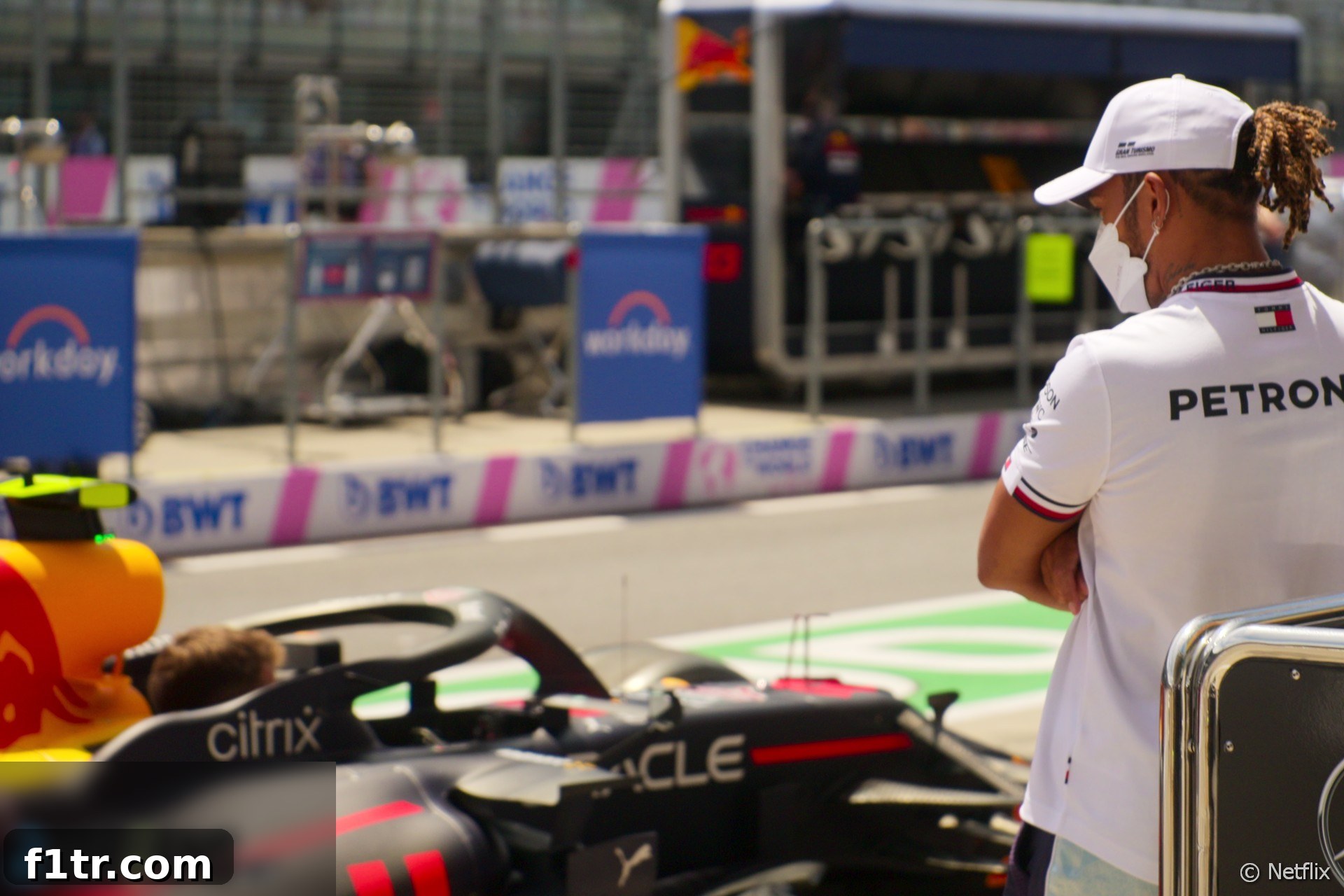
Formula 1’s highly successful Netflix docu-series, “Drive to Survive,” is poised for continued longevity beyond its current contractual obligations covering the 2022 and 2023 seasons. This popular series, which has revolutionized how fans engage with the pinnacle of motorsport, is not only expected to remain a staple in F1’s media strategy but also welcomes the growing trend of similar behind-the-scenes productions from other global motorsport championships.
Since its debut in 2018, “Drive to Survive” has granted viewers unprecedented access to the intricate world of the F1 paddock. This level of intimacy, once reserved exclusively for accredited media, has transformed the series into a global streaming phenomenon. It has become an indispensable vehicle for introducing Formula 1 to entirely new demographics, converting casual viewers into passionate followers and significantly broadening the sport’s appeal worldwide.
Speaking at the recent BlackBook Motorsport forum in London, Ian Holmes, F1’s astute director of media rights and content creation, offered profound insights into the origins, strategic vision, and promising future of “Drive to Survive.” The series is currently contracted for two additional installments: a fifth season, actively filming the ongoing championship, and a sixth, which will chronicle the exhilarating 2023 F1 season and be released the following year. Holmes expressed strong confidence in its future, stating, “I think if we’re happy with it, if people want to consume it and watch it, and Netflix is happy with it, then I think we will continue [beyond series six].” This sentiment underscores the mutually beneficial relationship between F1 and Netflix, driven by audience demand and critical acclaim.
Holmes highlighted a unique advantage F1 possesses over other sports venturing into similar documentary formats. While many sports leagues, such as football, are exploring their own versions of “Drive to Survive,” F1 benefits from a compact cast of key figures. “What we saw, certainly in the last series, maybe the last two series, the team principals seem to take a more central role. But effectively we’re dealing with 30 people. And this is where I think we have an advantage over perhaps some football leagues [with shows]. Pretty much every sport is looking at their own sub-version, shall we say,” he explained. “But we have an advantage. We have 30 people, and that’s it. So you can actually go in quite deep with them, and cover the whole grid. So I think our sport lends itself to that. Plus the fact that for years and years and years there was little or no coverage of the behind the scenes.” This focused approach allows for profound character development and intricate storytelling, capturing the diverse personalities and high stakes that define Formula 1.
The Genesis of a Global Phenomenon: How F1 Embraced the Docu-Drama
The spark for “Drive to Survive” was ignited by McLaren’s “Grand Prix Driver” series, available on Netflix’s primary streaming rival, Amazon Prime. At a time when Formula 1 viewership was almost exclusively confined to live race broadcasts on television, the championship’s new owner, Liberty Media, envisioned a more expansive, immersive approach. Unlike the previous F1 owner, Bernie Ecclestone, who preferred an “arm’s-length license” model that imposed strict limits on filming and footage rights for productions focusing on individual drivers or teams, Liberty Media sought to create a more inclusive, internally designed production that could captivate a broader audience.
Holmes elaborated on Liberty Media’s paradigm shift: “Off the back of Liberty wanting to take a slightly different approach to things, and an approach that was more inclusive, we thought wouldn’t it be better to actually adopt a narrative that focuses on the sport as a whole? All of the teams, all of the drivers, all the team principals, et cetera.” This holistic vision set “Drive to Survive” apart, promising a comprehensive view of the sport rather than fragmented narratives. Amazon already had a proven track record with its highly successful “All or Nothing” series, which covered various sports including NFL, soccer, rugby union, and NHL ice hockey. Inspired by this model, F1 pitched a similar, compelling product to Netflix, initiating negotiations that would ultimately redefine motorsport entertainment.
Winning Over the Paddock: A Collaborative Effort
While the agreement with Netflix was reached “pretty quickly,” as Holmes recounted, the true challenge lay in securing the participation of all ten Formula 1 teams. “But the deal was subject to delivering the teams. So then we had to sit down with 10 teams, which took quite a lot longer, to put it mildly,” he revealed. Famously, powerhouse teams Ferrari and Mercedes initially declined to participate, wary of the unprecedented access requested by the production. This initial resistance highlighted the secretive nature of the sport and the ingrained cautiousness of its participants.
However, Holmes emphasized the collaborative spirit that eventually prevailed: “But again, it was new for all of us. And essentially what we’re asking of the teams, and it’s important again that they recognise this, okay it took Ferrari and Mercedes a little bit longer, but they embraced the concept. Because we needed their buy-in. We felt that for the series to be successful, essentially they would have to provide a level of access that we couldn’t provide. A level of access that has never been provided with us [before].” The success of “Drive to Survive” hinged entirely on this willingness from the teams to open their highly competitive and often confidential environments to the cameras.
This initiative required a monumental shift, not only in the teams’ attitudes towards being filmed in such a historically guarded setting but also in Formula 1’s broader approach to footage access. For years, F1 had rigorously cracked down on the distribution of any unauthorized video from race weekends, strictly limiting it to its licensed international TV broadcasters. Holmes candidly recalled this era: “I’ve read certain stories about people in F1 having to write to Lewis Hamilton or whoever it was to tell them to remove footage from their social media accounts, and probably I sent a few of those myself.” Indeed, after Liberty Media acquired F1, Hamilton famously showed them a collection of ‘cease and desist’ letters he had received from Ecclestone regarding his social media content, illustrating the stark contrast in media philosophy.
Crafting the Narrative: Docu-Drama vs. Documentary
The “docu-drama” nature of “Drive to Survive,” which aims to tell an engaging story rather than merely recap each F1 season race-by-race, has inevitably drawn scrutiny. Accusations of fabricating rivalries or exaggerating events for dramatic effect have surfaced, prompting discussions about the balance between entertainment and factual accuracy. Holmes addressed this, clarifying the collaborative framework: “The way it [the show] works is contractually the teams have certain very, very defined areas where they are allowed to request amendments and changes. Areas such as anything that accidentally reveals anything either commercially or sportingly sensitive – at the time of release, of course.”
However, given that each series of the show is released online a couple of months after the conclusion of an F1 season, the teams’ bargaining power against the program’s narrative interests remains somewhat limited. “They get to see the rushes, but they don’t get to see it in the form of the final cut. And essentially it is so no one is going to throw anyone under the bus,” Holmes explained. While there have been minor controversies, the overall approach is collaborative. “There’s been a few things here and there that have caused some controversy. But it’s a very collaborative approach. There have been requests coming from teams that perhaps don’t strictly meet the criteria in which they are allowed to make them, but if we don’t think it will detract or dilute the narrative, and I know that Netflix themselves and the production company are also quite helpful, [then it can be cut]. Because it is a two-way thing.”
One particularly pointed accusation related to whether the Netflix cameras influenced the highly controversial conclusion of the 2021 world championship at the Abu Dhabi Grand Prix. Holmes offered a categorical denial, stating, “I think the answer is no. Certainly it doesn’t influence the outcome of a race or a session or the championship.” While the series undoubtedly amplifies the drama, it remains an account of events, not a determinant of them. F1’s live viewing figures surged for that race, partly due to free-to-air deals struck for the title decider between Lewis Hamilton and Max Verstappen, who entered the final weekend level on points. “Drive to Survive’s” broader impact on growing the audience was undoubtedly a contributing factor to this increased live viewership.
Unprecedented Growth and Demographic Shift: The “Drive to Survive” Effect
The true scale of “Drive to Survive’s” potential for success became abundantly clear with its third season. Holmes recollected, “We realised the full extent of the potential for success [with Drive to Survive] was in series three. Series one was very well-received, Netflix was happy. They famously don’t share a great deal of data in terms of viewing, but conversationally we had a good idea of how it was doing. Second series [of shows] never normally rate as high as the first series, there’s usually a small drop-off. And that was the case with us, we had a 5% drop-off, which is totally normal. And then series three, there was a 50% increase. And that’s when we sort of sat back and thought ‘that’s not normal’.”
Holmes drew a compelling comparison to Netflix’s critically acclaimed series “The Last Dance,” which chronicled basketball legend Michael Jordan and the Chicago Bulls NBA team. “The contributing factors, over and beyond just the narrative that was in series three, is that the genre’s grown. The Last Dance, many people have seen that, and people watch The Last Dance who perhaps don’t watch basketball. The same can be said for Drive to Survive.” This analogy perfectly encapsulates the cross-over appeal of “Drive to Survive” – it captivates viewers who might not traditionally follow Formula 1, drawing them into the human drama and high-octane spectacle of the sport.
The profound impact of this phenomenon extends far beyond mere viewing numbers; it lies in *who* is watching. “And that comes back into the viewing numbers. It’s not just how many people watch, it’s actually who’s watching. That’s where the value is. Because what we saw was that people were engaging with F1, who don’t necessarily sit down on Sunday afternoon and watch Sky, Canal+ or ESPN. Many of them now subsequently do as we’ve seen in our viewing figures. But essentially the real value is reaching out to a broader demographic,” Holmes articulated. This expansion to a younger, more diverse, and globally distributed audience has been invaluable to Formula 1, translating into increased brand engagement, sponsorship opportunities, and long-term growth for the sport.
“There’s a myriad of different ways of looking at it, and essentially it does translate to viewing figures. There are people who perhaps got into the sport watching Drive to Survive. Or indeed following a driver on social media, who then have translated through and will now watch the live coverage on Sunday afternoon or Saturday, whatever it might be. When we’ve looked at it internally, obviously that is the direction of travel that we want to see, but it’s not the absolute requirement,” Holmes concluded. The series acts as a crucial gateway, converting passive interest into active viewership and solidifying F1’s status as a leading global sport.
The Future of Drive to Survive and F1: A Symbiotic Relationship
Anticipation for the next series of “Drive to Survive” is already palpable, even as the current F1 season continues to unfold with gripping narratives. The ongoing verbal sparring between Mercedes and Red Bull team principals, a legacy of their intense 2021 rivalry, provides ample drama. Ferrari’s championship challenge, compromised by unexpected unreliability and strategic missteps, offers another compelling storyline. Meanwhile, the “silly season” – the period of driver transfers and team movements – has delivered some of its most dramatic twists and turns in years, ensuring an abundance of behind-the-scenes content. Furthermore, the F1 calendar has expanded with exciting additions like the Miami Grand Prix and the return of four grand prix circuits that consistently deliver some of the season’s most visually stunning and action-packed footage.
Ultimately, while Formula 1’s soaring popularity in recent years is undeniably fueled by “Drive to Survive,” this success is fundamentally rooted in the championship’s ability to deliver a strong, captivating on-track show. The compelling narratives, fierce rivalries, and human triumphs and struggles inherent in Formula 1 racing provide Netflix with a rich tapestry of stories, ensuring that “Drive to Survive” will continue to thrive as a vital component of the sport’s global appeal for the foreseeable future.
Become a RaceFans Supporter
RaceFans is run thanks in part to the generous support of its readers. By contributing £1 per month or £12 per year (or the same in whichever currency you use) you can help cover the costs of creating, hosting and developing RaceFans today and in the future.
Become a RaceFans Supporter today and browse the site ad-free. Sign up or find out more via the links below:
- Become a RaceFans Supporter
- RaceFans Supporter FAQ
2022 F1 season
- Mercedes told me “you’re wrong” about 2022 car’s problems – Hamilton
- FIA confirms all 10 F1 teams complied with 2022 cost cap
- Steiner “not ashamed” of panning “slow” Schumacher in Drive to Survive
- Albon believes year out of F1 improved him as a driver
- Hamilton sees diversity gains in F1 years on from his ‘traumatising’ experience of racism
Browse all 2022 F1 season articles