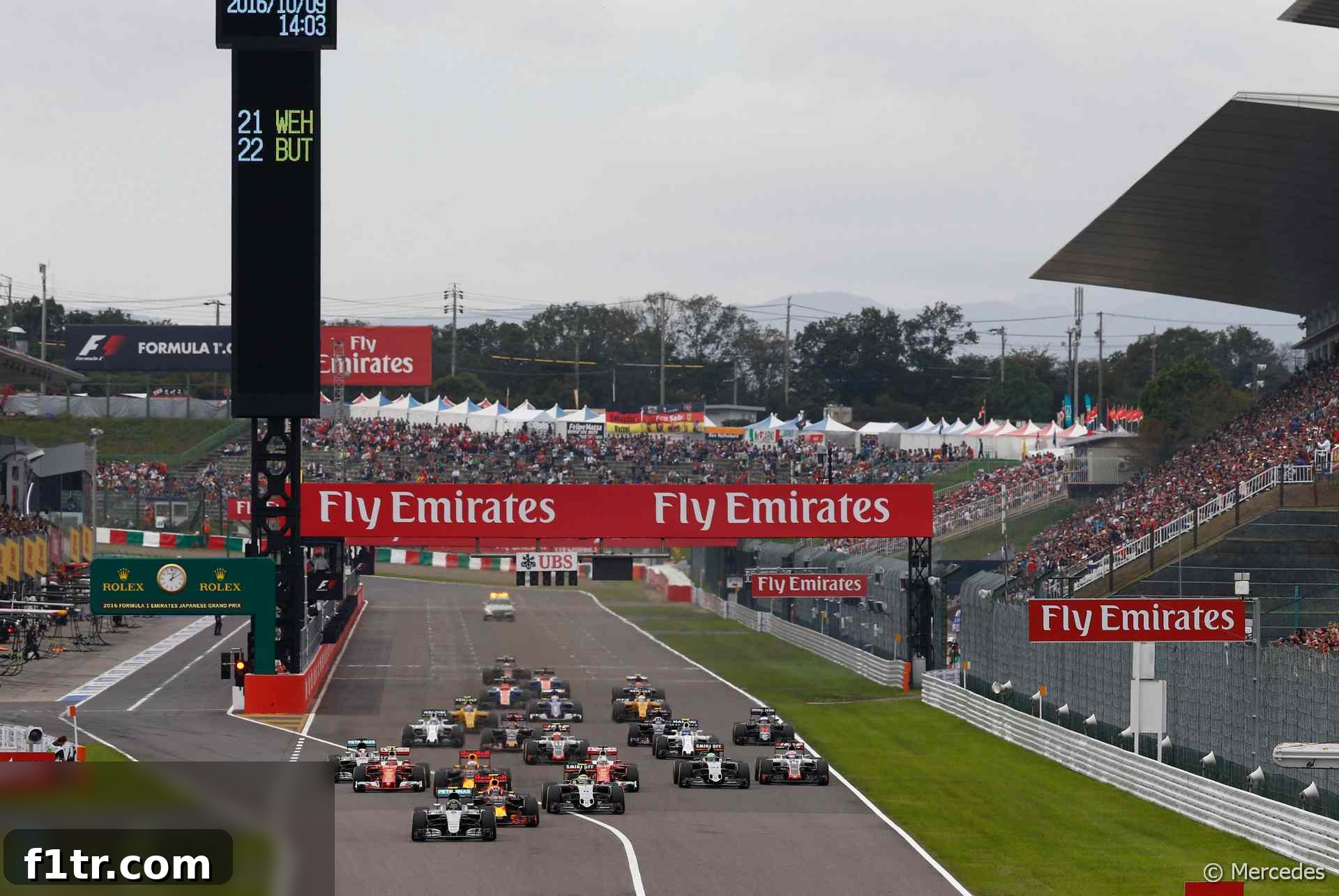
The dust has settled at Suzuka, and Nico Rosberg emerged victorious at the 2016 Japanese Grand Prix, securing his 23rd career win. This significant milestone places him alongside the esteemed three-time world champion Nelson Piquet in the annals of Formula 1 history. Interestingly, Piquet clinched his titles either side of Rosberg’s father Keke Rosberg’s 1982 championship triumph, creating a fascinating generational parallel in motorsport lore.
While Rosberg the younger is yet to claim a championship title himself, his masterful performance in Japan has brought him closer to that elusive goal than ever before. With only four races remaining in the exhilarating 2016 F1 Championship, Rosberg now holds a commanding lead over his Mercedes teammate, Lewis Hamilton. To guarantee the title regardless of Hamilton’s performance, Rosberg needs a minimum of three second-place finishes and one third-place finish in the upcoming rounds. The championship cannot be decided at the immediate next race, but the tension could reach a fever pitch by the following event, the highly anticipated Mexican Grand Prix.
Mercedes’ Unprecedented Dominance and the Championship Narrative
The 2016 Formula 1 season has unequivocally been a story of Mercedes’ unparalleled dominance. Following their sensational performance at Suzuka, it is now mathematically impossible for any non-Mercedes driver to win the drivers’ championship. The Silver Arrows not only extended their lead in the drivers’ standings but also emphatically secured their third consecutive Constructors’ Championship title. This remarkable achievement places Mercedes in an elite club as only the fifth team in Formula 1 history to win three constructors’ titles in a row. They join legendary outfits such as Ferrari (who achieved this twice, from 1975-77 and 1999-2004), McLaren (1988-91), Williams (1992-94), and Red Bull (2010-13).
Examining these periods of sustained team dominance reveals a captivating trend: rarely does the drivers’ title change hands between teammates during such streaks. A notable exception occurred between 1988 and 1989, when the fierce rivalry saw Ayrton Senna momentarily lose the championship to his McLaren teammate, Alain Prost. A critical factor in that intense intra-team battle, much like in the current Hamilton-Rosberg rivalry, was car reliability. The subtle yet significant differences in car performance and endurance can often swing the momentum in a title fight between drivers sharing the same machinery.
Lewis Hamilton’s Championship Challenges: Reliability and Starts
While Mercedes enjoys a historical period of dominance, the internal battle for the drivers’ title has been anything but straightforward for Lewis Hamilton. His championship aspirations in 2016 have been significantly hampered by two recurring issues: persistent reliability problems and a series of sub-optimal starts. These factors, more than outright pace, have created the current deficit he faces against Nico Rosberg.
The Impact of Poor Starts
When analyzing race starts, raw statistics can sometimes be misleading. For instance, Rosberg’s net position change on lap one across the season is numerically worse than Hamilton’s, with 25 places lost compared to Hamilton’s nine. Furthermore, Rosberg has ended lap one in a lower position than he started more times than his teammate (six to four). However, a deeper dive reveals a more nuanced picture, especially regarding the severity and timing of these losses.
Hamilton’s poor starts have, unfortunately, been far more damaging to his prospects of winning races. Each instance where he lost positions at the start resulted in a significant drop, typically five places or more, effectively neutralizing his chances of victory from the outset. In contrast, Rosberg’s major losses of position at the start were almost entirely concentrated in just two races: Canada and Malaysia. Even in Malaysia, his worst start, the initial slow getaway was not entirely his fault, and any potential damage was ironically overshadowed and nullified by Hamilton’s eventual engine retirement from the lead, highlighting the cruel twists of fate in F1.
(Visual representation of start performance and its impact on points, typically shown in a chart. The following text summarizes its key findings.)
These four critical poor starts have cost Hamilton dearly throughout the season. Had he managed to hold his starting position in each of those instances, conservative estimates suggest he would have gained an additional 27 points. Concurrently, by not ceding those positions, he would have deprived Rosberg of 21 points that the German subsequently secured. This cumulative 48-point swing is monumental in the context of the championship, especially considering that Hamilton currently trails Rosberg by a crucial 33 points. This differential underscores how pivotal strong starts are in the tightly contested world of modern Formula 1.
Experience F1 Ad-Free: Become a RaceFans SupporterUnlock an uninterrupted Formula 1 experience for just £1 per month. Discover more and join our community of supporters today!
Qualifying Drama and Rosberg’s Suzuka Breakthrough
The battle for pole position at the Japanese Grand Prix was a masterclass in precision, with Nico Rosberg securing his 30th career pole by an astonishingly slender margin of just 13 thousandths of a second. At his average speed of 230.622 kph around the iconic Suzuka circuit, this miniscule time difference translates to a mere 83 centimeters on track – a testament to the hyper-competitive nature of modern F1 qualifying. This razor-thin advantage marked the closest front-row battle since Hamilton out-qualified Rosberg for pole at Singapore in 2014 by an even tighter seven thousandths of a second.
This marked Rosberg’s third pole position at Suzuka, a circuit where, until yesterday’s race, he had never managed to convert his qualifying prowess into a victory. His win at the 2016 event finally broke that streak, adding the coveted Japanese Grand Prix to his list of triumphs. Lewis Hamilton, despite his illustrious career, is yet to secure a pole position at the Suzuka circuit itself. His two Japanese Grand Prix poles occurred when the race was held at the Fuji Speedway in 2007 and 2008, highlighting the unique challenges and characteristics of Suzuka that have historically eluded him in qualifying.
Indeed, Hamilton has only managed to start ahead of his teammate at Suzuka twice in his eight appearances at the circuit. In 2010, he initially qualified ahead of Jenson Button, but a gearbox change penalty forced him to start behind, further illustrating his often-challenging relationship with this particular track.
Hamilton’s Milestone and Other Notable Performances
Despite the championship frustrations, Hamilton did reach a significant personal milestone at Suzuka: his third-place finish marked his 100th career podium appearance. This achievement places him in an exclusive club, making him only the third driver in Formula 1 history to reach this century mark, joining legends Alain Prost and Michael Schumacher. This statistical feat underscores his consistent excellence at the pinnacle of motorsport.
Bottas Surpasses Clark: A Williams Legacy
Valtteri Bottas made his 73rd Grand Prix start last weekend, a remarkable feat made even more significant by the fact that all of them have been with the Williams Racing team. This consistent loyalty and tenure mean Bottas has now exceeded Jim Clark’s tally for the longest career spent entirely with a single team. The legendary Jim Clark, a two-time world champion, started all 72 of his Grand Prix races with Team Lotus, leaving an indelible mark on the sport. Bottas’s achievement is a testament to his enduring presence and contribution to the iconic British team, although this particular record was previously broken by Lewis Hamilton during his tenure with McLaren before his high-profile switch to Mercedes.
Haas F1 Team’s Breakthrough in Qualifying
The Japanese Grand Prix also saw a significant breakthrough for the fledgling Haas F1 Team, as they managed to get both their drivers into Q3 for the very first time. Romain Grosjean’s seventh position on the grid marked their highest starting position to date, a clear indicator of the team’s progress. However, it could have been even better for the Frenchman. Grosjean’s lap time was measured as identical to Sergio Perez’s, down to one-thousandth of a second. Perez started ahead only because he had set his lap time first. Grosjean later revealed that he had lost a crucial few thousandths of a second when his Drag Reduction System (DRS) failed to open. With Sebastian Vettel’s subsequent grid penalty, Perez gained an extra place, meaning that without his DRS issue, Grosjean would have started an incredible fifth, highlighting the fine margins in Formula 1.
Adding to Grosjean’s palpable frustration, his eventual eleventh-place finish marked the seventh time this year that a Haas driver has finished in the highest position that scores no points. Even more agonizing for the team, five of those eleven-place finishes were achieved by his teammate Esteban Gutierrez, who, unlike Grosjean, is still yet to score a single point this season, despite often showing promising pace. This consistent flirtation with the points zone underscores both the potential and the growing pains of the American outfit.
Honda’s Home Race and a Clean Event
The home race for Honda, the engine supplier to McLaren, at Suzuka was not quite the excruciating experience it had been 12 months prior, but it offered only marginal improvements. Similar to last year, Fernando Alonso was the sole McLaren driver to reach Q2. While he was marginally closer to the fastest time in that session compared to 2015 (by just 0.178 seconds), the overall performance still fell short of expectations for their home crowd, indicating the ongoing struggle for the McLaren-Honda partnership to consistently compete at the front.
Finally, the 2016 Japanese Grand Prix was a remarkably clean event in several aspects. For only the second time this year, all 22 starters managed to finish the race, a rare occurrence in the demanding world of Formula 1 (the other instance being the Chinese Grand Prix). Moreover, the race was notable for the absence of penalties handed down to any of the drivers – at least once the initial post-race drama subsided. This period of calm followed Mercedes’ decision to withdraw their protest against Max Verstappen regarding a late-race defensive maneuver against Lewis Hamilton, allowing the results to stand without further controversy.
Dive Deeper into the 2016 F1 Season Statistics
The 2016 Formula 1 season continues to deliver exhilarating drama and captivating statistics. For those eager to delve further into the numbers and understand the intricate details shaping this championship, explore our comprehensive statistical reviews:
- 2016 F1 Championship Points Standings
- Detailed 2016 F1 Season Records and Milestones
- Comprehensive 2016 F1 Race Data and Analysis
- In-depth 2016 F1 Qualifying Data
- 2016 F1 Retirements and Penalty Overview
- Strategic Insights: 2016 F1 Pit Stops and Race Strategy
Did you uncover any other fascinating statistics or facts from the thrilling 2016 Japanese Grand Prix? We invite you to share your insights and observations in the comments section below!
More from the 2016 Japanese Grand Prix
- 2016 Japanese Grand Prix Predictions Championship Results
- Full 2016 Japanese Grand Prix Team Radio Transcript
- Nico Rosberg Secures Second ‘Driver of the Weekend’ Award
- Familiar Themes of 2016 Continue in an Average Suzuka Race
- Top Ten Pictures from the 2016 Japanese Grand Prix
Browse All 2016 Japanese Grand Prix Articles