The opening moments of the recent Hungarian Grand Prix delivered a dramatic and chaotic spectacle, as a multi-car pile-up at the very first corner effectively sidelined a significant portion of the Formula 1 grid. This calamitous incident saw one-quarter of the competing cars eliminated from the race immediately, while two additional drivers were forced to continue, severely hampered by heavily damaged machinery, battling valiantly to reach the checkered flag. Such a widespread disruption so early in a race is a rare and unfortunate occurrence, immediately raising questions about accountability and the nature of motorsport penalties in Formula 1.
Advert | Become a Supporter & go ad-free
The stewards overseeing the Hungarian Grand Prix wasted no time in pinpointing responsibility for this devastating opening lap melee. Their verdict was unambiguous: two drivers were deemed “fully to blame” for instigating the chaos. Valtteri Bottas, driving for Mercedes, initiated the primary collision when his car veered into Lando Norris, triggering a chain reaction that took out both Red Bull Racing machines. Simultaneously, further back in the pack, Aston Martin’s Lance Stroll made a significant error, launching his car into Charles Leclerc from a considerable distance, an impact that also swept Daniel Ricciardo into the growing wreckage. This clear designation of fault stood in stark contrast to previous incidents, such as Lewis Hamilton’s highly publicized clash with Max Verstappen at Silverstone, where the Mercedes driver was merely “judged predominantly at fault.” FIA Formula 1 Race Director Michael Masi underscored this distinction, stating, “There was no ‘predominantly’ [to blame] or anything else. It was point-blank their mistake.” This firm stance from race control highlighted the severity and clear-cut nature of the infractions committed by Bottas and Stroll, leaving no room for nuanced interpretations of blame.
Given the sheer scale of destruction, with multiple high-value Formula 1 cars rendered irreparable and several drivers’ races abruptly ended, the penalties subsequently handed down to Bottas and Stroll struck many observers as surprisingly lenient. Both drivers received a five-place grid penalty for the subsequent race – a sanction that seemed minimal when weighed against the catastrophic consequences. Considering that two of the drivers involved, Charles Leclerc and Sergio Perez, would require complete power unit replacements as a direct result of the crash, thereby incurring further associated grid penalties later in the season (potentially forcing back-of-the-grid starts), the perpetrators appeared to have escaped with a relatively light reprimand. This perception of leniency sparked considerable debate among fans, pundits, and affected teams, who questioned whether the punishment truly fit the crime, especially when recalling historical precedents for similar incidents.
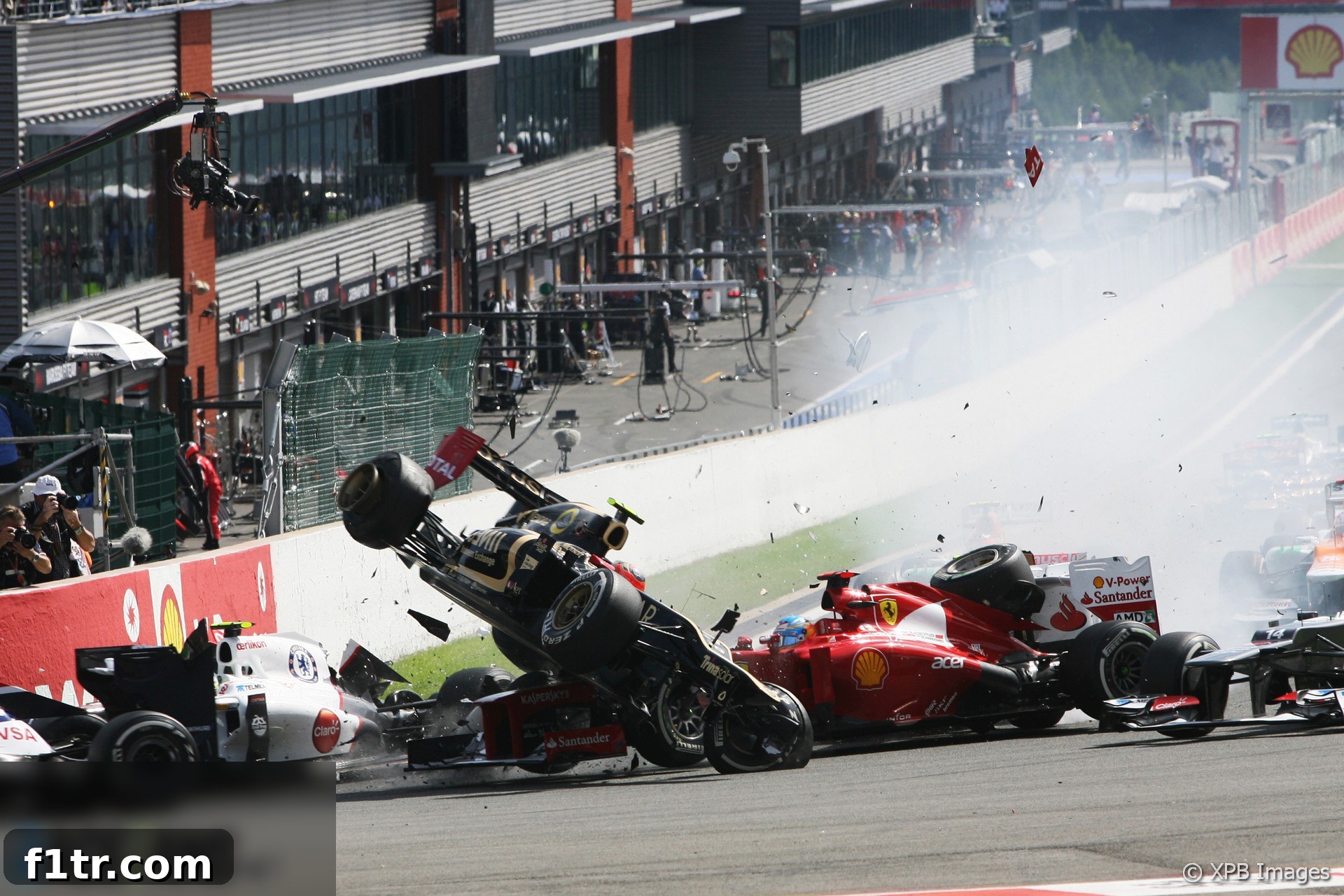
The sense of disproportion regarding the Hungarian GP penalties became even more pronounced when benchmarked against previous instances of multi-car carnage. Most notably, the last time Formula 1 witnessed a pile-up of comparable devastation, the driver deemed responsible, Romain Grosjean, was handed an immediate race ban for the very next event. This significant disciplinary action, issued after the 2012 Belgian Grand Prix, underscored the severity with which such incidents *could* be treated. Grosjean’s Lotus had, in a horrifying sequence of events, eliminated three of his rivals on the opening lap. In the pre-Halo era, his car terrifyingly skimmed over Fernando Alonso’s head, while Sergio Perez’s Sauber and Lewis Hamilton’s McLaren were also caught in the uncontrolled melee. Grosjean’s ban was an exceptionally rare disciplinary measure, marking the first time a driver had been sidelined since Michael Schumacher missed two races in 1994 for infamously ignoring black flags during the British Grand Prix. This precedent naturally led many to question why Bottas and Stroll, jointly responsible for a similarly destructive incident, were not met with a comparable, more severe sanction. However, a deeper analysis reveals crucial differences between the incidents that clarify the stewards’ differing approaches.
Advert | Become a RaceFans supporter andgo ad-free
The fundamental distinctions between the 2012 Spa crash and the recent Hungarian pile-up are pivotal in understanding the stewards’ varied responses. The Spa incident in 2012 transpired on a completely dry track, under optimal racing conditions, and crucially, unfolded well before the designated braking zone for the first corner. Grosjean’s aggressive manoeuvre saw him move from his starting position on the left, squeezing Lewis Hamilton on the right, leading to inevitable contact with the McLaren. Once out of control, both vehicles, along with others, were unable to avoid the cars ahead. In stark contrast, the Hungarian Grand Prix commenced under dramatically altered conditions. Heavy rain had fallen just moments before the race start, transforming the track surface from dry to treacherously slippery, offering drivers significantly different levels of grip and downforce compared to their previous practice sessions. On the lengthy run down to the notoriously tight first corner, Valtteri Bottas, having lost several positions, tucked in behind Lando Norris. At this critical juncture, battling reduced downforce and navigating the slick track, Bottas lost control of his Mercedes, initiating the devastating chain collision that ensnared three other competitors. Further back, Lance Stroll’s error was also exacerbated by the challenging conditions; he braked far too late for the opening corner, attempting to navigate onto the grass to avoid rivals, but ultimately failing to prevent contact with Charles Leclerc. Race Director Michael Masi explicitly highlighted the change in weather conditions as a significant mitigating factor considered by the stewards. He stated, “Allowing for the rain and so forth, you could say possibly if it was dry conditions and the same incident happened, it may have been a stronger penalty.” This acknowledgement confirms that environmental factors played a substantial role in influencing the severity of the sanctions imposed.
Beyond the mitigating circumstances of track conditions, a more profound and philosophical shift in Formula 1’s approach to penalty adjudication also accounts for the difference in treatment. Grosjean’s ban and the accompanying €50,000 fine were controversial not because anyone doubted his culpability – indeed, neither the driver nor his team offered any defence for the clear error – but due to a specific rationale cited by the stewards. In addition to noting that the crash “had the potential to cause injury to others,” a clear and undeniable fact, the stewards controversially highlighted a particular consequence: that the incident had “eliminated leading championship contenders from the race.” This pointed implication suggested that Grosjean’s penalty was influenced, at least in part, by the identity and championship standing of the drivers he took out. Had he collected drivers of, by implication, “less consequence” to the championship battle, he might have faced a softer sanction. Such a subjective approach, where the severity of a penalty could be influenced by external factors like championship implications rather than solely the nature of the incident, raised significant concerns about fairness and consistency. However, between these two major crashes – Grosjean’s in 2012 and the Hungarian GP pile-up in 2021 – a critical change in regulatory philosophy occurred. In 2013, the FIA, in collaboration with representatives from teams and drivers, formally agreed that the consequences of a penalty should no longer be a consideration when determining the sanctions for an incident. This landmark agreement aimed to ensure that all incidents are judged on their own merit, based on the severity of the infraction itself, rather than the arbitrary outcome or impact on the championship standings. This very principle was also a crucial factor in the penalty handed down to Lewis Hamilton for his collision with Max Verstappen at Silverstone earlier in the season. Michael Masi reiterated this updated philosophy regarding the Hungarian crashes, stating, “It’s not the outcome, it’s the incident itself. [The stewards] can issue three grid spots, five grid spots, 10 grid spots, pit lane start, whatever, depending upon what they judge the incident. So it was judged on the basis of the incident, not the outcome.” This fundamental shift ensures a more objective and consistent application of penalties across the sport, regardless of who is involved or what their position in the championship might be.
Advert | Become a RaceFans supporter andgo ad-free
In the wake of the Grosjean incident, and partly as a direct response to the debates and concerns it raised, the FIA introduced a new disciplinary tool: the penalty points system. While this system has garnered its fair share of critics, its primary objective is to provide a more structured and transparent framework for driver discipline. It allows the threat of a race ban to be utilized as a proportional disciplinary measure to deter reckless driving, rather than arbitrarily punishing a driver more severely simply because they happened to impact a title contender instead of a rival deemed, by implication, to be of lesser importance. This system ensures that accumulated errors, rather than a single, albeit impactful, incident, lead to the ultimate sanction of a race suspension. The evolution of this approach is further exemplified by the response to Nico Hulkenberg’s comparable multi-car crash at Spa just four years ago, in 2018. While strikingly similar in its dramatic nature and initial impact to Grosjean’s 2012 incident, Hulkenberg was not handed a race ban. Instead, he received a 10-place grid penalty and three penalty points on his Super Licence. The stewards explicitly referenced the change in regulations at the time, noting, “Since 2014 the FIA has introduced the penalty points system which takes into account previous offences by a driver and can lead to a race suspension if 12 points are accumulated within a 12-month period. This system was not in force when an incident not dissimilar to this occurred in 2012.” This highlights a clear and intentional shift towards a cumulative system, where a single, severe incident typically results in grid drops and penalty points, while a full race ban is reserved for drivers who demonstrate a persistent pattern of dangerous or reckless driving over a rolling 12-month period. The current system aims for greater fairness and predictability, removing the subjective element of ‘championship implications’ from individual incident assessments.
While the penalty points system provides a robust framework for progressive discipline, it still begs the question of whether a driver could commit an error of such catastrophic magnitude that it would warrant an immediate race ban, even without prior penalty points. To date, no Formula 1 driver has received more than three penalty points for a single incident within the championship itself, underscoring the FIA’s preference for grid penalties as the primary immediate sanction. Although Nikita Mazepin notably accumulated four penalty points for causing a substantial crash in a Formula 2 race in Sochi two years prior, this occurred in a feeder series, where penalty structures can sometimes differ slightly. This suggests that the threshold for an immediate, single-incident F1 race ban, bypassing the cumulative penalty points system, has been set extraordinarily high, if it exists at all under current regulations. The shift in stewarding philosophy, away from consequence-based penalties and towards a structured, incident-based system with cumulative points, reflects a mature and evolving approach to maintaining safety and fairness in the pinnacle of motorsport. The Hungarian Grand Prix pile-up, therefore, serves as a crucial case study, demonstrating how Formula 1’s disciplinary measures have adapted over time, prioritizing consistency and objective evaluation over subjective factors or the arbitrary impact on championship narratives.
2021 F1 season
- Masi ‘basically gifted the championship’ to Verstappen says 2021 FIA steward Sullivan
- Las Vegas race backers looking to extend F1 deal beyond 2025
- Why Mercedes put ‘a reminder of joy and pain’ on display in their factory lobby
- Verdict on error in GT race suggests Mercedes would have lost 2021 Abu Dhabi GP appeal
- Title ‘stolen’ from Mercedes made us ‘underdogs people cheer for’ – Wolff
Browse all 2021 F1 season articles