Renowned as one of the most influential automotive designers globally, Professor Peter Stevens has left an indelible mark on the high-performance car industry. His most celebrated creation, the McLaren F1 road car, not only redefined automotive excellence but also continues to inspire and set benchmarks for supercars worldwide. Stevens’ visionary touch extends far beyond this iconic vehicle, encompassing a diverse portfolio of high-octane machines.
His impressive design resume includes the aggressive lines of the Jaguar XJR-15, the World Rally Championship-winning Subaru for Prodrive, and several iconic Lotus models such as the Esprit Mark Two, Excel, and Elan SE. He also contributed to BMW’s 1999 Le Mans winner, showcasing his versatility across various motorsport disciplines. Less known, perhaps, but equally significant, is Stevens’ extensive work in designing racing car graphics and liveries. His artistic vision graced the cars of prestigious Formula 1 teams like Brabham, Benetton, Prost, and Arrows, in addition to crafting visuals for Jaguar’s Le Mans champions and various touring car projects. His insights into the aesthetics of speed and branding make him an unparalleled authority on Formula 1 car liveries.
Recalling his very first Formula 1 livery assignment in 1978, Stevens vividly remembers the pivotal moment with Brabham. “I heard Brabham had secured a new sponsor [Parmalat],” he recounts, illustrating his proactive approach. “So I called Bernie [Ecclestone] up, introduced myself and asked whether he would like some new ideas. He said, ‘Get down here by 12’.” This immediate summons underscored the fast-paced, demanding world of F1, where decisions are made swiftly and opportunities seized with alacrity.
Upon his arrival, Stevens was immediately thrust into a challenging situation. “I presented myself and Bernie said, ‘Yeah. Just what we want. We’ve got a bit of trouble actually,’ and took me to the workshop.” There, he encountered legendary driver Niki Lauda, visibly agitated by the current state of a car adorned with a chaotic mix of colors: light green, dark green, yellow, red, blue, white, and gold. Lauda’s blunt assessment, “‘Bernie, what the hell is this? I ain’t never going to drive a car looks like shit. And this looks like shit,’” perfectly encapsulated the urgent need for a cohesive and professional design. It was in this high-pressure environment that Stevens demonstrated his mettle. Bernie Ecclestone, ever the pragmatist, introduced Stevens to Lauda, declaring, “This is Peter Stevens. He’s going to come up with some new schemes for us by midday tomorrow.” This anecdote highlights the immediate trust placed in Stevens’ abilities, leading to his long-standing role in crafting all subsequent Parmalat Brabham liveries, which became synonymous with the team’s identity. His ability to transform a visual disaster into an iconic design under extreme deadlines solidified his reputation.
Stevens’ influence extended beyond superficial aesthetics, often touching upon practical elements of the racing machine. He recounts another instance with Brabham during the era of in-race refuelling, when the team used cumbersome aluminum, high-pressure ‘beer cans’ for fuel. “There were these horrible things that looked like they had fallen off the back of a truck,” he observed. Bernie Ecclestone, recognizing Stevens’ keen eye for detail, sought his opinion. “Bernie said to me, ‘Come have a look.’ I said, ‘You have to have those anodised blue because they just look awful.’ Bernie said, ‘Herbie [Blash, team manager], have those anodised blue.’ Just like that.” This swift decision, based on Stevens’ aesthetic advice, underscores the value placed on even the smallest visual details in F1, demonstrating how design considerations often intertwine with functionality and brand image.
When approaching livery design, Stevens begins with a fundamental question: “Why would people do it?” From the team’s perspective, the primary driver is financial gain through sponsorship. However, Stevens emphasizes that a sponsor seeks more than just exposure; they aim for a particular brand perception. He critically analyzes the effectiveness of designs in conveying quality and style, crucial elements for successful sponsorship in the high-stakes world of Formula 1. This philosophical approach differentiates him from many others in the field, moving beyond mere visual appeal to delve into the core marketing objectives.
“One of my criticisms when I first looked at the Benettons [in 1997] was that they looked like part of a fairground ride, and I asked why they wanted that,” Stevens explains, highlighting his quest for purpose in design. He argues that many sponsors are attracted to Formula 1’s high profile and perceived worth, but this only translates into tangible benefits if the car itself “exudes that sense of quality and style.” Without this inherent visual integrity, he finds the rationale behind certain sponsorships “a bit of a mystery.” This perspective underscores his belief that a livery should be a thoughtful extension of a brand’s values, not merely a canvas for logos. A well-designed livery, he contends, elevates the sponsor’s message, imbuing it with the prestige and technological prowess associated with F1, rather than diminishing it through a cluttered or aesthetically unrefined appearance.
Peter Stevens’ exceptional contributions to design have been recognized with numerous accolades. He was twice nominated for the prestigious Prince Philip Designer’s Prize, named Autocar magazine’s Designer of the Year in 2002, and received the British Design Council Award for the Lotus Elan SE in 1991. These honors reflect a career dedicated to pushing the boundaries of automotive aesthetics and functionality. His current consultancy, PSD LLP, is actively involved in the conceptualization and design of a diverse range of vehicles for both domestic and international markets. Recent projects, though under embargo, hint at his continued innovation, including designs for low-cost vehicles tailored for developing countries and urban environments, alongside high-performance electric race cars and road vehicles. Beyond his professional endeavors, Stevens is a prolific writer on design topics, a vintage Ford Dry Lakes Hot-Rod racer, and, intriguingly, a maker of excellent Sloe Gin. As the first cars of the 2021 F1 season prepared for their debut, he shared his expert appraisal of modern livery designs, offering an unfiltered view on the current state of Formula 1 aesthetics.
Alfa Romeo: A Clear Message on a Modern Canvas
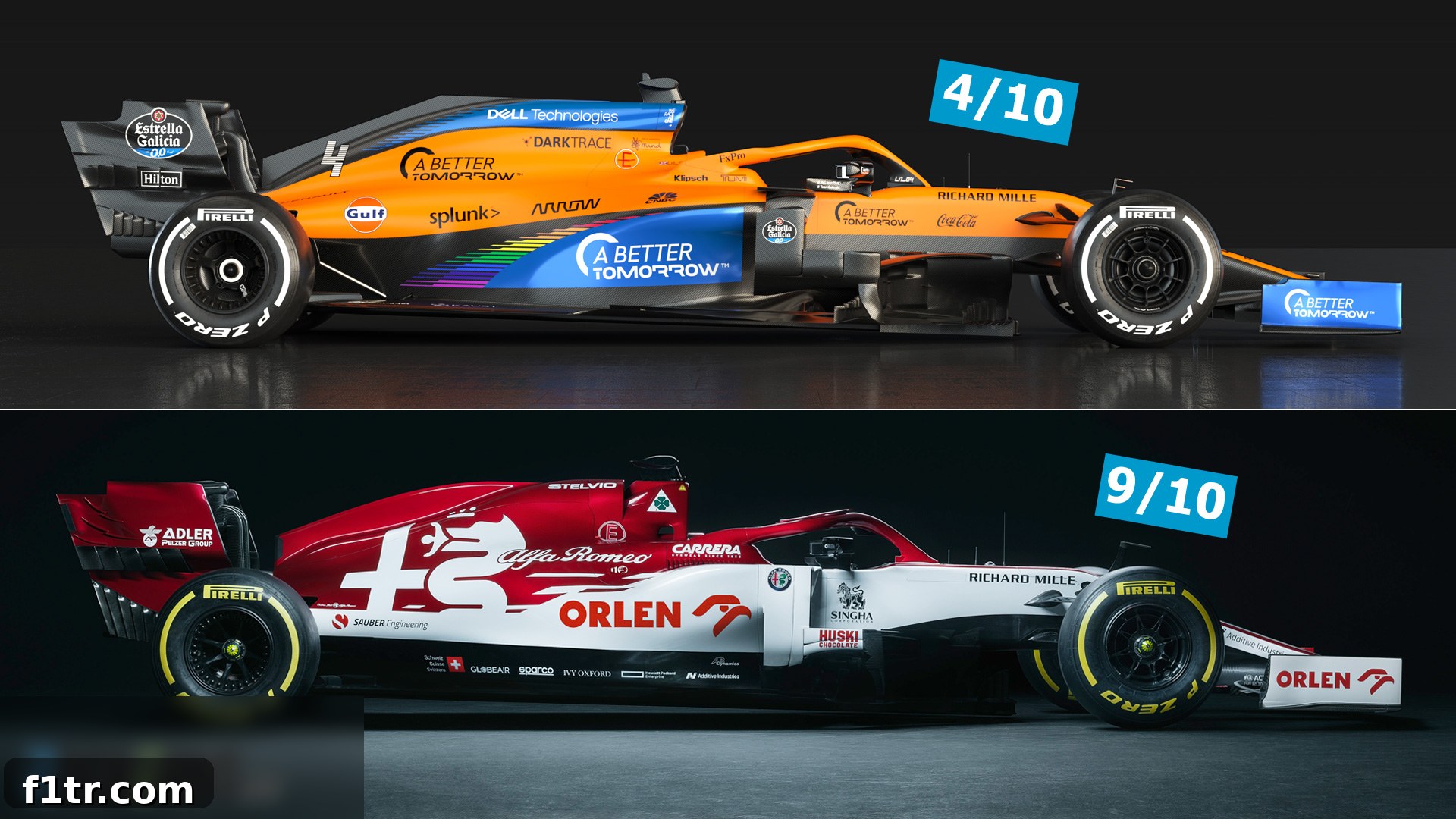
Regarding the Alfa Romeo livery, Stevens highlights the importance of clear communication given their return to Formula 1 after a long absence since the mid-eighties. “The thing about Alfa Romeo is they hadn’t been in Formula 1, so it has to be a very clear, straightforward message,” he states. This clarity is crucial for television audiences, where a split-second glimpse must convey the brand identity. He acknowledges the challenges posed by contemporary F1 car designs, which he describes as “not beautiful cars these days with some weird bits, and the nose is really grim.” However, he commends Alfa Romeo for effectively navigating these constraints, noting that “the bit that stands out is the bit they want to stand out, which is that glorious white [serpent] graphic on the engine cover.” This strategic placement ensures key brand elements are immediately recognizable.
Stevens particularly praises the metallic red used in the livery, noting its visual impact. “The metallic red works really well in sunlight, which is interesting because it’s not really Italian racing red. They’ve given it that metallic edge, which makes it really stand out.” This modern interpretation contrasts with the darker, more “brooding red” historically associated with Alfas. He credits Marlboro, Alfa Romeo’s title sponsor in the early eighties, for influencing this shift from the traditional 1950s scarlet to a more contemporary red. According to Stevens, “(Parent) Philip Morris was pretty good; some of those companies had a culture of good graphics which they brought with them to Formula 1,” demonstrating how sophisticated corporate branding can elevate motorsport aesthetics. The overall execution earns the Alfa Romeo livery a high score for its clear message and striking visual appeal.
Stevens’ rating: 9/10
AlphaTauri: Simplicity and Brand Recognition
Peter Stevens admits a degree of partiality when it comes to the AlphaTauri livery, influenced by his admiration for the team’s spirit. “I have a problem, because if I like a team, then I may be a little more likely to like the graphic presentation – and I like that team. It’s cool. That [Monza 2020] win was just a knockout,” he shares, acknowledging the emotional connection that can sway aesthetic judgment. Despite this, his professional eye still finds much to praise in the design. He describes the livery as “very clear and crisp… and it’s terribly simple,” appreciating its uncluttered approach. A key aspect of its success, he notes, is that “the lines don’t try and defeat the shape of the car,” allowing the car’s form to shine through rather than being obscured by overly complex graphics.
The livery also succeeded in its primary marketing objective: capturing attention and sparking curiosity. “I was intrigued to know what AlphaTauri is, so I looked it up and saw it’s a clothing brand owned by Red Bull. It worked in that it got my attention, which is really what they are trying to do in this internet age.” This demonstrates the power of effective visual branding in an era of information overload. He emphasizes the instant recognition of the Red Bull connection, noting that while the success of the clothing line is a separate marketing challenge, the visual identity of the F1 car itself is undeniably strong. “There’s no doubt, you know, it looks good on the grid.” Stevens draws a parallel to his own design work from the eighties, recalling the inverted blue/white Brabham liveries he created. “Dark blue and white, those were our two colours, and anything on the white would be dark blue, and anything on the dark blue would be white. That was it.” This minimalist yet impactful philosophy resonates strongly with the AlphaTauri design, solidifying its place among his favorites for its elegant simplicity and immediate brand impact.
Stevens’ rating: 9/10
Ferrari: The Challenge of Iconic Red
For Ferrari, Peter Stevens identifies a unique challenge: the power and limitation of its iconic red. “Ferrari, yeah, it’s Ferrari, it’s red. It’s almost like it’s a matter of ‘It’s red; job done’,” he observes. However, he quickly dismisses this simplistic view, arguing that simply painting a car red isn’t enough to convey the luxurious and sophisticated imagery associated with Ferrari road cars. He points out a disconnect between the meticulous detailing of their production vehicles and the comparatively unimaginative application of color and branding on their F1 cars. “Where Ferrari use black on the car is pretty unimaginative. They’ve got that strip of sponsors along the bottom on the black bit – which I can recognise from what we did on [Richard] Lloyd’s [WSC Porsche] 40 years ago,” he critiques, suggesting a lack of innovative thought in their design execution.
Stevens finds fault with the reliance on simple stickers for key sponsors like Shell and UPS, believing it undermines the perceived value and dynamism these brands represent. “Once UPS is a sticker, it’s a sticker. It undermines what I think UPS wants the message to be – we’re fast moving, modern, we understand all this stuff – not ‘We give you some money, and you put a sticker on the car’.” He contrasts this with the Rayban logo, which he finds “cool because it looks almost like it was done by hand, like when sign painters did the cars,” suggesting a lost artistry in modern applications. Furthermore, the choice of matte red draws his criticism. “The matte red – once it’s matte it’s sort of dead, and you can’t read the shape,” he explains. While a matte finish might hide unattractive shapes, it also sacrifices the “sensuousness in the shapes that tells you it’s powerful and efficient.” For Ferrari, a brand celebrated for its curves and inherent beauty, obscuring these forms with a matte finish is a missed opportunity. Despite these criticisms, he concedes the necessity of a red Ferrari on the grid, acknowledging its undeniable iconic status, even if the current livery falls short of its potential for elegance and sophisticated branding.
Stevens’ rating: 5/10
Haas: An Ugly Compromise
Peter Stevens’ assessment of the Haas livery is notably critical, focusing on its disjointed and unappealing visual division. “It’s kind of funny, a black front of the car and a white back of the car,” he remarks, noting how this stark contrast creates a static appearance. He elaborates that “if you just divide it in these two sections ahead of the radiators, it all goes black because in the side-on views you don’t see the little white [stripe] down the nose.” This lack of visual flow means the car doesn’t appear dynamic, an essential quality for a racing machine. While he appreciates the attempt to mask the “weird shape of the nose by simply making that white and that pale grey,” he finds the execution flawed. “But from a side view there’s an abrupt kind of vertical break,” further contributing to the disconnected aesthetic.
Stevens also comments on the industrial grey coloring and font used for the Haas branding, which is fitting given their machine tool product. However, he believes the design team failed to capitalize on this inherent stylistic element. “It’s like the lettering was done with some kind of machine tool, a milling machine. There’s an angle to those letters, you could pick up on the angle [for the rest of the livery]. That’s so strange, people don’t pick up on the bit they have.” This suggests a missed opportunity to create a cohesive and purposeful design that integrates the brand’s identity more deeply. While acknowledging the team’s position as “really in at the deep end, and they can’t really swim terribly well,” Stevens ultimately rejects making excuses for poor aesthetics. “But I don’t, because when you have a car that looks ugly, I kind of analyse it in my mind as to why it’s ugly. But people who just look at it just say ‘that’s ugly’, and they don’t need to examine why.” This stark verdict underscores his belief that a compelling livery should be intuitively appealing, not require analytical justification for its shortcomings. The Haas livery, in his view, simply fails to meet this basic standard of aesthetic appeal.
Stevens’ rating: 2/10
McLaren: Wasted Potential and Disjointed Lines
Peter Stevens’ critique of the McLaren livery focuses on its execution and perceived lack of cohesive design philosophy, despite the adoption of the historic orange. “They’ve gone to the orange [but] whether it rings a [historic] bell with some people [is debatable],” he ponders, questioning the effectiveness of historical references if not universally understood. His primary frustration stems from what he perceives as a prevalent issue in modern livery design: reliance on external agencies that often work from flat, two-dimensional views of the car. “The frustrating thing is, it’s partly the way that the schemes are done by an agency. Somebody gets a side view, a plan view of the car and they kind of do the colours on that.” This approach, he argues, fails to account for the car’s complex three-dimensional form.
Drawing on his own meticulous process, Stevens recalls, “I used to lay masking tape lines on a car, follow the shape of the car. I used to love doing that, because then I’d look along the tape and tweak it so it flowed with the surface.” This hands-on method ensures designs integrate seamlessly with the vehicle’s contours. In stark contrast, he finds the McLaren livery lacks this organic flow. “When I look at the McLaren now, between the blue and the orange on the airbox, that junction line in the side view just kind of wanders about. Same on the side pod: the join lines wander about for no reason.” This observation highlights a fundamental flaw in translating a 2D concept to a 3D object, resulting in awkward and arbitrary transitions. While he doesn’t strongly object to the blue and orange color combination itself, calling it a “subtle range of colours,” he is particularly exasperated by the application of the car number. “But the number they put on the fin, it drives me bonkers! They’ve just stuck on a colour, like a club racer,” he exclaims, criticizing its crude, unsophisticated placement which detracts from any professional intent. The overall impression is one of missed opportunities and a lack of refined integration, leading to a disappointing rating for a team with such a rich design heritage.
Stevens’ rating: 4/10
Mercedes: A Powerful Message with Design Flaws
Mercedes’ decision to switch from their traditional silver to an all-black livery for the 2020 season, a powerful statement in support of diversity and against racism, was met with surprise and immediate impact. “Was a big surprise,” Stevens admits, acknowledging the boldness of the move. He recognizes the livery’s strength on track, noting, “No doubt about it – it’s pretty strong in the field, but it just looks like a black car in the field and your mind says, ‘That’s Mercedes’.” This immediate association demonstrates the success of the overarching brand message. However, Stevens, ever the meticulous designer, points out specific aesthetic elements that detract from its overall elegance. “What I don’t like about it is that squiggly blue line that wanders along the side and I’m asking, ‘Why did you need to do that, do it so wiggly?’” This questioning of arbitrary design elements reveals his preference for purposeful and clean lines.
His strongest criticism is reserved for the placement of a key sponsor’s logo: “But the bit I really don’t like is that red sticker on the airbox that says, ‘Ineos’ – an afterthought beyond belief.” This haphazard application, he argues, undermines the professionalism and value that should be associated with Formula 1 sponsorship. Drawing on past experiences, he states, “Something that looks like an afterthought never gains the value that there should be in being involved in Formula 1. Having previously been involved with Guy Edwards [known for his last-minute sponsorship deals] it said to me, ‘Oh, somebody rushed up with some money at the last moment, so we’ll stick it on here…’” This perception of a rushed, unintegrated element diminishes the impact of the entire livery. While he appreciates subtle details like the “little silver three-pointed stars,” he notes their limited visibility at speed, making them more suitable for still photography than dynamic racing. Nevertheless, the black theme creates a very strong and recognizable image on the grid, easily picked out alongside the distinctive pink car. Despite its design flaws, the Mercedes livery effectively conveyed a powerful message and maintained strong brand recognition, earning it a respectable, though not perfect, score.
Stevens’ rating: 6/10
Racing Point (Aston Martin from 2021): A Disappointing Pink
Peter Stevens expresses considerable disappointment with the Racing Point livery, particularly its use of color and the integration of its primary sponsor. “The pink is a sucking-a-lemon sort of pink,” he describes, conveying a distinctly unpleasant hue. His main criticism, however, revolves around the haphazard application of the BWT logo, which he finds reminiscent of past design struggles. “The way the BWT is just stuck across reminds me of when I went to Benetton to see what we could do about the cars when there was a lot of stuff stuck on them. I thought ‘Why did you have to do it [like this]?’” This echoes his earlier concerns about cluttered and unintegrated design elements, suggesting a lack of thoughtful planning.
Stevens attributes such design choices to a fundamental lack of strategic thinking. “I think it’s because people don’t really think sufficiently strongly about what they are trying to achieve. Either BWT said ‘Yeah, we love it’ for reasons which are quite obscure, or the person at Racing Point said, ‘That’s what it’s gonna be like.’ Neither of those are good reasons for doing something so untidy.” This highlights his belief that effective livery design must stem from a clear, shared vision and a commitment to aesthetic quality, rather than obscure preferences or arbitrary decisions. Looking ahead to the team’s transition to Aston Martin, likely in British Racing Green, Stevens expresses concern. “I never thought that green actually works that well on TV,” he states. He further points out that this particular shade of green is rarely used for car launches, even by brands like Aston Martin and Jaguar, suggesting it lacks the visual pop needed for televised motorsport. “It’s not a colour that jumps off the page,” he concludes, anticipating that the new livery might also struggle for impact, despite its historical resonance. The current Racing Point livery, in his professional estimation, represents a significant missed opportunity for strong, coherent branding.
Stevens’ rating: 2/10
Red Bull: A Masterclass in Brand Cohesion
Peter Stevens rates the Red Bull livery as one of the strongest on the grid, praising its intelligent graphic application and undeniable brand impact. “One of the strongest [liveries]; the way Red Bull handle their graphics it’s obvious somebody knows what they’re doing,” he asserts. He highlights a crucial indicator of successful branding: even partial glimpses convey the message. “There’s an overhead shot of the Red Bull and the letters on separate elements of the front wing could just have ‘ED’ and ‘BU’, and everybody would know it’s Red Bull. That’s a real mark of success, and the bull itself in yellow is just so strong.” This ability to maintain brand recognition through fragmented visuals is a testament to the design’s effectiveness and careful planning.
Stevens also notes the practical challenges and aesthetic benefits of the satin paint finish. “The satin paint finish looks like a wrap, and that’s pretty tricky when you’ve got removable panels. I remember with some of the more complex front ends I did you might easily need a spare nose, and you’d have to sticker them up so that they still fit properly.” This demonstrates his appreciation for the technical execution required to achieve such a polished look. He commends the consistent use of color for branding and racing numbers: “It’s neat that they use the same red for numbers as for Red Bull. They don’t impose a different colour, and all that thinking really works pretty darn well. It’s cohesive.” This cohesive approach strengthens the overall brand identity and avoids visual clutter. Stevens even suggests an ingenious secondary function of the design: “quite cunning because it hides all of (designer) Adrian Newey’s tricky bits. It’s a lesson in hiding the interesting bits.” This implies the livery cleverly draws attention away from sensitive aerodynamic details, a subtle but significant advantage. However, he does find a minor flaw in the branding of a secondary sponsor: “But the Aston Martin looks weedy on the rear wing, it’s kind of weak. This car says ‘Red Bull’ and suddenly the rear wing sticks its hand up and says in a squeaky voice, ‘Hello, I’m Aston Martin’.” This slight dissonance prevents a perfect score, but the Red Bull livery remains a shining example of integrated and impactful design.
Stevens’ rating: 8/10
Renault (Alpine from 2021): A Step Backwards
Peter Stevens expresses significant disappointment with the Renault livery, especially in contrast to what he believes the team is capable of achieving. “I was so disappointed because Renault had done some much stronger schemes with the yellow and black,” he laments, recalling a striking concept. He specifically references an earlier design study: “They did a future concept Formula 1 car and the use of the yellow was just terrific. They have kind of ended up with the weakest solution.” This indicates a perceived regression in design quality, moving away from bold and impactful concepts to a more subdued and less effective scheme.
Stevens reveals an internal disconnect within Renault regarding F1 livery design. “It’s a shame because I’ve got friends in design at Renault, and they told me they don’t really have a say [in F1 livery design], which they did in that concept, of course. That black and yellow was good.” This suggests that the F1 livery decisions were not fully integrated with the expertise of the company’s core design teams, leading to a compromise. Looking ahead, the team’s rebrand to Alpine for 2021, adopting a striking blue, comes with its own set of questions. “Anyway [in 2021] it’s going to be Alpine, which is a wonderful blue. It’s all about marketing business, but I can’t, at the moment, see what the marketing advantage is by calling it Alpine instead of Renault.” While acknowledging the inherent beauty of Alpine blue, Stevens remains unconvinced by the strategic marketing rationale, implying that a strong livery needs both aesthetic appeal and a clear commercial purpose. The current Renault livery, in his expert view, failed to deliver on both fronts.
Stevens’ rating: 3/10
Williams: A Reflection of Uncertainty
Peter Stevens views the Williams livery as a visual representation of the team’s struggles and uncertainty. “I’ve watched the downs and downs of Williams, and it’s just colours on a car here,” he states, suggesting a lack of cohesive design strategy. He perceives the livery as reflecting internal panic: “Frank never panicked, but [the livery] represents panic within the company: ‘We’ve got to make it look like this, put some stuff on it’.” This interpretation highlights how a livery can inadvertently communicate a team’s organizational state, rather than project strength or ambition. His emotional connection to the team is evident: “It’s a shame, I was sad every time I saw it because I wanted it to look better and go better.”
The sudden loss of title sponsor Rokit shortly before the 2020 season left large gaps in the original livery, which were then filled primarily by driver-linked support. Stevens identifies a critical flaw in this approach: “The tricky bit is they don’t attract me to go and find out who they are,” referring to the new sponsors. A successful livery, he argues, should spark curiosity and invite engagement with the brands it carries. He draws a parallel to McLaren’s past struggles with sponsorship, noting that the visual presentation “exuded a lack of confidence.” He believes Williams should have prioritized conveying strength and stability, even in challenging times. “I’d hoped they’d have realised ‘we’ve got to make it look like we have all these good sponsors.’ But somebody did a marvellous job to get some sponsorship on there.” While acknowledging the impressive effort to secure any sponsorship, Stevens ultimately finds the resulting livery to be a visual testament to the team’s instability, failing to project the confidence and appeal essential for a thriving F1 outfit.
Stevens’ rating: 4/10