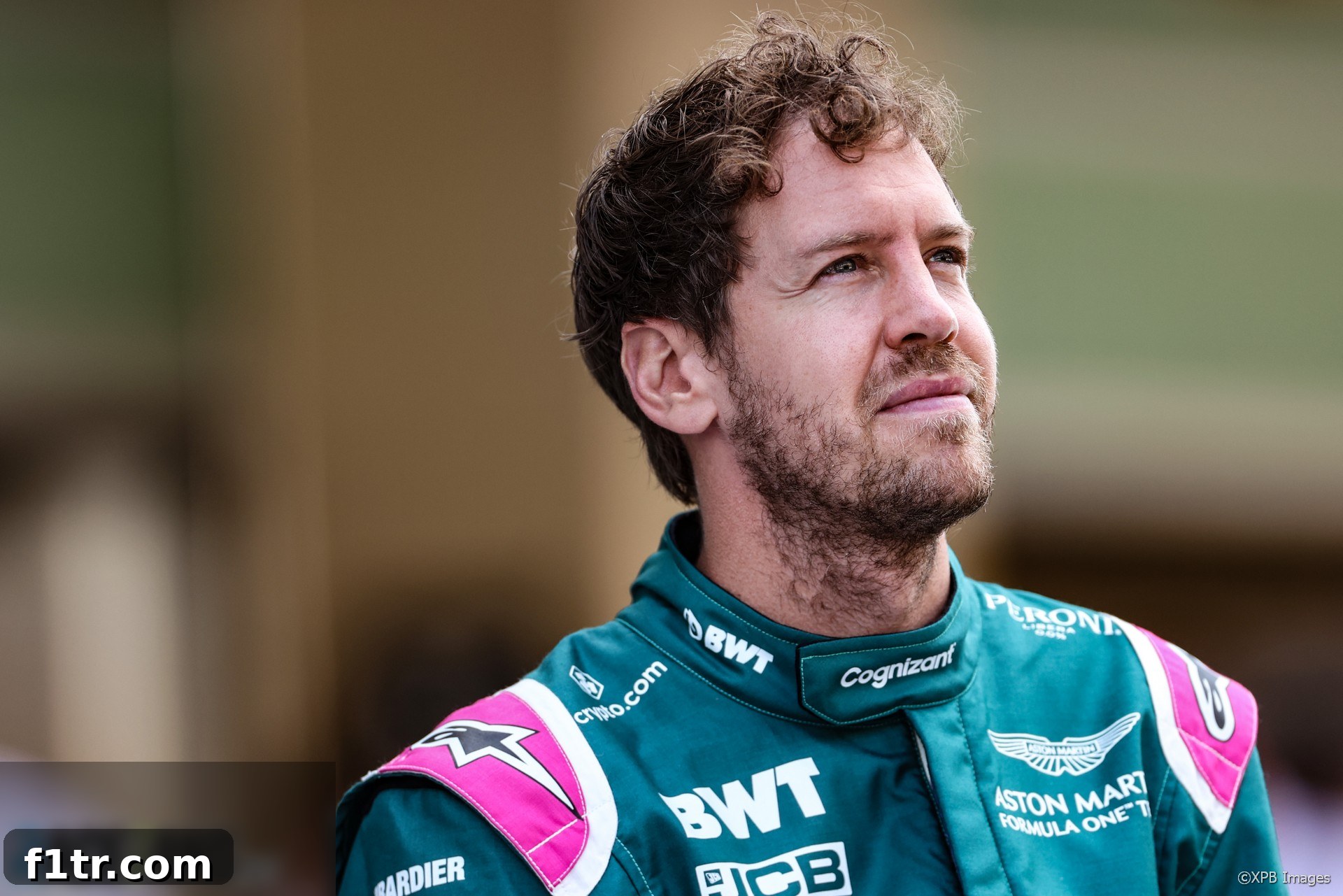
Four-time Formula 1 world champion Sebastian Vettel embarked on a pivotal chapter of his illustrious career in 2021, joining the rebranded Aston Martin Cognizant Formula One Team. This move followed a challenging and ultimately dismal conclusion to his six-year tenure at Ferrari, where he had failed to secure a championship since 2017. The transition to Aston Martin, a team with significant aspirations and backing, offered Vettel a fresh start and the opportunity to rediscover the form that made him a serial winner during his Red Bull years. The pressure was immense: not only did he need to adapt to a new car and team environment, but he also had to reassert his authority against his new, younger teammate, Lance Stroll.
Sebastian Vettel |
|
|---|---|
| Beat team mate in qualifying | 13/21 |
| Beat team mate in race | 7/17 |
| Races finished | 19/22 |
| Laps spent ahead of team mate | 522/1145 |
| Qualifying margin | -0.21s |
| Points | 43 |
Having been comprehensively outshone by Charles Leclerc at Ferrari in 2020, Vettel faced the immediate task of establishing himself as the clear number one driver at Aston Martin. His teammate, Lance Stroll, while a competent and occasionally brilliant driver, was not widely perceived as a future world champion in the same vein as Leclerc. The expectation was clear: Vettel, with his vast experience and multiple titles, should comfortably outperform his Canadian counterpart. However, the initial phase of the 2021 season painted a worrying picture, appearing eerily similar to the struggles that plagued his final years at the Scuderia.
The season opener in Bahrain set a grim tone. Vettel collected a grid penalty for failing to slow sufficiently under yellow flags during qualifying, compromising his starting position. The race itself was marred by a clumsy collision with Esteban Ocon, earning him further penalty points and a reputation for ill-judged maneuvers. This inauspicious debut was followed by mechanical woes at Imola, where car trouble spoiled his efforts. While he managed to reach Q3 in Portugal, a glimmer of his old pace, he subsequently slipped back during the race, failing to convert qualifying potential into points. In Spain, he finished a lowly 13th, following Kimi Räikkönen’s Alfa Romeo home. These early performances raised legitimate concerns about whether Vettel could truly escape the slump that had defined his recent past.
Fortunately, as the season progressed, Vettel gradually found his rhythm behind the wheel of the AMR21. This car, however, proved to be a challenging machine, representing a disappointing step backwards from the impressive pace and competitiveness displayed by its predecessor, the Racing Point RP20, which had earned the team a fourth-place finish in the 2020 Constructors’ Championship. Despite the car’s inherent limitations, Vettel began to demonstrate flashes of the strategic acumen and racecraft that characterized his championship-winning years. The turning point began to materialize with a strong performance in Monaco, a circuit that rewards precision and experience.
In the principality, Vettel successfully navigated his way into Q3. In the race, he executed a brilliant strategic overcut during his first pit stop, leapfrogging none other than Lewis Hamilton. Emerging from the pits, he aggressively defended his position against Pierre Gasly, showcasing the elbows-out racing style that many fans had longed to see from him. This display was a significant psychological boost, reminiscent of the decisive and confident Vettel from his Red Bull days, and provided the first real indication that the spark had not been extinguished.
Even better fortunes followed at the Azerbaijan Grand Prix, which undoubtedly stood out as the highlight of his 2021 campaign. In a chaotic race on the streets of Baku, Vettel deftly picked up several places before a late red flag paused proceedings. At the subsequent standing restart, he demonstrated superb race craft, masterfully passing both Gasly and Leclerc to move into a podium position. This shrewd and opportunistic drive ultimately earned him a superb second place, a result made even sweeter on a day when many of the championship contenders, including Max Verstappen and Lewis Hamilton, encountered significant trouble. It was a classic Vettel performance, capitalizing on every opportunity and delivering a much-needed morale boost for both himself and his Aston Martin team. He further augmented his points tally with a solid ninth-place finish in France, confirming his growing confidence.
Following this early turning point, Vettel’s Aston Martin often appeared to be the car most likely to snatch a result when an opportunity presented itself among the midfield. He generally held the upper hand over his teammate in qualifying throughout the season, beating Stroll in 13 out of 21 sessions. However, this advantage wasn’t always as decisive as a four-time world champion might have wished for, with Vettel suffering three Q1 eliminations compared to Stroll’s seven. While the statistical lead was clear, the margin of performance wasn’t always as dominant as one might expect from a driver of Vettel’s caliber against his teammate.
The Hungarian Grand Prix provided another dramatic chapter in Vettel’s season. While Lance Stroll was unfortunately involved in the chaotic first-lap pile-up, Sebastian Vettel expertly navigated through the carnage, capitalizing on the incidents to rise to an incredible second place, trailing only Esteban Ocon. For a significant portion of the race, a victory seemed within his grasp, a prospect that would have been nothing short of sensational for Aston Martin. However, a slight mispositioning during his pit stop led to a slower-than-ideal tyre change, potentially costing him crucial track time. Ultimately, his magnificent second-place finish was tragically annulled by a post-race disqualification due to a technical infringement – specifically, an insufficient fuel sample. This issue was largely beyond his control, making the loss of a potential 18 points even more bitter and impacting his final standing significantly.
Beyond these standout moments, genuine opportunities for substantial points hauls were relatively scarce for the Aston Martin team in 2021. Nonetheless, Vettel consistently delivered other strong performances that modestly topped up his points tally. At the Circuit of the Americas in Austin, an engine change forced him to start from the back of the grid. Undeterred, he drove a determined race to claim a commendable tenth place. Furthermore, one of his many characteristically strong starts helped him secure a valuable seventh position in Mexico, showcasing his enduring race craft and ability to make up ground in the opening laps.
Once Vettel settled into his new environment and grew accustomed to the AMR21, he rarely resembled the struggling driver who had so visibly floundered at Ferrari the previous year. His confidence appeared to return, and with it, his consistent performance. However, there were a couple of notable exceptions to this resurgence. A spin on cool tyres during the restart of the British Grand Prix served as a stark reminder of his occasional vulnerability. Similarly, his bold gamble to switch to slick tyres on a painfully slowly drying track at Istanbul for the Turkish Grand Prix did not pay off, costing him valuable positions and demonstrating that even a four-time champion can misread challenging conditions.
Despite his renewed vigor, Vettel never truly established a dominant edge over Lance Stroll throughout the season. On the majority of occasions where both drivers finished, Stroll actually crossed the finish line ahead of his more decorated teammate. A couple of on-track clashes with Stroll, at Monza and Sochi, further complicated matters. While neither incident was deemed Vettel’s responsibility, particularly at Monza where he was badly compromised, these moments did not foster a smooth team dynamic. Moreover, Stroll managed to secure more points-scoring finishes than Vettel did over the course of the season, underscoring the Canadian’s own improvements and consistency.
Nonetheless, despite the significant setback of his costly Hungaroring disqualification and concluding the year with no points in the final two races – Saudi Arabia (where he was involved in collisions with Kimi Räikkönen and Yuki Tsunoda) and Abu Dhabi – Sebastian Vettel still managed to finish ahead of Lance Stroll in the drivers’ standings. This achievement capped what could be considered a decent, albeit imperfect, first season in the green livery of Aston Martin. While there was undoubtedly room for improvement and moments of frustration, Vettel demonstrated resilience, flashes of his old brilliance, and ultimately proved that he still possessed the raw speed and strategic intelligence to compete at the pinnacle of motorsport. His journey with Aston Martin in 2021 was one of rediscovery, laying a foundation for future aspirations.
Go ad-free for just £1 per month>> Find out more and sign up
What’s your verdict on Sebastian Vettel’s 2021 season? Which drivers do you feel he performed better or worse than? Have your say in the comments section below. Add your views on the other drivers in the comments.
2021 F1 season review
- 2021 F1 driver rankings #1: Max Verstappen
- 2021 F1 driver rankings #2: Lewis Hamilton
- 2021 F1 driver rankings #3: Lando Norris
- 2021 F1 driver rankings #4: Charles Leclerc
- 2021 F1 driver rankings #5: Carlos Sainz Jnr
Browse all 2021 F1 season review articles