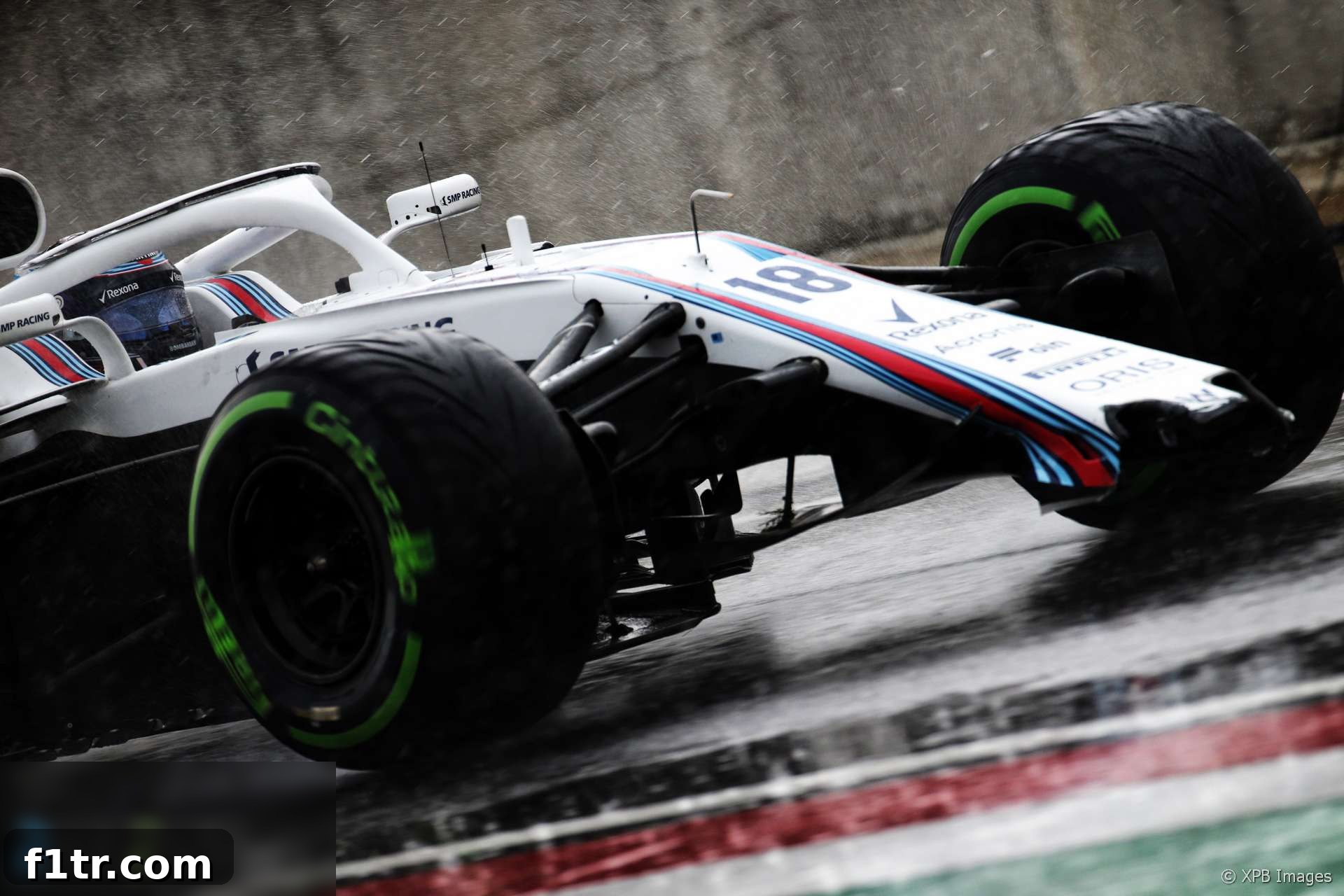
Lance Stroll’s Hungarian Grand Prix Nightmare: A Costly Front Wing Incident Leads to Pitlane Start
The Hungarian Grand Prix weekend took an unexpected turn for Williams driver Lance Stroll, who was controversially relegated to a pitlane start after his team was compelled to make an unauthorized front wing change under the stringent parc fermé regulations. What began as a promising qualifying session in challenging conditions quickly unraveled into a significant setback for the Canadian driver and the Grove-based outfit, underscoring the relentless pressures and unforgiving rules of Formula 1.
The Dramatic Qualifying Session and Stroll’s Costly Error
The drama unfolded during the second stage of qualifying (Q2) at the Hungaroring, a session heavily influenced by unpredictable wet weather. Lance Stroll, having admirably navigated the treacherous conditions of Q1 to advance ahead of his teammate Sergey Sirotkin, pushed the limits in Q2. His aggressive approach, while initially yielding positive results in the low-grip environment, ultimately led to a critical error. Losing control as he exited Turn 9, Stroll’s car made contact with the barrier, resulting in significant damage to his front wing. Crucially, this wasn’t just any front wing; it was the latest specification, a component vital for aerodynamic performance and a testament to Williams’ ongoing development efforts.
The impact, though not race-ending for the chassis, rendered the advanced aerodynamic component unusable. In the high-stakes world of Formula 1, every millimeter and every gram counts, and a damaged front wing is not merely cosmetic. It fundamentally alters the airflow, downforce, and balance of the car, making it uncompetitive and potentially unsafe.
Parc Fermé: Unravelling Formula 1’s Strict Technical Custody Rules
At the heart of Stroll’s predicament lies the concept of ‘parc fermé’, a cornerstone regulation in Formula 1 designed to ensure fairness and prevent teams from making significant alterations to their cars between qualifying and the race. Once a car leaves the pitlane for qualifying, it enters parc fermé conditions. This means that only minor adjustments are permitted – such as brake bias, tire pressure, and front wing angle – under strict supervision. Any major component change, especially one affecting aerodynamic performance or weight, generally constitutes a breach of these regulations and incurs a penalty.
The rules are in place to freeze car specifications, ensuring that the car raced is essentially the same car that qualified. This prevents teams from running aggressive, qualifying-specific setups that might be illegal or unsustainable for a full race distance, and then reverting to a different specification for the race itself. By enforcing parc fermé, the FIA aims to maintain a level playing field and uphold the integrity of the competition.
In Stroll’s case, the damaged front wing, being of the latest specification, was a critical performance component. Williams’ inability to replace it with an identical, undamaged version meant they were forced to revert to an older specification wing. This change, considered a deviation from the parc fermé rules because it alters the car’s specification from its qualifying trim, automatically triggers a pitlane start penalty. The rationale is clear: the car starting the race is no longer identical to the one that achieved the qualifying time, therefore it must start from a position that does not benefit from that qualifying performance – the pitlane.
Williams’ Challenging Dilemma: A Shortage of Spare Parts
The immediate aftermath of the qualifying incident presented Williams with a significant logistical and strategic headache. The team confirmed that they did not have a spare “latest specification” front wing available to replace the one damaged by Stroll. This shortage highlighted a recurring challenge for smaller, less resourced teams in Formula 1, particularly during the demanding 2018 season which saw Williams grappling with substantial performance issues and financial constraints.
Developing and manufacturing cutting-edge aerodynamic components, especially in multiple identical units, is an incredibly expensive and time-consuming process. Teams often prioritize having a limited number of the very latest parts, with older specifications or less robust versions kept as backups. For Williams, the absence of a duplicate latest-spec wing forced their hand, leaving them with no choice but to install an older specification, consequently incurring the pitlane start penalty for Stroll. This situation underscored the tightrope walk teams perform between innovation, budget management, and operational readiness, where a single incident can expose vulnerabilities in their spare parts inventory.
Lance Stroll’s Perspective: Aggression, Risk, and the Price of Ambition
Prior to the incident, Lance Stroll had shown promising pace in the treacherous wet conditions. He had successfully advanced to Q2, outperforming his more experienced teammate Sergey Sirotkin – a notable achievement for the young Canadian. Speaking after qualifying, Stroll candidly reflected on his approach, acknowledging the fine line between calculated risk and critical error in the rain.
“I think someone was going to get caught out. It can happen,” Stroll commented, referencing the unpredictable nature of the wet session. He further elaborated, “In Q1 it was raining a little bit and I saw some spots of rain on my visor and I didn’t really back off too much and that’s kind of what got me into Q2. It goes both ways. A little bit too much on the kerb and it can happen.”
Stroll’s words painted a clear picture of a driver pushing the limits, embracing aggression to extract maximum performance from a challenging car in difficult conditions. While this approach propelled him into Q2, it also led to the unfortunate incident at Turn 9. The penalty meant that his hard-earned 15th place on the grid, a respectable position for Williams in 2018, was forfeited. The frustration of seeing a strong qualifying effort undone by a single mistake and subsequent regulatory breach undoubtedly weighed heavily on the young driver, serving as a stark reminder of the razor-thin margins in Formula 1.
Team’s Stance: Paddy Lowe on the Impossibility of a Wing Swap
Amidst the discussions and conjectures following Stroll’s incident, a question arose regarding the possibility of swapping front wings with his teammate, Sergey Sirotkin, to avoid the penalty. Williams’ Chief Technical Officer, Paddy Lowe, swiftly and decisively ruled out any such manoeuvre. “No, we’re not going to do that,” Lowe stated emphatically.
Lowe’s firm stance highlighted the rigid ethical and technical boundaries within Formula 1. While teams often share components, swapping a specific, performance-critical part like a front wing between cars post-qualifying, especially if it’s not identical to the one damaged and potentially for strategic gain to avoid a penalty, would be fraught with regulatory complications. It could be seen as an attempt to circumvent parc fermé rules and would likely incur even harsher penalties from the FIA. Moreover, such a swap could compromise Sirotkin’s car, potentially affecting his race performance and raising questions about fairness within the team. Lowe’s decision underscored Williams’ commitment to operating within the established rules and maintaining the integrity of their racing efforts, even in the face of adversity.
The Challenge of a Pitlane Start at the Hungaroring
Starting from the pitlane at the Hungarian Grand Prix presented Lance Stroll with an exceptionally formidable challenge. The Hungaroring is notoriously known as a ‘Mickey Mouse’ circuit – tight, twisty, and often compared to a karting track. Its characteristics make overtaking incredibly difficult, often likened to Monaco in terms of the premium placed on track position. The narrow layout, coupled with the reliance on aerodynamic grip, means that a pitlane start severely compromises a driver’s ability to make progress through the field.
From the pitlane, Stroll would begin a significant distance behind the last car on the grid, needing to navigate the entire field before he could even dream of competing for points. The strategy would likely revolve around hoping for safety cars, which can bunch up the pack and offer opportunities to close the gap, or banking on variable weather conditions that might create chaos and allow for opportunistic overtakes. However, without such external factors, a pitlane start at the Hungaroring typically condemns a driver to a long, arduous race with minimal prospects of a strong finish, especially for a team already struggling for pace like Williams in 2018.
Williams’ 2018 Season: A Broader Context of Struggle
The incident at the Hungarian Grand Prix was, unfortunately, symptomatic of a broader narrative for Williams during the 2018 Formula 1 season. The team was enduring one of its most challenging periods in its illustrious history. Plagued by a fundamentally flawed car, the FW41, Williams consistently found itself at the back of the grid, struggling for pace, reliability, and points. Technical issues, aerodynamic deficiencies, and resource constraints all contributed to a season marked by frustration and disappointment for both drivers and the team personnel.
In this context, Stroll’s qualifying incident and the ensuing penalty were not just isolated setbacks; they added another layer of difficulty to an already arduous campaign. The lack of a spare latest-spec front wing itself pointed to the operational strains and limited resources that characterised their season. Every point, every strong performance, and every opportunity to showcase potential was crucial, making this particular setback feel even more significant for a team fighting for survival at the rear of the grid.
The Road Ahead for Stroll and Williams: Learning from Adversity
While the pitlane start for the Hungarian Grand Prix was undoubtedly a bitter pill to swallow for Lance Stroll and Williams, such incidents are part and parcel of the high-stakes world of Formula 1. They serve as harsh lessons, highlighting the importance of precision, resource management, and strict adherence to regulations. For Stroll, it was a reminder of the fine line between aggressive ambition and costly errors, particularly in the unforgiving wet conditions.
For Williams, it underscored the ongoing challenges in a season defined by struggle. The team’s ability to regroup, learn from these setbacks, and continue to develop its technical capabilities and operational efficiency would be crucial for future seasons. Ultimately, the Hungarian Grand Prix incident became another chapter in a tough 2018 campaign, but also an opportunity for resilience and reflection for both driver and team, as they strived to navigate the complexities and pressures of top-tier motorsport.
2018 F1 season
- F1 feared “death knell” for Drive to Survive after Ferrari and Mercedes snub
- McLaren staff told us we were “totally crazy” to take Honda engines in 2018 – Tost
- ‘It doesn’t matter if we start last’: How Red Bull’s junior team aided Honda’s leap forward
- Honda’s jet division helped F1 engineers solve power unit problem
- McLaren Racing losses rise after Honda split
Browse all 2018 F1 season articles