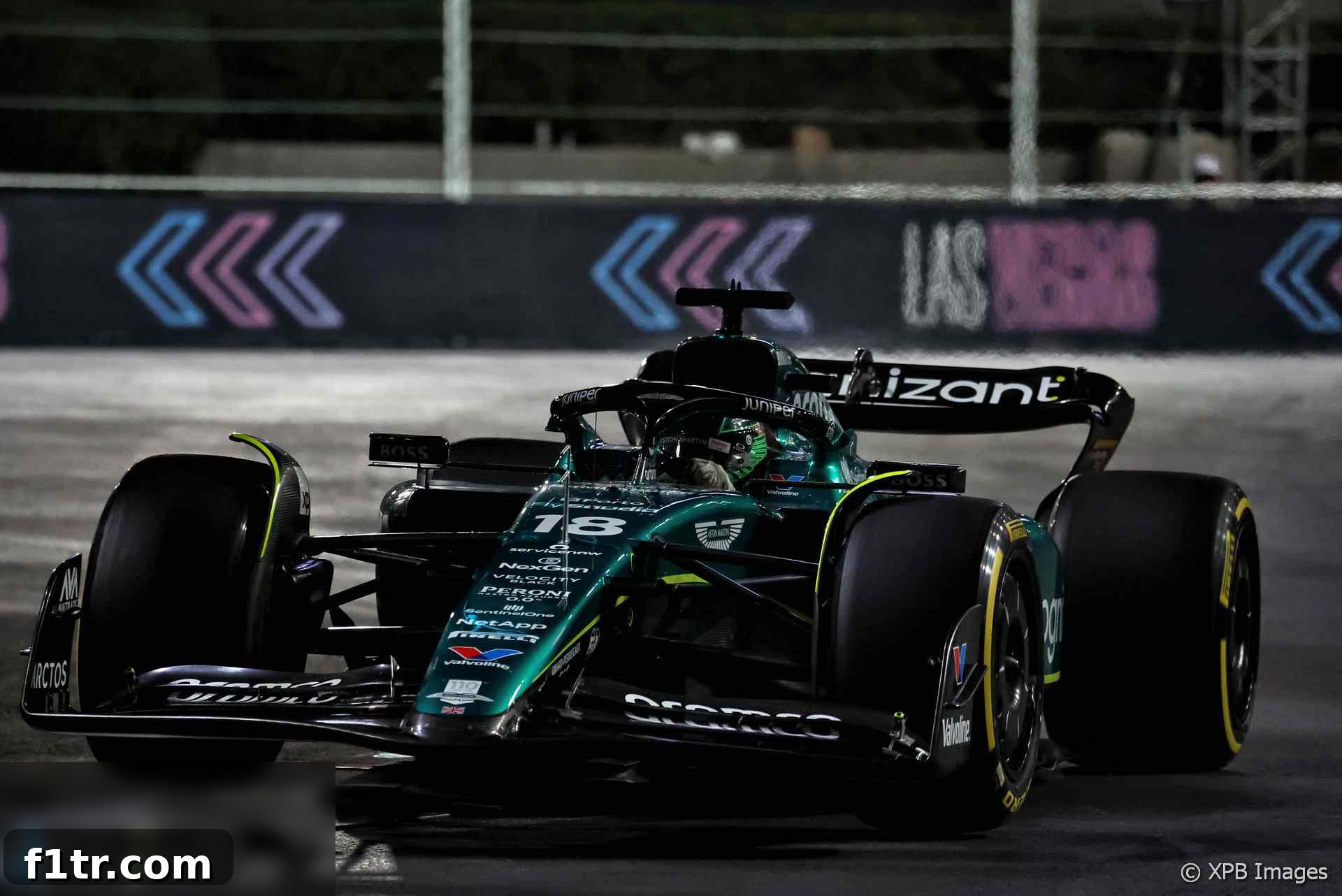
Aston Martin driver Lance Stroll faced a challenging start to the inaugural Las Vegas Grand Prix weekend, receiving a five-place grid penalty for Saturday’s main event. This sanction was imposed after stewards determined he had unlawfully overtaken another competitor under double yellow flag conditions during the final practice session. The incident not only affected his starting position but also highlighted critical discussions around driver vigilance and the reliability of Formula 1’s electronic warning systems.
Advert | Become a Supporter & go ad-free
The penalty stemmed from an event that unfolded in the closing minutes of Friday’s final practice. With under 10 minutes remaining in the one-hour session, Alexander Albon, driving for Williams, made contact with the wall at the exit of Turn 5. This unfortunate incident resulted in a left-rear puncture for Albon, forcing him to slow down dramatically as he attempted to nurse his damaged car back to the pits. The situation quickly escalated when Albon’s compromised tyre eventually detached from the wheel as he drove along the iconic Las Vegas Strip, leaving potentially hazardous debris on the track and creating a dangerous scenario for following drivers.
In response to the clear and present danger, marshals at Marshal Post 12.9 reacted swiftly and professionally, displaying prominent double yellow flags. These flags are a universal signal in motorsport, indicating a significant hazard on or near the track and requiring drivers to immediately reduce speed, be prepared to stop, and, crucially, prohibit overtaking. Despite the physical warnings, a critical discrepancy emerged: the FIA’s electronic warning system, which transmits real-time flag information to drivers’ dashboards and trackside light panels, bafflingly failed to activate promptly for the yellow flag zone.
Lance Stroll, on a fast lap and pushing hard to extract performance from his Aston Martin, approached this hazardous section of the track. Even with the clearly waved double yellow flags visible at the marshal post, Stroll proceeded to overtake Carlos Sainz Jnr. This action directly contradicted the fundamental safety regulations enforced under double yellow conditions. Compounding the issue of the delayed electronic system, it was not until Stroll had already reached the braking zone for Turn 14 – a full 50 seconds after Albon’s tyre had become detached – that the yellow flag finally appeared on the FIA’s electronic system. This significant delay meant drivers were operating without the additional layer of electronic warnings for a critical period.
Although AlphaTauri driver Yuki Tsunoda also appeared to overtake Valtteri Bottas in close proximity to the double-waved yellow flags, it was Stroll’s specific maneuver that was noted and subsequently investigated by the stewards. Following a thorough review of the incident, including onboard video footage and driver testimony, the stewards unequivocally deemed Stroll to have infringed the regulations.
In their official decision, the stewards meticulously detailed their findings: “Double yellow flags were waved at Marshal Post 12.9 as Car 18 [Stroll] approached that point along the straight. After passing the flags, which were clearly visible on the onboard video from Car 18, Car 18 overtook Car 55 [Sainz].” Stroll’s explanation to the stewards shed light on his perspective, as he stated he had his ‘head down’ looking at his dashboard and was primarily concentrating on the Ferrari ahead of him, which he claimed caused him to miss the physical flags. He further elaborated on the perceived system failure, asserting: “Normally we get it on the dash and on the yellow [marshal] board, but there was nothing that came up on the monitors. I think it was a problem with the system, so I missed the flag.”
However, the stewards were clear in their interpretation of the rules, emphasizing that driver responsibility extends beyond electronic alerts. Their decision highlighted that “Although there were no yellow light panels displayed, the regulations are clear that the flags and light panels have the same meaning.” This ruling firmly establishes that physical marshal flags carry the same binding authority as electronic warnings, and drivers are ultimately responsible for observing and reacting to all forms of safety signals. The paramount importance of safety in Formula 1 means that regulations concerning yellow flags are strictly enforced to protect drivers, track personnel, and officials from potential hazards.
The immediate consequence for Lance Stroll was a five-place grid penalty for Saturday’s Las Vegas Grand Prix. This demotion meant he would start the race from a provisional 19th position, severely compromising his strategic options and making his quest for points significantly more challenging. In addition to the grid penalty, Stroll also received three penalty points on his superlicence. This brought his total tally to five penalty points over the preceding twelve months, serving as a serious reminder of the FIA’s strict enforcement of regulations and the cumulative nature of such infractions on a driver’s licence.
Speaking to media, including RaceFans, Stroll reiterated his belief that a technical glitch contributed to the incident. “I just didn’t see the yellow flags,” he explained. “Normally we get it on the dash and on the yellow [marshal] board, but there was nothing that came up on the monitors. I think it was a problem with the system, so I missed the flag.” This statement underscores a critical discussion point within motorsport: the reliance on and synchronization between physical marshal signals and the advanced electronic warning systems designed to enhance safety. While technology provides invaluable assistance, the human element of observation and immediate reaction remains indispensable.
Adding another layer of drama to Stroll’s weekend, he was subsequently investigated by the stewards for a separate incident following qualifying. This second inquiry concerned an alleged failure to slow down under yellow flags when another car went off track at Turn 5. However, this investigation reached a different conclusion. After a meticulous review of Stroll’s telemetry data, the stewards determined that he had indeed lifted off the throttle sufficiently ahead of the corner and had navigated through that particular sector at a reduced speed compared to his previous lap. This data-driven analysis provided conclusive evidence that no infringement had been committed in this instance, clearing Stroll of any wrongdoing related to the qualifying incident.
These two distinct incidents involving Lance Stroll during the Las Vegas Grand Prix weekend encapsulate the complex, high-pressure environment of Formula 1. They highlight the intricate balance between technological aids, the crucial role of human marshals, and the ultimate responsibility of the driver. While system malfunctions can certainly create ambiguities, the stewards’ decisions firmly reinforced that drivers are expected to be acutely aware of their surroundings and adhere to all safety signals, particularly physical flags, which serve as the most fundamental and immediate warnings on track. The integrity of F1 safety protocols is paramount, and such rulings ensure that vigilance and compliance are consistently maintained for the well-being of all participants, making the enforcement of yellow flag rules a non-negotiable aspect of the sport.
Advert | Become a RaceFans supporter andgo ad-free
2023 Las Vegas Grand Prix
- Tost blames track inspection oversight for Sainz’s damage in Las Vegas
- Hard to repeat “rare” combination of factors behind Vegas shunt – Norris
- Las Vegas Grand Prix “got a lot more hate than it deserved” – Sargeant
- Williams’ “incredible” Vegas qualifying made us “poor” in race – Vowles
- Piastri is first rookie to take two fastest laps in a season since Hamilton
Browse all 2023 Las Vegas Grand Prix articles