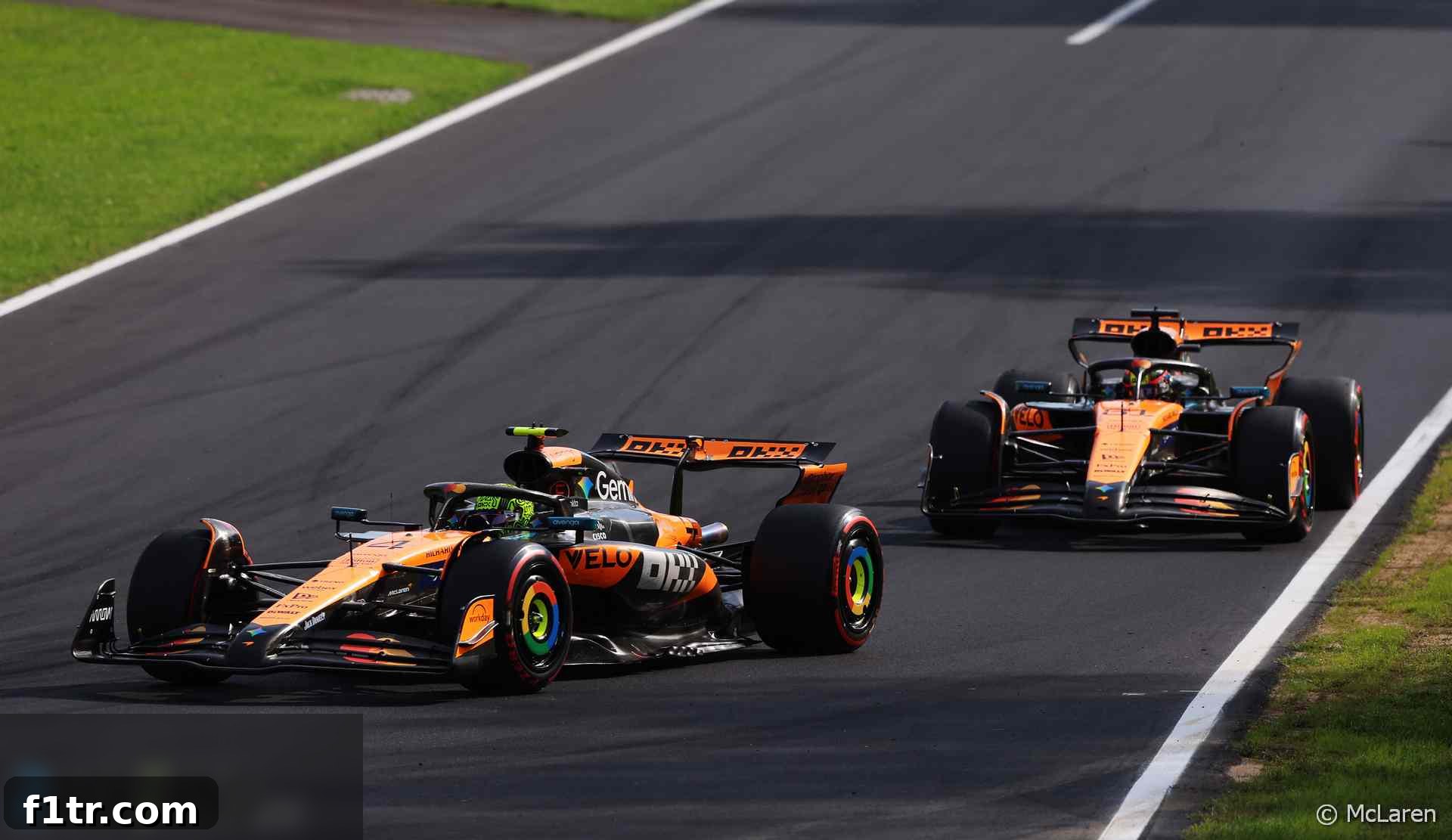
The exhilarating world of Formula 1 often delivers moments of high drama, not just on the track with wheel-to-wheel racing, but also within the teams themselves, particularly when strategic decisions intersect with driver ambitions. Such was the case at the recent Italian Grand Prix, where McLaren found itself at the center of a discussion regarding team orders. Andrea Stella, McLaren’s team principal, has articulated his belief that rookie sensation Oscar Piastri will ultimately accept the team’s decision to swap positions with his more experienced teammate, Lando Norris, during a crucial phase of the race at Monza.
Advert | Become a Supporter & go ad-free
The pivotal moment unfolded after both McLaren drivers made their final pit stops. Despite Norris having run ahead of Piastri for the majority of the race leading up to their stops, a sequence of events led to a temporary reversal of their on-track positions. Consequently, the team issued a direct instruction for Piastri to cede his position, allowing Norris to move ahead into second place. This decision sparked immediate debate and highlighted the intricate balance teams must strike between individual driver performance and overarching strategic objectives.
Understanding the context behind such a directive is crucial. While the conventional protocol in Formula 1 often dictates that the leading driver receives priority for pit stops, McLaren opted for a different approach in this instance. Piastri was brought into the pits first, a strategic move aimed at defending his position from the rapidly approaching Charles Leclerc, who posed a significant threat from behind. This early stop was a tactical response to an external challenge, designed to maximize the team’s collective points haul by securing their track positions against rival constructors.
However, the meticulously planned pit stop sequence encountered an unforeseen complication. When Norris came in for his own tyre change on the subsequent lap, his stop was unfortunately slower than anticipated. This operational delay effectively placed Piastri ahead of Norris on the track, despite Norris having maintained the lead prior to the pit cycle. It was this unexpected turn of events, rather than a deliberate strategy to alter the running order, that prompted McLaren’s instruction to revert the positions.
Piastri, demonstrating professionalism, complied with the team’s order. Nevertheless, his radio communication revealed a degree of questioning, as he pointed out that slow pit stops are an inherent and often unavoidable part of racing. Despite this valid observation, Andrea Stella staunchly defended the team’s call, expressing confidence that Piastri would ultimately understand and accept the rationale behind it. Stella’s conviction underscores McLaren’s firm adherence to its established team principles, which prioritize fairness and the rectification of situations where a driver’s track position is unduly compromised by operational factors beyond their control.
The timing of this incident inevitably drew parallels to Norris’s unfortunate retirement at the Dutch Grand Prix just a week prior, where a technical failure on his McLaren forced him out in the final laps. However, Stella was quick to dispel any notion that the decision at Monza was influenced by Norris’s misfortune in Zandvoort. He explicitly stated to the official Formula 1 channel that “The decision we made today doesn’t have to do with what happened in the Netherlands. It’s completely independent of the DNF that the team caused in the Netherlands for Lando. This is a completely separate situation and we take one race at a time.” This clear separation of events highlights McLaren’s commitment to making objective, race-specific strategic decisions, free from emotional or compensatory biases.
Advert | Become a RaceFans supporter andgo ad-free
Stella further elaborated on the team’s expectation for Piastri’s acceptance of the decision. He reiterated that the initial pit stop sequencing, which saw Oscar enter the pits first, was undertaken “with a clear intent that we would not swap the positions.” The subsequent slow pit stop for Norris compounded the situation, creating a track position that McLaren deemed unfair to the more senior driver. “But because we had the sequence with Oscar first and then the slow pit stop, we thought that the fair thing to do was to go back to the positions that we had before the pit stop,” Stella explained. He concluded with optimism, “I’m sure Oscar will be very comfortable with this. He already was comfortable during the race. So we show again the values, the principles that we have at McLaren.” This statement emphasizes the transparent communication and shared understanding within the team regarding their operational guidelines.
The practice of team orders, while often contentious among fans, is a fundamental aspect of Formula 1 strategy, designed to optimize a team’s performance in the Constructors’ Championship and achieve broader strategic goals. For a team like McLaren, which is actively striving to climb the competitive ladder, maximizing every available point is paramount. These decisions are not taken lightly and are typically rooted in a philosophy that balances individual driver potential with the collective good. Piastri, as a highly promising rookie, is now navigating the complex nuances of F1 team dynamics, where loyalty and adherence to strategic directives are as crucial as raw pace.
This incident also brings to mind a previous situation at the Hungarian Grand Prix the year prior, where McLaren faced another internal discussion regarding driver positions. On that occasion, Lando Norris had moved ahead of his teammate due to pitting earlier. While Piastri’s pit stop wasn’t notably slow, the scenario still led to internal discussions. After that race, Stella revealed that McLaren had engaged in “so many conversations” to foster “alignment with each other as to how we go racing.” These dialogues are essential for establishing clear guidelines and ensuring that both drivers, despite their competitive instincts, understand and abide by the team’s overarching strategy. Stella stressed, “We just stick and refer to the principles and the approach that we have in the way we go racing. I think it’s all right.” This reinforces the idea that McLaren operates under a well-defined code of conduct, which helps them navigate these challenging situations with consistency and clarity.
Advert | Become a RaceFans supporter andgo ad-free
The delicate balance between nurturing individual talent and enforcing team cohesion is a perpetual challenge in Formula 1. For a young driver like Oscar Piastri, adhering to such directives is part of his development within a top-tier team. It demonstrates his ability to be a team player, a characteristic highly valued in the competitive environment of F1. For Lando Norris, it reaffirms the team’s commitment to ensuring that his hard-earned on-track advantage is not nullified by a technical misstep in the pit lane. Andrea Stella’s management style, characterized by transparency and adherence to established principles, aims to ensure that such decisions, while tough, are understood and ultimately accepted by all parties, fostering a strong and unified team spirit.
Ultimately, McLaren’s decision at Monza, though controversial to some, serves as a testament to their focus on the bigger picture: the Constructors’ Championship. Every point matters, and rectifying a situation where a pit stop error inadvertently altered the natural race order is seen as a fair and principled approach. As McLaren continues its resurgence in Formula 1, how it manages its internal dynamics, particularly between two highly talented drivers, will be crucial. Stella’s firm but fair stance in these situations aims to build a solid foundation of trust and understanding, ensuring that both drivers feel valued while working towards the collective success of the team.
You say
Did McLaren do the right thing by swapping their drivers around? Cast your vote below and have your say in the comments.
Do you agree McLaren were right to tell Piastri to let Norris pass him?
- No opinion (1%)
- Strongly disagree (34%)
- Slightly disagree (12%)
- Neither agree nor disagree (9%)
- Slightly agree (19%)
- Strongly agree (24%)
Total Voters: 169
A RaceFans account is required in order to vote. If you do not have one, register an account here or read more about registering here. When this poll is closed the result will be displayed instead of the voting form.
Miss nothing from RaceFans
Get a daily email with all our latest stories – and nothing else. No marketing, no ads. Sign up here:
2025 Italian Grand Prix
- No change to McLaren’s team orders after Monza review – Stella
- Bearman did not deserve penalty for Sainz collision at Monza, says Vowles
- Transcript: Hamilton seeking final tenths as he closes gap to Leclerc
- McLaren can clinch F1’s earliest title win since 1988 with as little as fifth place
- How did Verstappen know about Norris’ slow stop in Italy? Red Bull told him
Browse all 2025 Italian Grand Prix articles