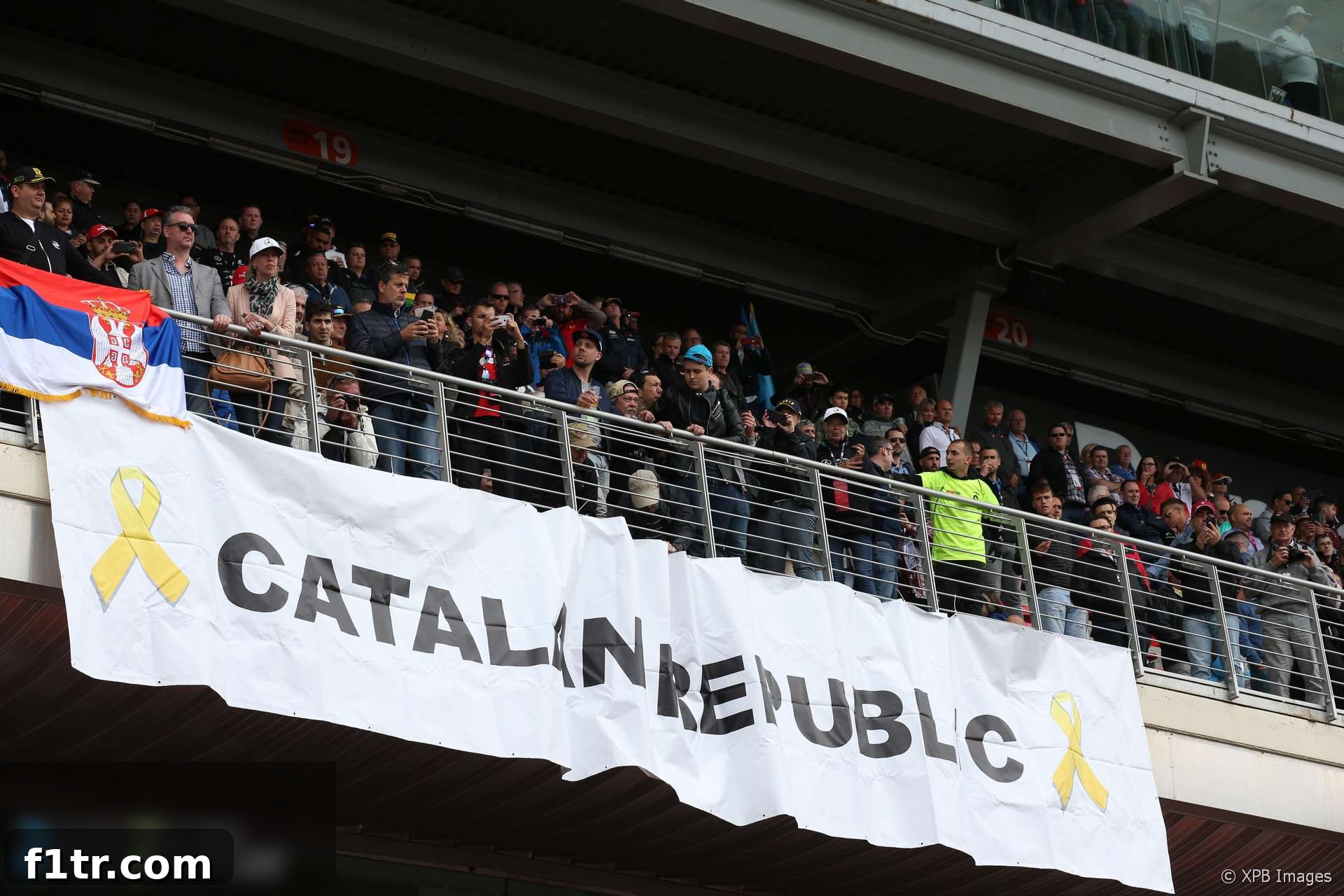
The prestigious Royal Spanish Automobile Federation (RFEdA) has ignited a significant controversy by vehemently criticizing the performance of the official national anthem of Catalonia during the pre-race ceremonies of the recent Spanish Grand Prix. This incident, occurring last weekend at the Circuit de Barcelona-Catalunya, has reignited the sensitive debate surrounding political expression within the highly regulated world of Formula 1.
In an open letter that quickly garnered widespread attention, the federation expressed its profound displeasure, citing a clear lack of consultation regarding the inclusion of “Els Segadors,” the Catalan anthem, immediately following the traditional Spanish national anthem. The RFEdA’s strong stance underscores its belief that such an unplanned alteration of established protocols sets a dangerous precedent, blurring the lines between sport and politics.
Advert | Become a Supporter & go ad-free
According to the RFEdA, the decision to play the Catalan anthem represented an “alteration of protocol,” a move it deems unacceptable for an event of such international stature. However, sources familiar with the event’s history indicate that both anthems have, in fact, been performed at the Spanish Grand Prix since its inception at the Circuit de Catalunya in 1991. This historical context adds a layer of complexity to the federation’s complaint, suggesting a possible shift in interpretation or a heightened sensitivity given the current political climate.
The core of this dispute is inextricably linked to the highly volatile issue of Catalan independence, a subject that remains acutely sensitive within the region and across Spain. Catalonia’s recent history includes a determined, albeit ultimately unsuccessful, attempt to declare independence from Spain following a controversial referendum. This move led to the Spanish government imposing direct control over the region, a period marked by significant political tension and public division. Against this backdrop, the performance of the Catalan anthem is far from a mere ceremonial gesture; it is widely perceived as a powerful political statement, echoing the aspirations of many Catalans for self-determination.
The RFEdA’s letter articulated this perception clearly, stating that the anthem’s performance “has been understood by the media and by a large number of motorsport fans, as an evident use of the capacity of public communication of the sport, for the launching of political messages, at a particularly delicate and painful moment for Catalonia and for Spain.” This highlights the federation’s concern that a premier sporting event, designed to unite and entertain, was instead inadvertently (or intentionally) utilized as a platform for political expression during a period of national fragility.
The potential ramifications of this ongoing independence debate extend beyond mere symbolic gestures. As previously reported, whispers and concerns are growing that the political climate could directly impact the future of Spain’s round of the Formula 1 World Championship. Speculation suggests the race might even be relocated out of Catalonia, with Madrid emerging as a potential new host city. Such a move would represent a significant blow to the Circuit de Barcelona-Catalunya and the regional economy, underscoring the high stakes involved in this political-sporting entanglement.
The international governing body of motorsport, the FIA (Fédération Internationale de l’Automobile), has a well-established history of reacting with uncompromising firmness when it perceives that a race or sporting event has been exploited for political ends. This policy reflects a fundamental principle: to keep sport neutral and free from external political agendas. A notable precedent occurred in 2006 at the Turkish Grand Prix, where the race promoters faced a substantial fine from the FIA. The penalty was levied after the winner’s trophy was presented by Mehmet Ali Talat, who was introduced as the ‘president of the northern Turkish republic of Cyprus’ – a political entity recognized solely by the Turkish government. This incident served as a stark reminder of the FIA’s resolve to uphold its apolitical stance, setting a clear standard that could potentially be invoked in the current Spanish Grand Prix controversy.
Advert | Become a RaceFans supporter andgo ad-free
Royal Spanish Automobile Federation’s Official Stance on the Catalan National Anthem Controversy
To fully grasp the depth of the RFEdA’s concerns and the foundation of its official complaint, it is essential to review the federation’s own words. The following is a translated excerpt from their open letter, which comprehensively outlines their objections and expectations regarding the protocol breach at the Spanish Grand Prix. This letter not only highlights a perceived violation of sporting regulations but also articulates a broader concern about the political weaponization of sport during a sensitive period for Spain and Catalonia.
In view of the events that took place last Sunday, May 13th, at the start of the Spanish Grand Prix of Formula 1, after having analyzed the matter in depth, and with the backing of the members of the Board of Directors of this Royal Spanish Federation of Motoring, which I am honored to chair, we feel the need to highlight the following issues in this open letter:
1. That the Sporting Regulations of Formula 1, in its article 19.4, provides for the interpretation of the National Anthem, 14 minutes before the beginning of the formation round [lap], within the protocol of the Exit Ceremony.
Spanish GP boss vows to “fight like a devil” to protect race
2. That, obviously, in the case of the Spanish Grand Prix, and how the regulation speaks in the singular of “the national anthem,” this cannot be other than the Spanish Anthem or March of Granaderos, which is the only official anthem of Spain since 1770, and the interpretation of any other anthem is not foreseen. Therefore, both the mere presence on the track of the Catalan flag and the interpretation of the Anthem of Catalonia, are out of place in that Ceremony.
3. That, given the current political circumstances, this alteration of the protocol – contrary to the Sporting Regulations of Formula One – has been understood by the media and by a large number of motorsport fans, as an evident use of the capacity of public communication of the sport, for the launching of political messages, at a particularly delicate and painful moment for Catalonia and for Spain.
4. That this Royal Spanish Federation of Motorsports was not informed that it was going to make this change of protocol, with which it did not know about it, and was surprised in its good faith.
5. That, if this Royal Spanish Automobile Federation had been consulted about the possibility of carrying out this alteration of the regulatory protocol of the Grand Prix Exit Ceremony, it would have opposed its authorization, always with the maximum and absolute respect to the symbols of Catalonia, but the exit of a Formula 1 Grand Prix is a regulated sporting event, and the rules are to be respected and fulfilled.
6. That the Royal Spanish Motoring Federation expects and wishes that this type of situation does not happen again in an event of our sport, and requires the special collaboration for this purpose of the FIA, the FOM, the Higher Sports Council and of the Government of Spain, and of the Organising Committee of the Grand Prix of Spain of Formula 1, “Circuit de Barcelona Catalunya”.
Sincerely,
Manuel Aviñó Roger
President
The points raised by RFEdA President Manuel Aviñó Roger underscore a rigid interpretation of sporting protocol. The emphasis on Article 19.4 of the F1 Sporting Regulations, which specifies “the National Anthem” in the singular, forms the cornerstone of their argument. For the federation, this clearly indicates that only the official anthem of the host nation – in this case, Spain – should be performed. The inclusion of the Catalan flag on track alongside the anthem is viewed as an equally unwarranted departure from established procedure, fundamentally altering the apolitical nature expected of such international events.
Furthermore, the RFEdA’s assertion of having been blindsided by this protocol change speaks volumes about the perceived disrespect and lack of transparency. Their insistence that they would have actively opposed the authorization of the Catalan anthem’s performance, had they been consulted, highlights a deep commitment to maintaining the integrity of sporting regulations above regional political considerations. This perspective, while acknowledging respect for Catalan symbols, firmly prioritizes adherence to the rules governing a Formula 1 Grand Prix, viewing it strictly as a regulated sporting event.
Looking ahead, the Royal Spanish Motoring Federation’s call for “special collaboration” from key stakeholders – including the FIA, Formula One Management (FOM), the Higher Sports Council, the Spanish Government, and the Circuit de Barcelona-Catalunya organizers – indicates a desire for preventative measures. Their aim is to ensure such situations do not recur, thereby preserving the apolitical sanctity of future sporting events. This incident not only casts a shadow over the recent Spanish Grand Prix but also sets a precedent for how F1 and its governing bodies will navigate the complex interplay of sport and national identity in politically charged regions moving forward.
Advert | Become a RaceFans supporter andgo ad-free
Explore More from the 2018 F1 Season
F1 feared “death knell” for Drive to Survive after Ferrari and Mercedes snub
McLaren staff told us we were “totally crazy” to take Honda engines in 2018 – Tost
‘It doesn’t matter if we start last’: How Red Bull’s junior team aided Honda’s leap forward
Honda’s jet division helped F1 engineers solve power unit problem