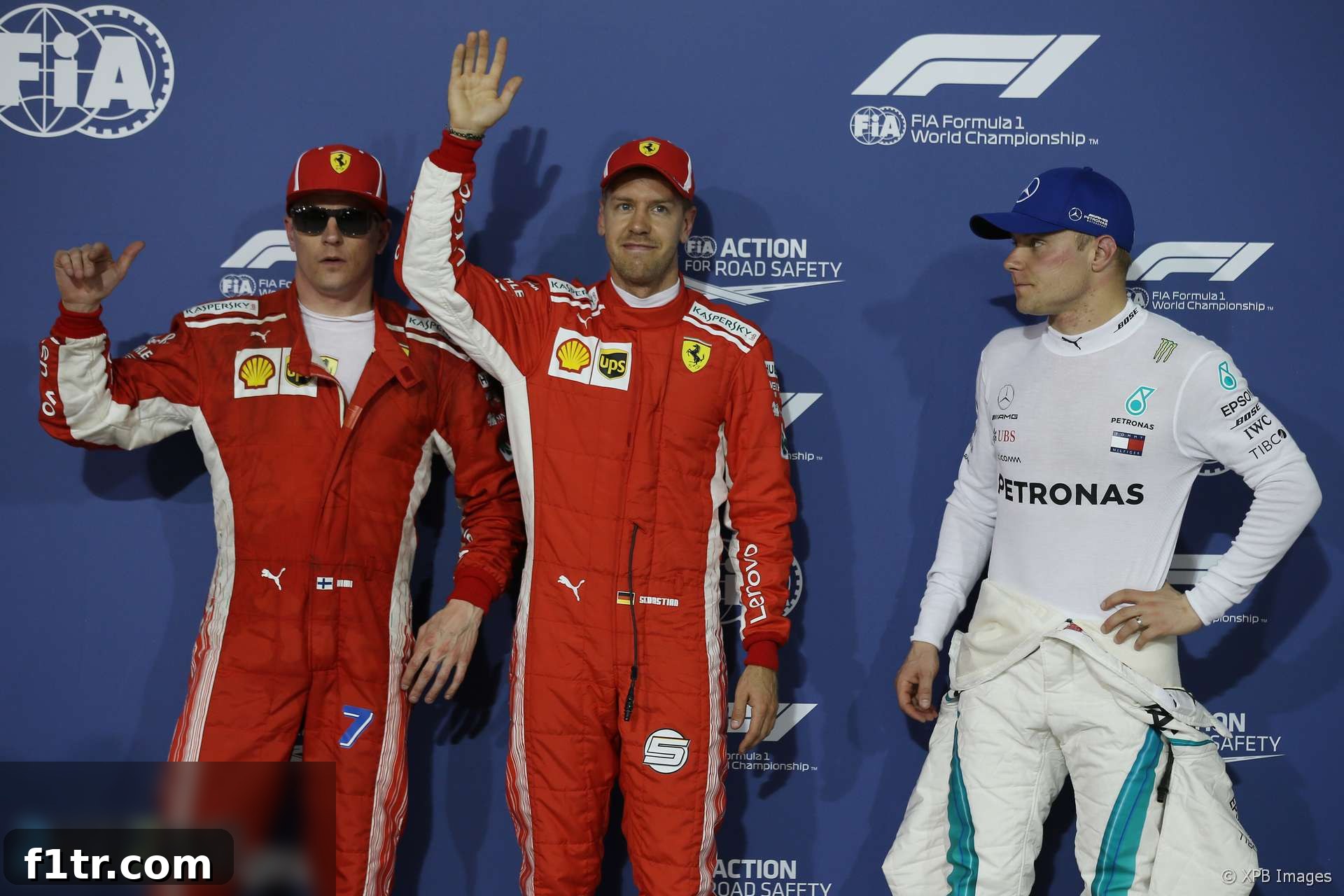
The desert night sky over the Bahrain International Circuit bore witness to a seismic shift in the Formula 1 pecking order as Sebastian Vettel masterfully ended Mercedes’ impressive five-year dominance of pole positions at the Bahrain Grand Prix. In a stunning display of power and precision, Ferrari not only secured pole but locked out the entire front row of the grid for Sunday’s race, signalling a formidable challenge to their Silver Arrows rivals.
While the Mercedes pair found themselves relegated to the second row, the situation was further complicated for Lewis Hamilton, who faced a five-place grid penalty for an unscheduled gearbox change. This crucial penalty meant that despite qualifying fourth, Hamilton would ultimately start Sunday’s Grand Prix from a challenging ninth position, adding an intriguing strategic layer to the race.
The qualifying session itself was a crucible of high drama and unexpected twists. Red Bull Racing, typically a strong contender, experienced a significant setback when Daniel Ricciardo emerged as their sole representative in Q3. His teammate, the highly-rated Max Verstappen, suffered an unfortunate crash early in the first part of qualifying (Q1), effectively ending his hopes of a strong grid position before the session truly began. This set the stage for an exhilarating battle under the Sakhir floodlights, promising an unpredictable and captivating start to the 2018 Formula 1 season’s second race.
Q1: Early Drama and Unexpected Exits
The initial segment of qualifying, Q1, immediately set a tense tone. Displaying remarkable confidence and superior car performance, the Ferrari duo, alongside Mercedes’ Valtteri Bottas, strategically navigated their way through without needing to deploy the softer, faster super-soft tyres. Instead, they comfortably ran on the harder soft compound, securing the top three positions after their initial runs. The Mercedes, driven by Bottas, impressively trailed the red cars by a mere two-tenths of a second, suggesting that while Ferrari held an edge, Mercedes’ race pace on the harder tyre could be a significant factor.
The session’s most dramatic moment, however, belonged to Max Verstappen. Pushing the limits on super-soft tyres, his Red Bull RB14 abruptly spun away from him at Turn 2. In a near carbon copy of a mistake made by Marcus Ericsson in Friday’s second practice session, Verstappen’s car lost control, but unlike Ericsson, the RB14 made heavy contact with the barrier, severely damaging its front-left corner. Though Verstappen emerged unhurt, his qualifying session was prematurely concluded. The incident necessitated a red flag, halting the session while his stricken car was safely recovered.
The session resumed with a frantic final five minutes, as several drivers, eager to improve their times, found themselves hampered by an earlier yellow flag which had temporarily disabled DRS. Among those caught in the precarious lower half of the leaderboard was Fernando Alonso, who voiced his frustration at being forced to run again to secure his passage to Q2. His initial final effort provisionally placed him 12th, but as rivals posted improved times, he precariously slipped towards the drop zone. The tension peaked with Romain Grosjean, who had previously compromised a lap by running wide at Turn 1. On his make-or-break final attempt, Grosjean again pushed too hard, running wide at the very last corner. In a cruel twist of fate, he crossed the line with a lap time identical to Alonso’s.
According to the rules, as Alonso had set his time first, Grosjean was eliminated, prompting a crestfallen apology to his Haas team over the radio. Rookie Charles Leclerc also experienced a challenging Q1, spinning off at the final corner and ultimately finishing 19th. His Sauber teammate, Marcus Ericsson, also failed to progress, as did both Williams drivers, Sergey Sirotkin and Lance Stroll, highlighting the performance struggles faced by these teams in the early stages of the 2018 season.
Amidst the eliminations, both Toro Rosso drivers impressively made it through to Q2. Brendon Hartley, in particular, showcased resilience, joining his teammate Pierre Gasly despite an incredibly unusual incident on his first flying lap. Hartley reported striking a bird at Turn 7, an impact which caused minor front wing damage but thankfully didn’t impede his progression. This added an unexpected element of drama to an already eventful Q1.
Drivers eliminated in Q1
| 16 | Romain Grosjean | Haas-Ferrari | 1’30.530 |
| 17 | Marcus Ericsson | Sauber-Ferrari | 1’31.063 |
| 18 | Sergey Sirotkin | Williams-Mercedes | 1’31.414 |
| 19 | Charles Leclerc | Sauber-Ferrari | 1’31.420 |
| 20 | Lance Stroll | Williams-Mercedes | 1’31.503 |
Go ad-free for just £1 per month>> Find out more and sign up
Q2: Hamilton’s Strategic Gamble and Midfield Surprises
The second qualifying segment, Q2, saw strategic decisions come to the fore, particularly from Mercedes and Lewis Hamilton. Facing an inevitable five-place grid drop due to his gearbox change penalty, Hamilton made a calculated gamble, electing to start the race on the more durable soft tyres. This critical choice meant he had to set his fastest Q2 lap on this compound, rather than the faster super-softs used by most of his competitors. Encouragingly for Mercedes, Hamilton demonstrated impressive pace, ending up second in Q2, just one-tenth slower than Sebastian Vettel, who achieved his time on the grippier super-soft tyres. This move not only showcased Mercedes’ confidence in their race pace on the softs but also aimed to provide a strategic advantage for the long run on Sunday.
Meanwhile, the midfield continued to deliver compelling narratives. Nico Hulkenberg, who had battled a loss of power at the end of his initial Q1 run, showed remarkable resilience and pace. There was no repeat of the glitch on his flying lap at the culmination of Q2, allowing him to put in an impressive performance that secured him sixth position. His blistering lap was six-tenths of a second quicker than his Renault teammate Carlos Sainz Jnr, who also managed to progress to the final qualifying session, Q3. This strong showing underscored Renault’s potential and Hulkenberg’s skill.
The fiercely competitive Q2 also saw the remaining Haas car of Kevin Magnussen, Pierre Gasly’s Toro Rosso, and Esteban Ocon in the Force India all successfully advancing to Q3. These midfield heroes highlighted the depth of talent and the closely matched performance among several teams. However, the margins were razor-thin; Brendon Hartley, despite his earlier bird-strike drama, narrowly missed the cut by just a tenth of a second, underscoring the relentless competition in Formula 1.
On the other end of the spectrum, both McLaren drivers failed to progress any further. Fernando Alonso and Stoffel Vandoorne found themselves the slowest among the cars that participated in the second part of qualifying, signalling the continued struggles for the Woking-based team to find consistent pace and competitive performance in the 2018 season. Max Verstappen’s absence from Q2, following his earlier crash, also meant one less strong contender in the mix, although his Red Bull’s potential was undeniable.
Drivers eliminated in Q2
| 11 | Brendon Hartley | Toro Rosso-Honda | 1’30.105 |
| 12 | Sergio Perez | Force India-Mercedes | 1’30.156 |
| 13 | Fernando Alonso | McLaren-Renault | 1’30.212 |
| 14 | Stoffel Vandoorne | McLaren-Renault | 1’30.525 |
| 15 | Max Verstappen | Red Bull-TAG Heuer |
Q3: Ferrari’s Super-Soft Mastery and Vettel’s Pole
The final and most anticipated segment of qualifying, Q3, was where Ferrari truly unleashed their raw pace, particularly on the softer Pirelli super-soft compound tyres. While Mercedes had demonstrated impressive form on the soft tyre in Q2, Q3 starkly exposed their comparative weakness on the super-softs around the challenging Bahrain International Circuit. The red cars consistently held a decisive edge, finding precious tenths of a second on the grippier rubber that Mercedes simply couldn’t match.
The initial runs in Q3 saw Kimi Raikkonen set the provisional pole position, demonstrating Ferrari’s collective strength. Sebastian Vettel, however, made a slight but costly error at the final corner during his first attempt, momentarily ceding the advantage to his Finnish teammate. This internal battle added another layer of excitement to Ferrari’s dominant display.
Lewis Hamilton, still running on the soft tyres due to his earlier strategy, could only manage third with his first Q3 effort. His predicament worsened significantly on his crucial final run. Despite his best efforts, he lost valuable time across the first two sectors, rendering his quickest run through the final sector ultimately irrelevant in the quest for pole. To add insult to injury for Hamilton, his teammate Valtteri Bottas put in a stellar final effort, improving his lap time to claim third position, further solidifying Mercedes’ position on the second row but clearly behind the formidable Ferraris.
The Ferrari drivers then engaged in a dramatic final sprint, swapping positions on their ultimate runs. Raikkonen later attributed his inability to improve his time and take pole to encountering traffic during his flying lap, a common frustration in tight qualifying sessions. However, it was Sebastian Vettel who delivered a sensational performance. He became the only driver to lap the Bahrain circuit in under 88 seconds, an extraordinary feat that secured him a hard-fought pole position. His blistering 1’27.958 lap demonstrated Ferrari’s significant step forward and Vettel’s exceptional skill under pressure, emphatically ending Mercedes’ multi-year pole streak in Bahrain.
Beyond the front-row battle, the tightly-knit midfield once again delivered outstanding performances. Pierre Gasly, driving for Toro Rosso, produced a truly stellar run to secure an impressive sixth place on the grid. This exceptional result for the Frenchman will convert to fifth position after Lewis Hamilton’s grid penalty is applied, marking a phenomenal achievement for both Gasly and his team. He managed to beat Kevin Magnussen’s Haas by less than three-hundredths of a second, highlighting the incredible competitiveness and precision required in modern Formula 1 qualifying. Nico Hulkenberg, Esteban Ocon, and Carlos Sainz Jnr rounded out the top ten, each earning valuable grid positions in a fiercely contested Q3 session, setting the stage for an enthralling race under the Bahrain lights.
Top ten in Q3
| 1 | Sebastian Vettel | Ferrari | 1’27.958 |
| 2 | Kimi Raikkonen | Ferrari | 1’28.101 |
| 3 | Valtteri Bottas | Mercedes | 1’28.124 |
| 4 | Lewis Hamilton | Mercedes | 1’28.220 |
| 5 | Daniel Ricciardo | Red Bull-TAG Heuer | 1’28.398 |
| 6 | Pierre Gasly | Toro Rosso-Honda | 1’29.329 | 7 | Kevin Magnussen | Haas-Ferrari | 1’29.358 |
| 8 | Nico Hulkenberg | Renault | 1’29.570 |
| 9 | Esteban Ocon | Force India-Mercedes | 1’29.874 |
| 10 | Carlos Sainz Jnr | Renault | 1’29.986 |
2018 Bahrain Grand Prix
- Top ten pictures from the 2018 Bahrain Grand Prix
- Vettel’s narrow win bodes well for 2018 title fight
- 2018 Bahrain Grand Prix Star Performers
- McLaren go 100 races without a win as Hamilton equals Raikkonen record
- Vote for your 2018 Bahrain Grand Prix Driver of the Weekend
Browse all 2018 Bahrain Grand Prix articles