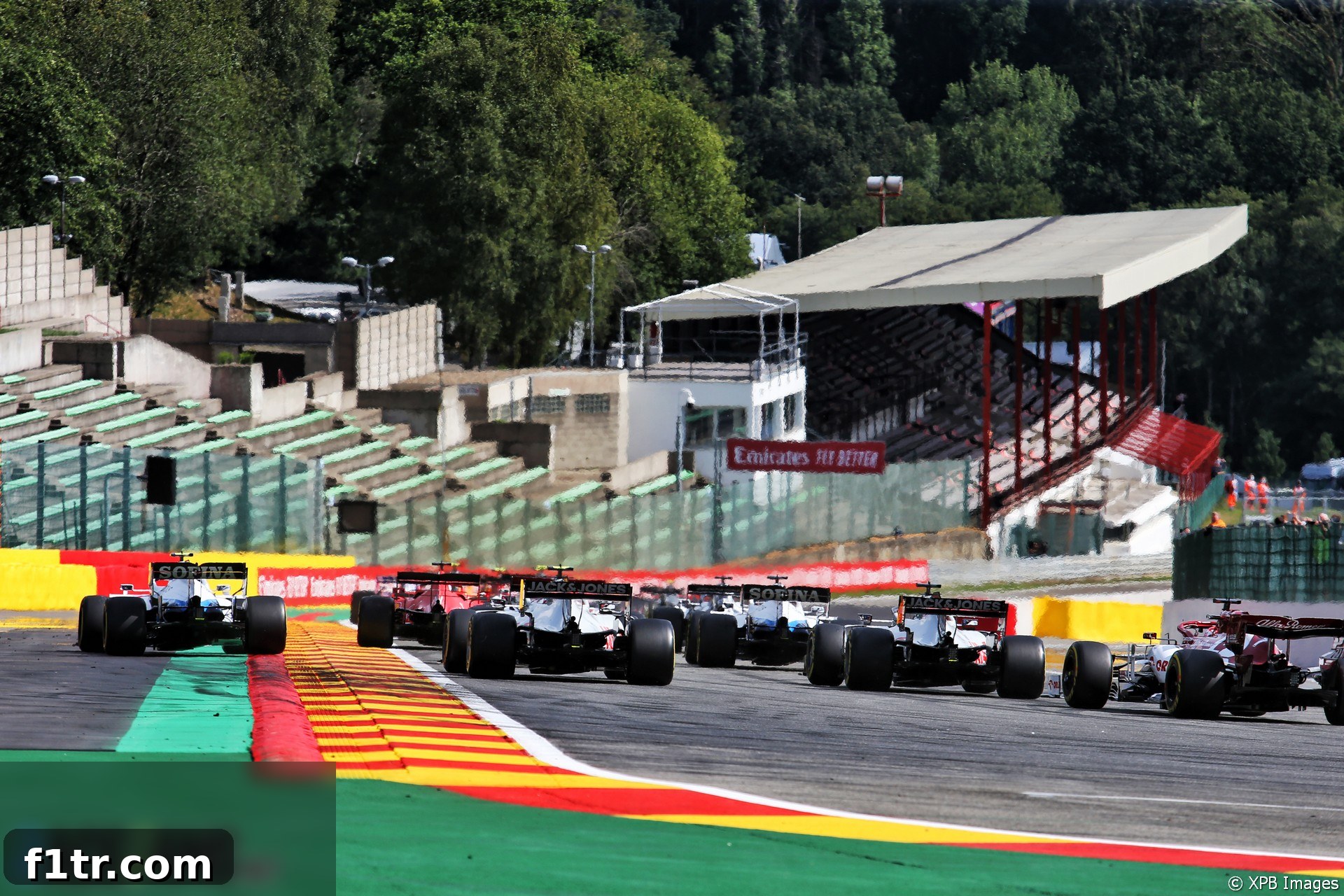
In a significant development for Formula 1 circuit management and driver conduct, Race Director Michael Masi recently elaborated on the reasons behind the complete removal of artificial grass from the crucial corner exits at the iconic Spa-Francorchamps circuit. This alteration, implemented just before the Belgian Grand Prix, sparked considerable discussion among drivers and fans alike, raising questions about track limits, safety, and the evolving nature of motorsport venues.
The practice of integrating artificial grass, often referred to as ‘Astroturf,’ at various points around Formula 1 circuits has been a common feature for years. These strips were typically positioned beyond the kerbs at corner exits, serving as a subtle deterrent to prevent drivers from exceeding track boundaries. While less punishing than gravel traps, they aimed to penalize drivers by reducing grip or potentially damaging tyres, thus encouraging them to stay within the white lines.
However, prior to the recent Belgian Grand Prix weekend, every section of this artificial grass was systematically removed from Spa-Francorchamps. In its place, asphalt run-off areas were extended, creating a smooth, consistent surface beyond the traditional track limits. This change immediately allowed drivers to run wider through certain corners without the previous penalty of reduced grip or potential car instability, leading to concerns about the policing of track limits.
The FIM License Imperative: Why Spa Ditched Astroturf
The primary driver behind this significant modification, as explained by FIA F1 Race Director Michael Masi, stems from the Spa-Francorchamps circuit’s ambition to secure a Federation Internationale de Motocyclisme (FIM) license. This license is essential for circuits wishing to host top-tier motorcycle racing events, such as MotoGP or World Superbike championships. The requirements for motorcycle racing safety differ substantially from those for car racing, particularly concerning run-off areas.
“It’s no secret that the Spa circuit is diligently working towards obtaining its FIM license, a crucial step for bringing motorcycle racing back to this historic venue,” Masi stated. He further clarified, “Artificial grass simply isn’t conducive to motorcycle safety requirements. For bike racing, a rider who runs off track needs a predictable and consistent surface to regain control or to slide safely. Artificial grass, with its varying texture and potential for unpredictable grip changes, poses a significant risk to motorcyclists. Therefore, its removal was a necessary step in their FIM homologation process.”
This decision highlights a broader trend in motorsport where multi-purpose venues must adapt their infrastructure to meet the stringent and often contrasting safety standards of different racing disciplines. While artificial grass might offer a nuanced deterrent for cars, its unpredictable nature under wet conditions or during a motorcycle crash makes it unsuitable for two-wheeled competition, necessitating the switch to asphalt, which provides a more consistent and forgiving surface for sliding riders.
The Evolution of Track Limit Enforcement in Formula 1
With the removal of physical deterrents like artificial grass, the responsibility for enforcing track limits increasingly falls on technological solutions. Michael Masi acknowledged that while artificial grass “may be more forgiving in certain areas,” the FIA has established and continues to refine alternative measures for monitoring track boundaries throughout the year.
Precision Through Technology: The Role of Timing Loops
Formula 1 has progressively relied on sophisticated timing loops embedded within the track surface to precisely detect whether drivers have exceeded the designated track limits. These electronic sensors provide an accurate and impartial method of monitoring, offering a level of consistency that physical deterrents sometimes lack.
“Track limits at Spa, much like at many other circuits recently, were rigorously monitored using an array of timing loops,” Masi confirmed. “These loops, strategically placed at critical corner exits, work in conjunction with all available visual evidence. We integrate data from various sources, including comprehensive CCTV coverage, real-time onboard camera feeds from the cars, and the broadcast footage. By combining all these advanced tools, we achieve a highly accurate and holistic overview of track limit infringements, ensuring fair play and consistent enforcement across the grid.”
The use of timing loops offers several advantages: they are unaffected by weather conditions, they provide instant data, and they minimize the subjective element that can sometimes arise from human observation alone. This technological approach allows for a more consistent application of the rules, reducing ambiguity and potential disputes.
The Controversy of Sausage Kerbs and the Search for Safer Alternatives
While timing loops offer a digital solution, circuits have also employed physical deterrents to discourage drivers from straying too wide. Among these, tall ‘sausage kerbs’ became a particular point of contention. These robust, raised kerbs, designed to be an unambiguous physical barrier, gained notoriety and considerable criticism last year following a severe incident.
The incident involved Formula 3 driver Alex Peroni at Monza’s infamous Parabolica corner, where his car was launched dramatically into the air after making contact with a sausage kerb. The alarming nature of the crash, which saw Peroni’s car become airborne and sustain significant damage, ignited a fierce debate within the motorsport community regarding the safety implications of such aggressive deterrents, especially for open-wheel cars that can be vaulted by them.
In light of these concerns, the FIA has re-evaluated the deployment of sausage kerbs, especially in high-speed and critical corner exits. Michael Masi addressed the ongoing assessment, particularly concerning their use at the historic Monza circuit.
Monza’s Parabolica: A Corner Requiring Precision
Monza, known as the ‘Temple of Speed,’ features several high-speed sections and iconic corners, none more so than the final bend, the Parabolica. This long, sweeping right-hander demands absolute precision from drivers as they carry immense speed onto the main straight. Exceeding track limits here can yield a significant time advantage, making enforcement critical.
Masi confirmed that while some sausage kerbs remain present at Monza, particularly in less critical areas, alternative measures have been adopted for sensitive zones like the Parabolica. “Regarding Monza, while a number of the sausage kerbs are still in place, we’re implementing other alternative measures for track limits enforcement next weekend,” he explained. “Specifically, at the final corner, the Parabolica, we will be utilizing two timing loops. We will closely monitor how this system performs and whether it effectively addresses the track limit challenges at this crucial part of the circuit.”
This strategic decision to replace physical, potentially dangerous, kerbs with invisible, precise timing loops at a high-speed corner like the Parabolica underscores the FIA’s commitment to driver safety while maintaining the integrity of competition. It also reflects Masi’s broader philosophy that there isn’t a singular “one-size-fits-all” solution for track limits. Instead, each particular area of a circuit requires an appropriate and carefully considered approach, balancing safety, fairness, and the unique characteristics of the corner.
Balancing Safety, Integrity, and the Thrill of Racing
The ongoing adjustments at circuits like Spa-Francorchamps and Monza illustrate the dynamic nature of motorsport regulations. The FIA, under the guidance of figures like Michael Masi, is constantly seeking to strike a delicate balance between enhancing driver safety, maintaining the integrity of competition by enforcing track limits, and preserving the thrill and challenge that define Formula 1.
The shift away from artificial grass and, in critical instances, sausage kerbs, towards more technologically advanced and less physically intrusive methods like timing loops, signifies a maturity in track management. It aims to provide consistent and fair policing of the rules without introducing unnecessary risks to drivers. This approach allows circuits to adapt for multiple racing disciplines, ensuring their longevity and versatility, while simultaneously modernizing how races are officiated.
Looking ahead, the collaboration between circuit operators, the FIM, and the FIA will continue to shape the future landscape of motorsport venues. The emphasis will remain on creating environments that are safe for all categories of racing, while still offering the demanding challenges that push drivers and riders to their absolute limits, ultimately enhancing the spectacle for fans worldwide.
Further Insights into the 2020 F1 Season
- Grosjean to make F1 test return tomorrow for first time since Bahrain horror crash
- Pictures: Wrecked chassis from Grosjean’s Bahrain fireball crash to go on display
- Bottas vs Rosberg: Hamilton’s Mercedes team mates compared after 78 races each
- F1 revenues fell by $877 million in Covid-struck 2020 season
- Hamilton and Mercedes finally announce new deal for 2021 season
Browse all 2020 F1 season articles