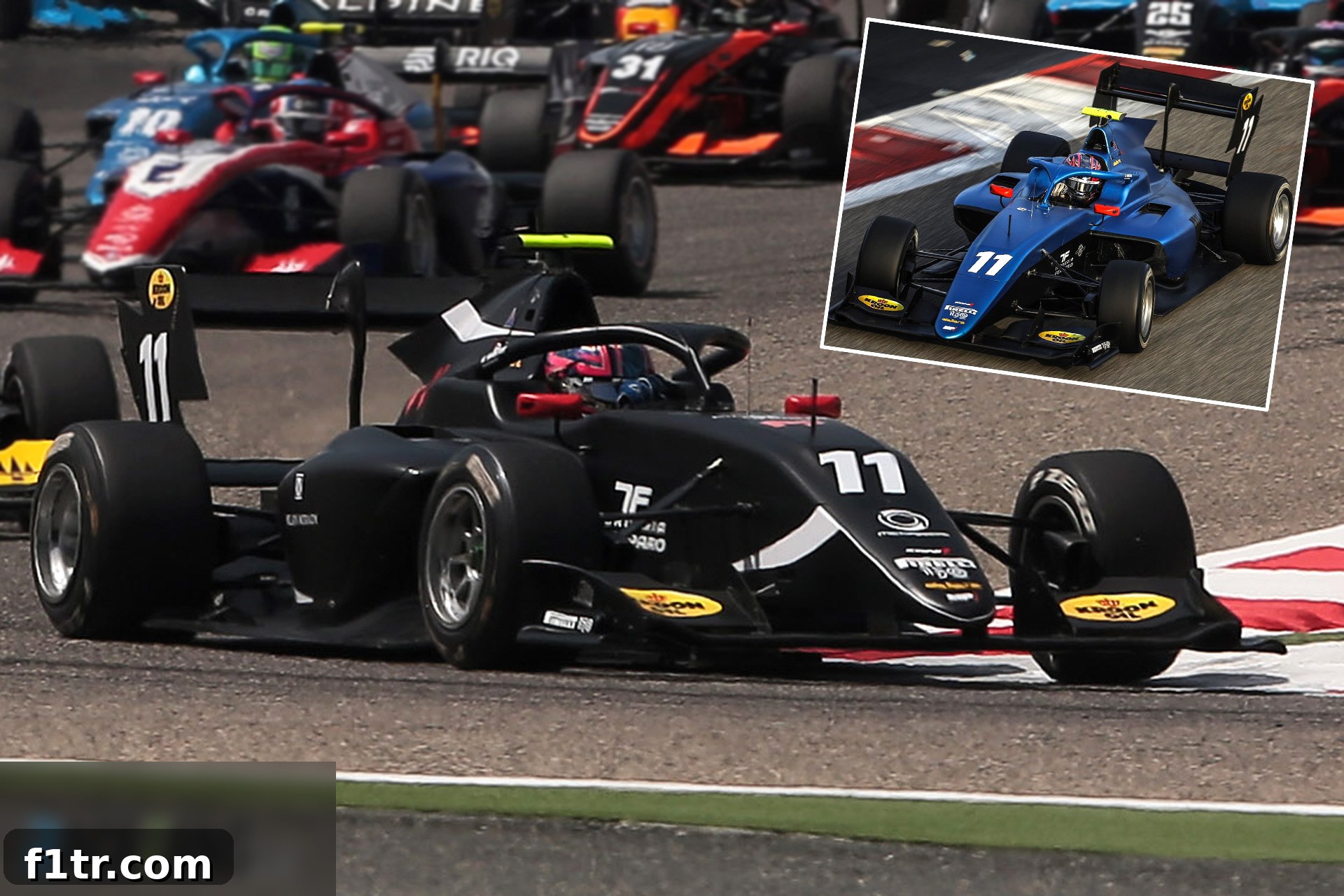
In a season opener fraught with geopolitical tension and sporting ethics, Russian Formula 3 driver Alexander Smolyar made headlines not just for his impressive third-place finish but also for the circumstances surrounding his participation. Competing as an Authorised Neutral Driver, Smolyar’s MP Motorsport car featured a striking, plain black livery, a stark visual departure from the team’s usual colors, symbolizing the complex position he occupies in international motorsport.
Smolyar’s journey to the podium in today’s season-opening race was far from straightforward. His presence on the grid was confirmed only a day before practice commenced for the new season, following a period of intense uncertainty. This unexpected turn of events captivated the motorsport community, highlighting the broader implications of global conflicts on individual athletes.
The Genesis of a Neutral Competitor: FIA’s Stance and Smolyar’s Dilemma
The backdrop to Smolyar’s situation is the ongoing conflict in Ukraine and the subsequent response from international sports governing bodies. The Fédération Internationale de l’Automobile (FIA), motorsport’s global authority, introduced stringent restrictions on Russian competitors. These measures were a direct reaction to Russia’s invasion of Ukraine, aiming to separate state-affiliated entities from individual athletes who may not endorse their government’s actions.
Initially, Smolyar, like many of his compatriots, faced the prospect of withdrawal from international competitions. He had previously announced his intent to step away from Formula 3, aligning with the decision of his long-time backer, SMP Racing. In a statement released last week, Smolyar articulated the challenges: “I stand with the decision of SMP Racing to stop its European program as a result of an unprecedented requirements that FIA put on any Russian driver as a condition for access to international competitions.” This sentiment underscored the profound impact these new regulations had on Russian drivers and their teams, many of whom found themselves in an unenviable position.
The FIA’s framework for Authorised Neutral Drivers (AND) was designed to offer a pathway for individual Russian and Belarusian athletes to compete, provided they adhere to strict neutrality protocols. This included a ban on displaying national flags, symbols, or anthems, and a crucial stipulation that drivers must not express support for the conflict. The agreement signed by Smolyar underscored these conditions, making it clear that any deviation could result in forfeiture of their right to compete. This mechanism, while controversial, allowed athletes like Smolyar to continue their careers under the motorsport umbrella, albeit under significant constraints.
A Visual Statement: The Plain Black Livery
One of the most visually striking elements of Smolyar’s return to the F3 grid was the complete transformation of his car’s appearance. Unlike his MP Motorsport teammates, Caio Collet and Kush Maini, whose cars proudly bore the team’s distinctive blue and branding, Smolyar’s machine was stripped of any national or team-specific identifiers, painted instead in a stark, plain black livery. This wasn’t merely an aesthetic choice; it was a powerful, silent declaration of his neutral status, visually reinforcing the FIA’s restrictions.
The black car served as a constant reminder of the extraordinary circumstances. It symbolized a driver forced to navigate a complex political landscape, stripped of traditional national pride in a sport where national identity often plays a significant role. For many spectators, the sight of the unbranded black car was a poignant image, representing the personal sacrifices and compromises made by athletes caught in geopolitical crosscurrents. It also highlighted the meticulous efforts required by teams and drivers to comply with the new regulations, ensuring no accidental display of banned symbols.
Podium Finish in Bahrain: A Race of Resilience
Despite the immense pressure and uncertainty surrounding his participation, Alexander Smolyar delivered a phenomenal performance in the opening race of the season in Bahrain. Finishing third, he secured a podium spot, a testament to his talent and resilience amidst an incredibly challenging period. The race itself was a thrilling display of F3 competition, but the post-race ceremony carried its own unique significance.
On the podium, as the top three drivers celebrated their achievements, the absence of a national flag above Smolyar was conspicuous. While Oliver Bearman of Great Britain had his national flag displayed for his second-place finish, Smolyar’s spot above the steps remained blank, a silent but powerful symbol of his neutral status. This moment encapsulated the delicate balance between sporting achievement and the political realities that now permeate international competitions.
Smolyar’s Perspective: Focus Amidst Adversity
Speaking after the race, Smolyar offered insights into the difficulties he faced leading up to the season opener and his approach to competing under such unique conditions. His comments revealed a driver attempting to compartmentalize the political turmoil and focus purely on his craft.
“I would say thanks to MP, because there was some difficulties in the beginning and then we basically found a solution to sort it out and then basically just happy to be to be here,” Smolyar stated, acknowledging the crucial role played by his team in navigating the bureaucratic and logistical hurdles. His gratitude underscored the collaborative effort required to ensure his place on the grid, suggesting that the “solution” involved complex negotiations and adherence to the FIA’s strict terms.
When asked about the broader context, Smolyar emphasized his determination to remain focused on racing. “I’m trying not to think about it too much. I just focus on racing. I know this is a difficult, difficult time, but I’m also trying to focus on my job,” he added. This reflects a common coping mechanism among athletes facing external pressures: channeling energy into performance and finding solace in the familiar routines of their sport. His words resonate with the struggle many professionals face when personal lives and global events intersect with their careers.
The Road Ahead: Future Uncertainties in Europe
While Smolyar successfully navigated the Bahrain opener, his path for the remainder of the Formula 3 season remains fraught with uncertainty. A significant portion of the F3 calendar takes place in Europe, where Russian sportspeople are facing increasingly severe restrictions. This regional variation in policy adds another layer of complexity to Smolyar’s participation.
For instance, Motorsport UK, the governing body for motorsport in Great Britain, announced earlier this month that Russian license-holders would not be able to compete in British events. This poses a direct challenge for Smolyar, as F3 is scheduled to race at the iconic Silverstone circuit in July. The British ban, a response by national federations to the conflict, highlights the fragmented nature of international sports policy and the potential for a patchwork of regulations across different host countries.
The question of whether Smolyar will be able to complete the entire season is thus a pressing one. Each European round could present new obstacles, requiring constant vigilance and potential further negotiations with event organizers and national sporting authorities. His ability to race at circuits like Silverstone, Spa-Francorchamps, or Monza will depend on evolving political landscapes and the specific interpretations of sanctions by each host nation’s motorsport body. The situation underscores the delicate balance between a driver’s aspirations and the geopolitical realities that now define a significant part of the sporting world.
Broader Implications for Motorsport and Beyond
Alexander Smolyar’s story is more than just about a single driver; it reflects a broader trend in international sports where geopolitical events are directly impacting athlete participation. The FIA’s decision to allow neutral athletes, while controversial, represents an attempt to strike a balance between condemning state actions and not penalizing individual athletes indiscriminately. However, this approach also creates a complex moral and logistical maze for competitors, teams, and organizers alike.
The plain black livery and the absence of national symbols on the podium serve as powerful reminders of this new era. They symbolize the loss of traditional sporting pride for some, while for others, they represent a necessary stance against aggression. As the season progresses, Smolyar’s journey will continue to be a focal point, not just for his racing prowess but also for the ongoing debate about the role of sports in a politically charged world.
His performance in Bahrain demonstrated that even under immense pressure, talent and determination can shine through. However, the external challenges are far from over, making his campaign a compelling narrative of resilience, adaptation, and the enduring power of sport to reflect the wider human condition.
Formula 3
- McLaren drop three drivers from junior roster and hire FREC runner-up De Palo
- Lawson: Tsunoda ‘had his time – I beat him in the junior series’
- F3 driver’s penalty cancelled after FIA asks stewards to review decision
- Antonelli and Bearman’s F1 graduations show the limitations of its feeder series
- Win-less Fornaroli clinches F3 title with last-lap pass in epic Monza finale
Browse all Formula 3 articles