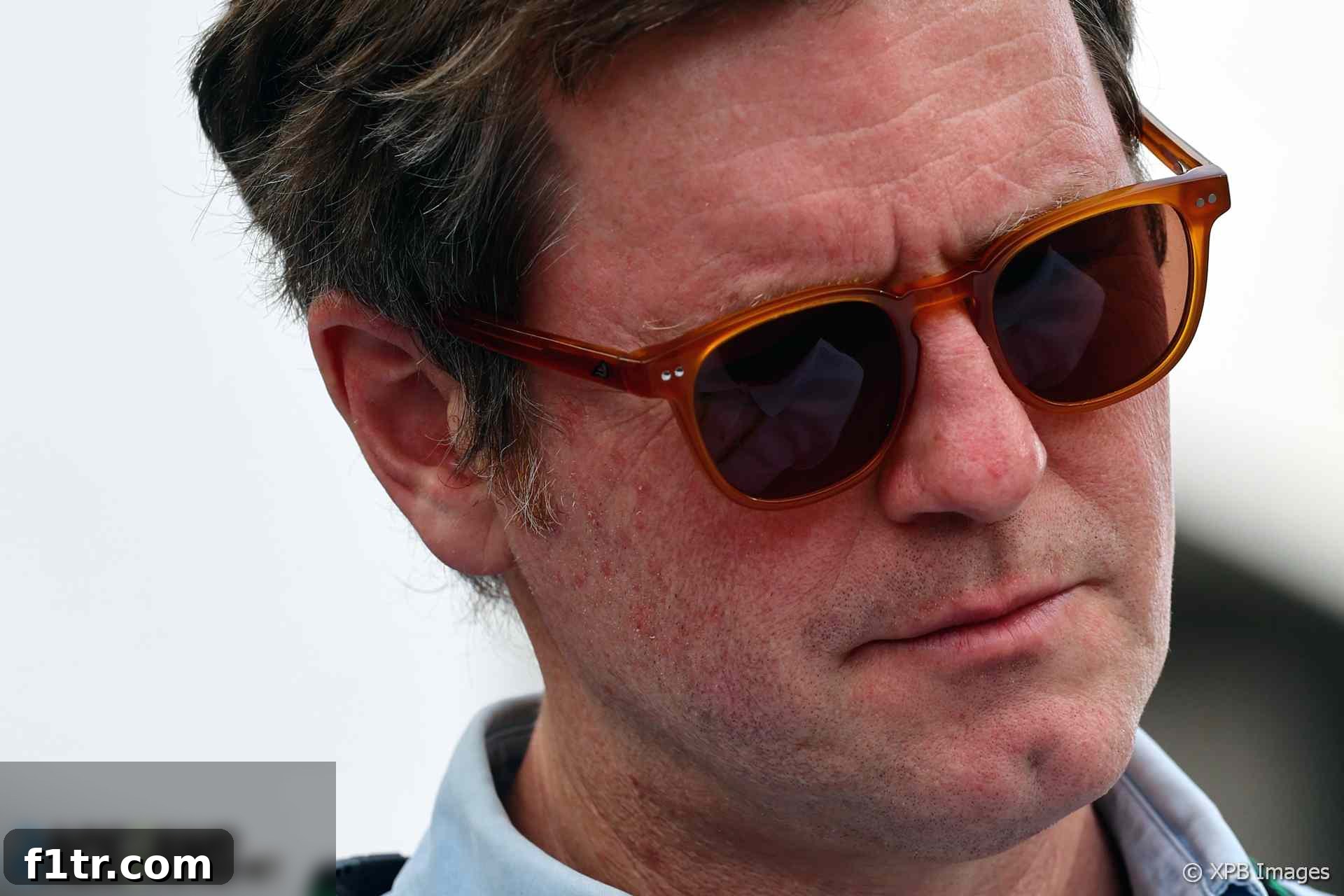
Legendary Formula 1 race engineer Rob Smedley, renowned for his memorable exchanges with Felipe Massa during their tenure at Ferrari, believes modern F1 engineers have become excessively cautious in their radio communications. Smedley argues that the time for “pussyfooting around” is over, advocating for a more direct and assertive approach when instructing drivers in the heat of competition.
Advert | Become a Supporter & go ad-free
Smedley’s career is marked by iconic team radio moments that captivated audiences during a period when such messages were a nascent feature of Grand Prix broadcasts. His soothing yet firm “Felipe, baby, stay cool,” delivered amidst the chaos of the 2009 Malaysian Grand Prix, became an instant classic. Perhaps even more famously, in 2010, Smedley was the voice behind the infamous coded instruction at the German Grand Prix, where Massa was discreetly told to yield his position to teammate Fernando Alonso: “Fernando is faster than you.” This incident sparked considerable controversy, highlighting the fine line between strategic team play and sporting integrity, and ultimately led to a re-evaluation of team order regulations.
The Evolution of F1 Team Radio and Smedley’s Critique
Following the 2010 controversy, the FIA eventually scrapped the ban on team orders from 2011, meaning engineers today no longer need to resort to veiled messages as Smedley once did. Despite this regulatory freedom, Smedley observes a persistent reluctance among some engineers to deliver unequivocal instructions to their drivers. He suggests that a culture of excessive deference may be hindering optimal performance in a sport where every millisecond and every decision counts.
In a candid discussion for The Red Flags podcast, Smedley voiced his frustration: “In general, I think in Formula 1 now, there’s too much pussyfooting around. The way the radio messages go to the driver – I don’t watch every single race, but the races I watch, I’m like, fucking grow a pair, man. Just tell him what you need to tell him, right?” His blunt assessment underscores a belief that directness, even if perceived as harsh, is crucial for efficiency and authority within the high-stakes environment of Formula 1 racing.
Smedley further elaborated on his philosophy, drawing a comparison to managing strong personalities. “You give any narcissistic sociopath an inch and they’ll take a yard, right, so don’t give him that inch to start with,” he explained. This provocative analogy highlights the need for engineers to establish and maintain clear authority. He stressed that a race scenario is a professional workplace, demanding adherence to instructions without question. “Don’t give him this fact that I’ve got some kind of inferiority complex here and I’m going to tell you something and maybe you’ll do it… No, mate, we’re at work, right? I’m going to tell you something, you do it.”
For Smedley, the dynamic is simple and hierarchical, mirroring professional life beyond the racetrack. “When my boss tells me something, I do it. That’s the way the world works.” He argues that in an environment as intensely pressured as Formula 1, any deviation from this fundamental principle can lead to catastrophic consequences. “If we don’t do that, right, as long as we’re not working for narcissists and sociopaths and they’re telling us to do the wrong things, if we don’t do that in a high-pressure environment like this, the whole thing’s going to get spun out. It’s going to get spun off his axis.” He concluded by stressing the importance of establishing clear “ground rules for how we all engage. The rules of engagement, how we talk to each other.” This framework of mutual understanding and clear command structure is, in Smedley’s view, non-negotiable for success.
Advert | Become a RaceFans supporter andgo ad-free
Decisive Action Over Emotional Consideration
A key aspect of Smedley’s argument is the necessity for race engineers to prioritize strategic decision-making over concerns about a driver’s immediate feelings. He believes that hesitation born from the fear of upsetting a driver can be detrimental. “There’s a lot of this stuff like: should I make a decision? Should I ask this driver to move over or that driver to move him? Will his feelings be hurt?” Such internal debates, Smedley contends, are luxuries that a Formula 1 pit wall cannot afford.
He takes a pragmatic view of driver satisfaction: “Look, you’re only ever going to get one driver at the end of the race who’s happy, right? You can’t please all of the people all of the time. So just fucking grow a pair and get on and make the decisions that you need to make.” This stark assertion reflects the competitive reality of motorsport, where individual desires must often be subordinated to team strategy and the pursuit of victory. Smedley extends this lesson beyond Formula 1, stating, “I think that’s true in Formula 1 and it’s true in life. You’re kind of like walking on eggshells and you daren’t make a decision, you just end up in the worst possible place.” This highlights a universal truth about leadership and decision-making in high-pressure environments, whether on a racetrack or in a boardroom.
The Gold Standard: Max Verstappen and Gianpiero Lambiase
When pressed for an example of effective communication, Smedley points directly to the dynamic duo of Max Verstappen’s race engineer, Gianpiero Lambiase, often affectionately known as “GP.” Smedley highlights their relationship as a benchmark for how driver and engineer should interact.
“Between Max and GP, they’ve definitely got that relationship right. GP tells him how it is and Max will fire back.” This exchange, characterized by frankness and direct feedback, is precisely what Smedley advocates. It’s a relationship built on trust and mutual respect, allowing for open dialogue, even when it involves blunt assessment or a challenging instruction.
Smedley admires Lambiase’s willingness to hold Verstappen accountable, even for his behavior. “One thing I really like about GP – and again that’s very similar to how I always felt as well – is sometimes the drivers can get slightly sociopathic with their views on the team. These are guys who are staying up until midnight a lot of the nights working for you and getting things right.” This insight underscores the importance of an engineer not just as a strategist but also as a moral compass, ensuring the driver maintains respect for the immense effort of the entire team.
Advert | Become a RaceFans supporter andgo ad-free
Smedley recalls his own instances of confronting drivers and praises Lambiase for doing the same. “You’ve heard GP a couple of times, and I’ve definitely said it to my drivers, I think you need to go back in the garage and apologise to the guys because how you’ve been behaving is not very adult or you haven’t been a very nice person, put in polite terms, so get in there and apologise. GP’s done that with Max, I certainly did it in my time.” This demonstrates a crucial aspect of leadership: the ability to correct behavior and reinforce team values, even with a star driver.
Their bond was particularly evident during a tense moment last year when Lambiase unequivocally told Verstappen he would not tolerate “childish” radio exchanges regarding other drivers’ adherence to rules. Smedley sees this as a testament to their authentic connection. “I think the way Gianpiero conducts himself on the radio is probably just a reflection of their real relationship,” Smedley commented. “They’ve got this good relationship, you’ve got a relationship that works, they both rely on each other fully and they both trust each other fully.”
This deep foundation of trust allows for a communication style that bypasses typical corporate politeness. “When you’ve got that, you can talk to each other how you want. You don’t have to have this like, ‘control’, ‘check’, ‘ten-four’, all of this nonsense, right? We are checking, fucking hurry up then because I’m driving a car at 200 miles an hour.” The removal of unnecessary jargon and pleasantries in favor of raw, efficient instruction highlights the practicality and effectiveness of their established rapport, a critical advantage when operating at the absolute limits of human and mechanical performance.
Beyond F1: Giving Back Through FAT Karting League
Despite continuing to receive offers from Formula 1 teams, Rob Smedley has chosen a new path, focusing his energy on establishing the FAT Karting League, a junior racing series designed to democratize motorsport access. This initiative reflects Smedley’s deep desire to “give back” to a sport that has given him so much.
“I’m from a fairly humble background and I ended up in this dream position in Formula 1 and building, I guess, a dream life, if you like. So I know that I’ve been super fortunate. I know that I’ve been ‘right place, right time’. That’s where a lot of my breaks have come from.” Recognizing the immense privilege and luck involved in his journey, Smedley is driven to create opportunities for others who may not have the same advantages.
His motivation stems from a stark realization about the astronomical odds of a child from an ordinary background reaching the pinnacle of motorsport. “Therefore I looked inwardly at myself and I thought, well, what was the chance of a kid like me getting to Formula 1 and being successful in Formula 1? I don’t know, like 10 million [or] 100 million to one, one billion to one.” The FAT Karting League aims to drastically improve these odds. “So I start to think about like, how do we lower the odds? How do we make the odds better for kids from more normal backgrounds to get to Formula 1?” By making karting more accessible and affordable, Smedley hopes to unearth and nurture talent that might otherwise be overlooked due to financial barriers, thereby fostering a more diverse and meritocratic pipeline for future motorsport stars.
Advert | Become a RaceFans supporter andgo ad-free
Miss nothing from RaceFans
Get a daily email with all our latest stories – and nothing else. No marketing, no ads. Sign up here:
Formula 1
- Controversies, Norris, Newey and more: Five new motorsport books reviewed
- One of F1’s greatest races happened 15 years ago today. Or did it?
- “Overtaking is overtaking”: Domenicali denies F1’s yo-yo racing is “artificial”
- The crashes F1 is trying to prevent may be rare – but the danger is obvious
- F1 returning to India soon after 2027 sounds like wishful thinking
Browse all Formula 1 articles