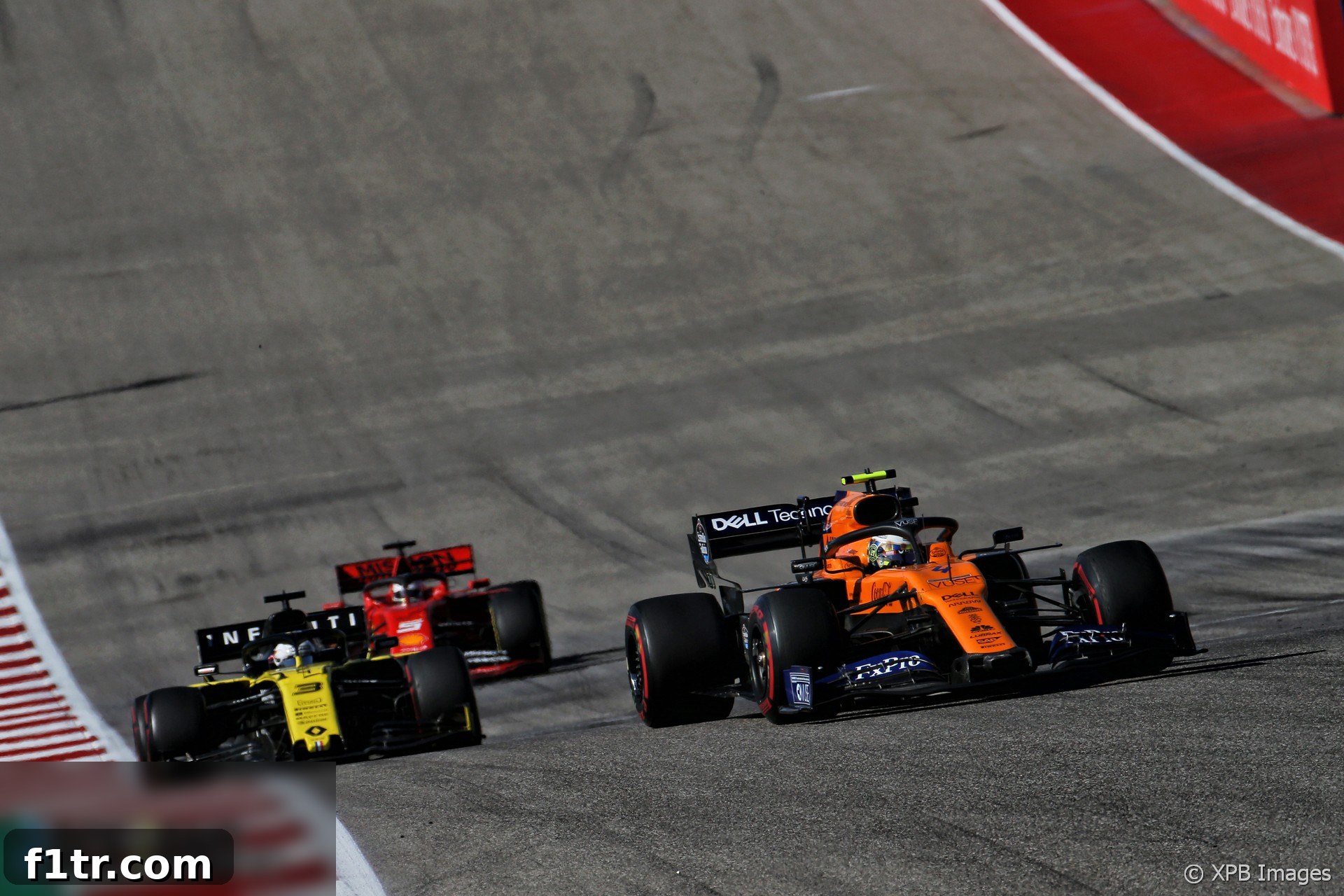
Lando Norris Reflects on Near-Miss with Daniel Ricciardo and the Strategic Gamble at the 2019 United States Grand Prix
McLaren Driver Details Close Encounter and Frustration of Missing P6 by a Whisker
The 2019 Formula 1 season delivered countless thrilling moments, but few were as intensely contested in the midfield as the battle between McLaren and Renault. At the United States Grand Prix in Austin, Texas, McLaren’s rising star Lando Norris found himself embroiled in a gripping duel with Renault’s seasoned campaigner, Daniel Ricciardo. Despite an impressive qualifying performance, Norris ultimately finished P7, just a mere four-tenths of a second behind Ricciardo, a gap that left the young Brit reflecting on what could have been. His post-race comments revealed the raw frustration of missing out on a higher position by such a fine margin, underscoring the fierce competition that defined the midfield at the time.
Norris candidly recounted a hair-raising moment on the opening lap that nearly brought his race to an abrupt end. “He got ahead of me on the first lap into turn two,” Norris explained, his voice still carrying a hint of surprise. “I almost didn’t see him, I almost had a huge shunt. It was a bit of a surprise seeing him come up the inside, he must’ve been in my blind spot around Turn 2.” This incident highlighted the aggressive nature of Ricciardo’s driving and the razor-thin margins drivers operate within during the crucial opening stages of a Grand Prix. Navigating the crowded track in the initial laps, particularly through high-speed corners like Turn 2 at COTA, demands exceptional awareness and precision, and any misjudgment can have catastrophic consequences.
Advert | Become a Supporter & go ad-free
Despite the initial scare and losing a position, Norris, in his rookie season, demonstrated his characteristic resilience. “I got him back, I was in fifth place,” he affirmed, showcasing his fighting spirit. However, the superior race pace of the Renault became increasingly evident as the Grand Prix unfolded. “But their pace was better than us today,” Norris conceded, acknowledging the fundamental difference in performance on race day compared to Saturday’s qualifying sessions.
Qualifying Prowess vs. Race Day Realities: McLaren vs. Renault
The 2019 season saw a compelling battle for supremacy in the midfield, with McLaren and Renault often vying for the coveted “best of the rest” position behind the dominant top three teams. This particular Grand Prix was a microcosm of that season-long struggle. McLaren had indeed shown strong form in qualifying, with both Norris and his teammate Carlos Sainz outperforming the Renault duo of Daniel Ricciardo and Nico Hülkenberg. This suggested that the MCL34 had the outright single-lap pace, particularly in cooler conditions or when drivers could extract maximum performance from new tyres.
However, the narrative often shifted dramatically on Sunday. “Obviously, like we proved yesterday, we were the quicker team and we had a quicker car [in qualifying],” Norris reiterated, emphasizing McLaren’s Saturday advantage. “But on race pace we were expecting them to be definitely stronger than us, especially with the wind conditions and so on today. So I wasn’t shocked that he was able to get past me. I was kind of expecting it at one point.” This insight from Norris sheds light on the nuanced differences in car performance. While McLaren might have had the raw qualifying speed, Renault often boasted better tyre management and more consistent long-run pace, a critical factor in a full-length Grand Prix. The mention of “wind conditions” also highlights how external factors can disproportionately affect different car philosophies and setups, requiring teams to make difficult pre-race predictions and strategic choices.
The High-Stakes Two-Stop Strategy and the “One Corner Away” Frustration
With the understanding that Renault held an advantage in race pace, McLaren’s strategists opted for a bold alternative: a two-stop strategy. This decision was a calculated risk, aiming to leverage fresh rubber in the latter stages of the race to overcome Renault’s inherent pace advantage. A two-stop strategy generally involves more time lost in the pit lane but offers the potential for faster lap times on fresher tyres towards the end. It’s a gamble that often pays off when a team can make up the lost track position with superior speed.
“The fact that we tried the alternate strategy, we tried the two-stop and missed out by one corner, under a second, that was a bit more frustrating,” Norris reflected. This statement perfectly encapsulates the agonizing nature of Formula 1 racing, where months of design, engineering, and meticulous planning can come down to fractions of a second and geographical points on a circuit. To be “one corner away” from beating a rival after committing to a challenging alternative strategy speaks volumes about the fine margins and intensity of the sport. It implies that had the race been a lap longer, or if Norris had had just one more opportunity to attack, the outcome might have been different. The frustration stemmed not from a lack of effort or pace on his part, but from the cruel hand of circumstance and the relentless pursuit of perfection that defines F1.
The strategic choice of the two-stopper was an attempt to outmanoeuvre Renault, a direct rival in the Constructors’ Championship. Had it worked, it would have been a significant tactical victory. The fact that it came so close to fruition, yet ultimately fell short, made the pill harder to swallow for Norris. This kind of aggressive strategy often adds an extra layer of excitement for fans, showcasing the chess match that unfolds between teams in the pit lane and on the data screens.
Lando Norris’s Rookie Season and the Pursuit of Excellence
The 2019 season marked Lando Norris’s debut in Formula 1, and he quickly established himself as a promising talent with a blend of raw speed, intelligent racecraft, and an engaging personality. His battle with Daniel Ricciardo at COTA was just one example of his tenacious approach to racing. Despite the frustration of missing out on sixth place, Norris expressed overall satisfaction with his performance and the team’s efforts. “But apart from that I was happy,” he concluded, highlighting his ability to find positives even in defeat.
This attitude is characteristic of elite athletes who understand that while immediate results are important, the lessons learned and the effort expended are equally valuable. For a rookie, consistently fighting with experienced drivers like Ricciardo and pushing a midfield car to its limits was a testament to his burgeoning potential. The 2019 United States Grand Prix served as another valuable learning experience for Norris, teaching him about strategic execution, race management, and the relentless demands of Grand Prix racing.
Advert | Become a RaceFans supporter andgo ad-free
The Broader Context: McLaren’s Resurgence and Midfield Dynamics
The 2019 season was a crucial year for McLaren. After several challenging seasons, the Woking-based team was showing strong signs of recovery, with the MCL34 proving to be a significantly more competitive package. The intra-team rivalry with Renault, their engine supplier at the time, added an extra layer of intrigue to their on-track battles. Every point scored in the fight for fourth place in the Constructors’ Championship was vital for McLaren’s renewed ambitions.
Daniel Ricciardo, having made the high-profile switch from Red Bull to Renault, was also navigating a season of adaptation and working to elevate the French manufacturer’s fortunes. His experience and race craft were invaluable in these midfield skirmishes, and his ability to leverage Renault’s race pace against McLaren’s qualifying advantage made for compelling viewing. The US Grand Prix battle was a perfect example of two highly skilled drivers, in two closely matched cars, pushing each other to the absolute limit.
The Significance of “One Corner” in Formula 1
The phrase “one corner away” resonates deeply within the world of Formula 1. It encapsulates the extraordinary precision, fine margins, and psychological toll of a sport where success and failure can be separated by mere inches or split seconds. Drivers spend countless hours honing their skills, engineers meticulously refine car performance, and strategists pore over data, all with the aim of gaining that minuscule advantage that can make all the difference. Norris’s comment is a poignant reminder of how much effort goes into every single moment on track, and how a race can be lost or won in the blink of an eye, often in the very last phase of the competition.
For Norris, this moment at COTA likely became another brick in the foundation of his career. It instilled further understanding of what it takes to convert potential into results, how to manage expectations, and how to learn from the races that almost go your way. It’s these experiences, the near misses and the hard-fought battles, that forge the character of a championship contender. The 2019 United States Grand Prix, while not a victory for Norris, provided a valuable testament to his potential and McLaren’s upward trajectory, promising even more thrilling encounters in the seasons to come.
2019 F1 Season Insights
- Ocon’s Career Low: Crying in Melbourne Car Park at 2019 Grand Prix
- McLaren Racing Reports Reduced £71 Million Loss in 2019
- Kvyat’s “Biggest Achievement”: Hockenheim Podium in 2019
- FIA’s New Fuel Flow Meter Targets Ferrari’s Suspected ‘Aliasing’ Trick
- 23 Must-See Moments from ‘Drive to Survive’ Season Two
Browse all 2019 F1 season articles