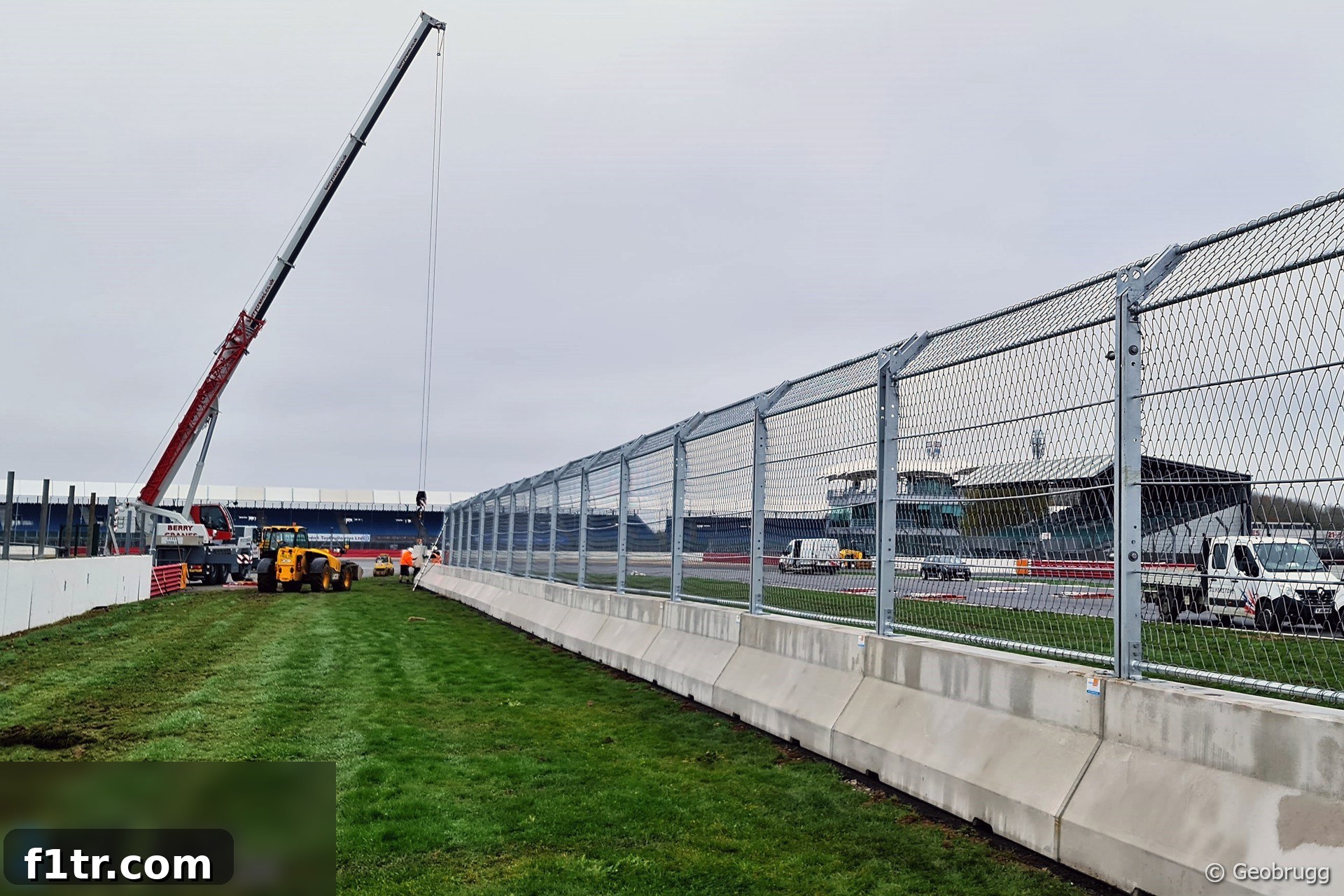
The legendary Silverstone Circuit, revered globally as the spiritual home of the British Grand Prix, has implemented a significant upgrade designed to dramatically enhance the fan experience. A state-of-the-art safety barrier has been installed at one of the track’s most thrilling and action-packed sections, promising spectators an unparalleled view of the racing spectacle. This strategic improvement underscores Silverstone’s ongoing commitment to both spectator enjoyment and paramount driver safety, solidifying its reputation as a premier destination for motorsport enthusiasts.
Revolutionizing Spectator Views and Circuit Safety at Silverstone
For decades, Silverstone has delivered unforgettable moments, from nail-biting overtakes to legendary battles that have etched themselves into Formula 1 history. Now, with the introduction of this innovative barrier system, the circuit is taking another monumental step forward. Positioned along the approach to the challenging Brooklands corner (Turn Six), this new fence stands approximately 15 meters closer to the track than its predecessor. This seemingly minor adjustment creates a profound difference, effectively bridging the gap between the fans and the high-speed drama unfolding on the tarmac.
The rationale behind this enhancement is twofold: to bring the heart-pounding action closer to the grandstands and to integrate the latest advancements in circuit safety technology. The choice of barrier is not arbitrary; it’s a meticulously selected system that has already proven its efficacy on a global stage, notably at the newly inaugurated Miami International Autodrome. This transatlantic adoption highlights a shared vision within top-tier motorsport venues to continuously elevate safety standards without compromising the thrill for spectators.
The Strategic Placement at Brooklands Corner: A Fan’s Paradise
Brooklands corner is more than just a bend in the road; it’s a critical braking zone following the high-speed Wellington Straight, demanding precision and courage from every driver. F1 cars hurtle towards Brooklands at speeds exceeding 300 kilometers per hour before drivers slam on the brakes, shedding immense velocity to navigate the technical turn. This makes it an ideal spot for witnessing overtakes, brave late braking maneuvers, and the sheer G-force capabilities of modern Formula 1 machinery. By moving the barrier closer, Silverstone is transforming a fantastic viewing point into an extraordinary one.
The new fence, which spans 248 meters along the drivers’ left-hand side of the Wellington Straight, directly impacts how fans perceive the race. Imagine the raw speed, the dazzling sparks from titanium skid blocks, and the intricate car control, all now visible in sharper detail. This change is particularly exciting for photographers and casual fans alike, as it offers a more intimate connection to the apex of motorsport. It’s a testament to Silverstone’s commitment to ensuring every attendee, whether a seasoned fan or a first-time visitor, leaves with an unforgettable experience.
Introducing the Advanced Geobrugg Barrier System: A Benchmark in Safety
The barrier system selected for Silverstone is a product of Geobrugg, a name synonymous with high-performance protective solutions in various demanding environments, including motorsports. This isn’t merely a fence; it’s an engineering marvel designed to absorb and dissipate immense impact energy. Crucially, it has been rigorously homologated by both the FIA (Fédération Internationale de l’Automobile) for car racing and the FIM (Fédération Internationale de Motocyclisme) for motorbike racing, signifying its compliance with the highest global safety standards.
The homologation process is exhaustive, involving a series of stringent tests that push the limits of material strength and structural integrity. For instance, the barrier must demonstrate its capability to withstand the impact of a vehicle striking it at a formidable speed of 120 kilometers per hour at a 20-degree angle. This simulation replicates a realistic, high-energy impact scenario that could occur during a race. Beyond direct vehicle impacts, the barriers also undergo a unique test where a 780-kilogram steel ball is fired from a cannon at 60 kilometers per hour. This “ballistic test” evaluates the barrier’s ability to contain heavy debris, tires, or other objects that might be shed from a crashing vehicle, preventing them from entering spectator areas or other parts of the track where they could pose a hazard. The successful passing of these tests instills confidence that Silverstone’s new installation represents the pinnacle of circuit safety technology.
A Collaboration for Excellence: Dromo Circuit Design’s Precision
The precise placement and integration of Silverstone’s new barrier system were meticulously overseen by Dromo Circuit Design, an internationally renowned firm celebrated for its expertise in racetrack architecture and safety. Dromo is no stranger to Silverstone, having previously handled the comprehensive resurfacing of the circuit in 2019, a project critical for improving grip and drainage, particularly for events like Moto GP. Their prior involvement ensures an intimate understanding of Silverstone’s unique topography and operational demands.
Jarno Zaffelli, CEO of Dromo, articulated the rationale behind choosing the Geobrugg system, stating, “We decided to use this system not only because it’s FIA-approved but because it’s very easy to install and if we have to move it slightly or adjust something, we can. It was a no-brainer.” This emphasis on ease of installation and adjustability is paramount for a dynamic venue like Silverstone, which hosts a multitude of racing events throughout the year. The modular nature of the Geobrugg barrier allows for greater flexibility in circuit configurations and maintenance, ensuring that any necessary changes can be implemented swiftly and efficiently, minimizing disruption and optimizing track usage. This strategic advantage underlines a forward-thinking approach to circuit management, blending cutting-edge safety with operational pragmatism.
The Miami Precedent: Innovation Meets Controversy
The Geobrugg barrier’s adoption at Silverstone gained significant momentum following its prominent deployment at the inaugural Miami International Autodrome in 2022. The Miami Grand Prix marked a new chapter for Formula 1 in the United States, bringing the glitz and glamour of the sport to a temporary street circuit constructed around the Hard Rock Stadium. The unique challenges of building a world-class racing facility within a compact, urbanized area made the flexible and high-performance Geobrugg barriers an ideal solution.
The Miami International Autodrome and its Unique Challenges
Designing and constructing a temporary Formula 1 circuit presents a distinct set of hurdles compared to permanent venues like Silverstone. The Miami track had to be erected and dismantled with efficiency, while still meeting the stringent safety requirements of the FIA. Geobrugg barriers, with their modular design and robust protective capabilities, proved to be perfectly suited for this environment. They offered the necessary safety envelope for high-speed racing while accommodating the logistical constraints of a temporary setup. Their ability to be easily installed and, if needed, slightly reconfigured, was a key factor in their widespread use across the Miami International Autodrome’s challenging layout. This successful, albeit not entirely uncontroversial, deployment served as a powerful case study for other circuits considering similar upgrades.
Safety Concerns at Turn 14: A Critical Debate
While the Geobrugg barriers generally performed well in Miami, their use at a specific section of the track, the slow chicane at Turn 14, sparked considerable debate among drivers and team principals. This particular corner became notorious during the inaugural event when both Carlos Sainz Jnr of Ferrari and Esteban Ocon of Alpine experienced crashes. The nature of these incidents, particularly Sainz’s high-speed impact, led to questions about the most appropriate barrier type for that specific, tight and unforgiving section of the circuit.
Alpine team principal Otmar Szafnauer was among those who publicly raised concerns, questioning whether a TecPro barrier should have been used instead. TecPro barriers, known for their deformable plastic blocks filled with energy-absorbing material, are designed to progressively deform upon impact, significantly reducing the G-forces experienced by a driver. They are typically favored in high-impact, low-speed corners where a rapid deceleration is required to prevent a car from bouncing back onto the track or hitting a harder surface. The debate highlighted a critical aspect of circuit design: matching the right safety barrier to the specific characteristics of each corner, considering entry speeds, impact angles, and the potential for secondary impacts. While Geobrugg excels in containing debris and providing a robust primary barrier, the specific requirements of a slow, tight chicane with potential for heavy impacts might lean towards the energy-absorbing properties of TecPro. This discussion in Miami, although a point of contention, ultimately contributes to the continuous evolution and refinement of motorsport safety standards worldwide, informing decisions made at circuits like Silverstone.
Silverstone’s Vision for the Future of Grand Prix Racing
The decision to invest in these advanced barriers and enhance spectator views is a clear indicator of Silverstone’s forward-thinking approach and its unwavering dedication to the fans. Silverstone circuit manager Lee Howkins aptly summarized this vision: “With the speed of the straight and the new safety aspects of Formula 1, it was the right time to move to the Geobrugg system. We want to make sure we’re giving the fans the best experience and the best views.” This statement encapsulates the delicate balance that modern F1 venues must strike – pushing the boundaries of safety while simultaneously amplifying the spectacle for the millions who follow the sport.
The upgrades at Brooklands corner signify more than just new fencing; they represent a strategic enhancement that reinforces Silverstone’s status as a world-class racing destination. By adopting technologies proven in demanding new venues and leveraging the expertise of firms like Dromo, Silverstone ensures it remains at the forefront of motorsport innovation. The improved fan proximity to the track’s most exhilarating moments will undoubtedly elevate the live experience, drawing more visitors and enriching the legacy of the British Grand Prix for years to come. This continuous evolution ensures that Silverstone not only honors its rich history but also embraces a dynamic future where safety and spectator engagement go hand-in-hand.
Related: 2023 F1 Season News
- FIA president cleared of alleged interference in two 2023 races
- First week viewing figures for new Drive to Survive season fall again
- Max who? Drive to Survive season six prefers its favourite faces
- RaceFans’ complete 2023 season review
- The F1 drivers who pulled off the 10 biggest charges through the field in 2023
Browse all 2023 F1 season articles