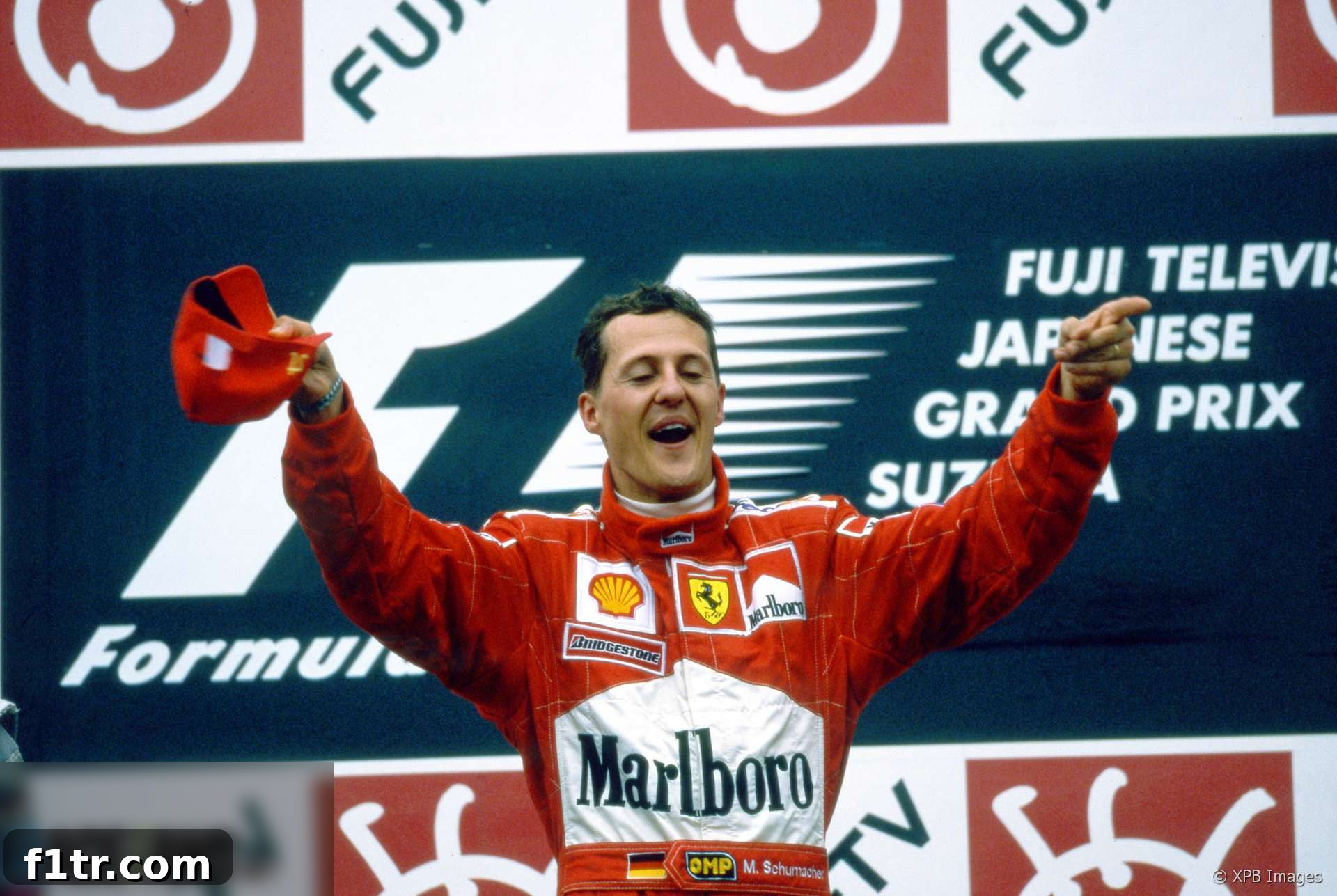
The 2000 Formula 1 season delivered one of the most enthralling championship battles in recent memory, primarily contested between two titans of the sport: Michael Schumacher of Ferrari and Mika Hakkinen of McLaren. As the season approached its climax, the title fight had taken a dramatic turn following the United States Grand Prix. A dominant victory for Michael Schumacher and a rare retirement for Mika Hakkinen meant the German Ferrari driver arrived at Suzuka, Japan, with a crucial eight-point advantage over his McLaren rival. With only 20 points still on the table across the final two races, the pressure was immense, and the stakes were higher than ever. The Japanese Grand Prix wasn’t just another race; it was the penultimate round, a golden opportunity for Schumacher to clinch his long-awaited first World Championship with Ferrari and end a two-decade drought for the Scuderia, or for Hakkinen to reignite his hopes and force a thrilling final showdown.
Suzuka, a circuit revered by drivers and fans alike for its challenging layout and high-speed demands, had historically been a scene of heartbreak for Ferrari in previous season finales. However, this year offered a different narrative. Schumacher, keenly aware of the added risks and psychological burden of a last-race decider, was determined to secure the title at the first possible opportunity. His focus was singular: perform flawlessly and leave nothing to chance.
Adding another layer of intrigue to the already charged atmosphere was a pre-race announcement from the FIA. The sport’s governing body declared that any blocking maneuvers deemed to interfere with the title fight would be met with a black flag if sustained. This directive was a direct response to controversial incidents in recent title deciders, most notably the 1997 European Grand Prix where Ferrari-powered Sauber racer Norberto Fontana had controversially impeded Schumacher’s then-title rival, Jacques Villeneuve. Depending on one’s perspective, this FIA edict was either a welcome move to clean up the racing ethics in a high-stakes scenario, ensuring a fair fight, or it removed an element of cunning tactical play that had long been part of Formula 1’s strategic landscape.
The intensity of the championship battle was immediately evident in the practice sessions. The points leader, Michael Schumacher, consistently demonstrated strong pace, topping the timing sheets in the first three free practice runs. Mika Hakkinen, however, reminded everyone of his formidable talent, snatching the fastest time in the crucial final Saturday morning session, signaling that he was ready to challenge for pole. The second practice session was also notable for an entirely unexpected occurrence: an earthquake registering 7.1 on the Richter scale was felt at the circuit. Remarkably, this significant seismic event caused no structural damage to the circuit infrastructure or, humorously, to the notoriously flamboyant hairstyle of Benetton team principal Flavio Briatore, underscoring the resilience and focus of the F1 circus amidst external disturbances.
Qualifying Thriller: A Battle for Pole Position
The qualifying session for the 2000 Japanese Grand Prix was an absolute classic, a nail-biting spectacle that perfectly encapsulated the season’s intense rivalry. The two title protagonists, Schumacher and Hakkinen, engaged in a thrilling head-to-head battle, exchanging fastest lap times with each successive flying lap. The atmosphere was electric, with every pit exit and sector time watched with bated breath. Ultimately, it was Michael Schumacher who clinched his eighth pole position of the season, but by the smallest of margins – a mere nine-thousandths of a second separated him from Hakkinen. This incredibly tight margin set the stage for what promised to be an unforgettable race, with the two championship contenders starting side-by-side on the front row, poised for a direct confrontation into Turn 1.
Behind the dominant duo, the grid shaped up with an intriguing mix of talent. The second row saw David Coulthard, Hakkinen’s McLaren teammate, securing third place, ahead of Ferrari’s Rubens Barrichello. Coulthard’s presence meant McLaren had two cars at the sharp end, ready to support Hakkinen’s championship charge. The third row featured the Williams pair, an impressive showing given the circuit’s reputation as a true test of a driver’s skill. Notably, rookie sensation Jenson Button out-qualified his more experienced teammate, Ralf Schumacher, a testament to Button’s raw speed and adaptability on one of Formula 1’s most demanding tracks. This performance was particularly significant as Button was already confirmed to be leaving Williams at the end of the season, with Juan Pablo Montoya set to replace him.
The grid continued with a rather unique “Noah’s Ark” formation, a term used in Formula 1 when teammates qualify adjacent to each other. This pattern was observed down much of the order, with both Benetton, Arrows, Prost, Sauber, and Minardi drivers lining up side-by-side, highlighting the internal team battles as much as the overall grid positions.
| Position | Driver | Team | Time |
|---|---|---|---|
| 1 | Michael Schumacher | Ferrari | 1’35.825 |
| 2 | Mika Hakkinen | McLaren | 1’35.834 |
| 3 | David Coulthard | McLaren | 1’36.236 |
| 4 | Rubens Barrichello | Ferrari | 1’36.330 |
| 5 | Jenson Button | Williams | 1’36.628 |
| 6 | Ralf Schumacher | Williams | 1’36.788 |
| 7 | Eddie Irvine | Jaguar | 1’36.899 |
| 8 | Heinz-Harald Frentzen | Jordan | 1’37.243 |
| 9 | Jacques Villeneuve | BAR | 1’37.267 |
| 10 | Johnny Herbert | Jaguar | 1’37.329 |
| 11 | Alexander Wurz | Benetton | 1’37.348 |
| 12 | Giancarlo Fisichella | Benetton | 1’37.479 |
| 13 | Pedro de la Rosa | Arrows | 1’37.652 |
| 14 | Jos Verstappen | Arrows | 1’37.674 |
| 15 | Jarno Trulli | Jordan | 1’37.679 |
| 16 | Nick Heidfeld | Prost | 1’38.141 |
| 17 | Jean Alesi | Prost | 1’38.209 |
| 18 | Ricardo Zonta | BAR | 1’38.269 |
| 19 | Mika Salo | Sauber | 1’38.490 |
| 20 | Pedro Diniz | Sauber | 1’38.576 |
| 21 | Marc Gene | Minardi | 1’39.972 |
| 22 | Gaston Mazzacane | Minardi | 1’40.462 |
The 2000 Japanese Grand Prix: A Strategic Masterclass
Race day at Suzuka was met with dry, overcast conditions, but the palpable excitement from a vast crowd of over 150,000 eager spectators provided a vibrant backdrop. The atmosphere was charged with anticipation, a collective holding of breath as the world waited to see if a champion would be crowned.
Even before the race officially began, drama unfolded on the parade lap. A hydraulic leak on Mika Hakkinen’s McLaren caused wisps of smoke to trail from the car, sending a brief wave of panic through the McLaren garage and its supporters. Fortunately, the fault proved to be no more than cosmetic, allowing Hakkinen to take his place on the grid, albeit with a momentary scare.
As the lights went out, Hakkinen delivered a truly phenomenal start, catapulting his McLaren off the line and seizing the lead into the daunting Turn 1. He held his nerve under intense pressure, fending off a dogged challenge from Schumacher, who tried every angle to reclaim his pole advantage. Coulthard settled into third position, ahead of Ralf Schumacher and Barrichello, ensuring McLaren maintained a strategic presence at the front. Further back, Jos Verstappen made an impressive four-place gain, while Giancarlo Fisichella suffered a significant setback, dropping eight places due to an anti-stall system problem with his Benetton, severely compromising his race from the outset.
A Tense Early Battle and Strategic Plays
In the initial phase of the race, Hakkinen leveraged his strong start to build and maintain a slight buffer of a couple of seconds over Schumacher. Both drivers were operating at the absolute limit, pushing their machines and themselves in a relentless pursuit of advantage, gradually pulling away from the rest of the field. This was tense, high-stakes driving, with every corner and every lap critical in the unfolding championship narrative. However, for the first third of the race, the action was more a test of strategic endurance and mental fortitude than direct wheel-to-wheel combat. The first round of pit stops offered the first real opportunity for a shift in momentum. Hakkinen pitted first and initially retained his lead. Crucially, Schumacher stayed out for a lap longer, a strategic decision that would later prove to be of immense importance.
The middle phase of the race introduced a new element: the weather. Light rain began to fall, making the already challenging Suzuka circuit increasingly slippery. This subtle change in conditions played directly into Schumacher’s hands and tipped the balance of the battle. Hakkinen, being the first car around each lap, was understandably more tentative as he explored the changing grip levels. Schumacher, however, seized the opportunity, demonstrating his renowned wet-weather prowess and aggressive driving style. He began to close the gap rapidly, shrinking Hakkinen’s lead to within a single second. The Ferrari, though not quite within striking distance for an overtake, was able to pile on immense pressure, forcing Hakkinen to defend relentlessly. In his pursuit, Schumacher even made slight contact with Ricardo Zonta’s BAR while expertly navigating through backmarkers, a minor incident that underscored the intensity of his charge.
The Decisive Pit Stop and Ferrari’s Triumph
The second round of pit stops proved to be the pivotal moment of the 2000 Japanese Grand Prix and, ultimately, the championship. Michael Schumacher, masterfully executing Ferrari’s strategy, stayed out for three crucial laps longer than Hakkinen. During these laps, with a lighter fuel load and operating in clear air, Schumacher unleashed a series of blistering times. Coupled with flawless pit work from the Ferrari crew, this extended stint allowed him to emerge from his final stop a crucial four seconds clear of Hakkinen. It was a strategic masterclass, a testament to Ferrari’s meticulous planning and Schumacher’s unparalleled ability to extract maximum performance when it mattered most. While it might not have possessed the raw, direct wheel-to-wheel drama of some past Suzuka title deciders, the combination of brilliant on-track driving and astute strategic execution perfectly epitomized the era of Formula 1 where tactical intelligence was as vital as outright speed. Despite the setback, Hakkinen pressed on to the chequered flag with characteristic determination, but the gap was insurmountable.
Further down the field, the demanding conditions and relentless pace took their toll on several competitors. Alexander Wurz and Ralf Schumacher both suffered spins that led to their retirement, while mechanical problems plagued both Prost entries, a common occurrence for the team that season. Jos Verstappen’s Arrows, Heinz-Harald Frentzen’s Jordan, and Marc Gene’s Minardi also succumbed to various technical issues, highlighting the brutal nature of the Suzuka circuit.
In the intense battle for the remaining points-paying positions, David Coulthard maintained a comfortable edge over Rubens Barrichello throughout the race. The two finished as they had qualified, securing valuable points for their respective teams. Jenson Button capped off an impressive weekend by finishing fifth, showcasing his emerging talent, ahead of Jacques Villeneuve in the BAR who secured the final point. Michael Schumacher’s eighth victory of the season was more than just a race win; it officially sealed his third World Championship title and, more significantly, his momentous first for Ferrari. The celebrations were instantaneous and euphoric.
Outgoing champion Mika Hakkinen, despite the sting of defeat, displayed immense sportsmanship and graciousness in his post-race remarks about his rival. While outwardly composed, one can only imagine the thoughts swirling in his mind about what might have been, particularly given some of the mechanical woes and strategic twists that had affected his season.
Meanwhile, the Ferrari garage and headquarters in Maranello erupted in jubilant celebrations, marking the end of a 21-year drought without a Drivers’ World Champion. Ferrari President Luca di Montezemolo, visibly emotional, declared Schumacher’s victory “the most beautiful day of my life.” Given that di Montezemolo had married earlier that year on July 7th, his remark was met with good-natured humor, implying a potentially frosty reception awaiting him back home, but undeniably capturing the profound significance of this triumph for Ferrari.
The season was not entirely over, with one race still remaining in Malaysia and the Constructors’ Championship yet to be officially secured. Ferrari held a strong 13-point lead over McLaren, but for the passionate Tifosi and the entire Ferrari team, the Drivers’ Championship was the ultimate prize. Schumacher’s historic triumph had not only fulfilled his personal ambition but also delivered on a promise to bring the ultimate glory back to Maranello, cementing his legacy and ushering in a new golden era for the Scuderia.
2000 Japanese Grand Prix Result
| Position | Driver | Team | Laps | Time / laps / reason |
|---|---|---|---|---|
| 1 | Michael Schumacher | Ferrari | 53 | 1:29’53.435 |
| 2 | Mika Hakkinen | McLaren | 53 | +1.837 |
| 3 | David Coulthard | McLaren | 53 | +9.914 |
| 4 | Rubens Barrichello | Ferrari | 53 | +19.191 |
| 5 | Jenson Button | Williams | 53 | +25.694 |
| 6 | Jacques Villeneuve | BAR | 52 | +1 lap |
| 7 | Johnny Herbert | Jaguar | 52 | +1 lap |
| 8 | Eddie Irvine | Jaguar | 52 | +1 lap |
| 9 | Ricardo Zonta | BAR | 52 | +1 lap |
| 10 | Mika Salo | Sauber | 52 | +1 lap |
| 11 | Pedro Diniz | Sauber | 52 | +1 lap |
| 12 | Pedro de la Rosa | Arrows | 52 | +1 lap |
| 13 | Jarno Trulli | Jordan | 52 | +1 lap |
| 14 | Giancarlo Fisichella | Benetton | 52 | +1 lap |
| 15 | Gaston Mazzacane | Minardi | 51 | +2 laps |
| 16 | Marc Gene | Minardi | 46 | Engine |
| 17 | Ralf Schumacher | Williams | 41 | Accident |
| 18 | Nick Heidfeld | Prost | 41 | Suspension |
| 19 | Alexander Wurz | Benetton | 37 | Accident |
| 20 | Heinz-Harald Frentzen | Jordan | 29 | Hydraulics |
| 21 | Jean Alesi | Prost | 19 | Engine |
| 22 | Jos Verstappen | Arrows | 9 | Electrical |
2000 Japanese Grand Prix Championship Standings (After Race)
Following his victory at Suzuka, Michael Schumacher extended his lead in the Drivers’ Championship to clinch his third career title and his first with Ferrari. Mika Hakkinen, though disappointed, secured second place in the standings with one race remaining. Ferrari also significantly boosted their lead in the Constructors’ Championship, nearing their first team title in a generation.
Browse all F1 history articles