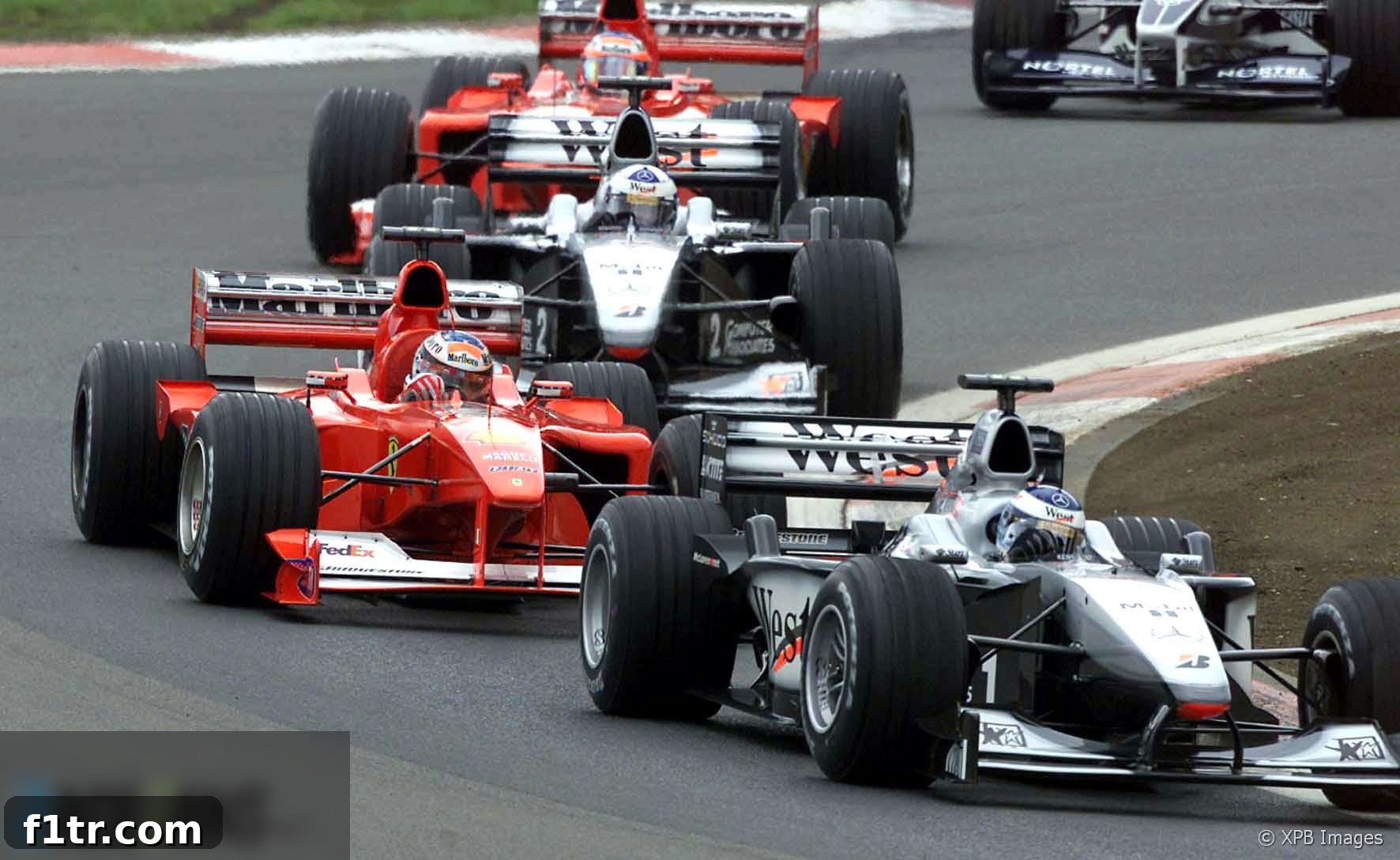
The year 2000 brought Formula 1 to the heart of continental Europe for the European Grand Prix, a stark contrast to some more recent iterations of the event held away from the continent. For the fifth time in its history, the revered Nürburgring circuit played host, a venue steeped in racing lore and previously familiar as the stage for both the German and Luxembourg Grands Prix. This particular race meeting was more than just another round on the calendar; it was a crucial chapter in an unfolding championship battle between two of the sport’s all-time greats, Michael Schumacher and Mika Häkkinen, and their respective teams, Ferrari and McLaren.
Having first re-embraced the ‘new’ Nürburgring circuit in the mid-1980s, Formula 1 found itself increasingly fond of the track. Its return in 1995 delivered a memorable race under notoriously damp conditions, a precursor to the drama that would often unfold at the Eifel venue. The most recent F1 encounter at the track, just eight months prior, had been even more thrilling, setting expectations high for the 2000 edition. What was once dismissed by some purists as overly sanitized when compared to its daunting neighbour, the legendary Nordschleife, had steadily gained appreciation among the drivers. The track’s natural undulations, sweeping turns, and technical sections provided a refreshing challenge, standing in stark contrast to the burgeoning wave of modern “Tilkedrome” circuits beginning to appear on the F1 calendar. Drivers valued its character, which blended high-speed sections with intricate corners, demanding both bravery and precision.
Michael Schumacher arrived at what was effectively his first of two home races for the season, leading the Drivers’ Championship points standings. However, his advantage was far from comfortable, with intense pressure mounting from the formidable McLaren duo of Mika Häkkinen and David Coulthard. The Woking-based team had skillfully navigated their early-season reliability concerns with the advanced MP4/15 challenger. With those initial teething troubles behind them, Häkkinen and Coulthard had decisively bounced back, securing victories in the preceding British and Spanish Grands Prix, signaling a formidable challenge to Ferrari’s championship ambitions.
The year 2000 was an era of unrestricted in-season testing, allowing teams to relentlessly pursue performance gains between races. In the weeks following the Spanish Grand Prix, the majority of the Formula 1 paddock had migrated south-west to the Jerez circuit in Spain, meticulously fine-tuning their cars. A notable exception was the Prost Grand Prix team, whose persistent struggles saw them pounding around the Magny-Cours circuit in France, desperately trying to unearth some much-needed pace for their notoriously recalcitrant AP03 chassis. Their efforts, however, yielded little in the way of improvement, painting a bleak picture for the French outfit.
The Prost team’s woes extended beyond on-track performance. Despite the introduction of new aerodynamic components designed to improve the AP03’s handling and speed, rookie driver Nick Heidfeld found himself unable to extract any meaningful pace from the car. In a particularly embarrassing comparison, the Prost AP03 struggled to better the benchmark lap time set by a rusty 2CV, underscoring the severe performance deficit the team faced. Compounding their competitive struggles, the team’s long-term future looked increasingly precarious. Engine supplier Peugeot had confirmed its intention to withdraw from Formula 1 at the close of the season, leaving Prost without a power unit. Furthermore, Mercedes-Benz, suppliers of the benchmark V10 engine, emphatically ruled out providing their powerplants to any team other than their exclusive partner, McLaren, effectively closing a vital avenue for Prost.
2000 European Grand Prix Qualifying: A Weather-Affected Battle for Pole
Upon arrival at the Nürburgring, it was immediately clear that the notoriously fickle Eifel weather would be a dominant talking point throughout the weekend. The ‘Ring’ is renowned for its changeable conditions, regardless of the season, and true to form, rain swept through the circuit on both days of practice. This culminated in a qualifying session characterized by mixed weather, adding an unpredictable element to the grid formation and testing the teams’ and drivers’ adaptability to the extreme. The shifting conditions meant that timing a lap perfectly was paramount, as grip levels varied dramatically from one moment to the next.
Adding another layer of intrigue to the weekend’s narrative were the pre-race mind games being played out at McLaren. Reigning world champion Mika Häkkinen, fresh from securing his first victory of the season in the previous round and having edged past his teammate David Coulthard in the points standings, offered some surprisingly blunt remarks about the other McLaren driver. “David is at the limit with his speed, and with that he is behind me,” stated a confident Häkkinen. “End of discussion. Even if he wins a few races, he would become a better, not quicker driver.” These provocative comments set a tense backdrop for the internal McLaren rivalry, fueling Coulthard’s determination to prove his speed.
Coulthard, undoubtedly motivated by Häkkinen’s public assessment, delivered a strong performance in qualifying, securing pole position for the first time in almost two years. His timing was impeccable, as the rain began to intensify midway through the qualifying hour, effectively sealing the grid with approximately 25 minutes remaining. Drivers who had failed to set a competitive lap early on found themselves at a significant disadvantage, unable to improve their times on the increasingly wet track. However, pole position at this stage in the season had developed an unusual reputation, almost becoming an ‘albatross’ around the neck of the pole-sitter. Remarkably, no driver had managed to convert pole into victory in the preceding eleven races, adding a psychological hurdle for Coulthard to overcome.
Coulthard was joined on the front row by Michael Schumacher in his Ferrari, the German driver having once again encountered misfortune on what promised to be his fastest lap, sliding wide at the challenging Ford Kurve. The second row mirrored this intense rivalry, with Häkkinen positioned ahead of Rubens Barrichello, the latter having compromised his grid position with mistakes on his first two timed laps. This setup ensured a thrilling start, with two Mercedes-powered McLarens sandwiching Schumacher on the front rows, much to the delight of the German fans.
Local interest was further bolstered by the presence of Ralf Schumacher in his BMW-powered Williams, who started an impressive fifth, continuing the team’s strong run of form. Jarno Trulli delivered a particularly commendable performance, securing sixth place for Jordan despite bravely nursing a perforated eardrum, showcasing his resilience and talent. The Arrows pair had shown promising pace during practice sessions, but Pedro de la Rosa could only manage 12th on the grid, two places ahead of his teammate Jos Verstappen. Verstappen, in a moment of frustration for his competitor, infuriated Heinz-Harald Frentzen by impeding the Jordan driver during his flying lap, leading to a heated exchange. Further back, Ricardo Zonta and Mika Salo shared the tenth row, having narrowly missed crossing the start/finish line before the session’s end to commence their final qualifying efforts, a costly misjudgment in the race against the clock.
The drama didn’t end with the checkered flag in qualifying. Post-session scrutiny revealed that Nick Heidfeld’s Prost AP03 was found to be 2kg underweight, a significant infringement under the stringent technical regulations of the era. This discovery surprised many, given that the car often appeared to possess the power-to-weight ratio more akin to a tugboat than a Formula 1 machine. Team principal Alain Prost did not mince his words, publicly attributing the “unforgivable mistake” to Heidfeld’s race engineer, Gilles Alegeot, for failing to account for weight-saving changes elsewhere on the car by not adding sufficient extra ballast. Under the tougher rules prevalent at the time, the consequences were severe and immediate. Heidfeld was disqualified from the entire weekend, meaning he was not permitted to start what would have been his highly anticipated first home race. In a testament to the undeniable nature of the infringement, Prost did not appeal the decision, accepting the harsh reality of the penalty.
Grid
| Position | Driver | Team | Lap time | |
|---|---|---|---|---|
| 1 | David Coulthard | McLaren | 1’17.529 | |
| 2 | Michael Schumacher | Ferrari | 1’17.667 | |
| 3 | Mika Hakkinen | McLaren | 1’17.785 | |
| 4 | Rubens Barrichello | Ferrari | 1’18.227 | |
| 5 | Ralf Schumacher | Williams | 1’18.515 | |
| 6 | Jarno Trulli | Jordan | 1’18.612 | |
| 7 | Giancarlo Fisichella | Benetton | 1’18.697 | |
| 8 | Eddie Irvine | Jaguar | 1’18.703 | |
| 9 | Jacques Villeneuve | BAR | 1’18.742 | |
| 10 | Heinz-Harald Frentzen | Jordan | 1’18.830 | |
| 11 | Jenson Button | Williams | 1’18.887 | |
| 12 | Pedro de la Rosa | Arrows | 1’19.024 | |
| 13 | Jos Verstappen | Arrows | 1’19.190 | |
| 14 | Alexander Wurz | Benetton | 1’19.378 | |
| 15 | Pedro Diniz | Sauber | 1’19.422 | |
| 16 | Johnny Herbert | Jaguar | 1’19.638 | |
| 17 | Jean Alesi | Prost | 1’19.651 | |
| 18 | Ricardo Zonta | BAR | 1’19.766 | |
| 19 | Mika Salo | Sauber | 1’19.814 | |
| 20 | Marc Gene | Minardi | 1’20.162 | |
| 21 | Gaston Mazzacane | Minardi | 1’21.015 | |
| 22 | Nick Heidfeld | Prost | Disqualified |
2000 European Grand Prix: A Rain-Soaked Masterclass
Race day dawned with another mixed weather forecast, ominously predicting rain at some point during the Grand Prix. This added an immediate layer of strategic uncertainty, threatening to transform the meticulously planned race strategies into a lottery. Despite the looming threat of precipitation, the grandstands were packed with an eager crowd, a sea of red adorned with Michael Schumacher’s distinctive Dekra caps. A few brave souls, perhaps optimistically, had opted for different team colors, but the overwhelming support for the German hero was palpable. With slick tires having been outlawed as a speed-limiting measure two years prior, all cars lined up on dry-weather grooved tires, but every team and driver had one eye on the darkening Eifel skies, bracing for the widely anticipated rain. Pole-sitter David Coulthard, however, had committed to a dry-weather setup on his McLaren, a decision that would soon be tested.
As the lights went out, Mika Häkkinen launched his McLaren with a phenomenal, lightning-fast start from the second row of the grid. He masterfully scythed between the two front-row qualifiers, Coulthard and Schumacher, snatching the lead into the demanding Castrol chicane – a more fluid right-left sequence than the much tighter hairpin that would replace it just two years later. Michael Schumacher also made an excellent getaway, gaining a crucial position over Coulthard. By the start of lap two, the Ferrari ace was already just half a second behind Häkkinen, setting the stage for an intense battle at the front. Rubens Barrichello settled into fourth, ahead of Jacques Villeneuve, whose BAR once again showcased his trademark strong starts, and Ralf Schumacher, who had also made up places in the opening skirmishes.
The race, however, was quickly marred by early incidents. Jarno Trulli’s impressive qualifying effort came to an abrupt end on the very first lap as he tangled with Giancarlo Fisichella on the frantic run to the first corner, eliminating the Jordan driver. The woes for the Jordan team continued just two laps later, as smoke billowed from the rear of Heinz-Harald Frentzen’s Mugen-Honda, signaling a piston failure and forcing his retirement. Williams, meanwhile, had committed Ralf Schumacher to an ambitious one-pit-stop strategy, which meant he was carrying a heavy fuel load. Struggling to make significant headway with his burdened car, Ralf soon found himself under pressure. Fisichella, seemingly unfazed by his earlier collision with Trulli, impressively passed him, and the fast-starting Pedro de la Rosa replicated the move a few laps later, further highlighting Ralf’s difficulties with his heavy car.
At the front, the elder Schumacher, Michael, was relentlessly applying pressure to Häkkinen, doing everything in his power to dent the McLaren driver’s hard-earned advantage. His efforts were rewarded on the eighth lap when he set the fastest lap of the race, showcasing Ferrari’s pace and his own determination. Behind them, Coulthard found himself similarly harried by the other Ferrari of Rubens Barrichello, maintaining the high-stakes battle among the championship contenders. The tension was palpable, a classic cat-and-mouse game unfolding on the asphalt, with every millisecond counting in the fight for supremacy.
Then, as predicted, the rain began to fall. Initially a light drizzle, it took a couple of laps for the track surface to become genuinely slippery, transforming the dynamic of the race. Michael Schumacher, a recognized master in wet conditions, wasted no time in seizing this crucial advantage. Executing a perfectly timed move, he slipstreamed past Häkkinen on the main straight and then bravely outbraked the Finn into the Veedol chicane, grabbing the lead to the roar of the home crowd. Now in clear air and with his superior wet-weather driving prowess, Schumacher immediately pulled away from the McLaren, quickly establishing a lead of over five seconds, demonstrating his unparalleled ability to adapt to changing conditions. Barrichello also capitalized on the treacherous track, securing a better exit from the final turn to pass Coulthard for third place along the start/finish straight, further shifting the momentum towards Ferrari.
As the rain intensified, the first wave of pit stops commenced, with teams making critical decisions on tire strategy. The race leaders, Schumacher and Häkkinen, bravely held out, aiming to hit the optimal window for switching from dry-weather grooved tires to intermediates. However, their stops were far from smooth. Ferrari suffered a critical fuel flow problem during Schumacher’s stop, costing him at least three precious seconds. Häkkinen’s stop was even more troubled, losing nearly ten seconds when his right-rear wheel became stubbornly stuck during the change. These delays proved pivotal. Schumacher, despite his own delay, rejoined the track just ahead of Coulthard, leading to some aggressive but vital blocking maneuvers as the Ferrari driver fiercely protected his newly established advantage. Rubens Barrichello, unfortunately, emerged as the biggest loser from this opening round of stops. His team’s decision to keep him out a touch too long meant he rejoined in traffic, forcing him to fight his way back through the field. Post-race, a frustrated Barrichello openly criticized the team’s strategy, convinced it had cost him a well-deserved podium finish.
The midfield, meanwhile, erupted into its own dramatic spectacle, highlighted by a lively and aggressive battle involving Ralf Schumacher, Eddie Irvine in the Jaguar, and Jos Verstappen in the Arrows. Perhaps inevitably, this intense tussle culminated in tears. Irvine, attempting an audacious overtake on Verstappen into the opening chicane, made contact, spinning his Jaguar directly into the path of Ralf Schumacher. Both Irvine and Schumacher were more or less out on the spot, their races prematurely ended. The residual damage from the collision then pitched Verstappen’s Arrows into the barriers further around the lap, resulting in a three-car retirement that scattered debris across a significant section of the circuit. Despite the intensifying rain and the substantial amount of wreckage on track, the race director controversially opted against deploying the Safety Car, a decision that would likely be viewed very differently in modern Formula 1.
Michael Schumacher made his final scheduled pit stop comparatively early, approximately ten laps before Mika Häkkinen. This strategic move presented McLaren with a clear opportunity to claw back time. Häkkinen, now on a lighter fuel load, unleashed a blistering pace, carving multiple seconds per lap out of Schumacher’s advantage. He was rapidly closing the gap, needing to build a half-minute lead by the time he made his own stop. However, just as he was nearing his target, Häkkinen began to encounter slower backmarkers, which proved to be a critical turning point. McLaren made the decision to keep him out, and in doing so, around five precious seconds were lost as he navigated through the traffic. Once Häkkinen finally pitted, Schumacher’s lead had comfortably extended to well over 12 seconds, deflating McLaren’s hopes of a late-race comeback.
Nonetheless, Häkkinen, ever the fighter, pressed on, relentlessly pushing his McLaren and once again beginning to cut into Schumacher’s lead. But fate, and more traffic, intervened a second time late in the race. Another encounter with slower cars cost him valuable time, forcing him to ultimately settle for a commendable second place, his charge thwarted by the circumstances. Further action unfolded outside the points-scoring positions, where Alexander Wurz, Jenson Button, and Johnny Herbert engaged in a spirited but ultimately ill-fated battle. This skirmish, too, ended in contact, putting both Wurz and Herbert out of the race. Button was briefly elevated to seventh place, but an electrical failure, a direct consequence of his earlier contact with Herbert, forced him to retire just a few laps from the finish, completing a high-attrition Grand Prix.
The final phase of the 2000 European Grand Prix was run in truly treacherous conditions, with the track severely compromised by rain and debris – a scenario that in today’s Formula 1 would undoubtedly trigger a prolonged Safety Car period or even a red flag. Despite the challenging circumstances, Michael Schumacher demonstrated his unparalleled mastery, bringing his Ferrari home just over 13 seconds clear of Mika Häkkinen. The Finn was the only other driver to finish on the lead lap, a testament to the brutal attrition of the race. David Coulthard secured the final podium spot in third, ahead of Rubens Barrichello, who recovered well after his strategic setback. Giancarlo Fisichella drove a strong race to fifth for Benetton, while Pedro de la Rosa secured a crucial sixth place for Arrows, earning the team their first championship point of the campaign, a significant achievement given their resources. Only nine of the 21 starters ultimately made it to the checkered flag, highlighting the demanding nature of the Nürburgring and the challenging conditions.
In a joyous scene before a jubilant home crowd, Michael Schumacher was presented with his race-winning trophy by European Commission President Romano Prodi and German Chancellor Gerhard Schroeder. His commanding performance in the treacherous wet conditions not only secured a vital victory but also effectively checked McLaren’s recent upswing in form, reaffirming Ferrari’s championship aspirations. This victory marked Schumacher’s fourth win in the first six races of the season, a dominant start to his campaign. However, despite Schumacher’s clear advantage on the day, both McLarens completing the podium meant that Mika Häkkinen and David Coulthard were still very much in contention for the drivers’ title. The Constructors’ Championship remained even tighter, with Ferrari holding a narrow ten-point lead over McLaren, setting the stage for a thrilling season-long battle for supremacy.
2000 European Grand Prix result
| Position | Driver | Team | Laps | Time / laps / reason |
|---|---|---|---|---|
| 1 | Michael Schumacher | Ferrari | 67 | 1:42’00.307 |
| 2 | Mika Hakkinen | McLaren | 67 | +13.822 |
| 3 | David Coulthard | McLaren | 66 | +1 lap |
| 4 | Rubens Barrichello | Ferrari | 66 | +1 lap |
| 5 | Giancarlo Fisichella | Benetton | 66 | +1 lap |
| 6 | Pedro de la Rosa | Arrows | 66 | +1 lap |
| 7 | Pedro Diniz | Sauber | 65 | +2 laps |
| 8 | Gaston Mazzacane | Minardi | 65 | +2 laps |
| 9 | Jean Alesi | Prost | 65 | +2 laps |
| 10 | Jenson Button | Williams | 62 | Electrical |
| 11 | Johnny Herbert | Jaguar | 61 | Accident |
| 12 | Alexander Wurz | Benetton | 61 | Accident |
| 13 | Ricardo Zonta | BAR | 51 | Accident |
| 14 | Marc Gene | Minardi | 47 | Throttle |
| 15 | Jacques Villeneuve | BAR | 46 | Engine |
| 16 | Eddie Irvine | Jaguar | 29 | Accident |
| 17 | Jos Verstappen | Arrows | 29 | Accident |
| 18 | Ralf Schumacher | Williams | 29 | Accident |
| 19 | Mika Salo | Sauber | 27 | Halfshaft |
| 20 | Heinz-Harald Frentzen | Jordan | 2 | Engine |
| 21 | Jarno Trulli | Jordan | 0 | Accident |
| 22 | Nick Heidfeld | Prost | 0 | Disqualified |
2000 European Grand Prix pictures
Jubel Michael Schumacherund David Coulthard nach seinem Sieg beim Formel 1 Grand Prix von Europa heute auf dem NŸrburgring. Vorn Romano Prodi und Bundeskanzler Gerhard Schršder. © xpb.cc
Jubel Mika Hakkinen, Michael Schumacher und David Coulthard nach seinem Sieg beim Formel 1 Grand Prix von Europa heute auf dem NŸrburgring. Vorn Romano Prodi und Bundeskanzler Gerhard Schršder. © xpb.cc