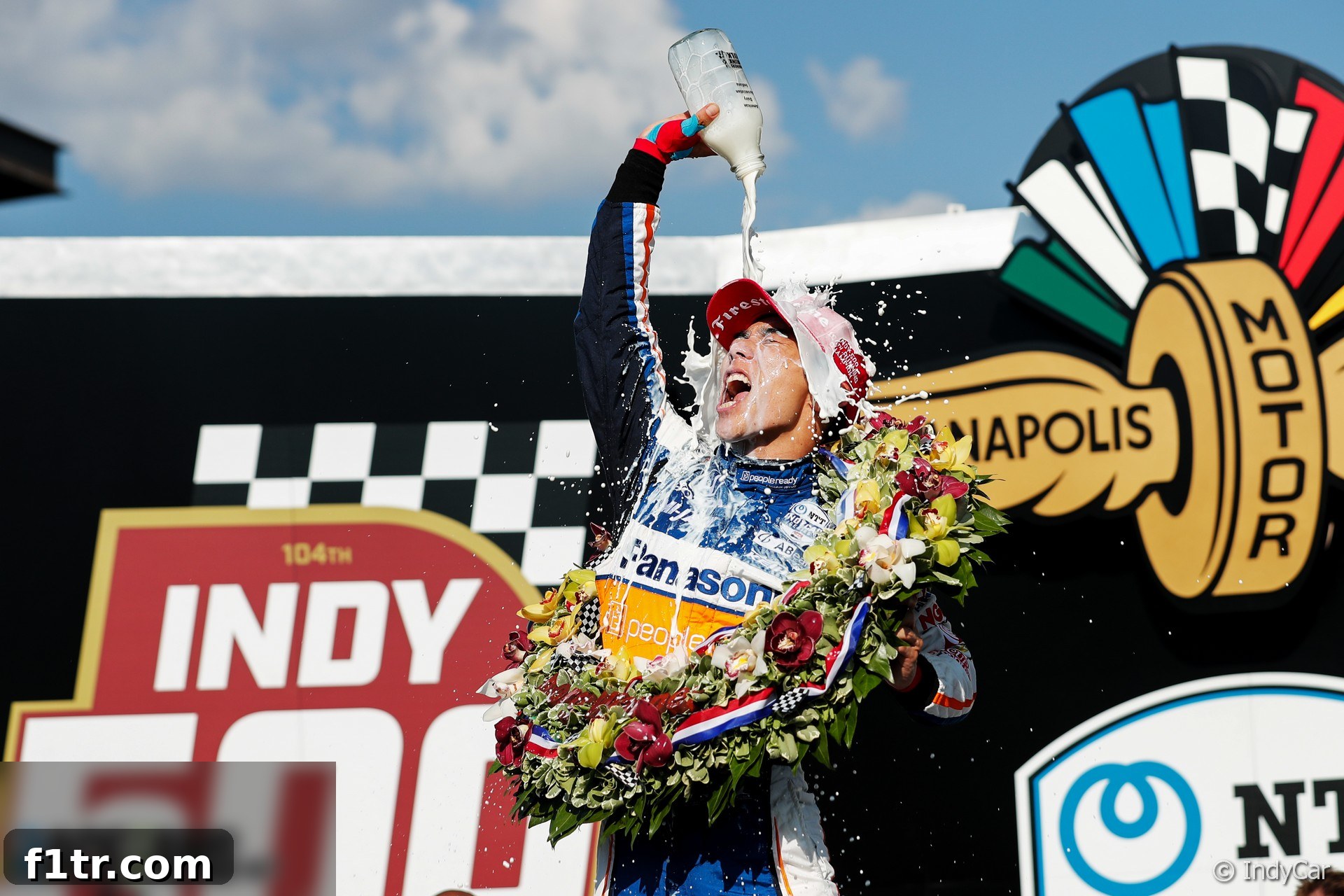
The Indianapolis Motor Speedway once again delivered an unforgettable spectacle as Takuma Sato, the seasoned Japanese racer, skillfully navigated his way to a sensational second career victory in the iconic Indianapolis 500. This triumph, a testament to strategic brilliance and late-race pace, saw him snatch the coveted Borg-Warner Trophy from the grasp of Scott Dixon, who had seemed destined for victory, dominating much of the day’s proceedings. The 104th running of ‘The Greatest Spectacle in Racing’ culminated in a dramatic, caution-filled finish, adding another layer of legend to the storied event.
From the outset, the race promised high drama and unpredictable turns. Marco Andretti, carrying the weight of his family’s legacy and the pride of starting from pole position, led the field to the green flag. The anticipation was palpable as the cars roared into Turn 1, but his starting advantage was immediately nullified. Scott Dixon, a five-time IndyCar champion and a master of oval racing, executed a breathtaking move around the outside, seizing the lead with an audacious sweep. From that moment, the Ganassi driver established a commanding presence, his No. 9 car appearing to be the benchmark for the rest of the field. Yet, as history often dictates at Indianapolis, a race rarely unfolds according to script, and a series of Safety Car interventions would constantly reshuffle the deck, bringing a succession of tenacious rivals into Dixon’s orbit.
The early stages of the race were marked by an unusual and alarming incident involving James Davison just seven laps in. A bizarre mechanical failure saw debris detach from the front-right wheel assembly of his Coyne/Ware/Byrd/Belardi-run car. This was quickly followed by an ominous build-up of heat, signaling a more severe problem. As Davison heroically attempted to nurse his ailing machine back to the pits, a full conflagration erupted, forcing him to bring the car to an abrupt halt on track. Safety crews swiftly converged to extinguish the blaze, leading to the first significant interruption of the day. This early caution offered a crucial opportunity for a handful of drivers running at the tail end to make an opportunistic pit stop, hoping to gain an advantage in the strategic chess match.
The race had barely resumed when a second caution period was triggered, further highlighting the unforgiving nature of the Speedway. Marcus Ericsson, one of Dixon’s key Ganassi teammates, found himself in trouble, making heavy contact with the Turn 2 barrier. The impact was significant, but thankfully, Ericsson was able to climb out of his damaged car unaided, a testament to the safety advancements in modern IndyCar racing. Under this second caution, the majority of the field, including the dominant Scott Dixon, streamed into the pits for their first scheduled stops. However, the pit lane proved to be a critical juncture for others; Ryan Hunter-Reay, who had made impressive gains at the start, found himself slipping back through the field after encountering traffic during his exit, illustrating how quickly fortunes can change in the congested pit lane.
The strategic battle continued to unfold with every lap. Oliver Askew, who had been among the first group of drivers to pit under the early caution, briefly found himself leading the field at the subsequent restart. His advantage, however, proved fleeting as defending race winner Simon Pagenaud quickly moved past him. Both drivers’ hopes were soon dashed by an ill-timed decision to pit under green flag conditions on lap 45. This move effectively doomed their chances of maintaining a strong position at the front, as pit stops under caution typically offer a significant time advantage. Despite quick work from the McLaren SP pit crew getting Askew back ahead of Pagenaud, the leaders had already cycled through, allowing Dixon to comfortably regain the lead, with Askew and Pagenaud now relegated to chasing the dominant Ganassi machine.
Dixon, ever the strategic thinker, then settled into a rhythm, carefully managing his fuel consumption. He cleverly spent a significant spell in the slipstream of the last driver on the lead lap, none other than two-time Formula 1 champion Fernando Alonso. This calculated move allowed Dixon to conserve precious fuel, only pushing harder once the fuel numbers on his dashboard display indicated a more favorable consumption rate. Alonso’s own position on the lead lap was temporarily saved when Dalton Kellett crashed, triggering the third Safety Car period of the day. This incident provided a momentary reprieve for those clinging to the lead lap, but the relentless pace and unforgiving nature of the Speedway soon delivered more drama.
The fourth caution period arrived hot on the heels of the third. Conor Daly, pushing hard on the restart, lost control and spun. In a chain reaction, Oliver Askew, directly behind Daly, had nowhere to go and subsequently went off track with him. The McLaren SP driver endured a heavy impact with the unforgiving SAFER barrier. Mercifully, Askew was able to extricate himself from the wreckage, albeit shaken, underscoring the ever-present dangers and the robust safety features designed to protect the drivers in such high-speed collisions. These escalating incidents continued to punctuate the race, constantly disrupting the flow and forcing teams to recalculate their strategies on the fly.
With precisely half of the grueling 200 laps completed, the race resumed, and Dixon once again led the charge. Behind him, the formidable Alexander Rossi, a former Indy 500 winner himself, executed a decisive pass on Sato to position himself as the primary challenger to the Ganassi driver. This promised to be a titanic battle, recalling Rossi’s relentless pursuit of Pagenaud just 12 months prior. However, fate had other plans. Rossi’s strong charge began to unravel when Alex Palou lost control and hit the wall, precipitating the fifth caution period of the afternoon. This mass caution period prompted another rush to the pit lane as teams scrambled to make their final scheduled stops under controlled conditions.
The pit stops under caution are always fraught with tension, and this one proved to be particularly dramatic for Alexander Rossi. During his stop, a slow right-rear wheel change cost him precious seconds, and in his haste to rejoin the fray, he emerged from his pit box directly into the side of Takuma Sato’s car. Race Control was quick to announce an investigation into the incident, and shortly thereafter, the stewards delivered a devastating blow to Rossi’s hopes, ordering him to drop to the tail of the field as a penalty. This decision effectively extinguished his chances of contending for the win, turning what had been a promising charge into a monumental struggle for recovery. It marked the beginning of the end for the 2016 winner.
Despite the setback, Rossi, renowned for his never-give-up attitude, immediately went on the attack, carving his way through a string of cars with furious determination. His charge was momentarily aided when Simon Pagenaud slowed dramatically after nudging the rear of Ryan Hunter-Reay, creating an opening. However, the sheer effort required to recover eventually took its toll. On the 145th lap, pushing his car to the absolute limit, Rossi twitched wide at Turn 2 and slammed into the barrier, bringing his valiant but ultimately doomed day to an abrupt and premature end. It was a heartbreaking conclusion for a driver who had shown so much potential.
With 45 laps remaining and the field needing one final pit stop to reach the checkered flag, the race resumed with Scott Dixon still holding the lead, closely pursued by Takuma Sato. Behind them, Josef Newgarden moved into a strong third position, displacing Graham Rahal. The final round of crucial pit stops unfolded under green flag conditions, adding another layer of strategic complexity and tension. Despite a slightly slower pit stop, Dixon initially rejoined the track with his effective lead seemingly intact. However, Sato, whose car truly came alive in the final stint, displaying exceptional handling and balance, began to reel in the Ganassi car with relentless efficiency. Exhibiting remarkable poise and precision, Sato cruised up behind Dixon and executed a masterful overtake for the effective lead of the race.
Once the remaining drivers had completed their final pit stops, Takuma Sato officially became the true leader on track, now firmly on course for a repeat of his glorious 2017 victory. Scott Dixon, still in hot pursuit, found his Ganassi machine lacking the same late-race strength and agility that Sato’s car possessed. Sato, driving with calm assurance, made light work of the inevitable traffic, expertly weaving through backmarkers without losing momentum. His relentless march towards the finish line seemed unstoppable, a symphony of precision driving and perfectly timed strategy.
With only five laps remaining, the destiny of the Indianapolis 500 was ironically sealed by one of Sato’s own Rahal Letterman Lanigan Racing teammates. Spencer Pigot, pushing hard at the very exit of the final corner, lost control of his car, spinning backwards down the main straight. In a heart-stopping moment, just before striking the pit lane divider, his car snapped broadside. Pigot then suffered a horrific, heavy impact with the pit wall barrier, which sent his car flying back across the track and into the opposite retaining wall. It was a terrifying crash, highlighting the extreme forces at play in IndyCar racing.
Thankfully, the RLL driver was safely recovered from his demolished car, a testament to the safety standards and quick response of the trackside medical teams. However, the extensive damage to the barrier necessitated significant repairs. Facing the logistical challenge of repairing the wall in a timely manner and considering the dwindling number of laps, race control made the difficult but decisive decision against red-flagging the proceedings. Instead, they opted to let the race conclude under the seventh and final caution period of the day. This meant that Takuma Sato, having established an unassailable lead, gracefully crossed the finish line under yellow flags, securing his magnificent second Indianapolis 500 triumph in a dramatic, memorable fashion.
The final results saw Graham Rahal, Sato’s other teammate, securing a commendable third place, following closely behind Dixon. Santino Ferrucci put in a strong performance to finish fourth, ahead of former champion Josef Newgarden in fifth. Pato O’Ward, who had briefly elevated his McLaren SP car to an impressive second position earlier in the race, ultimately brought it home in sixth. His highly anticipated teammate, Fernando Alonso, endured a rather anonymous third appearance at the legendary speedway, struggling for pace and finishing a disappointing, lapped 21st. The Spaniard’s quest for the Triple Crown remained unfulfilled, adding another chapter to his challenging relationship with the iconic race.
Further down the order, James Hinchcliffe staged a resilient recovery from a slow pit stop earlier in the race to secure a solid seventh place finish. Colton Herta, Jack Harvey, and Ryan Hunter-Reay rounded out the top 10, each battling fiercely for their positions in what was a grueling and strategically complex race. The 104th Indianapolis 500 will undoubtedly be remembered for its numerous caution periods, the strategic battles, the dramatic crashes, and ultimately, Takuma Sato’s masterful drive to claim his place among the elite multi-time winners of this truly legendary event.
IndyCar
- IndyCar driver McLaughlin cleared of injury after crashing through barrier at Barber
- Schumacher says his IndyCar feels like ‘an F2 car, just with better tyres’
- IndyCar “way faster than Formula 1” in some corners, says Grosjean
- FIA to award more F1 superlicence points to IndyCar drivers from 2026
- Schumacher to race full-time in IndyCar with RLL in 2026
Browse all IndyCar articles