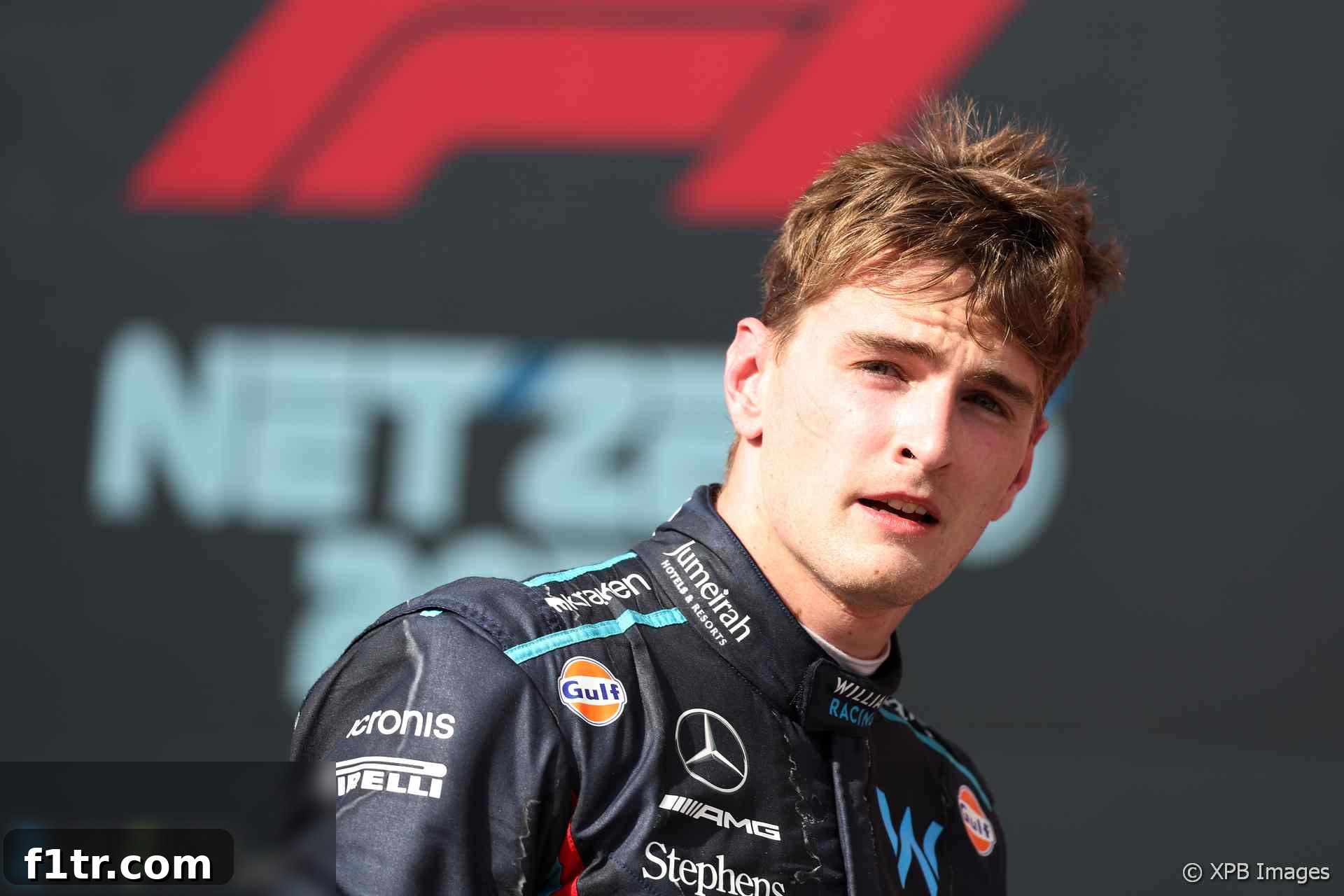
In a significant moment for his burgeoning Formula 1 career, Williams driver Logan Sargeant has attributed his breakthrough points finish at the recent United States Grand Prix to a surge in self-belief and a deeper connection with his car. The American rookie, who secured his first championship point following the disqualifications of Lewis Hamilton and Charles Leclerc, highlighted how increased confidence has been a pivotal factor in unlocking greater performance.
While acknowledging the persistent need to refine his qualifying prowess – a challenge underscored by his grid positions at his home race in Austin – Sargeant emphasized that substantial progress is being made. His journey through the demanding world of Formula 1 has been one of continuous learning, and the Austin result served as a tangible reward for his dedication.
Building Momentum: The Austin Experience
Reflecting on the unique challenges of the United States Grand Prix weekend, Sargeant commented, “Austin wasn’t easy, only having one session. You can’t really find where you want to go with tools, it’s all happening really quick.” The compressed schedule, featuring just one practice session before competitive running, offered minimal time for setup adjustments and driver acclimatization, placing immense pressure on every lap. Despite these constraints, his race pace was exceptionally strong, culminating in a 12th-place finish on the track before being elevated to tenth. This wasn’t an isolated incident, as Sargeant revealed he had felt similarly competitive in previous races during his debut season.
“I would say there’s been races this year that have also been close to that level of pace,” Sargeant explained, suggesting a pattern of underlying performance that had previously gone unrewarded. He viewed the Austin weekend as a net positive, despite the qualifying setbacks. “I think it’s been getting better and better. Austin as a whole wasn’t a terrible weekend. On Friday I was very close to where I need to be, just made a little mistake in qualifying. Saturday, yes, was a struggle for sure – a bit of a question mark.”
The turning point, according to Sargeant, came on race day. “But then Sunday was back to where I was expecting to be. We worked hard overnight to find a direction, mainly using tools on my steering [wheel], just to get a better balance.” The ability to make precise, lap-by-lap adjustments to his car’s setup through the intricate controls on his steering wheel proved crucial. “We were changing things through the lap every single lap, trying to link the car together from one corner to another and I think that’s what I was missing on Saturday. And I was able to reconnect with that on the Sunday.” This nuanced understanding of his car’s behavior and the effective utilization of in-car tools underscore a growing maturity in his race craft.
Overcoming Challenges and Unlocking Potential
Sargeant’s point in Austin represented a significant milestone, especially after a challenging period following the summer break, marked by several incidents and setbacks. However, throughout this time, he remained confident in his underlying speed. “I think from since the summer break, it’s been a lot better. There’s been times where qualifying has been going really well,” he noted, pointing to instances where external factors or minor errors prevented him from converting pace into results.
He recounted specific examples: “In Singapore, I was on a great lap and the gearbox failed. There’s not much I can do about that. Japan, I was right where I need to be and made a silly mistake.” These anecdotes illustrate that the raw speed has been present, even when results haven’t fully reflected it. “So it’s not like the pace isn’t there. It’s all coming together, it’s getting better and better, it’s getting stronger and stronger.” This sentiment reflects a crucial psychological shift – the belief that the pieces are falling into place, fostering increased confidence.
Intriguingly, Sargeant believes his “quali pace has been even closer than the race pace” at times, suggesting that converting potential into a clean, optimal one-lap performance remains his primary hurdle. “I just didn’t get it quite right in Austin and I had a really good Sunday,” he stated. His objective for upcoming races is clear: “So I think if I can get back to what I was doing from a one-lap pace before and make sure I do a good job there, be as close as I can and then try to have another good Sunday, that’s really all I need to do.”
Mastering the F1 Machine: The Downforce Revelation
A frank admission from Sargeant shed light on one of the fundamental challenges rookies face in Formula 1: “at times struggling to use the amount of downforce that I’ve had.” Formula 1 cars are engineering marvels designed to generate immense downforce, pressing the car into the track and allowing for incredibly high cornering speeds. However, fully exploiting this aerodynamic grip requires absolute trust and a deep understanding of the car’s limits, something that comes with experience.
“It can be quite surprising how much grip there is and just trying to understand that,” explained the driver who transitioned from F2 last year. The transition from junior formulae, where cars generate significantly less downforce, to F1’s extreme grip levels is a steep learning curve. The physical and mental demands of consistently pushing a car to the edge of its downforce capabilities are immense. Sargeant’s growing comfort in this area is a testament to his development: “I feel like I’m much closer to knowing where the limit is at all times, which is obviously very beneficial.”
This evolving understanding is crucial for maximizing performance, especially in high-speed sections. “Just finding the level of the limit between grip and downforce. I feel like now it’s becoming – there’s been a bit of a switch where now I go into a high-speed corner and I know pretty much where the limit is. So that’s been really nice, just to sort of naturally move forward from a driving sense.” This newfound intuition for the car’s aerodynamic limits allows him to attack corners with greater aggression and precision, a hallmark of top-tier F1 drivers.
Beyond raw driving feel, Sargeant also highlighted the importance of “the little things that you would never really do in a junior formulae.” This includes the sophisticated use of in-car tools, not just for balance but for managing tire warm-up and other intricate aspects of race weekend preparation. “So using the tools more, and starting earlier in the weekend on that sense, and understanding how they can be used to help you more. There’s so much time there that you might not even realise. But those small things make a big difference to tyre warm-up, stuff like that.” The complexity of modern F1 cars demands a holistic approach, where technical mastery goes hand-in-hand with driving talent.
The Value of Teammate Collaboration and Strategic Acumen
In his quest for continuous improvement, Sargeant has actively engaged with his experienced Williams teammate, Alexander Albon. “He said he’s conferred with Williams team mate Alexander Albon ‘a lot more recently, just to try to help me on that front,’ because there is so much potential to unlock from the car. ‘It’s been moving me forward.'” The guidance from a more seasoned driver, particularly one with Albon’s proven talent and understanding of the Williams package, is invaluable for a rookie navigating the complexities of F1. This collaboration fosters a synergistic environment, allowing Sargeant to accelerate his learning curve and extract more from the machinery at his disposal.
The “small things” that are not natural to a rookie but are critical for extracting peak performance are gradually being integrated into Sargeant’s repertoire. “Those are the small things that aren’t natural to me. But the more you start to understand them, the more you start to extract from them, and the amount of time that you can find from those things is unimaginable.” This sentiment perfectly encapsulates the continuous refinement required to succeed in Formula 1, where marginal gains can translate into significant lap time advantages.
As his understanding of the car deepened, Sargeant also grew more confident in providing insightful feedback to his engineering team during races – a critical skill that directly contributed to his points-scoring drive in Austin. “Just knowing how difficult the car can become to drive when the tyres are going off gave me a sense of ‘they want me to keep going, but now is the time to stop’, kind of. And that is just from previous errors,” he explained. This newfound ability to proactively communicate his car’s condition and advocate for strategic decisions demonstrates a significant step forward in his race management.
While engineers rely on data, a driver’s subjective feel is equally vital. “Normally of course you have to trust what [the engineers] are saying. But I also know how it feels in the car and I feel like I’m just at a point where I also knew the strategy, I knew where we were at in the race and I knew that if we stopped, I could still make it to the end.” This blend of trust in his team and confidence in his own judgment is a hallmark of an experienced driver. “I know when I’m losing too much, when there’s too much risk, and when we just need to move on. And I feel like that’s somewhere I’m getting better at.”
Continued Progress and Future Outlook
Sargeant’s improved race-day performance continued to be evident in subsequent events. He impressively ran in 12th position at the Mexican Grand Prix a week after Austin, before a fuel pump issue unfortunately forced his retirement. He then followed this up with a strong performance at the Brazilian Grand Prix, finishing just one place outside the points, demonstrating consistent progress in race conditions.
Despite these encouraging race outings, qualifying remains an area targeted for refinement. He faced challenges in Mexico, failing to set a representative lap time while Albon secured 14th on the grid. In Brazil, he started from the back row for both the Sprint Race and the Grand Prix, highlighting the ongoing work required to extract optimal one-lap performance. The intricacies of getting the tires into their perfect operating window for a single qualifying lap, coupled with maximizing grip and downforce at the absolute limit, are formidable tasks for any rookie. However, with his growing confidence, improved car understanding, and dedication to refining his technical skills, Logan Sargeant is clearly on an upward trajectory, poised to build on his breakthrough point and establish himself as a consistent contender in Formula 1.
2023 United States Grand Prix
- US GP was Mercedes’ best race of 2023 despite disqualification – Wolff
- Singapore and Austin retirements cost me top 10 championship place – Ocon
- United States Grand Prix result unchanged as FIA rejects Haas’ call for review
- Sargeant admits he’s ‘struggled to use all the downforce at times’ in F1
- Mercedes’ Brazilian GP set-up was “conservative” after US GP disqualification
Browse all 2023 United States Grand Prix articles